
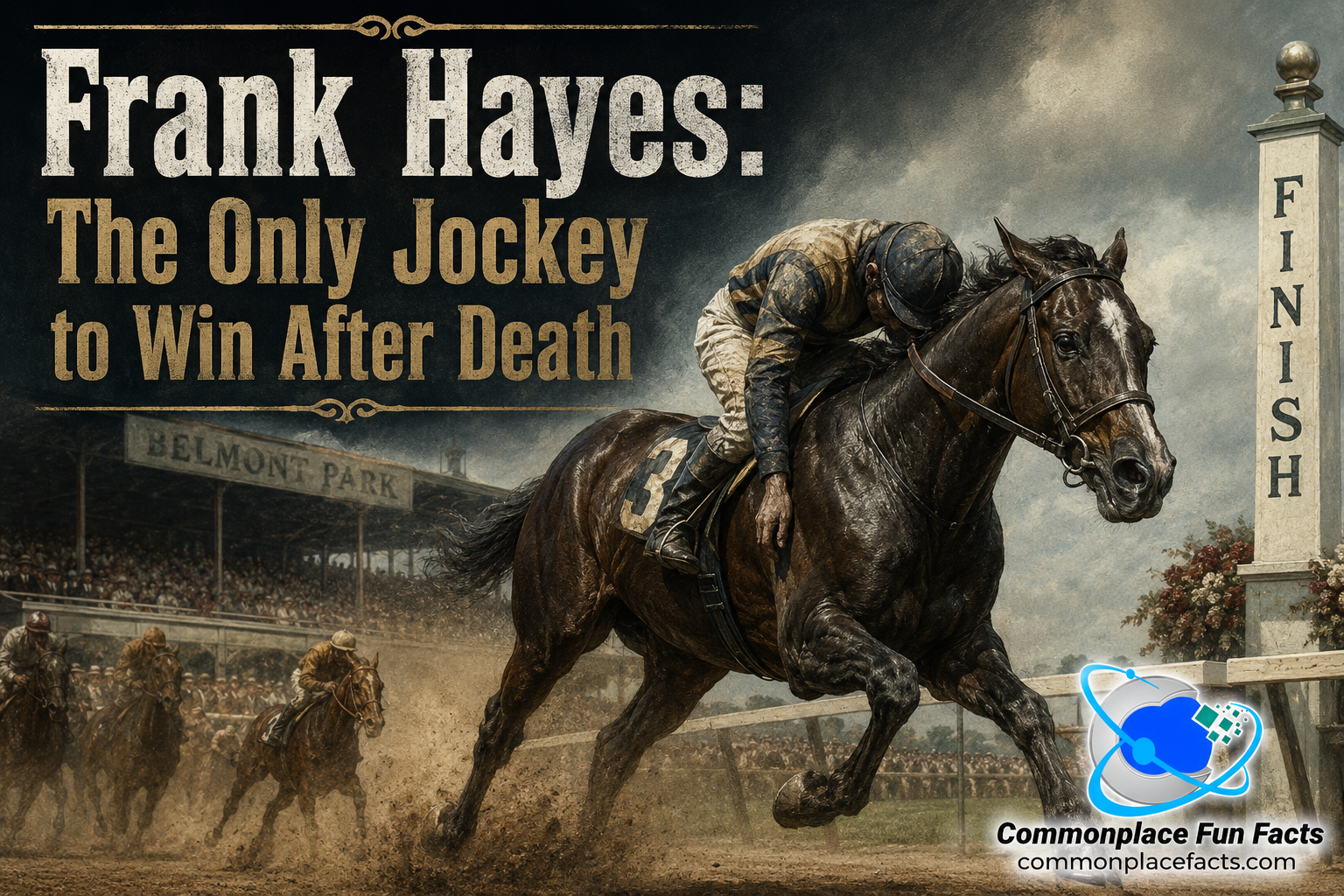

On June 4, 1923, Frank Hayes rode a horse named Sweet Kiss to victory in a steeplechase at Belmont Park in New York. It was Hayes’ first victory as a jockey. It was also his last race, for reasons that became disturbingly apparent immediately after he crossed the finish line.

Frank Hayes was dead.
Hayes was a 22-year-old Irish immigrant who worked primarily as a stableman and horse trainer rather than as a professional jockey. He reportedly dreamed of riding competitively, however, and eventually received the opportunity to ride Sweet Kiss, a horse owned by the family for whom he worked.
The horse was not exactly regarded as the Secretariat of her generation. Sweet Kiss entered the race as a 20-to-1 long shot, which is the polite gambling-industry way of saying that anyone betting heavily on her was presumed either unusually optimistic or unfamiliar with the concept of money.
Hayes also faced a considerable obstacle before he could even enter the race. He weighed too much to ride at the required weight, so he undertook an intense effort to lose more than 10 pounds in a very short period. Contemporary accounts described a miserable combination of restricted food, strenuous exercise, and efforts to sweat away the excess weight. Nutrition science was apparently represented by the general principle that if the human body complained loudly enough, it was probably working.
Whatever Hayes endured, it worked. He reduced his weight to approximately 130 pounds and took his place aboard Sweet Kiss for the steeplechase.
Against the odds, Sweet Kiss ran an excellent race. Hayes remained in the saddle as the horse cleared the final fence and charged toward the finish line. Sweet Kiss crossed first, defeating the nearest competitor by a head.
The victory should have been the greatest moment of Hayes’ young life. Unfortunately, he was no longer in a position to enjoy it.
At some point during the latter part of the race, Hayes suffered a fatal heart attack. His body nevertheless remained secured in the saddle while Sweet Kiss continued racing, jumped the final obstacle, and carried her motionless rider across the finish line. The horse continued for approximately another 100 yards before Hayes slipped from the saddle near the judges’ stand.
A track physician examined him and pronounced him dead. Whether Hayes died from the excitement and exertion of the race, the extreme measures he had taken to lose weight, or some combination of the two could not be determined with certainty. Whatever the precise cause, he appears to have died before Sweet Kiss completed the course.
Hayes was not the first athlete to turn death into an inconvenient postgame detail. More than two thousand years earlier, the Greek pankration champion Arrhichion won his final Olympic competition after dying. His opponent surrendered without realizing that the man he had just conceded to was already dead.
In the case of Hayes, it created a procedural question that the rules of horse racing had apparently neglected to address: Does a jockey have to be alive to win?
Race officials decided that he did not. The normal post-race formalities, including the customary weighing of the jockey, were waived. Sweet Kiss had crossed the finish line first while carrying the required weight, and the result was declared official. Hayes therefore became the first—and remains the only known—jockey to win a horse race after his death.

Hayes was buried three days later at Holy Cross Cemetery in Brooklyn. He was dressed in the colorful racing silks he had worn during his only victory—a touching tribute, although one suspects the undertaker received very few requests resembling it.
Sweet Kiss never raced again. Later accounts claimed she acquired the nickname “Sweet Kiss of Death,” because subtlety had already left the barn and was not expected to return.
At least Hayes knew he had entered a competition. For an entirely different variety of accidental sports history, consider Margaret Abbott, who won an Olympic golf tournament without realizing she was competing in the Olympics.
Most athletes hope to leave their sport at the top of their game. Frank Hayes managed it more literally than anyone would recommend. He entered the record books as a victorious jockey and proved, under circumstances he presumably would have preferred to avoid, that a competitor does not always need to remain alive until the awards ceremony.

The Great Lafayette: The Magician Whose Greatest Trick Came After Death
In 1911, the Great Lafayette died in a devastating Edinburgh theater fire. Authorities identified his body, cremated it, and considered the matter settled. Then another corpse appeared wearing his distinctive rings. With a body double, a beloved dog, a real lion, and one extraordinarily unfortunate case of mistaken identity, the famous magician managed his strangest…

The Erfurt Latrine Disaster of 1184: When Politics Literally Went Down the Toilet
In 1184, a peace meeting in Erfurt ended when the floor collapsed and nobles plunged into a cesspit. The bizarre Erfurt Latrine Disaster was real.

Michael Godwin: The Murderer Who Escaped the Electric Chair—Then Electrocuted Himself on a Toilet
Michael Godwin escaped South Carolina’s electric chair—only to accidentally electrocute himself while repairing headphones on a prison toilet.


Leave a Reply