

We’ve all been trapped in one of those meetings where the agenda items move with all the speed and urgency of the intestinal contents of a constipated sloth. Somewhere around item seven—“Old Business,” naturally—everyone in the room is thinking the same thing:
Boy, this meeting really stinks.
Then, just when you are convinced it cannot possibly get any worse, something happens that sends the whole thing straight down the toilet.
If history teaches us anything, it is the comforting—or perhaps deeply discouraging—lesson that some things never change.
Nearly 850 years ago, some of the most powerful men in Germany gathered in Erfurt for a meeting that was supposed to settle a political dispute. There were nobles. There were church officials. There was the future Holy Roman Emperor. There were undoubtedly strong opinions, wounded egos, and people wondering how much longer this was going to take.
And then the meeting literally went down the toilet.
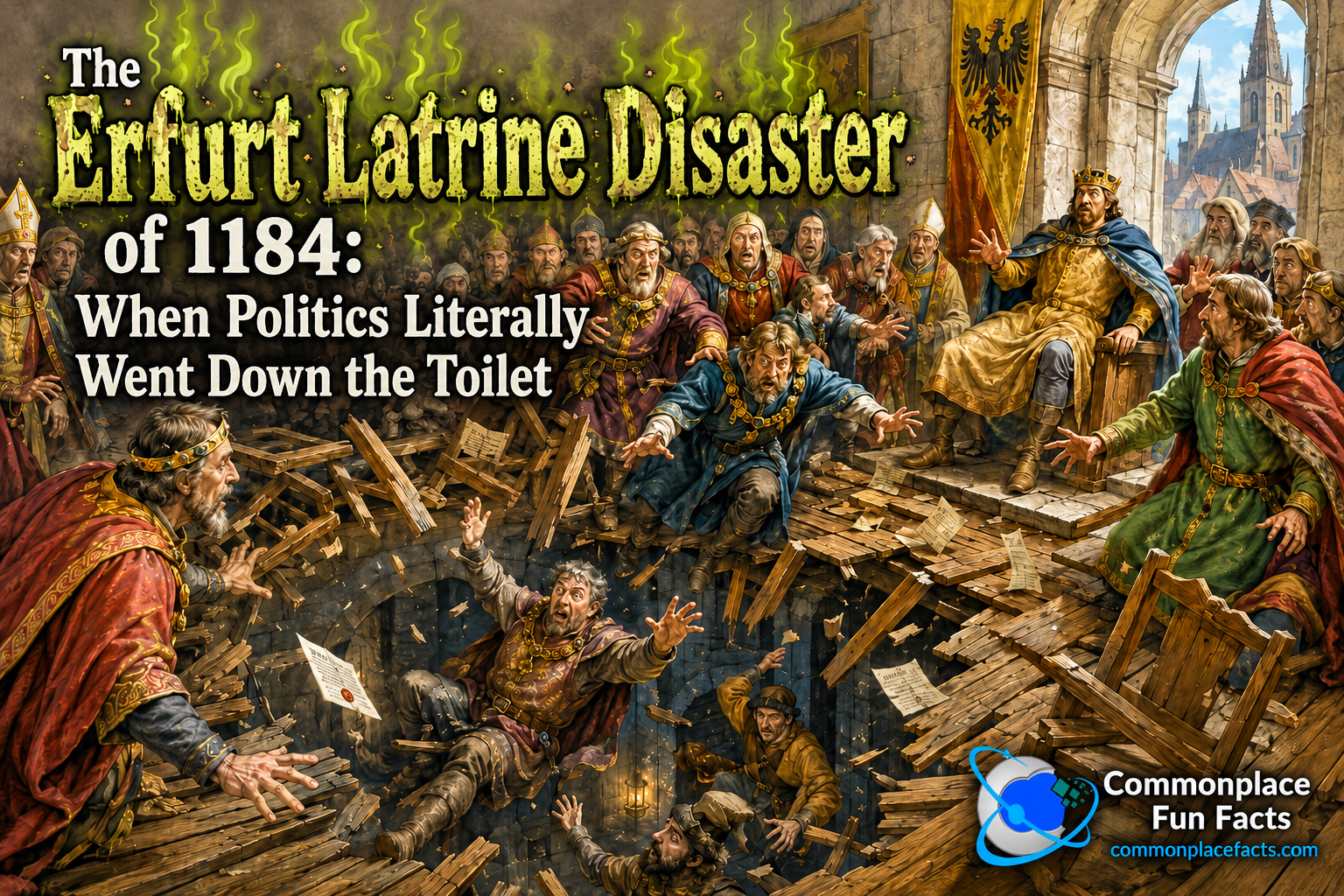
In late July 1184, the floor beneath them collapsed, sending a substantial portion of the assembled medieval aristocracy crashing through the building and into a terrifying mass of human waste below.
Suddenly, whatever had been listed under “New Business” seemed considerably less important, and the Erfurt Latrine Disaster guaranteed its place in history.
Contents
A Peace Conference With a Load-Bearing Problem
The story begins with Henry VI, son of Holy Roman Emperor Frederick I—better known as Frederick Barbarossa, whose name has already made an appearance in our article about the War of the Oaken Bucket.

Henry requires a small clarification because historical titles have a habit of arriving early in modern retellings. He is commonly described in accounts of the disaster as “Holy Roman Emperor Henry VI,” which he eventually was. In 1184, however, his father was still very much alive and occupying the imperial position. Henry had been elected and crowned king years earlier and was Barbarossa’s heir, but he would not be crowned emperor until 1191.
In other words, although he was not yet emperor, he was certainly an important royal figure and absolutely the sort of person whose reputation caused powerful nobles to straighten their tunics and pretend they had not just been feuding with the neighbors.
Henry was traveling east after the magnificent imperial court held at Mainz at Pentecost in 1184. According to the Deutsche Biographie’s account of Henry VI, the gathering at Mainz had been an especially important moment for the young king. There he and his brother received their ceremonial knighthood from Barbarossa.
Later that summer, Henry headed toward Poland. Along the way he reached Erfurt, an important city in Thuringia, where he encountered a political dispute requiring royal attention.
Archbishop Conrad I of Mainz and Landgrave Ludwig III of Thuringia were feuding. The surviving chronicles describe a serious disagreement involving damage done to the archbishop’s interests, with powerful regional nobles lining up behind the competing parties.
Henry decided to mediate.
This was perfectly reasonable. Bringing powerful people into one room and making them talk through their differences is one of civilization’s best and infrequently used alternatives to letting them raise armies and burn each other’s property.
Henry’s efforts would be successful (at least briefly) and distressingly memorable.
The Meeting Begins
On July 25 or 26, depending on the source, Henry gathered the disputing parties and a sizable collection of nobles in an upper room in Erfurt. The meeting is sometimes described as a Hoftag, a royal court assembly, although that term can conjure up something more organized than the reality. Do not picture a modern convention center with name badges, breakout sessions, and complimentary muffins. A medieval ruler’s court traveled with him, and wherever he stopped could temporarily become the center of government, complete with princes, counts, bishops, officials, retainers, petitioners, and enough competing interests to make any modern committee feel positively efficient.
Henry’s purpose was to broker a settlement between Archbishop Conrad and Landgrave Ludwig. According to the Chronicle of St. Peter at Erfurt and the Cronica Reinhardsbrunnensis, Henry was seated in consultation in an upper room, surrounded by a large crowd. After considerable effort, the parties had apparently managed to reach at least a temporary peace.
After considerable discussion, Henry appeared to have brokered a peace when the building abruptly introduced an entirely different subject for consideration. During the negotiations, the beams beneath them broke.
Then the Floor Stopped Being a Floor
The upper floor collapsed beneath the assembled dignitaries, sending them crashing downward onto the level below. That floor, suddenly burdened with the combined weight of a roomful of nobles, broken furniture, and falling timber, gave way as well. The unfortunate men continued downward through the building.

Unfortunately, the space beneath them was not where someone had thoughtfully stored extra mattresses or the medieval equivalent of a bouncy house. It was a latrine pit.
Medieval sanitation varied considerably depending on place, wealth, and architecture. Some privies emptied through chutes outside a building, while others deposited their contents into pits beneath or alongside the structure. Those pits had to be periodically emptied, presumably by someone whose career counselor had failed him spectacularly. In Erfurt, that underground waste pit became the final destination for a startling cross-section of the regional aristocracy.
There is no delicate euphemism that improves this part of the story, and the historical accounts do not really try. The Chronicle of St. Peter reports that many fell into the latrine below. Some were pulled out only with great difficulty, while others suffocated in the filth. The Cronica Reinhardsbrunnensis is equally unambiguous, describing the victims as falling into a particularly foul cloaca, with some rescued alive and others dying there.
A later account by Pastor Leitzmann of Tunzenhausen preserves the same grim tradition. He wrote that some of those who fell into the “secret room”—a polite term for the privy—“could hardly be pulled out with great difficulty,” while others “suffocated in the most hideous filth.”
We are struggling to compose the words that properly convey the horror of the scene. Sometimes history arrives, having already done all of the heavy lifting.
How Many People Died in the Erfurt Latrine Disaster?
This is where the story becomes less precise.
You will routinely encounter the claim that exactly 60 nobles died in the Erfurt Latrine Disaster. Sometimes the number appears as “about 60,” sometimes “roughly 60,” and sometimes simply “60,” because historical uncertainty tends to evaporate at roughly the same speed that webpages copy from one another.
The safest answer is that a substantial number of people died, but the exact total is uncertain. The surviving medieval sources themselves do not agree on the number, while later tradition eventually settled on a figure of around 60.
The surviving medieval accounts name several high-ranking victims. Depending on the chronicle and the rendering of medieval names, they include Heinrich of Schwarzburg, Friedrich of Abenberg, Friedrich of Kirchberg, Gozmar of Ziegenhain, Burchard of Wartberg, and Beringer of Mellingen. The St. Peter chronicle adds that others “of lesser name” also died.
That last phrase tells us something useful about medieval recordkeeping. History was perfectly interested in documenting a count who disappeared into the cesspit. The unnamed fellow standing beside him was apparently expected to understand that archival space was limited.
Local Erfurt historian Dr. Steffen Raßloff gives the traditional figure as around 60 deaths. That is a reasonable figure to report as an estimate. It is less reasonable to present it as if someone emerged from the ruins with a clipboard and a completed OSHA incident report.
Henry VI Had the Best Seat in the House
Remarkably, Henry survived, which brings us to one of the most memorable details of the story—and one that requires a little historical fine print. Modern and local accounts commonly say that Henry had been sitting in a masonry window recess when the wooden flooring around him collapsed. The stonework remained standing, leaving him stranded above the wreckage until rescuers could reach him with ladders. Some versions of the story place Archbishop Conrad safely in a window recess as well.

It is an irresistible image: much of the regional nobility suddenly disappears through the floor while the future emperor remains perched in a window, presumably reconsidering every decision that had brought him to Erfurt that morning. Not all of the medieval sources provide that much detail. The Chronicle of St. Peter confirms the disaster and Henry’s presence but does not explain precisely how he escaped. The later medieval Cronica Reinhardsbrunnensis, however, preserves the story that Henry and those with him were protected by the window embrasure and eventually rescued by ladder.
That does not make the story false. It simply means we should distinguish between what the medieval chronicles explicitly tell us and the later explanation for how Henry managed to escape. History is usually more interesting when we leave a little uncertainty in place rather than sanding it down into a perfectly confident anecdote.
Whatever the precise mechanics of his survival, Henry made it out alive. According to local tradition, he left Erfurt soon afterward, which seems like a perfectly rational response. A negative Yelp review wouldn’t have been out of line either.
Where Exactly Did the Erfurt Latrine Disaster Happen?
Here, too, modern retellings sometimes become more confident than the evidence warrants.
You will find the disaster described as occurring in a church, a monastery, the residence of the archbishop, the cathedral provostry, or a building associated with St. Peter’s Church.
The earliest chronicle account is much less helpful. It simply has Henry sitting in council in an upper room in Erfurt when the structure collapsed into the latrine below.
Local Erfurt tradition places the meeting in the Dompropstei, the cathedral provostry associated with the Marienstift. Bayerischer Rundfunk notes both that identification and an alternative tradition placing the meeting in the archbishop’s residence.
So it is better to say that the disaster occurred in a building used for Henry’s gathering in Erfurt—probably the cathedral provostry—than to confidently point to a specific medieval room and announce, “Right there. That was the poop floor.”
That sort of precision is satisfying. It just happens to be precision we do not possess.
Was the Crowd Simply Too Heavy for the Floor?
The usual explanation is straightforward: too many people gathered on an aging wooden floor whose supporting beams were no longer equal to the task.
Local accounts describe the beams as old or rotten and the crowd as unusually large. When the upper floor failed, the falling people and debris overloaded the level beneath it, which also collapsed.
That scenario makes structural sense, but we should resist adding details for which there is no evidence. You sometimes see descriptions suggesting that the nobles were all wearing enormous suits of armor and collectively exceeded the medieval building code.
They may have been impressively dressed. They were certainly numerous. But there is no reason to imagine Henry convened peace negotiations with everyone outfitted for the Battle of Agincourt.
The medieval source gives us all we really need: the beams failed while a large group was assembled above them.
There was no posted occupancy limit warning the assembled nobility that the room was already several counts, two bishops, and a landgrave over capacity.
The Politics Continued, Because Of Course They Did
If you are expecting the catastrophe to have inspired Conrad and Ludwig to look into each other’s eyes, recognize the fragility of human existence, and declare that their earthly disagreement suddenly seemed petty, then you are adorable. Truly. You have considerably more confidence in politicians than anyone has a right to.
The feud was not magically erased.
The Chronicle of St. Peter records that conflict between the archbishop and the landgrave broke out again afterward, with property in Thuringia and Hesse being devastated and both sides fortifying positions.
Apparently even watching colleagues vanish through the floor into a cesspit could not permanently resolve a jurisdictional dispute.
There is something almost comforting about that level of institutional consistency. A few centuries later, another group of nobles would attempt reconciliation with hand-holding and a ceremonial procession during the Loveday of 1458. That did not work either.
Medieval Europe tried a surprising number of approaches to conflict resolution.
“Don’t fall into the toilet” was apparently the most achievable.
Is the Erfurt Latrine Disaster Really True?
Yes.
That question is worth asking because the Erfurt story has every ingredient necessary for historical folklore: famous people, an absurd death, bodily functions, and a punchline so perfectly constructed that it seems to have been written backward from the ending.
Yet the central event is unusually well supported for a bizarre story from the 12th century.
The Chronicle of St. Peter at Erfurt records the catastrophe under the year 1184 and gives the date as July 26, while the Regesta Imperii argues for July 25. Henry came to Erfurt, attempted to mediate the dispute between Conrad and Ludwig, sat in consultation in an upper room, and then suffered the sudden collapse that sent many people into the latrine pit. It names several of the dead.
The Cronica Reinhardsbrunnensis, preserved in the Monumenta Germaniae Historica, independently describes the same political mission, structural collapse, cesspit, rescues, and named fatalities.
We can argue about the total death count, the precise identity of the building, and whether Henry’s famous window recess is securely documented in the earliest evidence. We do not need to argue about whether a gathering of German nobles really crashed into a latrine in Erfurt in 1184.
It did.
History Has a Surprisingly Distinguished Toilet Department
The Erfurt catastrophe is also a useful reminder that some of history’s strangest stories survive precisely because ordinary infrastructure suddenly becomes important.
Toilets, in particular, have been working remarkably hard to get themselves into Commonplace Fun Facts.
We have already encountered the bizarre story of how a General Patton latrine became something of a local war hero. We have also met the German submarine U-1206, whose sophisticated toilet system helped bring its combat career to an embarrassing conclusion. We even shared the story of the mayor of Betterton, Maryland, who drowned in a pool of raw sewage in 1980.
Erfurt managed to get there first.
The Meeting Is Adjourned
Nearly 850 years later, some of the details of the Erfurt Latrine Disaster remain frustratingly murky. We cannot say with certainty exactly how many people died, precisely which building hosted the meeting, or whether Henry VI really survived because he happened to be sitting in the world’s most fortuitously constructed window seat. What we can say is remarkable enough: in 1184, some of the most powerful men in Germany gathered to settle a political dispute, the floors beneath them collapsed, and a significant portion of the assembled nobility ended up in a latrine pit.

You might imagine that surviving such an experience would give everyone involved a renewed sense of perspective. Perhaps Conrad and Ludwig would have emerged from the disaster, contemplated the fragility of life, embraced one another, and agreed that whatever they had been fighting about really wasn’t worth all the trouble. That would make for a touching ending, and it would demonstrate a profound misunderstanding of both medieval politics and politicians generally.
The dispute eventually resumed. Apparently even watching your political allies and opponents disappear through the floor and into a cesspit was insufficient to make everyone reconsider their positions. In that respect, the Erfurt disaster may offer the most enduring lesson of all: buildings change, sanitation improves, and meeting rooms eventually acquire occupancy limits, but the ability of people to continue arguing long after everyone else thinks the matter should have been settled appears to be timeless.
So the next time you find yourself trapped in a meeting that seems to be moving nowhere, take heart. However slowly the agenda may be progressing and however strongly you may suspect that the whole thing stinks, history assures us that it could always be worse.
All the same, it wouldn’t hurt to make sure that the floor is up to code.
You may also enjoy…

How General Patton’s Latrine Became a National Hero
Discover the fascinating story of how a misunderstood latrine during WWI became a revered ‘heroic site’ in France, showcasing cultural differences and General Patton’s legacy.

Monica Meyer: The Strange Death of the Mayor Who Drowned in Raw Sewage
Discover the tragic and bizarre true story of Monica Meyer, the mayor who met a shocking fate in a sewage tank. A strange death but true political incident that still baffles today.

The London Beer Flood of 1814: History’s Most Absurd Industrial Disaster
Discover the bizarre tale of the 1814 London Beer Flood, a tragic industrial accident that turned porter into a deadly wave.






Leave a Reply