
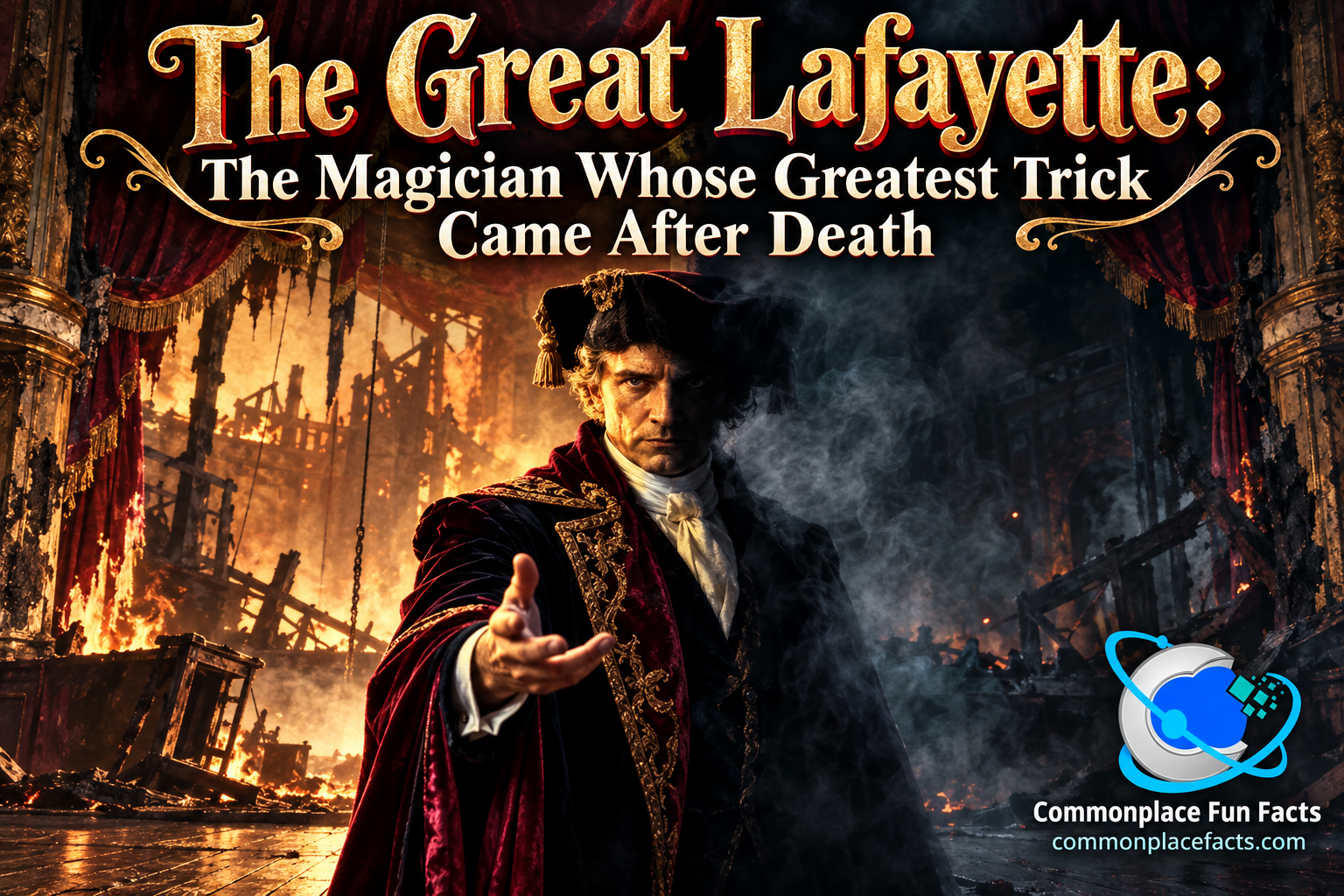

Most stage magicians consider it a professional triumph when they convince an audience that someone has disappeared, transformed into somebody else, or materialized where no reasonable person should be standing. The Great Lafayette took things a step further. He managed to confound people long after he was no longer available to explain the trick.
In 1911, the Great Lafayette was one of the highest-paid entertainers in the world. His spectacular productions featured elaborate scenery, bewildering costume changes, a live lion, and enough theatrical secrecy to make a government intelligence agency look like a neighborhood gossip club. He also had a dog who enjoyed a standard of living considerably better than that of most of the people buying tickets to his performances.
Lafayette built his career on the principle that appearances could not be trusted. Audiences loved him for it. They paid handsomely to watch him manipulate reality, or at least produce a sufficiently convincing imitation that nobody felt inclined to demand a refund.
Then, on May 9, 1911, a performance at Edinburgh’s Empire Palace Theatre went catastrophically wrong. What followed was a genuine tragedy, an extraordinary mystery, and a series of developments so improbable that they would have seemed excessive even in one of Lafayette’s own productions.
Most magicians know that the trick is over when the curtain falls. In Lafayette’s case, the curtain fell, the theater burned, and the most astonishing deception of his career was still waiting to be discovered.
Contents
Who Was the Great Lafayette?
The Great Lafayette began life under the considerably less theatrical name of Sigmund Neuberger, born in Munich in 1871. Contemporary records and later accounts vary in their spelling of his surname—Neuburger and Newburger also make appearances—but he eventually solved the problem by adopting a stage name that left considerably less room for confusion and considerably more room for self-importance.

After emigrating to the United States, he entered the fiercely competitive world of vaudeville. This was an entertainment industry in which audiences could choose among singers, comedians, dancers, acrobats, jugglers, animal acts, impersonators, and performers whose principal talent was apparently having discovered something no sensible person had previously considered entertainment. A magician who merely pulled a rabbit out of a hat risked being upstaged by a man who could juggle six flaming torches while standing on his head.
Lafayette recognized that the secret to success was not simply performing an illusion. It was turning the illusion into an event. He developed increasingly elaborate productions that combined magic, quick-change artistry, impersonations, comedy, music, costumes, and theatrical effects. Rather than presenting a succession of isolated tricks, he created performances in which the spectacle surrounding the illusion became almost as important as the illusion itself.
A surviving Keith-Albee theater manager’s report from 1906 provides a glimpse of just how varied his act had become. It describes Lafayette’s quick-change routines, his burlesque of the Chinese magician Ching Ling Foo, and his “Travesty Band,” in which he impersonated famous orchestra leaders. The manager was not uniformly impressed with everything he saw, which is reassuring. History becomes considerably less trustworthy when every surviving review sounds as though it was written by the performer’s mother.
But Lafayette did not need every critic to admire every trick. He needed audiences to buy tickets, and at that he was extraordinarily successful. His combination of elaborate productions, theatrical personality, and sheer showmanship turned him from another performer competing for attention into one of the biggest attractions on the international variety circuit. He had discovered that audiences might forget a clever card trick, but they were much less likely to forget a performance that seemed to involve the entire contents of a theater’s storage department.
By 1911, one contemporary account estimated that Lafayette earned at least £20,000 a year, equivalent to approximately £2.9 million (about $3.8 million) in 2025 purchasing power. To put that in perspective, the average British wage earner made approximately £59 annually in 1911, meaning Lafayette’s reported earnings were roughly 340 times as much. He commanded hundreds of pounds per week for major engagements and reportedly had bookings extending years into the future. He was no longer simply a magician performing between singers and comedians. He was an international theatrical superstar, with the income to match. Apparently, making money appear was one illusion he had mastered.
His success was particularly remarkable in an era when radio entertainment had yet to arrive, motion pictures were still silent, and live theatrical performances remained a major source of popular entertainment. Lafayette had mastered the art of giving audiences something they could not experience anywhere else. If an illusion was impressive, he made it more elaborate. If a theatrical effect was spectacular, he found a way to make it bigger. And if the production required enough scenery, costumes, musicians, animals, and assistants to qualify as a traveling circus, that was apparently a reasonable operating expense.
That philosophy eventually produced his signature attraction, The Lion’s Bride, a production that demonstrated just how far Lafayette was willing to go in pursuit of theatrical spectacle. It would also become the setting for the final, disastrous performance of his career.
The Lion’s Bride Was More Theater Than Magic Trick
Lafayette’s signature production was The Lion’s Bride, a roughly 25-minute theatrical extravaganza that involved an elaborate Persian setting, performers, scenery, fire effects, and—because subtlety had apparently left the building—a real lion.
A 1909 description in Stanyon’s Magic Magazine called the production a “story of Persia” featuring a remarkable quick-change illusion involving a genuine lion. The appearance of an actual large predator was an excellent way to discourage audience members from volunteering to inspect the props.
The basic effect was spectacular. A young woman was placed inside a cage with the lion. At the crucial moment, performers and scenery distracted the audience. When attention returned to the cage, the lion apparently transformed into Lafayette himself.
The secret depended on timing, substitution, costumes, assistants, and the sort of backstage choreography magicians traditionally prefer not to explain to people who have paid for tickets.
Lafayette guarded those secrets fiercely.
That obsession would matter on May 9, 1911.
Harry Houdini Gives Lafayette a Dog
Among Lafayette’s fellow magicians was Harry Houdini, whose own relationship with the history of magic could become complicated enough to turn admiration into a campaign of professional demolition.

Houdini reportedly gave Lafayette a dog named Beauty.
Lafayette adored her.
This was not “occasionally lets the dog sleep on the sofa” affection. Beauty had a private room at Lafayette’s London home, wore expensive collars, traveled with him, and appeared in his act. According to Edinburgh’s Capital Collections archive, her collar was edged with diamonds and she had a room with an adjoining bathroom.
Contemporary newspapers described Lafayette’s devotion in even more extravagant detail. Beauty’s collar carried gold plates bearing the signatures of theater managers. When those filled up, Lafayette added another piece of jewelry for additional signatures. His home in Tavistock Square contained portraits and plaques honoring her.
One sign essentially informed visitors that they were welcome to eat his food, drink his wine, and issue instructions to his servants—but they had better respect the dog.
This is precisely the kind of household hierarchy one expects in a civilized society. Whatever else may be said of the Great Lafayette, the man clearly understood who was in charge.
Our admiration for him continues to grow.
Beauty Dies During Lafayette’s Edinburgh Engagement
Lafayette began his engagement at Edinburgh’s Empire Palace Theatre on May 1, 1911. Three days later, on May 4, his beloved Beauty died. The loss devastated him, and the timing could hardly have been worse. While audiences continued flocking to see his spectacular performances, the magician was privately mourning the companion who had occupied such an extraordinary place in his life.

Lafayette wanted Beauty buried at Piershill Cemetery, but burying a dog in a human cemetery posed an obvious problem. According to contemporary and municipal accounts, an arrangement was eventually reached: Lafayette obtained a burial plot for Beauty with the understanding that he himself would eventually be interred there as well.
It was supposed to solve the cemetery’s objection.
It also produced one of the more unsettling coincidences in theatrical history.
Beauty died only days before Lafayette.
A contemporary newspaper later reported that Lafayette, grieving the loss of his longtime companion, had remarked that his mascot was gone and that he did not expect to live much longer.
Whether that was gloomy intuition, theatrical melodrama, or a quotation polished after subsequent events is difficult to establish with certainty.
What happened next requires no polishing.
May 9, 1911: The Final Performance
On the evening of May 9, the Empire Palace Theatre was packed for Lafayette’s performance.
The University of Birmingham’s detailed history of the disaster puts the audience at roughly 3,000.
The show reached its finale: The Lion’s Bride.
The stage was filled with combustible scenery—fabric, curtains, paper decorations, cushions, and theatrical material designed to look magnificent beneath stage lighting and, regrettably, to burn with equal enthusiasm when exposed to flame.
Exactly how the fire began is one of the details where later accounts diverge. The University of Birmingham attributes it to an electrical lighting failure above the stage. The Magic Circle describes a lantern falling and setting scenery alight.
Whatever the precise cause, the result was catastrophic. Flames spread rapidly through the elaborate scenery, feeding on curtains, fabrics, paper decorations, and other highly combustible materials. A stage designed to transport audiences to a magnificent Persian fantasy was suddenly doing a remarkably convincing impression of a furnace. Unfortunately, this was one theatrical effect nobody had planned.

At First, the Audience Thought It Was Part of the Show
Lafayette had spent years teaching audiences that anything they saw on his stage might be deceptive.
Now that became a problem.
Reports of the fire say members of the audience initially hesitated because the flames could have been another special effect. This was, after all, a performance already involving exotic scenery, theatrical spectacle, animals, illusion, and carefully engineered surprise.
Reality had entered a room specifically designed to make reality difficult to identify.
The theater manager reportedly found an ingenious way to signal that the show was over without triggering mass panic. He instructed the orchestra to play “God Save the King,” traditionally performed at the conclusion of an evening’s entertainment.
The audience understood the message. As the familiar anthem began, spectators rose and made their way toward the exits, apparently recognizing that the evening’s entertainment had come to an abrupt conclusion. Remarkably, the audience escaped without fatalities. Considering that approximately 3,000 people were leaving a theater in which the stage was rapidly becoming an inferno, the orderly evacuation was an extraordinary achievement.
This was no small achievement. Only eight years earlier, the Iroquois Theatre fire in Chicago had killed more than 600 people after flames broke out during a performance and disastrous building design turned evacuation into catastrophe.
Edinburgh could easily have experienced something similar.
Instead, the fire curtain helped protect the auditorium long enough for thousands of spectators to leave.
Backstage was another story.
The Fire Curtain Protected the Audience, but Not the Performers
The theater’s safety curtain descended between the stage and auditorium, but the mechanism jammed before the curtain could close completely. Even so, the barrier provided enough protection to help thousands of spectators escape. Behind it, however, the stage was rapidly becoming an inferno, and the people who had spent the evening creating Lafayette’s magnificent illusions faced a much more immediate problem: finding a way out.

Some backstage exits were locked. Later accounts suggest that Lafayette’s determination to protect the secrets of his illusions contributed to this arrangement, although accounts differ about precisely who ordered the doors secured. Preventing the lion from escaping was another concern. Both considerations may have seemed perfectly reasonable when the building was not actively trying to incinerate its occupants.
Once the flames spread, those security measures became deadly obstacles. Performers and stagehands encountered locked exits, thick smoke, combustible scenery, and complicated machinery while desperately attempting to escape. Eleven people died, including Lafayette, and both his horse and lion perished in the fire. The audience had escaped the illusion, but the people responsible for creating it had not.
Some stage exits were locked. Later accounts—including the Magic Circle’s history—say this was partly because Lafayette wanted to prevent outsiders from wandering backstage and discovering the mechanics of his illusions. Keeping the lion securely contained was another concern.
That arrangement was considerably more defensible when the stage was not on fire.
Once flames spread, performers and stagehands suddenly found that security measures intended to protect the act had become obstacles to escape.
Eleven people died, including Lafayette.
Among the victims were members of his company and young performers. His horse and lion also died in the fire.
The paying audience had escaped the illusion.
The people who created it had not.
Did Lafayette Escape and Go Back for His Horse?
One of the most repeated stories about the disaster says Lafayette initially escaped from the theater but then returned to rescue his horse.
It is an excellent story.
It may even be true.
Contemporary newspaper reports repeated versions of it, and the Scottish Legal News history of the fire includes the account that Lafayette went back for the animal and became trapped.
The University of Birmingham, however, properly treats the animal-rescue explanation with caution. In a burning theater filled with smoke, confusion, locked doors, panicked animals, performers wearing costumes, and collapsing scenery, reconstructing one man’s precise movements afterward was difficult.
The safer conclusion is that Lafayette died in the backstage area near the animals used in his show.
Whether he knowingly returned to rescue them belongs in the category of plausible but not completely settled history.
Fortunately, the next part of the story is considerably better documented.
They Found Lafayette’s Body
After the fire, searchers entered the wreckage.
Among the remains they found was a body dressed in clothing associated with Lafayette’s act.
The identification seemed obvious.
Lafayette was famous for quick changes and theatrical doubles. Someone dressed exactly like Lafayette lying dead amid the remains of Lafayette’s show seemed like an unusually straightforward identification problem.
The body was removed and taken to Glasgow for cremation.
Problem solved.
Except it wasn’t Lafayette.
Then They Found Lafayette’s Body Again
On May 12, three days after the fire, workers searching beneath the stage discovered another body near the mechanism associated with the fire curtain.
This corpse was also dressed as Lafayette.
More importantly, it still wore his unmistakable jewelry.
A contemporary dispatch published shortly afterward reported that Lafayette’s manager recognized the remains and that valuable rings still on the dead man’s fingers confirmed the identification.
The earlier body had already been cremated.
That body turned out to have belonged to Lafayette’s double, a performer who dressed like the magician so substitutions could occur without the audience noticing.
The Evening Herald of St. John’s, Newfoundland, reproduced the contemporary report: the first body had been cremated in Glasgow before the real Lafayette was discovered beneath the ruined theater.
For once, the phrase “one last illusion” is not journalistic exaggeration.
A magician who had spent years making audiences believe that one person was another had died beside the man whose job was to make precisely that mistake possible.
Then investigators made it.
Death Did Not Simplify the Funeral Arrangements
The mistaken cremation created an obvious complication.
There were now two sets of ashes associated with Lafayette’s act, and only one belonged to Lafayette.

The real Lafayette was cremated after his identification.
His ashes were then taken through Edinburgh in an enormous funeral procession on May 14.
The Magic Circle estimates that more than 200,000 people witnessed the procession. Contemporary reports certainly describe streets packed with spectators, with crowds lining the route to Piershill Cemetery.
The funeral itself was appropriately theatrical.
One floral tribute from Lafayette’s leading lady, Lalla Selbini, reproduced a miniature theater stage in flowers. Across the floral curtain were two words:
“The last act.”
Even death apparently required stage dressing.
Lafayette Was Buried With Beauty
Then came the final element of the arrangement Lafayette had made only days earlier.
Beauty had been embalmed.

Contemporary reporting describes her positioned inside her casket, and Lafayette’s ashes were placed with her for burial at Piershill Cemetery.
An extraordinary contemporary account of the funeral describes Beauty lying in state and Lafayette’s remains being placed with those of his beloved dog.
The Great Lafayette had spent years proclaiming Beauty his most faithful companion.
In the end, they occupied the same grave.
Considering the amount of trouble he had gone through to persuade cemetery officials to allow the arrangement, Lafayette at least had the grim satisfaction of having completed the paperwork in advance.
The Disaster Exposed a Dangerous Divide in Theater Safety
The Empire Palace fire became an important example in the history of theater safety because it demonstrated two dramatically different outcomes inside the same building. The audience was protected, but the performers were not.

The fire curtain, evacuation procedures, and front-of-house organization helped thousands of spectators escape. Behind the curtain, locked exits, combustible scenery, animals, and complicated stage machinery created lethal conditions.
The University of Birmingham notes that the disaster prompted calls for sprinklers above stages and better protection for performers. The theater was later altered with fire-resistant materials and improved exit doors fitted with panic bolts.
This is a recurring theme in the history of theater fires. The tragedy at Edinburgh came less than a decade after the Iroquois catastrophe had already demonstrated what happened when appearance, convenience, and management priorities took precedence over escape routes.
Show business had learned to create astonishing illusions.
It was taking considerably longer to master doors that opened reliably during emergencies.
The Great Lafayette Was More Than a Magician
Calling Lafayette a magician is accurate but incomplete.
He was closer to what later generations would call a multimedia entertainer. His acts blended illusion, impersonation, quick-change artistry, music, animals, comedy, scenic design, and spectacle.
This placed him firmly within the sprawling world of vaudeville, where specialization was useful but versatility paid the bills.
That entertainment culture would later produce performers as different as W.C. Fields, who built his early reputation as a vaudeville juggler, and Buster Keaton, whose family act taught him that physical danger was apparently an acceptable route to applause.
Lafayette belonged to that same theatrical ecosystem, but he operated at its extravagant end.
He did not merely perform illusions.
He built worlds around them.
Harry Houdini Outlived His Friend by Fifteen Years
Houdini survived Lafayette by fifteen years and became the name most permanently associated with stage magic and escape artistry.
Lafayette largely faded from public memory.
That is somewhat ironic because, during Lafayette’s lifetime, he was among the biggest names in international entertainment.
Houdini himself would eventually acquire an extraordinary afterlife in popular culture, including his campaign against fraudulent spiritualists and his attempts to establish whether genuine communication with the dead was possible. As we have explored in our look at Houdini’s battle with spiritualists and the eerie prediction of his own death, the boundary between performance, belief, and mortality followed Houdini almost to the end.
For Lafayette, that boundary became blurred much earlier.
He spent his career creating uncertainty about what audiences were seeing.
His death created one last uncertainty nobody had intended.
Film of the Aftermath Still Survives
The story is unusually well documented visually.
Edinburgh’s Capital Collections archive maintains an exhibition devoted to Lafayette and the Empire Theatre fire, including programs, photographs, and images of the damaged theater.
Even more remarkably, moving pictures survive.
More than a century later, it is possible to watch the physical aftermath of the event that ended one of the most elaborate theatrical careers of the Edwardian era.
For a man whose work depended upon making things disappear, Lafayette left behind a surprising amount of evidence.
The Final Illusion Was Real
Stories about magicians have a tendency to improve with age. A clever escape becomes impossible, a dangerous trick becomes a brush with certain death, and an ordinary coincidence eventually acquires all the characteristics of prophecy. Details accumulate because a story about an illusionist somehow feels disappointing unless reality itself eventually joins the act. Historians are left with the unenviable task of separating what actually happened from what would have made a considerably better publicity poster.
Fortunately, the Great Lafayette’s story hardly needs embellishment. The theater really did catch fire during his signature illusion, and while thousands of spectators escaped, eleven people died backstage. His beloved dog Beauty really had died only days earlier, and Lafayette had already arranged for them to share a grave. Most astonishingly, authorities really did identify and cremate the wrong body, only to discover Lafayette’s actual remains beneath the ruined stage three days after the disaster. The identification was confirmed in part by the distinctive rings still on his fingers.
Some details remain uncertain, including precisely how the fire started, whether Lafayette returned to the burning stage specifically to rescue his horse, and the accuracy of some accounts describing his final movements. But these uncertainties do little to diminish the extraordinary events that can be established with confidence. For once, the documented version of a magician’s story is sufficiently bizarre without anyone feeling compelled to produce additional rabbits from the historical hat.
The Great Lafayette’s Last Act
Lafayette had built his career around the art of substitution. A woman could vanish, a lion could become a man, and one performer could take another’s place without anyone in the audience noticing. His audiences understood that they were being deceived, of course, but that was precisely why they bought tickets. He had mastered the art of persuading people to believe something that wasn’t true, and they rewarded him handsomely for the privilege.
On May 9, 1911, that carefully constructed world of theatrical deception came to a catastrophic end. But one of Lafayette’s illusions continued working long after the performance had stopped. When rescuers discovered a body dressed in his costume, they made precisely the mistake he had spent years encouraging audiences to make: they assumed the person wearing the clothes was the person they appeared to be.
The difference, of course, was that this time nobody was waiting behind a curtain to reveal the secret. The real Lafayette lay undiscovered beneath the wreckage while his unfortunate double received a cremation intended for someone else. It was an extraordinary final case of mistaken identity, although one suspects that everyone involved would have preferred a slightly less convincing demonstration.
The Great Lafayette had spent his life teaching audiences that appearances could not be trusted. In the end, it took his death to provide the most convincing demonstration.
You may also enjoy…

The Houdini Death Prophecy and the Senate Showdown Over Spiritualists
Discover Houdini’s intense battle against fraudulent spiritualists, his historic Senate showdown, and the chilling Houdini death prophecy that proved to be true. A captivating journey through history’s veil of mystery and intrigue.

The Unlikely Quest to Destroy His Hero’s Reputation
The specific relevant content for this request, if necessary, delimited with characters: Jean-Eugène Robert-Houdin was a fraud, and Erik was determined to prove it. The whole world might think that Robert-Houdin was the greatest, but Erik was on a quest to show that the performer’s greatness was just one more illusion. By the time Erik…

The Iroquois Theater Fire: When “Fireproof” Proved to Be Just a Punchline
Discover the tragic story of the 1903 Iroquois Theater fire in Chicago. Learn how design flaws, corruption, and hubris led to over 600 deaths—and how Eddie Foy became an unlikely hero.


Leave a Reply