

Tic Tacs: Nature’s Perfect Sugar-Free Food?
Tic Tacs are among the simpler joys of human existence. Since the candy’s inception in 1968, the small, hard mints have been released in many flavors in over 100 countries. Anyone who is counting calories will take comfort in the nutritional information, which proudly proclaims 1.9 calories per serving and 0% sugar. Given that each Tic Tac is made almost entirely of sugar, it would seem that something is amiss. As it turns out, it is a true statement that a candy that is almost entirely sugar is also sugar-free. Confused? Read on, and we’ll explain.

The recipe for Tic Tacs includes sugar, fructose, maltodextrin, peppermint essential oil, rice starch, gum arabic, filling agent (magnesium salts of fatty acids), and glazing agent (carnauba wax). The flavor may change the ratios of these ingredients somewhat, but the primary ingredient, sugar, makes up over 94% of every delicious piece.
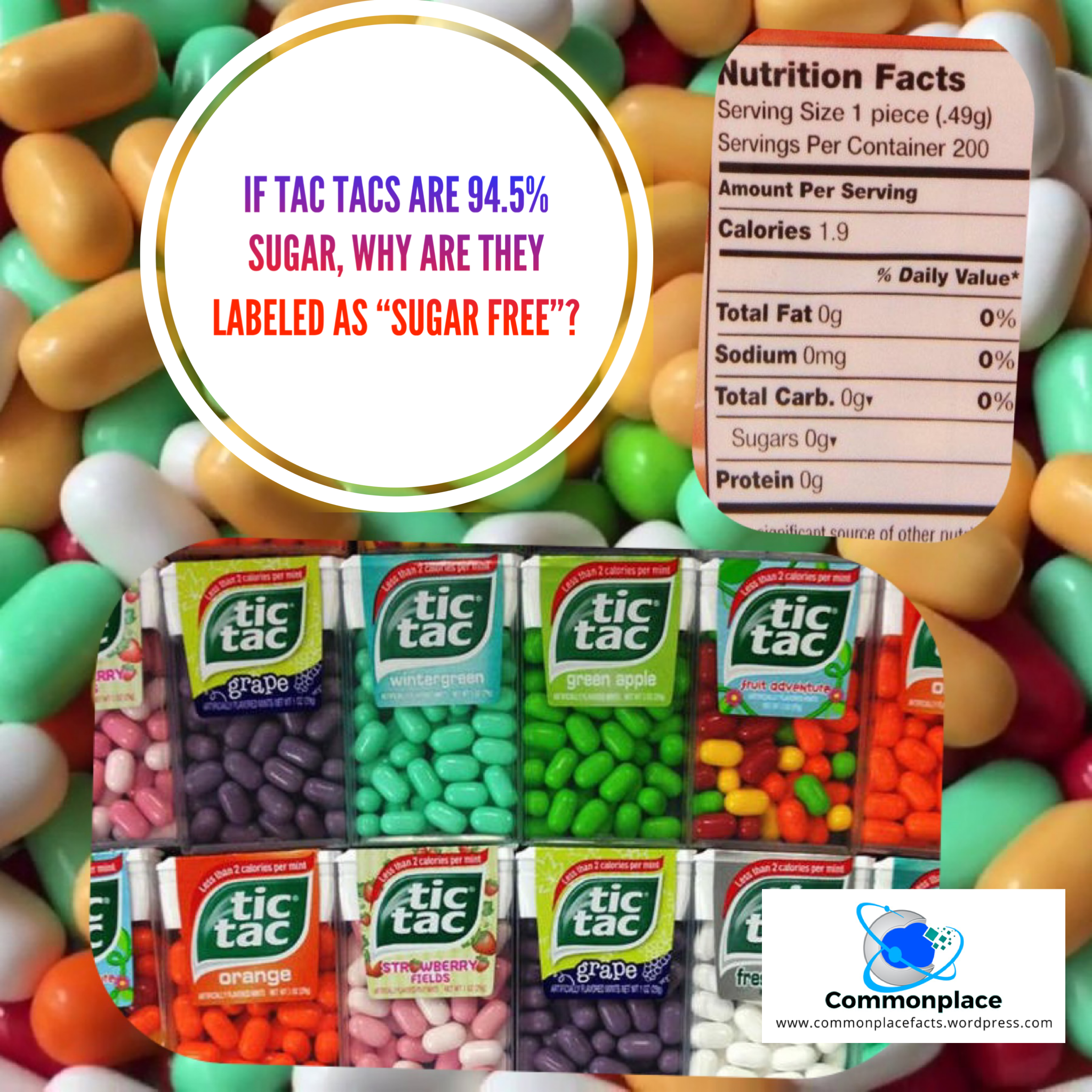
The reason the nutrition information can be reported as 0% sugar rests with the way the relevant government regulation is worded. If you look carefully at the Nutrition Facts on the back of the package, you will see that the information is reported on a per-serving basis. The serving size is one piece.
Federal regulations require that any amount of sugar in excess of 0.5 grams per serving must be reported. Each Tic Tac weighs in at 0.49 grams. That means none of the sugar needs to be reported, allowing the candy to be legally marketed as “sugar-free.”
The company’s website acknowledges this on its FAQ page:

The Nutrition Facts for Tic Tac® mints state that there are 0 grams of sugar per serving. Does this mean that they are sugar-free?
Tic Tac® mints do contain sugar as listed in the ingredient statement. However, since the amount of sugar per serving (1 mint) is less than 0.5 grams, FDA labeling requirements permit Nutrition Facts to state that there are 0 grams of sugar per serving.
The typical package of Tic Tacs contains 38 candies. If you gulp down all of them, you will have ingested about 18.5 grams of sugar and 74 calories. If it helps ease your conscience, however, just eat one at a time, and comfort yourself in the mathematical truth that zero multiplied by 38 is still zero, so you shouldn’t have anything to worry about.

The Day a Cheese Cannonball Was Fired in War (Yes, Really)
Yes, a cheese cannonball was really fired in war. Discover this bizarre moment and other strange facts from the devastating Paraguayan War.

Mad Honey Warfare: The Strange History of Hallucinogenic Honey in Battle
Discover mad honey—how toxic rhododendron nectar creates hallucinogenic honey used in ancient warfare, medicine, and modern curiosity.

The Savory Science of Artificial Flavors: Why “Banana” Is More of a Suggestion Than a Fact
Discover the science behind artificial flavors, why banana candy tastes different from real bananas, and how chemistry and psychology shape what we taste.





Leave a Reply to masercotCancel reply