

Honey has a reputation problem. Not because it has done anything wrong, but because humanity keeps insisting on dragging it into increasingly strange situations. This is the same substance that once turned up in France in shades of blue and green after bees developed a questionable fondness for discarded candy waste—an episode we previously covered in this entirely reasonable story about bees making rainbow-colored honey.
That particular incident raised an important question: if bees can accidentally produce honey that looks like it was produced by a distressed unicorn, what else might they be capable of? As it turns out, the answer is both fascinating and deeply concerning. Under the right conditions, honey can do more than just brighten your morning toast. It can incapacitate grown adults, disrupt entire groups, and—if you are an enterprising ancient general with a flexible moral compass—serve as a surprisingly effective weapon of war.
Welcome to the peculiar world of “mad honey,” where the line between snack and strategy becomes alarmingly thin, and where more than one army learned the hard way that not every free sample should be trusted.
Contents
What Is Mad Honey?
Mad honey is real, and, unlike many things in ancient military history, it does not require a suspiciously embroidered legend involving twelve dragons and a prophecy. It is honey made from nectar collected from certain rhododendron species containing compounds called grayanotoxins. These toxins can interfere with the body’s normal nerve and muscle function, leading to symptoms that include dizziness, nausea, vomiting, low blood pressure, slowed heart rate, confusion, and general incapacity.

In short, it produces similar symptoms to being locked in small, warm room with with a person who insists on explaining their diet, their crypto portfolio, and their recent “detox journey” while the walls slowly begin to spin.
This honey has historically been associated especially with areas around the Black Sea and with parts of modern Turkey and Nepal. It can be reddish or darker than ordinary honey, and in small amounts it has sometimes been used in traditional medicine. In larger or poorly judged amounts, however, it turns the consumer into a cautionary tale about the dangers of trusting food simply on the basis of it being labeled as “natural.”
What Happens If You Eat It?
Consuming mad honey is, in the technical terminology of science, “a mistake you will not repeat.” The effects typically begin within minutes to a couple of hours, depending on how much is consumed and how optimistic the individual was about free food.

The symptoms are not subtle. They often include dizziness, nausea, vomiting, sweating, blurred vision, confusion, and a heart rate that slows down just enough to make things interesting in all the wrong ways. Blood pressure can drop, coordination disappears, and the affected individual may find himself lying down—not out of choice, but out of necessity and a growing sense that gravity has become unusually persuasive.
In more severe cases, people can experience significant cardiac effects, including dangerously low heart rates and fainting. The good news is that most cases are temporary and treatable. The bad news is that the experience tends to be memorable in the same way one remembers touching a hot stove or trusting gas station sushi.
In short, mad honey does not typically kill you. It simply removes your ability to function in a way that would be considered useful, dignified, or upright. It may make you pray for the merciful touch of Death’s mysterious hand.
Medicinal Uses, Questionable Choices, and Other Experiments
Despite its reputation as a botanical prank gone too far, mad honey has not been entirely unwelcome in human history. In small, carefully controlled doses, it has been used in traditional medicine for centuries, particularly in regions where it is naturally produced. It has been employed as a treatment for high blood pressure, digestive issues, and, perhaps most notably, as an alleged performance enhancer in more romantic contexts —though the combination of dizziness, nausea, and impaired motor function suggests that expectations may occasionally exceed outcomes.
Ancient writers were well aware that this was no ordinary honey, although their conclusions occasionally wandered into territory best described as “creative.” Greek philosopher Aristotle observed that certain honey near Trapezus could cause healthy people to go mad while apparently curing epilepsy on the spot—a claim that, if true, would have made it the most efficient medical breakthrough in history. Roman naturalist Pliny the Elder referred to it as meli mænomenon, or “honey that makes one mad,” and was among the first to connect its effects to specific plants such as oleander, azalea, and rhododendron species. Greek physician Dioscorides added that the honey was only dangerous in certain seasons, while Pliny noted that it was especially potent after wet springs.
In other words, even in antiquity, people understood that mad honey was both useful and unpredictable—a combination that rarely leads to calm, measured decision-making. Its potency varied depending on geography, season, and perhaps how optimistic one felt about experimental medicine that day.
This brings us to its more modern and somewhat less medically supervised uses. In certain parts of the world, mad honey is still consumed recreationally for its intoxicating effects. These uses are often described as “mildly hallucinogenic,” which is a polite way of saying that the experience varies widely between “pleasantly unusual” and “I regret everything.” The line between medicinal use and ill-advised experimentation is, predictably, thin. Dosage is difficult to control, potency varies depending on the source, and what one person considers a therapeutic experience another may describe as an extended and deeply personal relationship with the bathroom floor.
All of which is to say: mad honey has been used for beneficial purposes, questionable purposes, and purposes that seemed like a good idea right up until they very much were not.
The Rhododendron Connection: A Beautiful Plant with Questionable Intentions
To understand where mad honey comes from, we have to start with a plant that looks entirely innocent. In this case, that something is the rhododendron—a plant so visually appealing that landscapers adore it, hikers photograph it, and state governments occasionally promote it to official floral status. West Virginia, for example, proudly claims Rhododendron maximum (the great laurel) as its state flower, which is both a lovely choice and, depending on your perspective, a mildly ominous one.

Not all rhododendrons are created equal, however. The real troublemakers in this story are specific species that produce compounds called grayanotoxins. These naturally occurring chemicals interfere with normal nerve and muscle function, leading to symptoms that include dizziness, confusion, nausea, vomiting, low blood pressure, and a sudden inability to behave as a functioning member of society.
The most infamous offenders include Rhododendron ponticum—native to the Iberian Peninsula and the Caucasus—and Rhododendron luteum, both commonly found around the Black Sea region. When bees collect nectar primarily from these plants, the resulting honey can carry enough of these toxins to produce mad honey.
This is where geography begins to matter. In regions where these toxic rhododendrons grow densely, bees may rely heavily on them as a nectar source, allowing the toxins to accumulate in meaningful concentrations. Historically, this created the perfect conditions for the incidents described by ancient writers, where entire groups of people were incapacitated after consuming what they assumed was a welcome snack.
By contrast, most rhododendrons found in the United States—while technically related—either contain much lower levels of grayanotoxins or are only one of many nectar sources available to bees. Even species like West Virginia’s Rhododendron maximum rarely produce true mad honey scenarios. American bees, like sensible diners at a buffet, tend to diversify their selections. The result is honey that is thoroughly diluted, mostly safe, and if you are looking for some inexpensive gateway hallucinogens, disappointingly unsuitable.
So yes, the same botanical family responsible for ancient battlefield misadventures exists in the United States. Before anyone begins eyeing Appalachian honey with suspicion, it is worth noting that modern beekeeping practices, diverse forage sources, and lower toxin concentrations make dangerous mad honey events in those parts of the country exceedingly rare.
Still, it adds a certain layer of intrigue. If you happen to know any West Virginian beekeepers, it would be wise to stay on their good side.
The First Big Example: Xenophon and the Accidental Snack Disaster
All of which is interesting from a botanical and medical standpoint. It becomes considerably more interesting when someone realizes that a substance capable of disabling a person might also be capable of disabling an army. History, as it turns out, did not miss that opportunity.

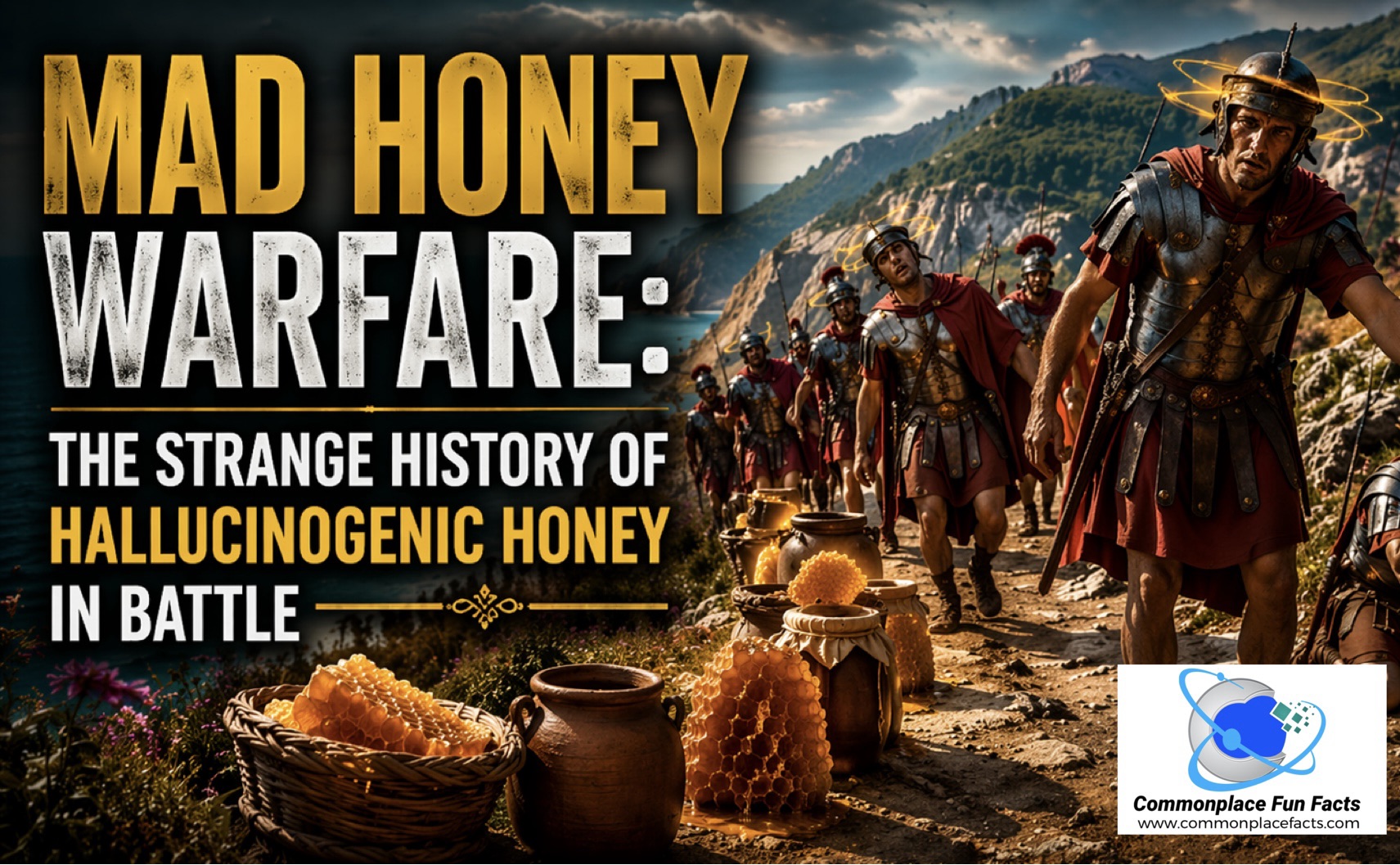
One of the earliest recorded incidents involving mad honey comes from Xenophon’s Anabasis, which already sounds like the sort of book a teacher would assign for the primary purpose of inducing symptoms of nausea and hallucinations. In 401 BC, Greek mercenaries known as the Ten Thousand were marching through territory near the Black Sea after a long and miserable campaign. They found honeycombs.
This seemed, at first glance, like excellent news. Hungry soldiers discovering free honey is usually the beginning of a morale boost. It is rarely the beginning of an impromptu group audition for “most dramatic collapse in a field.”
The men ate the honey and soon became violently ill. Xenophon describes them as unable to stand, staggering about as though defeated by the world’s least dignified banquet. Some appeared delirious. Others fell over entirely. For a while, the army looked less like an elite fighting force and more like the aftermath of a church potlock gone catastrophically wrong.
The good news, such as it was, is that most recovered within a day or so. The bad news is that being temporarily transformed into a groaning carpet of helpless warriors is not ideal when one is traveling through hostile territory.
This episode does not appear to have been an intentional attack. It was more of an accidental encounter between a tired army and the botanical equivalent of a prank phone call. Still, it demonstrated something important: under the right conditions, toxic honey could disable a large number of soldiers without ever drawing a sword.
The Honey Trap for the Romans
Human history has a reliable pattern. First, someone discovers something dangerous by accident. Then someone else, usually with a sharper eye for tactical opportunity and a weaker commitment to ethics, asks whether it can be used on purpose.

Enter Mithridates VI Eupator, one of antiquity’s more colorful anti-Roman troublemakers. If Rome was in the business of collecting enemies, Mithridates was one of its premium models. During the Mithridatic Wars, the kingdom of Pontus fought repeatedly against Roman expansion, and in at least one famous incident, local forces appear to have used mad honey deliberately as a weapon.
According to ancient accounts, including Strabo, troops allied with Mithridates left combs or containers of toxic honey in the path of Roman soldiers in the Black Sea region. The Romans found the honey, ate it, and became incapacitated. At that point, the enemy attacked and killed them.
It is difficult not to admire the tactical elegance, in the same way one reluctantly admires a raccoon that figures out how to open the refrigerator. This was not brute force. This was not glorious cavalry. This was a trap built on the timeless military vulnerability known as “our men found unattended food and made some choices.”
There is something almost offensively efficient about it. No need to storm fortified lines. No need to outnumber the opposition. No need for dramatic speeches about honor and destiny. Just leave out suspicious honey, wait for the enemy to help themselves, and then return when they are too busy hallucinating and vomiting to defend themselves effectively.
Ancient warfare is often imagined as all bronze, banners, and heroic poses. In reality, it was frequently a matter of logistics, terrain, disease, deception, and a startling number of ways to die because somebody made a poor decision before lunch. The mad honey ambush fits that pattern perfectly.
Not a One-Time Idea
The use of honey—or honey-based products—as a weapon did not end with Mithridates. Variations on the same general idea appear in later historical accounts, suggesting that once humanity realized food could be weaponized, it was reluctant to let the concept go.
In 946, during the campaign of Queen Olga of Kiev, her allies reportedly sent large quantities of fermented honey to opposing forces. The recipients consumed it, fell into a stupor, and were subsequently massacred—reportedly numbering in the thousands. A similar incident occurred in 1489, when Tatar forces consumed mead left behind in an abandoned camp and were attacked while incapacitated.
Whether these later cases involved true mad honey or simply very strong honey-based alcohol is open to debate. What is not in doubt is the underlying principle: if your enemy is willing to eat or drink something you leave behind, you have an opportunity—and history shows that opportunity has been taken more than once.
Why Mad Honey Worked So Well
The genius of the tactic lay in the fact that honey did not look like a weapon. It looked like loot. It looked like food. It looked like the sort of thing soldiers on campaign would absolutely help themselves to without pausing for a safety briefing.
That matters. Poisoned wells can be suspicious. A cloud of arrows tends to give the game away. Honey, by contrast, radiates harmlessness. It is wholesome. It is pastoral. It is associated with bees, flowers, and children’s stories in which woodland creatures wear waistcoats. It is not usually associated with a military-grade gastrointestinal and neurological collapse.
Mad honey also had another advantage: it did not necessarily kill immediately. Instead, it weakened, disoriented, and incapacitated. From a tactical standpoint, that is often better. A dead soldier is one less enemy. A collapsing, confused, vomiting soldier can also create panic, disorder, and delay among everyone around him. That sort of chaos is pure gold for an ambush.
It also turned the victims’ own appetites into the delivery system. No siege engines required. No specialized equipment. Just patience, geography, and confidence that the enemy would make the kind of decision armies have been making since the dawn of time: “Well, it’s free.”
The Geography of Weaponized Breakfast Condiments
One reason this tactic did not become the standard approach to warfare everywhere is that mad honey is geographically picky. You need the right plants, the right bees, and the right region. This was not something a general in every climate could simply add to the quartermaster’s shopping list.
The most famous ancient accounts come from the Black Sea region because that area contained the rhododendrons capable of producing toxic nectar. Outside such regions, honey remained its more traditional self: delicious, sticky, and mostly committed to breakfast rather than organized slaughter.
There was also the issue of dose. Too little, and the enemy might suffer nothing worse than a bad afternoon. Too much, and people might become suspicious before the trap had time to work on enough of them. Effective weaponized honey required a rather delicate balance, which is not generally a phrase one wants associated with military catering.
Mad Honey in the Modern World
Mad honey did not vanish with the ancient world. It still exists, and cases of poisoning are still reported today, especially in places where the honey is harvested and sold for supposed medicinal or recreational effects. Modern victims typically are not Roman legionaries or Greek mercenaries. They are more likely to be curious consumers who assumed that because something was natural, it must therefore be a sound life choice.

Nature has never agreed to that arrangement.
Modern medicine understands the cause more clearly than Xenophon did. Grayanotoxins affect sodium channels in the body, producing the cluster of symptoms that made ancient soldiers collapse in such memorable fashion. Most cases are treatable, and many people recover fully, but the experience is often severe enough to convince patients that perhaps regular honey was perfectly adequate all along.
Mad honey can be purchased (because this is the internet age, so of course it can), but prospective customers should be wary. Quality control is essentially non-existent. Given the symptoms we have described, saying it has “unique natural effects” feels like describing a hurricane as “a bit windy.”
And then there’s the price. The stuff is not cheap. One vendor offers it at a little more than $4 per teaspoon. Another pushes that to $6.62 per teaspoon, or $399 for 7.7 ounces of honey “harvested above 3,500 meters (11,500 ft) by brave Gurung honey hunters who scale vertical rock walls with bamboo ladders, offering a luxury and health indulgence like no other.” It even arrives in a hand-carved wooden box engraved with your name, ensuring that when you inevitably question your life choices, you will know exactly who to blame.
The Broader Tradition of Weaponized Food and Drink
Mad honey occupies a special niche in military history, but it also belongs to a larger family of unpleasant ideas involving food, drink, and treachery. Armies and assassins alike have long understood that what goes into the mouth can change what happens on the battlefield. Poisoned wells, tainted wine, drugged feasts, and contaminated supplies all testify to the same grim principle: if you can disable your enemy before the fight starts, the fight becomes much easier.
Mad honey stands out because it feels so absurdly specific. Poisoned wine has a certain sinister dignity. Toxic honey sounds like the setup to a joke told by a deranged beekeeper. Yet it was real, it worked, and it earned its place in the long and unsettling history of humans turning ordinary household items into instruments of war.
The Most Embarrassing Way to Lose a Battle
There are many noble ways for an army to be remembered. Holding the line against impossible odds. Executing a brilliant flank attack. Enduring brutal hardship with heroic resolve. There are also less noble possibilities, such as being unable to fight while recovering from mass circumcisions. Being undone because your troops could not resist free honey falls squarely into that latter category.
That, perhaps, is what makes the story so irresistible. It combines the grandeur of ancient warfare with the deeply familiar weakness of human beings around snacks. Strip away the armor and standards, and the soldiers in these stories are still people making the sort of poor impulse-control decisions that continue to shape history in ways large and small.
Xenophon’s men found honey and ate it. Roman troops found honey and ate it. Somewhere in the distance, military discipline packed a bag and left in disgust.
Why This Story Still Matters
Stories like this endure because they remind us that history is never only about kings, treaties, and battles. It is also about terrain, plants, chemistry, appetite, and the weird local knowledge that one side has and the other does not. Sometimes victory belongs not to the stronger army, but to the people who know which hillside flowers can turn a snack into a tactical catastrophe.
It also reminds us that “natural” and “harmless” are not synonyms. A flower can be lovely, a bee can be industrious, honey can be golden and inviting, and the final product can still knock a trained soldier flat on his back. Nature is full of marvels. It is also full of warnings, many of them wrapped in remarkably attractive packaging.
Final Thoughts
Mad honey is one of those rare substances that manages to sit comfortably at the intersection of botany, medicine, poor judgment, and military innovation. It begins as a flower, becomes a food, turns into a toxin, and, in the hands of sufficiently creative humans, ends up as a weapon. That is an impressive résumé for something most of us associate with tea and biscuits.
It also serves as a reminder that nature does not label its products for our convenience. The same plant that produces a beautiful hillside bloom can also produce a chemical capable of disabling a person—or, under the right circumstances, an entire army. The difference often comes down to knowledge, timing, and whether anyone in the group is willing to ask the dangerous but necessary question: “Should we be eating this?”
History suggests that the answer to that question has frequently been “yes,” followed shortly thereafter by regret.
From ancient Greek mercenaries to Roman legions to modern online shoppers with a credit card and a sense of curiosity, the pattern remains remarkably consistent. Give people something that looks appealing, call it natural, and place it within reach, and sooner or later someone will decide to try it. Occasionally, that decision alters the course of a battle. More often, it simply alters the course of their afternoon.
Either way, the lesson endures: not every sweet thing is harmless, not every natural remedy is wise, and not every free sample should be trusted—especially if it has already defeated an army.
You may also enjoy…

Bees Snacking on M&M’s Produce Multi-Colored Honey
If you are feeling a bit blue, there’s nothing like a little honey to cheer you up. What do you do if the honey itself is blue? Blue honey is causing some French beekeepers to see red. In August of 2012, beekeepers near Ribeauville in northeastern France began to notice a peculiar and troubling thing…

The Honey War of 1839: When Missouri and Iowa Nearly Went to War Over Honey
Discover the Honey War of 1839, the bizarre border dispute that nearly sparked a war between Missouri and Iowa over a surveying error and trees full of honey.

Some Sweet Facts about Honey Bees
The phrase “busy as a bee” denotes someone who seemingly has an inexhaustible supply of energy. Before you compare the biggest workaholic you know to a bee, you should probably take a moment and consider just how busy those little winged workers truly are. A honey bee visits between 50 and 100 flowers during one…





Leave a Reply