
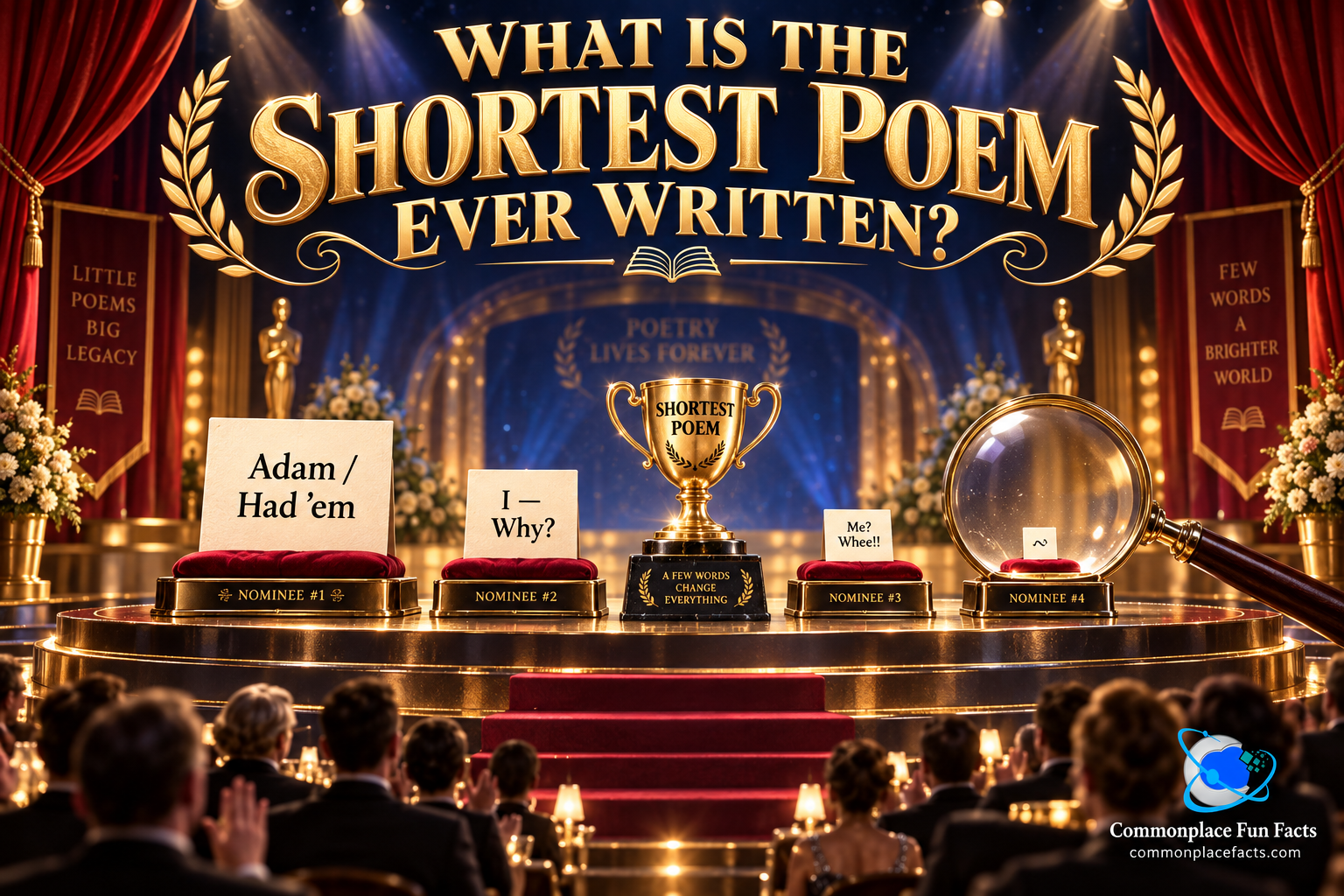

What is the shortest poem ever written?
This sounds like the sort of question that should require approximately three seconds to answer. Count the words, find the smallest number, declare a winner, and move on with your day.
Poetry, unfortunately, has other plans.
Over the years, several writers have claimed—or been awarded—the distinction of writing the shortest poem in the English language. One candidate has two lines and five syllables. Another consists of two words. Muhammad Ali managed to get into the competition. And poet Aram Saroyan eventually reduced the entire enterprise to a single letter that isn’t even quite a normal letter.
At that point, determining the world’s shortest poem stops being a matter of counting words and becomes a philosophical dispute over what qualifies as a poem in the first place.
Contents
Strickland Gillilan’s Famous Two-Line Poem About Fleas
For many years, the standard answer was a tiny poem written by American humorist Strickland Gillilan in 1904. Its wonderfully oversized title is Lines on the Antiquity of Microbes, although it is often known simply as Fleas.
Adam
Had 'em.
That’s it. Gillilan managed to provide a Biblical reference, zoological observation, rhyme, and punch line using five syllables. Some poets require 14 lines to make a sonnet. Gillilan apparently regarded the other twelve as unnecessary administrative overhead.
The poem’s claim to fame is not merely a modern internet factoid. A 1927 edition of Mount Rainier Nature News Notes printed the poem and reported that Gillilan himself described it as “the shortest poem existing.”
There is one small scientific problem with the title. Fleas are insects, not microbes. Evidently, when you are trying to write the world’s shortest poem, there is very little room left over for taxonomic precision.
Eli Siegel Asked an Even Shorter Question
Gillilan’s reign gets complicated almost immediately once we start looking for alternatives.
In 1925, American poet Eli Siegel published a work called One Question in the Literary Review of the New York Evening Post. It consisted of just two words:
I—
Why?
Siegel later said the poem was not written as an attempt to manufacture a record. In a discussion preserved by the Aesthetic Realism Online Library, he explained that he was genuinely interested in expressing a large philosophical problem in the most economical way possible. Other people subsequently began describing it as the world’s shortest poem.
That creates the first problem for anyone trying to hand Gillilan a trophy. If we count words or letters, Siegel is shorter. If we require a conventional rhyme, Gillilan has him. If titles count toward total length, everyone needs to go back to the scorer’s table.
Then Aram Saroyan Wrote a One-Letter Poem
By the 1960s, poet Aram Saroyan decided that two entire words represented an almost reckless commitment to verbosity.
Saroyan became known for minimalist and concrete poetry—works in which the appearance of letters and words on the page can be as important as their conventional meaning. Among his most famous creations is a poem consisting of what looks like a lowercase m with an extra leg.

You can see Saroyan’s peculiar little creation at the Poetry Foundation, which describes it as one of the shortest published poems in the world and dates the work to 1968.
Calling it a “one-letter poem” is already simplifying matters, because the character is not quite an ordinary m. It has four downward strokes instead of three. It could be an m and an n merging together. It could represent a letter in the process of becoming something else. Some readers have seen an echo of “I am,” turning the tiny mark into a statement about existence and consciousness.
Or it could be an m that has suffered an unfortunate clerical duplication.
Saroyan described works like this as “instant” poems. The idea was not necessarily that the reader should move through a sequence of words, but that the entire poem should arrive visually at once. The Poetry Foundation notes that looking at the work rather than conventionally “reading” it is an important part of the experience.
And that brings us to the obvious objection: is this actually a poem?
Does a Single Letter Count as Poetry?
If poetry requires words, meter, syntax, or even recognizable language, Saroyan’s entry is in trouble. His four-legged m looks at least as comfortable hanging in an art gallery as sitting in a poetry anthology.
Concrete poetry deliberately makes that distinction difficult. The visual arrangement of language is part of the work rather than merely the packaging that carries it. Saroyan pushed the idea to its logical—or perhaps deeply illogical—extreme by making the typography itself the poem.
That means the argument over whether his m qualifies as poetry is not an unfortunate side effect. The argument is rather close to the whole point.
Did Guinness Really Call It the World’s Shortest Poem?
For years, references to Saroyan’s poem have repeated another intriguing claim: that Guinness World Records officially recognized it as the world’s shortest poem.
When Commonplace Fun Facts first examined this subject in 2019, we could find plenty of sources repeating the claim but no current Guinness listing to confirm it. That mystery now has a better answer.
In a 2023 examination of the question, the creator of the I Could Think of Verse podcast contacted Saroyan directly. Saroyan recalled seeing his poem listed in the Guinness Book of World Records during the 1970s. According to Saroyan, competing claims eventually piled up and Guinness eliminated the category altogether.
That would explain why the citation is repeatedly mentioned in older discussions while no corresponding record appears on the modern Guinness website. It also suggests that saying Saroyan currently holds an official Guinness record would be misleading. He appears to have held the distinction historically, but Guinness no longer maintains a usable “shortest poem” category.
Apparently even the people whose business is determining world records eventually looked at minimalist poetry and decided they had other things to do.
Muhammad Ali Enters the Poetry Competition
Then there is Muhammad Ali, because naturally the heavyweight champion of the world also wandered into the history of minimalist poetry.
On June 4, 1975, Ali appeared at Harvard University’s Burden Auditorium. After delivering remarks on friendship and taking questions from the audience, he offered what the Harvard Crimson described several days later as “the shortest poem ever written on what it’s like to be as great as Ali.”
Me?
Whee!!
Journalist and editor George Plimpton later recalled the exchange somewhat differently. According to Plimpton, someone in the audience asked Ali for a poem. Plimpton mentioned Gillilan’s “Adam / Had ’em,” and Ali promptly announced that he had a shorter one. Plimpton subsequently told the story in essentially the same “Me? Whee!!” form.
The poem is frequently quoted today as “Me. We.” That version has acquired an appealing interpretation: the individual champion recognizing his connection to a larger community. It has even inspired later works of art.
There is just one difficulty. The contemporary newspaper account says “Me? Whee!!,” and that is also how Plimpton remembered it. The elegant “Me. We.” version appears to be a later transformation of the story.
Which is a useful reminder that a poem can apparently become misquoted even when it contains only two words. Humanity remains undefeated.
So What Is the Shortest Poem Ever Written?
The irritating but accurate answer is that there is no universally accepted winner.
Gillilan’s “Adam / Had ’em” remains perhaps the most famous traditional candidate. It has recognizable words, rhyme, meter, a joke, and enough structure to look unmistakably like a tiny conventional poem. Siegel’s “I— / Why?” is shorter and carries an impressive amount of existential baggage for two words. Muhammad Ali matched the two-word format while managing to make the poem unmistakably Muhammad Ali.
Saroyan went further still. If a poem can consist of a single manipulated character, his four-legged m has the strongest historical claim to the title—and appears actually to have been recognized by Guinness at one point. But accepting Saroyan’s entry requires accepting that poetry can survive after words themselves have disappeared.
At that point, the question is no longer “Which poem has the fewest words?” It becomes “What is the smallest possible thing that can still be called a poem?”
That is a considerably more interesting question, although admittedly a less convenient one for the person who just wanted a trivia answer.
Poetry Can Also Go in the Other Direction
If all this literary minimalism leaves you feeling cheated, rest assured that poets are perfectly capable of overcompensating. At the opposite end of the scale is the Mahābhārata, one of the longest poems ever composed, containing roughly 100,000 verses and enough material to make “Adam / Had ’em” look less like a poem and more like a clerical note.
Then there is Raymond Queneau’s Cent Mille Milliards de Poèmes, a book designed to produce 100 trillion possible sonnets. Reading every combination would occupy roughly 126 million years, which should be adequate for anyone who feels Saroyan did not give them enough material.
Literature has the same problem with sentences. Our look at the longest sentences in English literature begins with James Joyce and eventually reaches novels that more or less decline to stop being one sentence at all.
Writers, it seems, are incapable of leaving well enough alone. Give them language and someone will try to fit an entire poem into one letter, while somebody else will spend a thousand pages avoiding a period.
Copy editors must wonder why they bothered choosing this profession.
You may also enjoy…

Sheesh! The Chinese Poem Where Everything Is Pronounced “Shi”
It is always dangerous to try to write an article about something in a language that the author knows nothing about. We at Commonplace Fun Facts laugh in the face of danger. At the very least, we laugh at a lot of different things, including languages we do not understand. For that reason, we present…

The Chaos — The Aptly-Named Poem About the Insanity of the English Language
Those of us who love the English language have to admit to a bit of schizophrenia about the love affair. On the one hand, English is an utterly-flexible and ever-changing language, allowing near-infinite ways to communicate whatever you wish to express. On the other hand, its grammar consists of far more exceptions than constants, and…

The Mahābhārata: Take a Quick 6.5 Hours to Read the World’s Longest Poem
Discover the Mahābhārata — the 1.8 million word poem that takes 6.5 hours to read.




Leave a Reply