
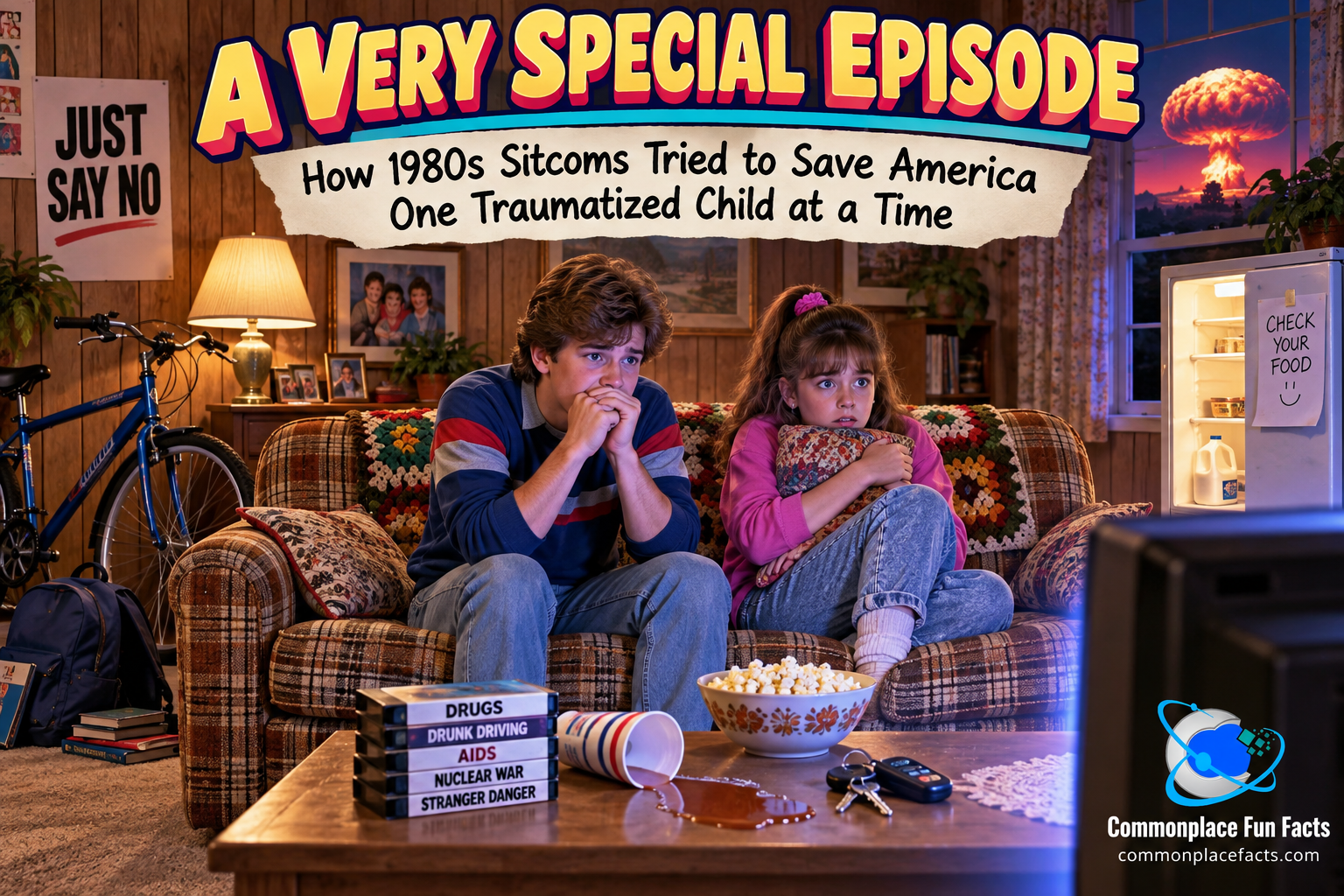

There was a time in American television when a child could sit down to enjoy a harmless family sitcom and, without warning, receive a graduate-level seminar in drugs, death, molestation, drunk driving, AIDS, grief, CPR, or the lethal ambitions of discarded kitchen appliances.
This was the age of the Very Special Episode.
One week, your favorite sitcom kid was arguing about homework, borrowing money, or learning that honesty is the best policy unless lying produces better comic timing. The next week, the studio audience went quiet, the music turned serious, and America’s children learned that behind every bicycle shop, school locker, house party, or abandoned refrigerator lurked a public-service announcement in sensible shoes.
The 1980s did not invent the idea of television tackling serious social problems. Norman Lear had already been using sitcoms like All in the Family, Maude, and Good Times to drag difficult subjects into American living rooms in the 1970s. But the 1980s perfected a very specific version of the form: the ordinary sitcom episode that suddenly looked the viewer directly in the face and said, “Tonight, laughter will be permitted only between federally approved messages.”
These episodes were sincere. They were educational. They were sometimes brave. They were also frequently as subtle as being hit in the head with a boombox playing “We Are the World.”
Contents
What Was a Very Special Episode?
A “very special episode” was usually a one-off installment of a comedy series that tackled a serious issue far heavier than the show’s usual diet of misunderstandings, wacky neighbors, and children learning not to charge long-distance phone calls to Paraguay.
The phrase itself became shorthand for sitcoms temporarily transforming into public-service announcements. These episodes often used familiar sitcom characters to introduce younger viewers to subjects such as drugs, sex, violence, child abuse, drunk driving, and illness. It was television as moral instruction, wrapped in a laugh track and delivered between cereal commercials.
The formula was usually pretty simple:
- A regular character encounters a serious social danger.
- A guest character often suffers the worst of it, because the regular cast still has to be back next Thursday.
- A parent, teacher, doctor, police officer, butler, or First Lady explains the lesson.
- Everyone hugs.
- The network hopes parents approve, critics notice, and nobody asks why the laugh track was invited to a child-molestation plot.
That last part is not a theoretical concern. The 1980s gave us sitcom episodes about genuinely horrifying subjects that still had applause breaks. It was a strange time. America had VCRs, shoulder pads, D.A.R.E. assemblies, and apparently no agreed-upon rule against combining child endangerment with jaunty theme songs.
Why the 1980s Were Prime Time for Sitcom Trauma
The 1980s were anxious years dressed in bright colors. The decade gave us cable television, music videos, personal computers, designer jeans, and a national suspicion that every child was one bad decision away from drugs, cults, kidnappers, peer pressure, satanic backward-masking, or Pop Rocks detonating internally. It was the golden age of moral panic wearing a Members Only jacket.
Television responded accordingly. Network sitcoms reached millions of families at the same time. Before streaming carved audiences into tiny demographic charcuterie boards, a hit sitcom could still function as a national campfire. If a network wanted to talk to American parents and children about drugs, AIDS, abuse, grief, or drunk driving, it could do so by handing the subject to Gary Coleman, Soleil Moon Frye, Michael J. Fox, or Matthew Perry and letting the emotional damage begin.
There was also a practical reason: these episodes got attention. They were promoted heavily. They won awards. They drew letters. They gave networks the warm glow of civic responsibility while still delivering the cold, delicious crunch of ratings. Television executives may have cared deeply about America’s children, but they also cared deeply about sweeps week. Both things can be true, which is how civilization ends up with a sitcom butler explaining AIDS.
Diff’rent Strokes: America’s Leading Supplier of Childhood Warnings
No discussion of 1980s very special episodes can avoid Diff’rent Strokes. The show began with one of the great sitcom premises of the era: two brothers from Harlem, Arnold and Willis Jackson, are adopted by wealthy Manhattan widower Phillip Drummond after their mother dies. The setup gave NBC comedy, class contrast, cute-kid catchphrases, and a nearly unlimited excuse to place Arnold Jackson in mortal or moral peril.
Arnold did not merely grow up on television. He apparently served as NBC’s Department of Child Endangerment.
The most infamous example is “The Bicycle Man,” a two-part 1983 episode in which Arnold and his friend Dudley befriend Mr. Horton, a bicycle-shop owner played by Gordon Jump, who is actually a predator. InsideHook later described the episode as one that “upended the sitcom’s structure” and featured a chilling look at pedophilia, while also being, in the delicate wording of understatement, “really awkward.”
That awkwardness is part of why the episode remains so unsettling. The subject matter is deadly serious. The setting is still a sitcom. Mr. Horton offers rewards, ice cream, secrets, and access to adult materials. Arnold and Dudley do not fully understand what is happening. The audience does. That is the horror. The canned laughter, when it appears around the edges, feels like it wandered into the wrong building and is now too embarrassed to leave.
And yet, for all its tonal madness, “The Bicycle Man” did something important. It gave children and parents a way to talk about grooming, secrets, and adults who exploit trust. It used blunt instruments, yes. But sometimes blunt instruments are what a mass audience notices. A scalpel is elegant. A frying pan makes the point.

The two-part Diff’rent Strokes episode “The Bicycle Man” can be watched on Tubi: Part 1 and Part 2.
And if “The Bicycle Man” feels like a bizarre one-off fever dream from the basement of 1980s network television, it was not. Five years later, Mr. Belvedere aired “The Counselor”, in which Wesley struggles to tell anyone that a camp counselor tried to molest him.
The fact that two mainstream sitcoms of the decade addressed child sexual abuse through familiar family-comedy characters says something important about the era. It also says something deeply strange about the era, since one of those shows starred a wisecracking child in a penthouse and the other starred a refined English butler living with Bob Uecker. The 1980s were not subtle, but they were apparently very committed to making sure no laugh track escaped moral responsibility.
The same year Diff’rent Strokes aired “The Bicycle Man,” it also brought us “The Reporter,” in which Arnold investigates rumors that drugs are being sold at his school. First Lady Nancy Reagan appeared in the episode as part of her “Just Say No” campaign.
This means Diff’rent Strokes managed to give America, in one season, both a child-predator warning and an anti-drug message from the First Lady. The show was basically a civics course with bunk beds.
The Diff’rent Strokes episode “The Reporter,” featuring Nancy Reagan and Arnold’s school-drug investigation, can be watched on Tubi: “The Reporter”.
The Drug Episodes: Marijuana, Peer Pressure, and Helen Hunt as a Gateway Threat
Drug episodes were practically mandatory in the 1980s. If your sitcom had teenagers, middle schoolers, or any character capable of spelling “peer pressure,” eventually someone was going to be offered marijuana by a guest star with feathered hair and suspicious confidence.

One early example came from The Facts of Life. In the 1980 episode “Dope,” Blair introduces Sue Ann to a popular clique whose members smoke marijuana. One of the young guest stars was Helen Hunt.
Yes, before winning an Oscar and multiple Emmys, Helen Hunt appeared in an anti-drug episode of The Facts of Life. Everyone has to start somewhere. Some people start by studying Shakespeare. Others start by helping Eastland School demonstrate the dangers of jazz cabbage.
These episodes often followed the same moral machinery. A “cool” group pressures a regular character to experiment. The regular character hesitates. A younger character stumbles into danger. Mrs. Garrett, or the nearest responsible adult, explains that popularity is not worth trading your judgment for a bong and a varsity jacket.
The messaging could be simplistic, but that was the point. These were not nuanced policy discussions about addiction, criminal justice, family dysfunction, or public health. They were episodes aimed at kids who might otherwise think the cool older students had cracked the code of adulthood by owning a lighter and using sarcasm professionally.
The Facts of Life episode “Dope,” featuring Blair’s brush with marijuana and Eastland peer pressure, can be watched on Tubi: “Dope”.
Family Ties: Alcoholism, Grief, and the Michael J. Fox Pain Delivery System
Family Ties was better equipped than most sitcoms to handle serious material. The Keaton family was warm, verbal, politically divided, and emotionally literate enough to discuss painful subjects without making viewers feel trapped in a pamphlet rack. Also, Michael J. Fox could do more with one wounded look than some shows could do with three speeches and a guidance counselor.
In the 1984 episode “Say Uncle,” Tom Hanks guest-stars as Uncle Ned, Alex’s admired relative whose drinking problem becomes impossible to ignore. The episode becomes especially jarring because Hanks’ character is not presented as a cartoon drunk. He is charming. He is funny. He is successful. He is loved. He is also out of control.
That made the episode more effective than a lot of Very Special programming. It understood something real: addiction often arrives wearing the face of someone you already trust.
Then came “A, My Name Is Alex,” the 1987 hour-long episode in which Alex struggles after the death of his friend Greg in a car accident. The episode was heavily promoted, aired partly without commercials, and became one of the most acclaimed sitcom episodes of the decade. It won Emmys for writing and technical direction and remains one of the best-remembered episodes of 1980s television.
It also broke the usual sitcom structure. Much of the second half takes place in a sparse, theatrical therapy-like setting, forcing Alex to confront survivor’s guilt, ambition, faith, fear, and loss. This was not merely “Alex learns not to be selfish.” This was “Alex stares into the abyss while America checks the TV Guide to make sure this is still Thursday night comedy.”
Unlike many Very Special Episodes, “A, My Name Is Alex” does not solve grief. It lets grief be messy. That is probably why it has lasted. It was still a product of its time, but it trusted the audience enough to sit with discomfort rather than immediately smothering it under a hug and a jaunty closing theme.
Punky Brewster: Abandonment, Challenger, and Refrigerator Terror
Punky Brewster was marketed as a cheerful show about a spunky little girl with mismatched shoes, a dog named Brandon, and enough optimism to power a small Midwestern utility. But underneath the rainbow-colored surface was a premise that began with child abandonment. Punky was not just quirky. She had been left by her mother in a grocery store parking lot.
So maybe it should not surprise us that Punky Brewster became one of the decade’s leading manufacturers of child trauma.
The most notorious example is “Cherie Lifesaver,” the 1986 episode in which Punky’s friend Cherie gets trapped inside an abandoned refrigerator during a game of hide-and-seek. Punky and her friends then use CPR to save her. The episode managed to convert an old appliance into one of the most memorable childhood terrors in television history.
For children who saw it, the episode did not merely say, “Learn CPR.” It said, “Every discarded refrigerator is a metal coffin with shelves.” That is a strong educational strategy, assuming the goal was to make a generation of children distrust Whirlpool.

And then there was “Accidents Happen,” the 1986 episode responding to the Space Shuttle Challenger disaster. The episode shows Punky struggling after the tragedy, with Buzz Aldrin appearing to help her class process what happened.
That episode touched a real national wound. Millions of American schoolchildren watched the Challenger launch live or learned about it during the school day. The disaster was not an abstract event for them. It entered classrooms in real time. For Punky Brewster to address it made sense. It was also emotionally ambitious for a children’s sitcom whose visual brand otherwise suggested “orphan Lisa Frank.”
In fairness, this is where Very Special Episodes could do real good. Children were already confused and frightened. Television gave them a familiar character who was also confused and frightened. That matters. Adults sometimes underestimate the comfort children find in seeing a fictional friend ask the same questions they are afraid to ask.
Growing Pains: Matthew Perry, Drunk Driving, and the Sudden Death of the Guest Boyfriend
Few sitcom lessons landed with the blunt force of Growing Pains and its drunk-driving episode, “Second Chance.” Matthew Perry guest-starred as Sandy, Carol Seaver’s boyfriend. After drinking and driving, Sandy is injured in a crash. At first, he seems to have survived with relatively minor injuries. Then the episode swerves. Sandy dies.
The episode’s central setup has Sandy hospitalized after driving drunk, and Carol must deal with the consequences. The reason it remains remembered is the escalation. The show does not let Sandy become merely bruised and repentant. It lets the mistake kill him.
This was Very Special Episode logic at its most ruthless. A guest character could be sacrificed so the regular character could learn. That sounds cynical, and structurally it is. But it also made the lesson stick. If Sandy had apologized, joined a support group, and returned for prom, nobody would still be talking about it. Instead, Growing Pains looked at teenage viewers and said, “Consequences are real, and sometimes they do not wait until the season finale.”
Also, let us pause over the fact that Matthew Perry, who would later become one of the defining sitcom stars of the 1990s, spent part of the 1980s as a dead boyfriend in an anti-drunk-driving lesson. Television history is less a straight line than a box of tangled Christmas lights.
Benson: Nuclear War, but Make It a Workplace Comedy
Then there was Benson, the political sitcom that looked at the 1980s nuclear arms race and apparently said, “What this needs is Robert Guillaume, a bomb shelter, and several civil servants confronting the end of civilization on an ABC soundstage.”
In the 1985 episode “Scenario,” Governor Gatling’s staff participates in a nuclear-attack exercise and attempts to operate the state government from a shelter. The premise sounds absurd only until one remembers that this was the Cold War, when popular culture was full of mushroom clouds, fallout drills, civil defense planning, and the cheerful national understanding that humanity might end because two superpowers were playing geopolitical chicken with extinction.
Unlike the more familiar child-safety Very Special Episodes, “Scenario” aimed its anxiety at adults. This was not a warning about drugs, peer pressure, or suspicious bicycle-shop owners. This was the big one: nuclear war. The staff is forced to think through what survival would actually mean after an attack, including who makes decisions, what government can still do, and whether “continuity of operations” sounds quite so reassuring when the operations in question are taking place after civilization has been flambéed.
That made the episode unusually grim for a sitcom. Benson was usually sharp, political, and character-driven, with Benson DuBois functioning as the sane person in a building full of official nonsense. But “Scenario” used that same setting to ask what happens when official nonsense is suddenly asked to preserve society. It is one thing to manage budgets, ceremonies, and political egos. It is another to do all of that while wondering whether the outside world still exists in any useful form.
The episode belongs in the same Very Special Episode family as the drug, abuse, AIDS, and drunk-driving installments of the decade, but it carries a different flavor of dread. Those other episodes usually warned viewers about dangers that might enter their homes, schools, or neighborhoods. “Scenario” warned that the whole neighborhood, along with the school, the home, the bicycle shop, and possibly the network affiliate, could disappear in a flash of strategic diplomacy gone poorly.
It is easy to forget how ordinary nuclear fear was in the 1980s. Children grew up with movies like The Day After, songs about mushroom clouds, classroom discussions about fallout, and adults pretending everything was normal while quietly wondering whether canned goods counted as a survival plan. Into that atmosphere came Benson, a sitcom that paused its usual political comedy long enough to place its characters in a shelter and ask whether anyone was actually prepared for the unthinkable.
The answer, because this was the 1980s and honesty occasionally slipped past Standards and Practices, was: probably not.
So yes, Benson did a nuclear-war episode, because apparently even the governor’s mansion was not safe from the decade’s favorite hobby: turning prime-time television into a guided tour of everything that could go catastrophically wrong.
The Benson episode can be watched on the Internet Archive: “Scenario”.
AIDS Episodes: Fear, Compassion, and the Sitcom as Moral Battlefield
Of all the serious subjects 1980s sitcoms handled, AIDS may have been the most socially charged. The decade’s public conversation about AIDS was often soaked in fear, misinformation, stigma, and cruelty. A sitcom episode about AIDS could easily become either timid, preachy, exploitative, or accidentally grotesque. Sometimes television achieved several of those at once. Efficiency is important.
One notable example came from Mr. Belvedere. In the 1986 episode “Wesley’s Friend,” Wesley’s classmate has AIDS. The setup reflected a real fear of the era: whether children with AIDS should be allowed in school, especially when many people badly misunderstood how HIV was transmitted.
But the most powerful AIDS episode of the decade may have been Designing Women’s “Killing All the Right People,” which aired in 1987. The episode features Kendall Dobbs, a young gay man dying of AIDS, who asks the women of Sugarbaker & Associates to design his funeral. The episode confronted not only illness but the vicious moral judgment many people attached to it. The title comes from a cruel remark made by a prejudiced character, and Julia Sugarbaker’s response remains one of the show’s most famous moments.
Unlike many Very Special Episodes, this one did not feel like a lecture stapled to a plot. It felt personal, because it was. The episode was written by series creator Linda Bloodworth-Thomason, whose mother died after contracting AIDS through a blood transfusion. The episode pushed back against stigma at a time when that was not television’s safest move.
This is where the Very Special Episode could rise above its own formula. The best examples did not simply announce, “Here is a problem.” They forced viewers to see a person. That is harder. It is also much more useful.
Why These Episodes Were So Traumatic
Part of the trauma came from surprise. Children tuned in expecting comfort. Sitcoms were safe spaces before “safe spaces” became something people yelled about on cable news. The living room set was familiar. The theme song was familiar. The characters were familiar. Then the story took a hard left into danger.
That tonal betrayal made the lesson stick. A child might ignore an after-school lecture. But when Arnold Jackson, Punky Brewster, Alex P. Keaton, or Carol Seaver encountered the danger, the danger became emotionally local. These were not strangers in a pamphlet. These were TV friends. When something bad happened to them, it felt like the neighborhood had changed.
These episodes lingered because they relocated danger into ordinary places. The bicycle shop, the school dorm, the family living room, the hospital, the summer camp, and the backyard all became possible stages for disaster. Then there was the abandoned refrigerator, which deserves its own grim little plaque in the Museum of Childhood Television Trauma.
The Punky Brewster refrigerator episode turned an appliance into a villain. For years afterward, children who had never performed CPR, never met a predator, and never faced an actual emergency knew one thing with absolute confidence: if they saw an abandoned refrigerator, they were not climbing inside. Educational television had done its job, albeit with emotional shrapnel.
Why They Also Worked
It is easy to mock Very Special Episodes because, frankly, many of them walked into the room already wearing clown shoes. The dialogue could be stiff. The lessons were obvious. Guest characters often existed only to demonstrate consequences and then disappear into the syndication fog. Some episodes treated massive social issues as problems that could be resolved in 22 minutes, minus commercials and theme music.
But mockery should not become blindness. These episodes sometimes did valuable work.
They gave children vocabulary for danger. They told them that adults who demand secrecy may not be safe. They taught that drunk driving can kill. They showed that addiction can affect people who seem successful and lovable. They challenged fear of AIDS at a time when misinformation was everywhere. They helped children process the Challenger disaster. They even taught CPR, while permanently damaging the reputation of large kitchen appliances.
Were they subtle? No. Neither is a fire alarm. Subtlety is not always the point.
The best Very Special Episodes worked because they used trusted characters to open conversations parents might not have known how to begin. A mother or father could say, “Remember what happened on Diff’rent Strokes?” or “Do you understand why Punky’s friend was in danger?” That mattered. Sometimes television’s greatest contribution was not solving the problem. It was making the problem discussable.
Why They Feel So Strange Now
Modern television usually handles social issues differently. Instead of dropping a moral grenade into Episode 17, contemporary shows often build difficult subjects into long character arcs. Addiction, trauma, illness, grief, identity, and abuse are more likely to unfold across seasons. That can create richer storytelling. It can also create twelve hours of prestige misery, because progress always comes at a cost.
The 1980s approach was blunt because network television itself was blunt. Shows had to reach broad audiences. Episodes had to be understandable immediately. Characters had to return to normal quickly. Syndication preferred reset buttons. Nobody wanted Season 6, Episode 3 to confuse viewers who missed Season 5, Episode 16 because their VCR was blinking 12:00.
That is why the Very Special Episode feels so strange today. It belonged to a television world where mass audiences still gathered around the same handful of shows, and where a sitcom could plausibly imagine itself as a national guidance counselor.
It was preachy because it was preaching. It was awkward because comedy and trauma make uneasy roommates. It was formulaic because the networks needed the cast back in place next week. And it was memorable because, for millions of viewers, it was the first time a familiar show admitted that the world outside the laugh track could be dangerous.
The Very Special Legacy
The 1980s Very Special Episode was a strange cultural artifact: part sermon, part ratings stunt, part public-health campaign, part emotional ambush. It could be ridiculous. It could be moving. It could be both in the same scene, which is how you end up with a sitcom child learning about molestation from a bicycle-shop plot while America’s television speakers prepare to applaud.
Some of these episodes have aged badly. Some were clumsy the day they aired. Some reduced complicated issues to cartoonish villains, convenient speeches, and tidy endings. But some were better than their reputation. They warned children about real dangers. They challenged cruel assumptions. They made grief visible. They taught parents how to start conversations. They scared the daylights out of viewers, occasionally for good reason.
And perhaps that is the best way to remember them. The Very Special Episode was not always good art. It was not always good comedy. It was not always even good television.
But for one peculiar decade, American sitcoms looked at drugs, AIDS, drunk driving, child abuse, national tragedy, addiction, grief, and refrigerator safety and said, “Yes, we can handle this between the opening credits and the closing theme.”
They could not always handle it well, but they handled it memorably.
And somewhere, deep in the collective memory of Generation X, a child is still looking at a bicycle shop and thinking, “Nope.”
You may also enjoy…

The Rise and Fall of Saturday Morning Cartoons: When Cereal, Toys, and Regulation Collided
Discover the rise and fall of Saturday morning cartoons—from cereal-fueled rituals and toy-driven plots to the regulations that pulled the plug. Relive the nostalgia and uncover the surprising history behind your favorite childhood shows.

5 Classic TV Commercials of the 70s and 80s That Took Over America’s Brain
Classic TV commercials like Morris the Cat, Mr. Whipple, Mother Nature, Mikey, and “Ring around the collar” became unforgettable pop culture.

The Rise and Fall of the Laugh Track: Television’s Most Annoying Invention
Discover the fascinating history of the laugh track, from its ancient origins to its rise in classic TV sitcoms. Learn how Charles Douglass’ “laff box” changed television, debunk the I Love Lucy myth, and explore why canned laughter has (mostly) faded away.



Leave a Reply