
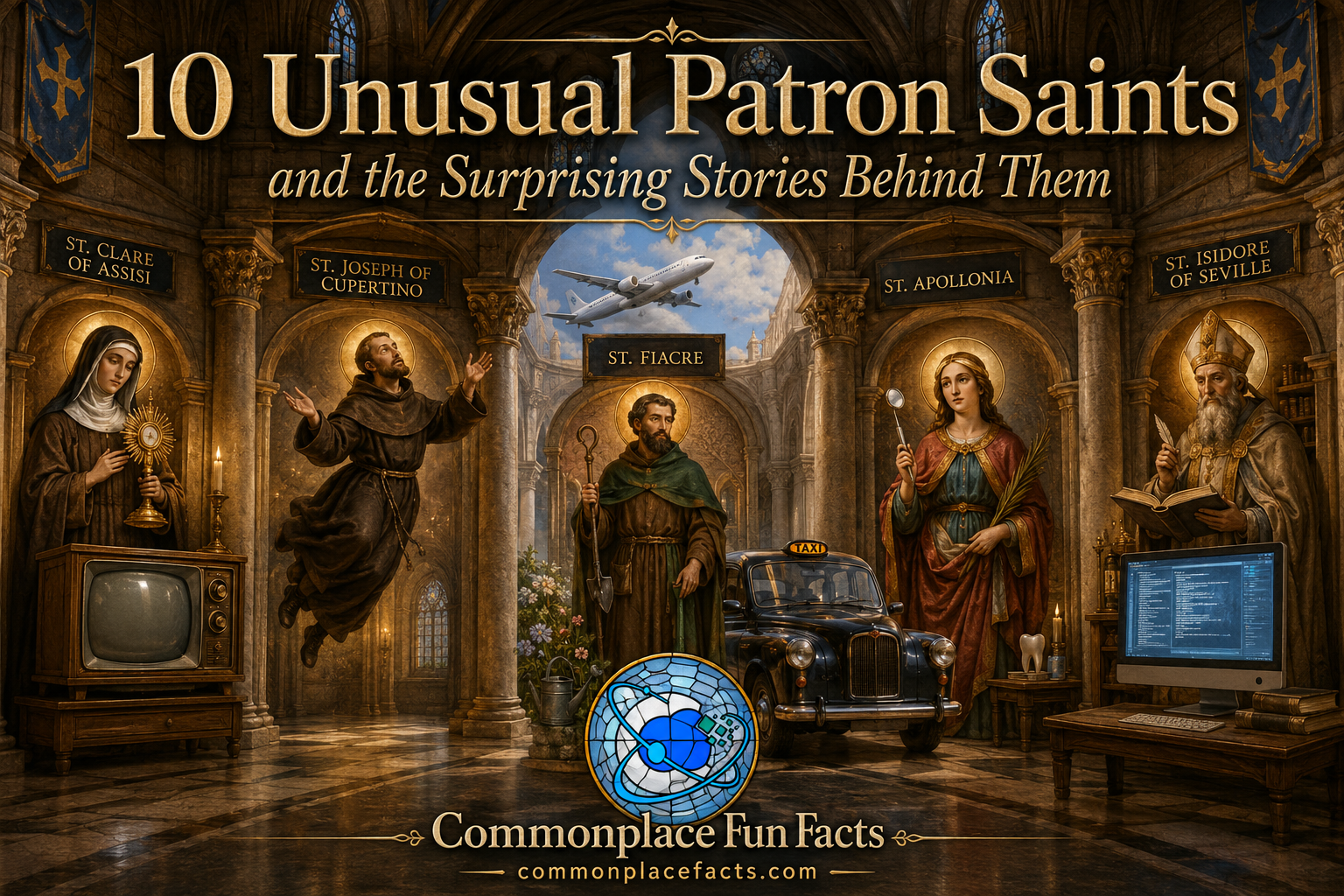

If you have a toothache, there is a patron saint for that. If you are about to board an airplane, there is a patron saint for that, too. Television viewers have one. So do actors, cooks, taxi drivers, advertisers, flight attendants, and ice skaters.
The Internet even has one, although, appropriately enough, the situation is a little less official than the Internet generally makes it sound.
Patron saints have been associated with occupations, illnesses, places, activities, and particular needs for centuries. Some of those connections are immediately obvious. St. Luke, traditionally identified as a physician, has long been associated with doctors. St. Joseph, a carpenter, is a patron of carpenters. St. Nicholas, whose legends include giving secret gifts to people in need, eventually became associated with children and gift-giving, with consequences that have kept shopping malls extremely busy every December.
Other associations require a bit more explanation.
Why, for example, is a 13th-century nun the patron saint of television? How did a 17th-century Franciscan friar end up looking after astronauts? Why would a saint who lived more than a thousand years before the invention of the automobile have anything to do with taxi drivers?
There are answers to all of these questions about unusual patron saints. And, generally speaking, the stranger the patronage sounds at first, the more interesting the story behind it turns out to be.
Contents
How Do Patron Saints Get Associated With Things?
Before proceeding, one distinction is worth making.
In Catholic belief, a patron saint is not a minor deity assigned administrative responsibility for a particular department of human affairs. Catholics ask saints for their prayers and intercession, much as they might ask another Christian to pray for them. Patronage reflects a special association between a saint and a place, occupation, circumstance, illness, or group of people.
And those associations did not all originate in the same way.
Some have been formally proclaimed by popes or other Church authorities. Many others developed over centuries through popular devotion. A saint might become associated with an occupation because he practiced it, with an illness because she suffered from it, or with a particular danger because some event in the saint’s life seemed especially relevant to people facing the same thing.
Sometimes the connection rests on a miracle or legend. Sometimes it comes from the manner of a martyr’s death. Sometimes it grows out of nothing more mysterious than wordplay.
Consequently, the history of patron saints is also a history of the things ordinary people have worried about, worked at, suffered from, and occasionally needed help getting through.
Which, several centuries later, can produce some wonderfully unexpected combinations.
1. St. Clare of Assisi: Patron Saint of Television
St. Clare of Assisi died in 1253.
Television, for those keeping track, arrived somewhat later.
Nevertheless, Clare is officially the patron saint of television, and the explanation comes from an event traditionally associated with the final years of her life.

Clare was one of the earliest followers of St. Francis of Assisi and founded the religious community that became known as the Poor Clares. During the last decades of her life, however, she suffered from serious illness and was frequently unable to leave her room.
According to tradition, on one Christmas Eve she was too sick to join the other sisters for Mass. As she lay in her cell, she was miraculously able to see and hear the service taking place some distance away, with the images appearing before her.
Several centuries later, humanity invented a device whose principal function was allowing people to sit in one place and watch something happening somewhere else.
The resemblance did not go unnoticed.
In 1958, Pope Pius XII formally proclaimed St. Clare the patroness of television. Pope Francis subsequently referred to her by that title as well.
It is one of the more striking examples of an ancient religious tradition finding an unexpectedly precise application to modern technology. Clare could not possibly have imagined television, but the story associated with her was suddenly describing something millions of people did every evening after dinner.
2. St. Joseph of Cupertino: Patron Saint of Pilots, Air Travelers, and Astronauts
St. Joseph of Cupertino lived from 1603 to 1663, which meant that powered flight was still more than two centuries away.

Joseph, however, reportedly did not always find this an obstacle.
A Conventual Franciscan friar and priest, Joseph became famous for entering states of intense religious ecstasy during which witnesses said he levitated from the ground. These reports were not merely later bits of folklore attached to his reputation. During the investigation preceding his canonization, testimony was collected concerning dozens of alleged incidents. Franciscan accounts note that 70 episodes of levitation were recorded.
Joseph himself did not seek attention because of these reported levitations. Quite the opposite. The crowds attracted by stories of them became disruptive, and his superiors sometimes restricted his public appearances. His life was marked considerably more by prayer, humility, and obedience than by any desire to become the 17th century’s answer to an air show.
But once human beings actually began flying, the association was fairly difficult to overlook.
St. Joseph of Cupertino became a patron of pilots and air travelers and, eventually, astronauts.
There cannot be many career paths that begin with caring for a monastery mule and eventually include responsibility for people traveling aboard spacecraft.
3. St. Bona of Pisa: Patron Saint of Flight Attendants and Tour Guides
If Joseph of Cupertino seems an understandable choice for people leaving the ground, St. Bona of Pisa has an equally interesting connection with the people helping them get where they are going.
Bona lived in the 12th and early 13th centuries and became known for making pilgrimages. She repeatedly traveled from Pisa to Santiago de Compostela in northwestern Spain, an enormous undertaking in an age when “frequent traveler” meant considerably more than remembering your rewards-program password.
She did not merely travel herself. Bona assisted and guided other pilgrims, helping people negotiate the physical and spiritual demands of long journeys.
Her association with travelers lasted long after her death. Then, in 1962, Pope John XXIII formally declared her the patron saint of flight attendants and tourist guides.
The technology changed. The basic job did not.
A medieval woman who helped travelers safely navigate hundreds of miles of unfamiliar territory became the patron of people who still spend their working lives assisting travelers—although the Camino de Santiago generally had fewer beverage carts and substantially more mud.
4. St. Fiacre: Patron Saint of Taxi Drivers
St. Fiacre provides perhaps the best example of a patronage acquired through a chain of events nobody could possibly have planned.
Fiacre was an Irish-born hermit who settled in what is now France, where he became associated with gardening, medicinal plants, and healing. That explains why he has long been a patron of gardeners.
The taxis take a little longer.
Centuries after Fiacre’s death, a Paris establishment called the Hôtel de Saint-Fiacre began renting horse-drawn carriages during the 17th century. The business apparently displayed an image of the saint, and the hired carriages became popularly known as fiacres.
The word stuck.
Fiacre became a general French term for a hired carriage, and the saint whose name happened to be attached to the original establishment eventually became associated with the people who drove them. When horse-drawn cabs gave way to motorized taxis, the patronage came along for the ride.
Thus an early medieval hermit became associated with taxi drivers because, roughly a thousand years after his lifetime, somebody opened a carriage-rental business bearing his name.
History does occasionally take the scenic route.
5. St. Apollonia: Patron Saint of Dentists and Toothaches
The connection between St. Apollonia and dentistry is much older and much more somber.
Apollonia was a Christian woman living in Alexandria during a period of violent persecution in the third century. The principal ancient account of her death comes indirectly through the historian Eusebius, who preserved a letter describing the persecution.
According to that account, Apollonia’s captors struck her and broke out her teeth before threatening to burn her alive unless she renounced her faith. She refused.
Because of what she endured, Christians later began invoking St. Apollonia particularly in cases involving tooth pain. She became associated with toothaches and eventually with dentists, dental hygienists, and other dental professionals.
This pattern appears repeatedly in the history of patron saints. A particularly painful experience in a saint’s life became a point of identification for later people facing a similar suffering.
To modern eyes, the connection may initially seem unexpected. Historically, however, it is quite direct: people with dental pain looked to someone remembered for having endured something far worse.
And if the thought of historical dental suffering has not already made you grateful for modern dentistry, we have previously examined an even stranger chapter in tooth-related medical history: the bizarre 19th-century reports of people whose teeth supposedly exploded. Compared with that, a patron saint of toothaches starts to seem almost reassuringly conventional.
6. St. Lawrence: Patron Saint of Cooks
St. Lawrence was a deacon of the Church in Rome who was martyred in the third century. He has been honored since antiquity, although many of the best-known details of his death come from later tradition rather than contemporary accounts.
According to that tradition, Lawrence was executed on a large iron gridiron over hot coals. It is an awful story, and Christian devotion has remembered it as part of his martyrdom. At the same time, it also produced one of the bleakest and most famous examples of saintly gallows humor.

The story says that, while being roasted, Lawrence told his executioners that he was done on one side and ought to be turned over. If that line is authentic, it is the sort of remark that could only qualify as humor under the worst possible circumstances. If it is legendary, it is still revealing, because it shows the way later Christians remembered Lawrence: brave enough, and composed enough, to answer cruelty with defiance so dry it could have come off the same grill.
That detail also explains one of his most surprising patronages. The gridiron became Lawrence’s principal symbol in Christian art, and from there he came to be associated with cooks.
This is one of the clearest examples of how patron-saint traditions could develop with a streak of very dark humor. No one is making light of martyrdom itself. Rather, the association seems to reflect the almost startling bluntness with which older Christian traditions sometimes handled suffering. Lawrence was remembered with a gridiron; cooks used gridirons; eventually the connection stuck.
So yes, St. Lawrence is the patron saint of cooks, which is the kind of fact that initially sounds bizarre until you realize that the explanation is both perfectly logical and just a little bit grim. History, as usual, was not especially worried about keeping things tonally tidy.
7. St. Bernardine of Siena: Patron Saint of Advertising and Public Relations
At first glance, a 15th-century Franciscan friar seems an unlikely choice for advertising and public relations.
Then you look at St. Bernardine of Siena’s career.

Bernardine was one of the most successful popular preachers of his age. He traveled throughout Italy speaking to enormous crowds and became particularly associated with devotion to the Holy Name of Jesus.
He also made extensive use of a striking visual symbol: the letters IHS, an ancient abbreviation for the name of Jesus. The monogram comes from the first three letters of Jesus’ name in Greek, ΙΗΣ, from ΙΗΣΟΥΣ (Iēsous). As the Greek abbreviation passed into Latin usage, those letters came to be represented as IHS. Bernardine did not invent the monogram, but he did an extraordinary job of making sure people recognized it.
Bernardine adopted the monogram as a centerpiece of his preaching, commonly displaying it within a radiant sunburst and urging people to place the emblem on homes, public buildings, and other prominent locations. In an age when rival families and political factions advertised their loyalties with coats of arms and other symbols, Bernardine encouraged people to rally instead around the name of Jesus. The result was something remarkably close to a highly successful visual identity campaign: a simple, memorable emblem, repeated consistently, that became instantly recognizable across much of Italy.
In modern terminology, Bernardine understood the power of a memorable message, a recognizable symbol, and consistent communication to a large audience.
That is not to reduce his ministry to a marketing campaign. His preaching addressed repentance, reconciliation, morality, peace, and religious devotion. But the skills required to communicate those ideas effectively were extraordinary, and later generations saw an obvious connection.
St. Bernardine became a patron of advertising, public relations, and public speaking.
He therefore managed, several centuries before anyone invented the phrase “brand identity,” to demonstrate why people in that business might want him on their side.
8. St. Genesius of Rome: Patron Saint of Actors and Comedians
The story of St. Genesius is one of those accounts that should be approached with two statements held simultaneously in mind: devotion to him is ancient, while the detailed story of his life is legendary and historically difficult to verify.
According to that tradition, Genesius was an actor in Rome during the reign of the emperor Diocletian. He participated in a theatrical performance intended to mock Christianity, including a parody of Christian baptism.
Something unexpected happened during the performance.
Genesius reportedly underwent a genuine conversion while portraying the sacrament he was supposed to ridicule. Instead of continuing the mockery, he declared his Christian faith before the emperor. He refused to renounce it and was subsequently executed.
Whatever can ultimately be established about the details, veneration of Genesius in Rome is very old, and he became particularly associated with actors and theatrical performers. He is also traditionally regarded as a patron of comedians.
There is something fitting about that association that goes beyond the obvious theatrical connection. His story, as Christians preserved it, is about the strange power of playing a role seriously enough to encounter something real within it.
9. St. Lidwina of Schiedam: Patron Saint of Ice Skaters
St. Lidwina lived in the Dutch town of Schiedam during the late Middle Ages. At about age 15, she went skating with friends.
She fell on the ice and was badly injured.
The accident changed the course of her life. Lidwina developed severe health problems and spent decades largely confined to bed. Her long experience of suffering became central to her spiritual life, and she eventually became known for her religious devotion and mystical experiences.
She was canonized in 1890 and is traditionally regarded as a patron saint of people suffering from chronic illness.
She is also a patron saint of ice skaters.
Here again, the association is not meant to make light of what happened to her. It reflects an old pattern in popular devotion: the defining circumstances of a saint’s life become the place where later generations feel a particular connection.
In Lidwina’s case, one afternoon on the ice set in motion everything that followed.
It is perhaps the most literal patronage on this list.
10. St. Isidore of Seville: The Unofficial Patron Saint of the Internet
Of all the surprising patron saints associated with modern technology, St. Isidore of Seville may be the one most frequently described with more confidence than the historical record permits.

You will routinely read that Isidore is the patron saint of the Internet.
Almost.
Isidore was a sixth- and seventh-century bishop and scholar whose greatest work, the Etymologiae, attempted to gather and organize an enormous body of existing knowledge. Its 20 books covered subjects ranging from language and mathematics to medicine, animals, agriculture, geography, buildings, law, and religion.
For centuries, it was one of medieval Europe’s most important reference works.
It is not difficult to see why people living in the information age looked at a man who tried to organize the accumulated knowledge of his civilization into an accessible system and thought, “We have a job for you.”
Beginning in the late 20th century, Catholic groups proposed Isidore as a patron saint for Internet users and computer workers. The association became so widespread that it is now frequently reported as an established fact.
There is, however, an important qualification: despite repeated claims that Pope John Paul II formally named Isidore patron saint of the Internet, Vatican News itself notes that an official proclamation is lacking. Isidore was proposed for the role during John Paul II’s pontificate, and the association has become widespread, but his Internet patronage is therefore better described as unofficial or popularly recognized.
Which means that one of the Internet’s favorite facts about the patron saint of the Internet has been repeatedly copied online without anyone being quite certain where it came from.
There may be no more appropriate ending to this story.
And Then There Is St. Gertrude, the Patron Saint of Cats—Sort Of
St. Gertrude of Nivelles deserves an honorable mention because her story illustrates how patronage can continue developing even in modern times.
Gertrude was a seventh-century abbess whose traditional associations included travelers, gardeners, and protection against rats and mice. Artistic representations dating back to the Middle Ages sometimes depict rodents around her feet or running up the staff of her crozier.
Today she is widely called the patron saint of cats.
The problem is that historians have found surprisingly little evidence for any old tradition connecting her with cats at all.
The feline association appears to be quite recent. Researchers have traced one of the earliest prominent English-language references to a 1981 Metropolitan Museum of Art publication that simply identified Gertrude as the patroness of cats. From there, the idea spread.
There is an understandable logic to it. Gertrude was associated with protection from mice and rats. Cats are famously associated with dealing with mice and rats. Somewhere along the line, the two ideas met.
That does not make modern devotion to Gertrude by cat lovers somehow invalid. Popular devotion has always played a role in the development of patronage. It simply means the history may be much newer than people assume.
Not every medieval tradition, it turns out, actually comes from the Middle Ages.
Gertrude’s connection with cats may be much newer than people assume, but cats themselves have a very long history of being recruited for practical mouse control. We have previously looked at one especially bureaucratic example: Britain’s Post Office cats, the officially employed mousers who quite literally ended up on the government payroll. Even saints, apparently, were not the only ones to discover that cats could acquire surprisingly formal job descriptions.
Why Unusual Patron Saints Aren’t Really That Unusual
Look at these associations long enough and they stop seeming quite so strange.
St. Clare is connected with television because of a centuries-old story about seeing an event from far away. St. Joseph of Cupertino became associated with aviation because of reports that he levitated. St. Bona spent her life helping travelers. St. Fiacre became linked to taxi drivers through the accidental history of a Paris carriage business. St. Apollonia’s suffering made her especially meaningful to people enduring dental pain.
None of these patronages arose because somebody decided heaven needed a Department of Television, a Bureau of Dentistry, and an Office of Taxi Regulation.
They arose because people looked at the lives of saints and recognized something familiar.
That is arguably the most interesting thing about the entire tradition.
Technology changes. Occupations appear and disappear. Horse-drawn carriages become taxis. Pilgrims become airline passengers. An encyclopedic manuscript becomes an obvious symbol for the Internet. A mystical vision described in the Middle Ages suddenly sounds remarkably like television.
But the basic impulse remains the same: people search the past for someone whose experience speaks to what they are experiencing now.
Sometimes the connection is profound. Sometimes it takes several centuries to become apparent. And sometimes it requires a medieval hermit, a Paris hotel, a fleet of horse-drawn carriages, the invention of the automobile, and a fairly generous understanding of historical continuity.
History has never been particularly concerned about taking the shortest route.
You may also enjoy…

The Real Sword in the Stone: How St. Galgano Went From Raucous Rogue to Saintly Sword Planter
Discover the true story of St. Galgano Guidotti, the knight who planted his sword in the stone as a symbol of peace and devotion. Explore his remarkable transformation, the Tuscan hermitage, and the history behind this real-life legend.

Melting and Circulating the Saints
One of the challenges faced by Oliver Cromwell (1599-1658) during his tenure as Lord Protector of England, Scotland, and Ireland was a severe shortage of silver. Without the precious metal, the nation ran into the prospect of being unable to make coins. Cromwell ordered his advisors to scour the country, looking for any source of…

Cadaver Synod: When a Dead Pope Was Put on Trial
Discover the bizarre historical trial known as the Cadaver Synod, where Pope Formosus was exhumed and tried posthumously in a surreal twist of Vatican history.






Leave a Reply