
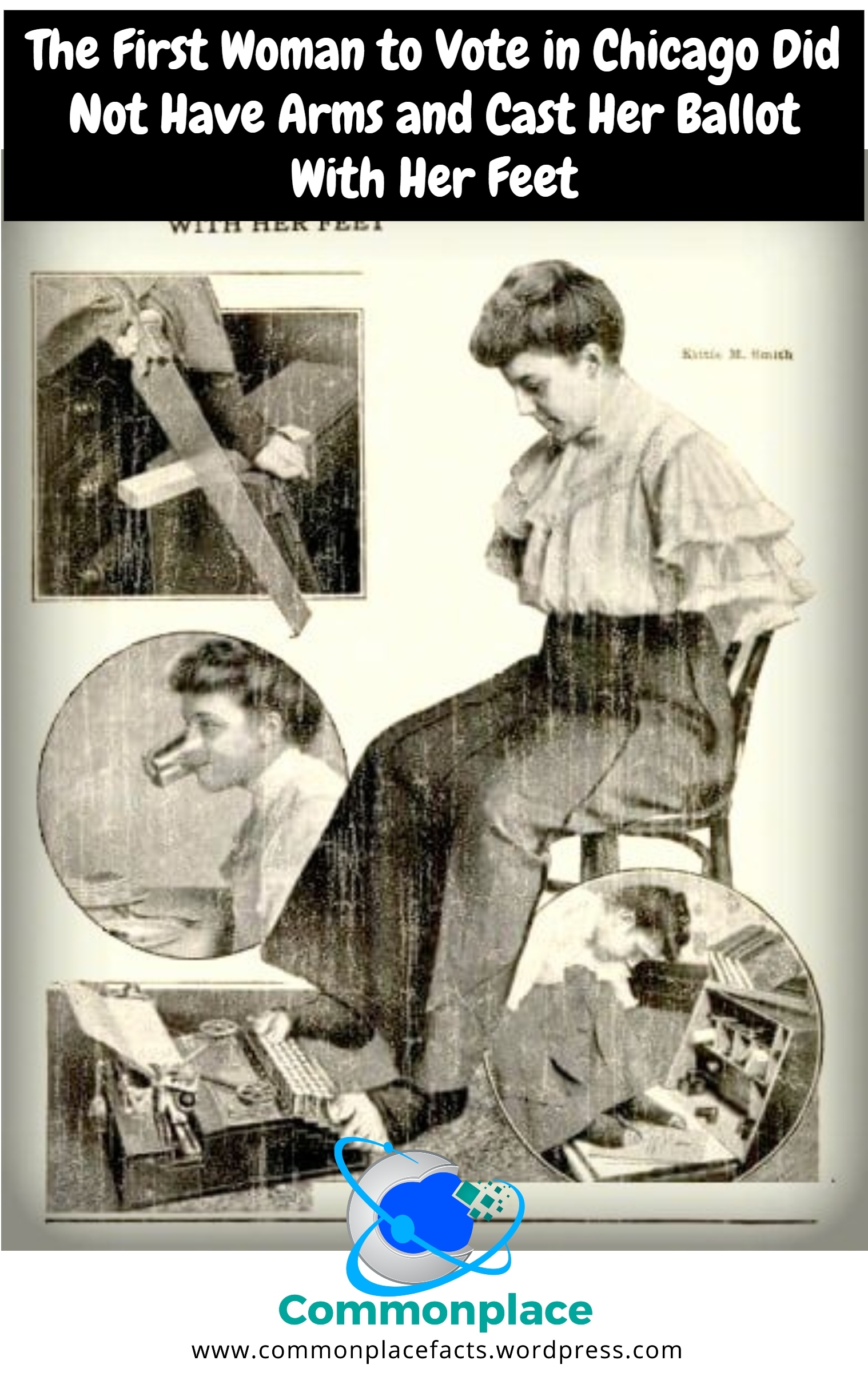

By just about every standard of society, no one should have heard about Kathryn M.R. Smith (1882-1967). Horribly disfigured at the hands of an abusive alcoholic father, the girl who went by the name Kittie wasn’t necessarily lucky to even be alive. One of her neighbors was heard to say that she would be better off dead than to survive and face the impossible life ahead of her. Despite all of this, Kittie did not just survive. She thrived and blazed a trail of accomplishments few could hope to match.
Kittie was ten years old when she lost both of her arms. She sustained life-threatening injuries when her abusive father, in a drunken fit of uncontrolled rage, held the little girl against the kitchen stove. Upon hearing the news of the tragedy, one of the neighbors said Kittie “would have been better off had she died than to be so afflicted with her father, baby sister, and two little brothers to housekeep for.”
Kittie never blamed her father for her injuries. Her father was placed on trial but was acquitted for lack of evidence. Her mother died a year before the incident, and Kittie was placed in foster care while her father’s legal fate was being decided. Shortly thereafter, he waived all parental rights, leaving Kittie as a ward of the state.
The next few years saw the young girl move from home to home, often spending only a few weeks at a time in one place. She would not allow anyone to feel sorry for her, however. She certainly did not take time to pity herself.

Despite everything that was stacked against her, Kittie made up her mind that she would make something of her life. She might not have arms, but she did not see that as any reason why she could not be productive. As long as she had two perfectly good feet, she reasoned she could get along just fine.

During her time in foster homes, Kittie worked hard at learning how to use her feet as replacements for her hands. She learned to brush her teeth, comb her hair, sweep the floor, and cook. These skills were remarkable enough, but they were just the beginning. Kittie also became quite accomplished at playing the piano, typing, woodworking, embroidery, writing, and drawing.

Kittie’s optimism and determination were so inspirational that she was encouraged to write her story to share it more broadly. She printed her story in a booklet, accompanied by a card with a slot for a quarter. Anyone who was so moved could use that card to send a donation to her. By 1906, Kitty had amassed some $35,000 ($997,000 in 2020 valuation) in quarters from a sympathetic public. She employed a manager, bookkeeper, stenographer, office boy, and eleven envelope stuffers. Known as “The Armless Wonder,” Kittie devoted her life to helping those with disabilities to rise above their circumstances.
There is one additional noteworthy item in Kittie Smith’s biography. Although women would not receive the right to vote throughout the United States until 1920, some localities permitted the practice sooner. In 1913, Chicago opened city elections to women voters. The first woman to cast a ballot in the city was none other than Kittie Smith. Incidentally, she voted with her feet.

The Little Man from Nuremberg
Matthew Buchinger (1674-1740) was known as “The Little Man of Nuremberg.” Buchinger was born without hands, legs, or thighs and was less than 29 inches tall. Despite his disabilities, Buchinger led a very accomplished life. He could play a half-dozen musical instruments including the bagpipes, dulcimer, hautboy, trumpet, and flute, some of which he invented…

The Practical Joke that Resulted in the First Woman Mayor
When Susana Salter’s name appeared on the ballot on April 4, 1887, it was all supposed to be a late April Fools Day gag. As it turned out, the joke was on those who pulled the prank when she won the election and became the first woman elected as mayor in the United States. The…

What if the President Goes Stark-Raving Mad? Presidential Succession Due to Disability
UPDATED November 19, 2021 An earlier post answered the question about what would happen if something happens to a presidential candidate during the election process. There, we discussed all kinds of scenarios, ranging from the time prior to the party conventions, all the way up to a death after the candidate takes office. Left unanswered…







Leave a Reply to BarbaraCancel reply