
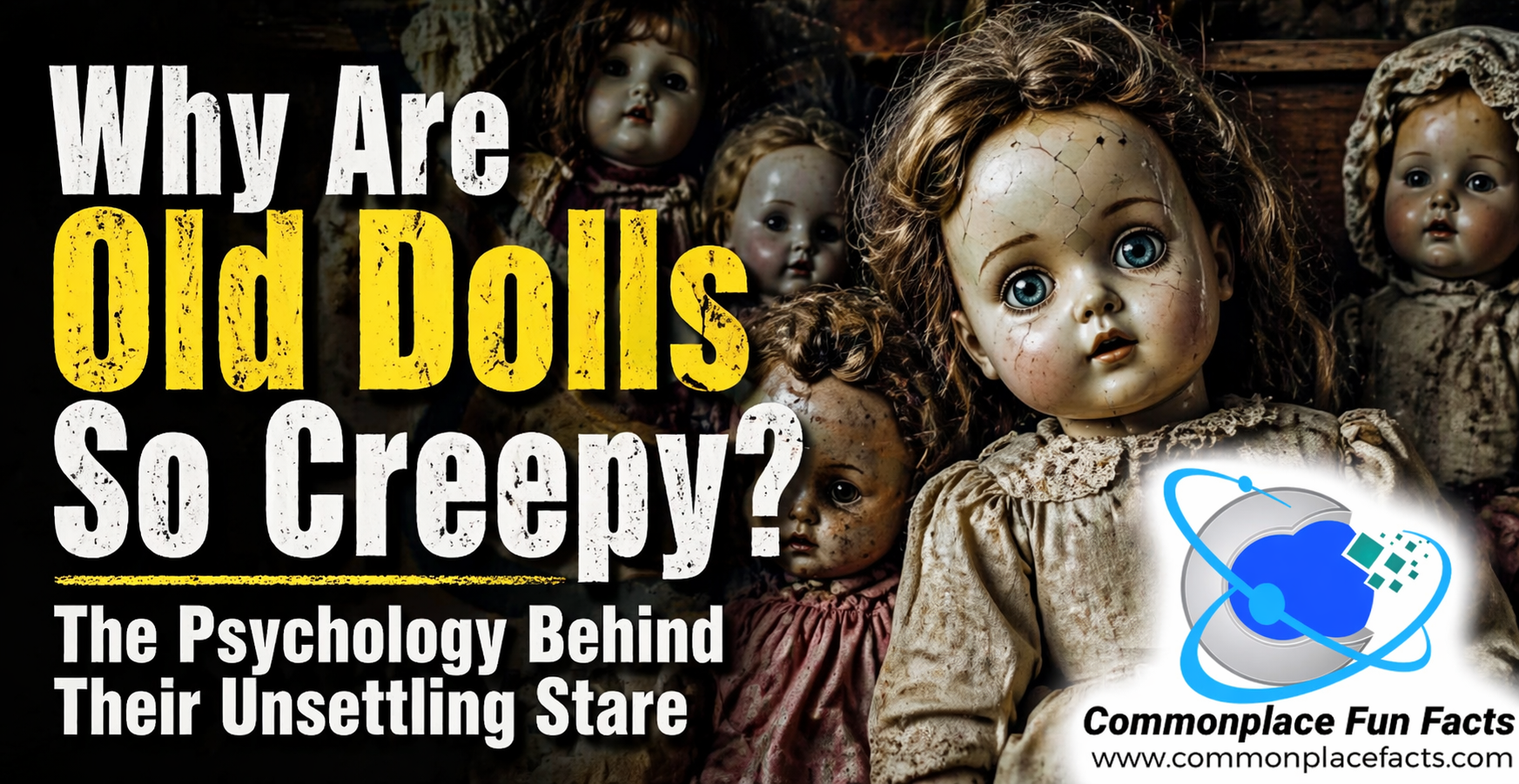

There are certain objects in life that inspire immediate and universal mistrust. A clown standing silently in a doorway is one. A tax form marked “simple” is another. An old doll with cracked cheeks, glassy eyes, and the facial expression of someone who has seen the end of civilization is very much on that list.
Modern dolls can be unsettling enough—thanks to the price tags and the occasional retail-induced mob scene (looking at you, Cabbage Patch Kids). Old dolls, however, operate on a completely different level. They do not merely sit on shelves. They loom. They do not merely have faces. They appear to have judgments. They do not merely exist in antique shops. They wait there, as though they have been expecting you, and they’re prepared to make you pay for keeping them waiting.
Everyone knows the feeling. You walk through a museum, an old house, or a vintage store, turn a corner, and there it is: a porcelain child from 1893 staring into the middle distance like it is about to convey bad news from the spirit world. Rationally, you know it is just an old toy. Emotionally, your brain has already taken a step back and regretted not bringing a flask of holy water with you.
Why is that? Why do old dolls seem so much creepier than almost any other antique toy? Why can an old teddy bear look charming and nostalgic while an old doll looks like it may know where the bodies are buried—or that it was the one who buried the bodies in the first place?
The answer lies in psychology, human perception, aging materials, cultural conditioning, and humanity’s long, uneven history of trying to make tiny artificial people without accidentally creating nightmare fuel.
Contents
Creepy Dolls Look Human, but Not Quite Human Enough
The biggest reason old dolls feel creepy is that they occupy the deeply uncomfortable space between “obviously not real” and “disturbingly person-like” — much like Steve Buscemi. They resemble human beings just enough to activate our social instincts, but not enough to satisfy them.

Humans are extraordinarily good at reading faces. We notice tiny changes in expression, slight movements in the eyes, and subtle differences in skin, symmetry, and posture. Our brains are built to process other people with ridiculous sensitivity. This is useful when dealing with actual human beings. It triggers other responses when the thing in front of us is a three-foot-tall porcelain toddler with a thousand-yard stare.
Long before robotics engineers gave us charts and terminology, nineteenth-century thinkers like Sigmund Freud were already circling the same idea: the moment something familiar becomes just slightly wrong, your brain files a formal complaint.
This is where the famous idea of the uncanny valley comes in. When something is very clearly non-human, such as a cartoon character or a stuffed rabbit, we usually have no problem with it. When something looks convincingly human, that can also be fine. Trouble begins in the middle ground. The more something resembles a person without quite pulling it off, the more likely it is to feel eerie. Read “The Uncanny Valley: Why Almost-Human Robots and CGI Characters Creep Us Out” for more about this phenomenon.
Old dolls live in that middle ground like they signed a lease there.
The face is the main culprit. The proportions are often close enough to human to register as a person, but off enough to feel wrong. The eyes are too fixed. The cheeks are too smooth or too cracked. The mouth has the rigid little pursed expression of someone who disapproves of your table manners and perhaps your entire bloodline. Everything is near-human, but it misses by millimeters. Psychologically, that is worse than missing by a mile.
The Eyes Are Doing Most of the Work
If we are being honest, the eyes deserve their own section because they are carrying the whole haunting operation.

Old dolls often have glass eyes, painted eyes, or eyes that were designed to look soulful and childlike when new. Time has not always been kind to that ambition. Over the decades, materials cloud, discolor, crack, and shift. A pleasant nineteenth-century attempt at innocence can age into something that looks like it has not blinked since the McKinley administration.
Human beings care intensely about eyes. We look to them for emotion, attention, intention, and life itself. Are the eyes tracking us? Are they engaged? Are they empty? Are they just a little too shiny? These are questions our brains ask automatically. When the answers come back in the form of a blank fixed gaze that seems aware without actually being alive, the result is discomfort.
It is difficult to overstate how much of creepiness comes down to a stare that does not behave like a real stare. A doll’s eyes may appear focused but are not actually looking at anything. They may catch the light in a way that makes them seem wet or animate. They may appear to follow you, which is usually just an optical effect and not, despite what every horror movie has taught us, evidence that the doll has selected you for unspecified consequences.
Frozen Expressions Are Weird, and We All Know It
Another problem is that dolls often have faces that imply emotion without actually expressing it. This puts the brain in an irritating little interpretive crisis.
When you look at a real person, even a still one, their face contains micro-expressions, muscle tension, warmth, asymmetry, and subtle variation. A doll has none of that. Its expression is permanent. It is locked into one small smile, one neutral look, or one faintly solemn expression forever—much like that grade school teacher who you were sure was an extraterrestrial.
That would be strange enough on its own, but creepy old dolls add the bonus feature of age-related distortion. A tiny painted smile can fade into something crooked or ambiguous. Cracks in the face can alter the apparent emotion. Wear and discoloration can make the doll look tired, sick, angry, or spiritually inconvenienced.
This matters because people are deeply uncomfortable with ambiguity in faces. We want to know what someone is feeling. We want to know whether the thing in front of us is friendly, neutral, sad, or threatening. A doll offers none of those answers clearly. It simply sits there radiating uncertainty.
Fear is straightforward. Disgust is straightforward. Creepy sits in the middle, where your brain is still trying to decide whether to run, stare, or slowly back out of the room.
Old Materials Age in the Creepiest Ways Possible
Part of the problem is not the original design of old dolls, but what time does to them. Antique dolls were made from wax, bisque, porcelain, wood, cloth, composition, and early plastics, among other materials. Many of these age badly in aesthetic terms, even when they remain historically fascinating.

Wax can crack, slump, or discolor. Composition can craze and chip. Paint can fade unevenly. Cloth bodies can sag. Hair can frizz or thin out into what can only be described as “haunted taxidermy adjacent.” The result is an object that was meant to imitate youth and vitality but now bears all the marks of age, wear, and decay.
This creates a particularly effective form of discomfort because the doll is associated with childhood, innocence, and domestic warmth, while its physical condition suggests damage, stagnation, and time gone wrong. In other words, it was designed to represent life and ends up looking like a tiny monument to entropy.
There is also the simple fact that old doll materials often produce uncanny textures. Skin that was once meant to look soft now looks brittle. Hair that was meant to look natural now resembles the remains of a very bad wig incident. Glass and glaze catch light in ways that make surfaces seem too hard, too cold, or too lifeless. Nothing about this helps.
Childhood and Creepiness Make an Unsettling Combination
There is something especially unnerving about anything associated with children becoming eerie. Toys are supposed to be safe. They are supposed to be playful, comforting, and benign. When an object from that category instead inspires dread, the contrast makes it even more disturbing.
An old shovel is not creepy. It is just old. An old chair is not creepy unless someone works very hard at making it so. An old doll, on the other hand, begins with the expectation of innocence and then swerves straight into “for reasons unclear, this object has become spiritually hostile.”
That mismatch matters. Our brains dislike category violations. A thing that should be warm and familiar but instead feels eerie is more unsettling than a thing that was already ominous to begin with. Nobody is shocked when a medieval torture device seems alarming. That is simply good branding. A child’s doll, however, is not supposed to feel like an accessory in a séance gone wrong.
They Suggest a Human Presence Without Delivering One
Dolls are, fundamentally, stand-ins for people. That is their whole deal. They are miniature humans meant to be dressed, carried, spoken to, and woven into imaginative life. Because of that, they imply social presence. They feel as though they should contain a person, or at least a personality.
A doll looks like a person but is missing the one feature we rely on most: emotion. It’s a face without feedback—a social interaction with no one on the other end of the line.
Of course, they do not. They are objects. But our brains do not always process them that way at first glance.
This creates a weird tension. A doll looks like something with agency, but has none. It resembles a social being, but offers no social feedback. It has a face, but not awareness. It has a body, but not movement. It hints at life while being entirely inert.
That gap between implied aliveness and obvious lifelessness is deeply uncomfortable. It is a reminder of how little it takes to trigger our instinct to perceive minds where none exist. This is the same species that names cars, apologizes to coffee tables after bumping into them, and occasionally feels guilty about ignoring a robot vacuum. We are not a hard audience to fool. Old dolls simply hit the exact wrong combination of cues.
Then Popular Culture Arrived to Make Everything Worse
Even if antique dolls were only mildly unsettling on their own, popular culture has spent generations turning them into ambassadors of dread.
Haunted doll stories have been around for a long time. Early creepy doll stories weren’t about murderous toys. They were about something arguably worse: someone had made the doll too convincing. We may think of Pinocchio as a children’s story, but the original version was absolute fuel for nightmares. In other words, the problem wasn’t that the doll was alive. It was that it looked like it might be. Ghost tales, spiritualist lore, and folklore about objects retaining emotions or spirits gave dolls an early head start in the creepiness department. After all, if you were inventing a haunted object from scratch, a human-shaped figure with blank eyes and a child-sized body would be hard to beat.
Then movies and television entered the chat and behaved exactly as expected.
Horror has had a wonderful time with dolls. Possessed dolls, cursed dolls, murderous dolls, dolls that move when no one is looking, dolls found in attics, dolls found in abandoned orphanages, dolls found in antique stores by characters who should really know better by now. The message has been delivered with admirable consistency: if there is an old doll in the room, something terrible is either happening or is about to happen after the soundtrack shifts into violins.
This cultural baggage changes how we see real dolls. You do not approach an antique porcelain doll as a blank slate. You approach it with decades of learned suspicion. Your brain has absorbed the visual language of horror. Dim lighting, cracked faces, antique clothing, fixed smiles, nursery settings, and silence all mean one thing now: leave. Quietly, if possible.
In fairness, old dolls did not ask for this reputation. But they have worn it almost too well.
Victorian Taste Was Not Especially Helpful
It must also be said that some historical doll aesthetics were, by modern standards, a bit intense.
Nineteenth-century and early twentieth-century dolls were often made to look highly detailed and realistic, because realism was the point. They were not meant to be broad, cheerful cartoons. They were intended to resemble actual children, complete with carefully modeled features, elaborate clothing, and serious expressions. At the time, this could be considered beautiful, refined, or educational.
Dolls from earlier periods, by contrast, made no serious attempt at lifelikeness. They were plainly toy figurines—far enough removed from reality that they never set off anyone’s spider sense.
Seen today, in a world raised on softer toy designs and less funereal ideas of childhood portraiture, some of these dolls can feel startlingly severe. Many old photographs of children already look unintentionally eerie to modern viewers because nobody is smiling, mothers are hidden behind upholstery, and everyone appears to be contemplating mortality. Dolls from the same eras carry some of that same visual energy.
What was once realism now reads as solemnity, and what was once delicacy now reads as menace. Fashion changes. So does the threshold at which a bonnet stops looking adorable and starts looking like a warning.
Motion Would Somehow Be Worse
One might assume the problem with old dolls is that they sit there doing absolutely nothing. History suggests the opposite. The moment someone decides a doll should do something, the situation deteriorates rapidly.

Inventors have been trying to bring dolls to life for centuries, and the results have been… memorable in the way that food poisoning is memorable. Mechanical dolls could blink, nod, or shuffle forward with all the grace of a sleepwalking furniture piece. The movements were never quite smooth, never quite natural, and always just off enough to make you wish you had asked Santa for a sled, instead.
Then came the truly ambitious idea: what if the doll could speak?
This is where things took a hard turn into “absolutely not,” courtesy of Thomas Edison’s talking phonograph dolls. In 1890, Edison’s team installed miniature phonographs inside porcelain dolls so they could recite nursery rhymes. On paper, this sounded delightful. In practice, it sounded like a Victorian ghost attempting to communicate through a malfunctioning gramophone.
The recordings were scratchy, distorted, and delivered in voices that seemed to emerge from somewhere deep within the doll’s torso. Even at the time, people found them unsettling. Modern listeners, who have had the benefit of a century of audio improvement and horror films, tend to find them even worse.
And this is the key point: motion and sound don’t fix the uncanny valley problem—they amplify it. A doll that sits still is at least consistent. A doll that moves or speaks introduces expectations it cannot meet. The timing is off. The voice is wrong. The movement lacks intention. Everything feels almost human, but not quite, which is precisely the problem.
A doll that closes its eyes when laid down sounds charming until one eye hesitates, as though checking to see if you are paying attention. A doll that speaks sounds delightful until the voice arrives a fraction of a second too late, like it had to travel through the ether of a demonic realm before reaching your ears. At that point, the issue is no longer whether the doll is realistic. The issue is that it is trying.
It turns out that the fastest way to make something unsettling is not to make it alive, but to make it almost alive—and then give it just enough motion to prove the point.
The Creepy Reaction Is Not Irrational
It is easy to laugh at the fear of dolls, and to be fair, it is often funny. But the reaction itself is not absurd. It grows out of normal human perception.

We are wired to detect faces, infer minds, evaluate expressions, and notice abnormalities. We are especially alert to things that seem almost human but violate just enough of our expectations to feel wrong. Add the effects of age, damage, stillness, cultural storytelling, and the eerie atmosphere of antique environments, and old dolls become nearly perfect discomfort machines.
That does not mean every old doll is terrifying. Some are genuinely charming. Some are fascinating works of craftsmanship. Some are important historical artifacts that tell us a great deal about childhood, design, class, fashion, and domestic life in the past.
It does mean, however, that many of them have accidentally become experts at making modern people extremely uneasy.
The Final Verdict from the Department of Absolutely Not
So why are old dolls so creepy?
Because they look enough like people to trigger our social instincts, but not enough like real people to satisfy them. Because their eyes stare without seeing. Because their expressions freeze halfway into emotions they can no longer explain. Because age turns lifelike materials into cracked masks and glossy, unnatural surfaces. Because culture has taught us that if an old doll appears at the end of a dark hallway, matters are unlikely to improve.
Most of all, they are creepy because they sit at the intersection of childhood, human likeness, and decay, which is not a cheerful intersection under any circumstances.
The same instinct that makes us uneasy also keeps us looking. We don’t just fear creepy things—we lean in slightly, just to see what happens next. Which is how antique stores stay in business.
An old rocking horse is nostalgic. An old tin train is charming. An old doll, especially one with chipped porcelain and faded clothes, feels like it knows a family secret that died in 1912 and is in no hurry to share it.
That may not be fair to the doll. But fairness left the room the moment it started staring.
And to be fair, so did we.
You may also enjoy…

The Uncanny Valley: Why Almost-Human Robots and CGI Characters Creep Us Out
Why do nearly human-like robots and CGI characters unsettle us? Explore the science behind the Uncanny Valley and why our brains reject near-human figures.

Learn About the Creepy Phonograph Dolls That Became One of Thomas Edison’s Greatest Failures
Thomas Edison’s Phonograph Dolls, patented in 1891, aimed to blend a phonograph with a child’s toy but became a failure due to high costs, technological issues, and unsettling aesthetics. While initially promising, the dolls were withdrawn from the market shortly after their release, marking a notable disappointment in Edison’s career.

Cabbage Patch Kids and Beanie Babies: the Great Toy Crazes of the 80s and 90s
Discover the wild history of Cabbage Patch Kids and Beanie Babies—two toy crazes that sparked riots, fueled speculation, and turned plush toys into prized investments in the 1980s and 1990s.






Leave a Reply