
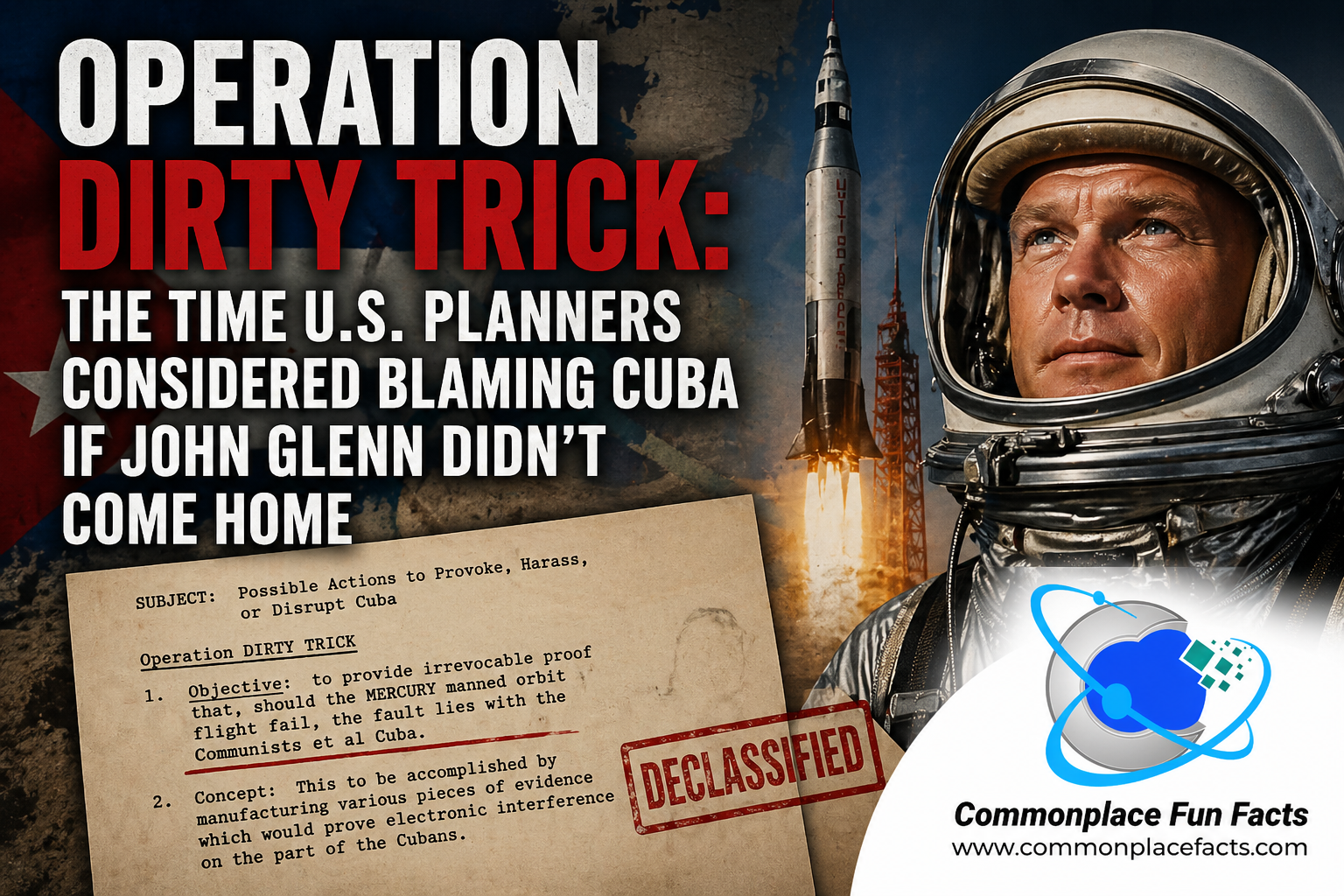

On February 20, 1962, John Glenn climbed into a tiny spacecraft called Friendship 7, was launched into orbit atop a converted missile, circled the Earth three times, and returned home as an American hero.
This is the version of the story we quite properly remember: brave astronaut, nervous nation, roaring rocket, dramatic reentry, splashdown, ticker-tape parade, and the general national feeling that maybe America was not going to lose the Space Race after all.
What we do not usually include in the school-pageant version is the part where, eighteen days before Glenn’s flight, someone in the U.S. national security apparatus wrote down a helpful little suggestion: if the Mercury orbital mission failed, the United States could manufacture evidence blaming Cuba.
Welcome to Operation Dirty Trick. Spoiler alert: when your own planners call something “Operation Dirty Trick,” you have already skipped past the part where history gives you the benefit of the doubt.
Table of Contents
The Claim: Too Wild to Be True, Except Unfortunately Not
The claim goes something like this: in 1997, declassified documents revealed that U.S. intelligence or military planners had considered blaming Cuba if John Glenn failed to return successfully from his space mission. The accusation would have been that Cuban radio or electronic interference caused the failure.

This sounds like something assembled in a basement laboratory from equal parts conspiracy theory, Cold War paranoia, and a copy of Dr. Strangelove left too close to a space heater.
Yet the basic claim is real.
The proposal was called Operation Dirty Trick. It appeared in a February 2, 1962 memorandum titled “Possible Actions to Provoke, Harass, or Disrupt Cuba”. The document was part of the files later released through the JFK assassination records review process and is now available through the National Archives.
Operation Dirty Trick was not a fully executed government program. It was not something that happened. It was not proof that John Glenn’s mission was sabotaged, threatened, or secretly manipulated by anyone. Let us keep the tin foil in the pantry where it belongs.
What it was, however, is disturbing enough: a written proposal to create fake evidence blaming Cuba if the Mercury orbital flight failed.
First, the Space Hero Part
To understand why this mattered, we need to remember the moment.
By early 1962, the United States was still smarting from a very public case of space-envy. The Soviet Union had launched Sputnik in 1957, sending Americans into a nationwide panic that combined national security anxiety, educational reform, and the sudden realization that maybe little Timmy should stop eating paste and learn algebra.
In one of the more audacious Cold War escapades, the CIA quite literally “borrowed” a Soviet spacecraft from a traveling exhibit, secretly dismantled it overnight, photographed everything, and then carefully put it back together before anyone noticed. If you would like the full story—which reads like a mashup of Ocean’s Eleven and a NASA engineering manual—you can find it here: The Great Lunik Heist: That Time the CIA Kidnapped a Soviet Spacecraft.
Then, in April 1961, Soviet cosmonaut Yuri Gagarin became the first human being to orbit Earth. The United States had managed suborbital flights by Alan Shepard and Gus Grissom, which were impressive, dangerous, and historically important. Still, from the standpoint of national prestige, they had the awkward quality of answering “the Soviets orbited the planet” with “we briefly went up and came back down.” It was not nothing, but it was not exactly a cosmic mic drop.
John Glenn’s Mercury-Atlas 6 mission was supposed to change that.
Glenn was already the sort of person biography writers love because he made their job easier. Marine pilot. Combat veteran. Test pilot. Congressional-looking haircut before he was ever in Congress. He had the square-jawed, straight-backed, “yes ma’am, no sir” public persona that made Americans feel as though space exploration had been entrusted to a man who would return the capsule washed and with a full tank of gas.
On February 20, 1962, Glenn became the first American to orbit Earth. His spacecraft, Friendship 7, circled the planet three times before splashing down safely in the Atlantic. NASA rightly remembers the mission as one of the defining achievements of Project Mercury and a turning point in America’s early space program.
It was also more dangerous than the celebratory newsreels made it look.
The Heat Shield Scare
During Glenn’s flight, mission controllers received an indication that the spacecraft’s landing bag had deployed prematurely. That raised a terrifying possibility: the capsule’s heat shield might be loose.
This was not a minor dashboard warning light of the “check engine sometime before Thanksgiving” variety. The heat shield was the thing standing between John Glenn and extreme reentry temperatures.
NASA decided to keep the retrorocket package attached during reentry, hoping the straps might help hold the heat shield in place if there really was a problem. Glenn was not immediately told the full reason. From the ground, the instruction sounded technical. In reality, it had the same energy as a doctor studying your chart, pausing just a beat too long, and then assuring you, “Nothing to worry about.”
As it turned out, the warning was false. The heat shield was secure. Glenn survived reentry, splashed down safely, and became a national icon.
But the people who wrote Operation Dirty Trick did not know that would happen. They were writing before the flight. They were imagining the possibility of failure. And, being Cold War planners, they did not merely ask, “How do we mourn a national tragedy?” They asked, “How do we weaponize it?”
Enter Operation Mongoose, Because the Name Was Somehow Not the Weird Part
Operation Dirty Trick was part of the broader anti-Castro campaign known as Operation Mongoose.
After Fidel Castro came to power in Cuba in 1959, U.S.-Cuban relations deteriorated with impressive speed. Cuba nationalized American-owned property, moved closer to the Soviet Union, and became a communist government ninety miles from Florida. To American policymakers in the Cold War, this was less “regional diplomatic challenge” and more “someone left a Soviet bear trap on our front porch.”
The Bay of Pigs invasion in April 1961 was supposed to solve the problem by supporting Cuban exiles in an attempt to overthrow Castro. Instead, it became one of the great foreign policy faceplants of the twentieth century, partly because the planners failed to set their clocks to the right time zone. The invasion failed, Castro was strengthened, and the Kennedy administration was left looking for other ways to undermine his regime.
Operation Mongoose was one of the results. It involved sabotage, psychological operations, propaganda schemes, and various plans to destabilize Castro’s government. Some were serious. Some were reckless. Some sound like they were brainstormed by Hollywood script writers with too much imagination and not enough adult supervision.
The February 2, 1962 memo containing Operation Dirty Trick included several proposed actions against Cuba. The list included ideas with names such as Operation Free Ride, Operation Good Times, Operation Cover-Up, and Operation Dirty Trick. The naming department, it must be said, did not strain itself trying to sound innocent.
What Operation Dirty Trick Actually Said
The relevant section of the memo is short, which somehow makes it worse. There is no elaborate moral wrestling, no pages of sober constitutional analysis, no “perhaps manufacturing evidence about a space tragedy is bad” footnote from the Department of Basic Human Decency.
Under “Operation DIRTY TRICK,” the memo states that the objective was:
“to provide irrevocable proof that, should the MERCURY manned orbit flight fail, the fault lies with the Communists et al Cuba.”
The concept was equally direct:
“This to be accomplished by manufacturing various pieces of evidence which would prove electronic interference on the part of the Cubans.”
There it is. Not “investigate possible Cuban interference.” Not “prepare to respond if hostile action is detected.” Not even “develop a communications strategy in the event of tragedy.”
Manufacture evidence.
That is the sort of phrase that does not improve with context. It just sits there on the page like a dead fish in a punch bowl.
The document did not name John Glenn personally. It referred to the “MERCURY manned orbit flight.” But the timing makes the target clear enough. The memo was dated February 2, 1962. Glenn’s Mercury-Atlas 6 orbital mission launched on February 20, 1962. The United States had exactly one first American orbital flight coming up, and John Glenn was the man strapped into it.

Radio Signals, Electronic Interference, and the Art of Cold War Hand-Waving
The popular version of the claim often says the United States planned to blame Cuban “radio signals” for the failure of Glenn’s mission. That is close, but not quite exact.
The document itself refers to “electronic interference.” That could include radio interference, and the public shorthand is understandable. Still, the more precise wording is important. The planners were not necessarily describing a specific technical theory in detail. They were describing the kind of evidence they wanted to manufacture after the fact.
That distinction matters because it reminds us how propaganda sometimes works. The point was not necessarily to prove a technically coherent case to engineers. The point was to create something that sounded plausible enough to a frightened, grieving, angry public.
Astronaut lost. Nation stunned. Cuba blamed. Evidence produced. Outrage follows.
It is not hard to see how such a scheme might have been useful to people already looking for ways to justify stronger action against Castro. That does not mean it would have worked, or that it would have been approved, or that it would have survived scrutiny. It means someone thought it was worth writing down and circulating in official channels.
There are bad ideas. There are very bad ideas. Then there are bad ideas typed in government format and preserved for future generations, so historians can stare at them and whisper, “Seriously?”
Was This an Approved Plan?
This is where we need to be careful.
Operation Dirty Trick was a proposal. It was part of a list of possible actions. The available record does not show that it was approved, implemented, or operationally prepared in the way a final action plan would have been.

That matters. History is already strange enough without inflating it.
It would be inaccurate to say, “The United States was definitely going to blame Cuba if John Glenn died.” It would also be inaccurate to say, “The CIA sabotaged the Mercury mission” or “NASA was part of a plot.” There is no evidence for those claims, and they should be sent to the same storage facility where we keep moon-hoax theories, Elvis sightings, and the belief that one can quickly find the end of a roll of packing tape.
The accurate statement is this: in February 1962, during Operation Mongoose, U.S. military/intelligence planning documents included a proposal to manufacture evidence blaming Cuba if the Mercury orbital flight failed.
That is still plenty.
The 1997 Revelation
The proposal became publicly known in 1997, when previously classified records were released as part of the broader effort to disclose documents related to the assassination of President John F. Kennedy.
The Washington Post reported in November 1997 that long-secret documents had revealed Operation Dirty Trick and its proposal to blame Cuba if the Mercury mission failed. The release came through the Assassination Records Review Board process, which unearthed many Cold War-era records that had been sitting quietly in government files, aging like radioactive cheese.
The reason these records appeared in JFK-related collections is not that Operation Dirty Trick had anything directly to do with Kennedy’s assassination. Rather, the assassination records law swept broadly through Cold War intelligence and national security records involving Cuba, Castro, anti-Castro operations, and related government activity. Since Operation Mongoose was a major anti-Castro effort during the Kennedy administration, its paperwork came along for the archival ride.
That is how a document about a proposed propaganda scheme involving John Glenn’s spaceflight ended up surfacing decades later among records people were reviewing because of Dallas, November 22, 1963. History is not a straight line. It is more like a junk drawer with consequences.
Operation Dirty Trick and Operation Northwoods
Operation Dirty Trick is often discussed alongside Operation Northwoods, another infamous 1962 proposal involving false-flag actions against Cuba.
Operation Northwoods was a separate but related set of proposals from the Joint Chiefs of Staff. It included suggested incidents that could be blamed on Cuba to justify U.S. military action. These ideas included staged attacks, fake or manipulated incidents, and other schemes that sound less like sober defense planning and more like a rejected villain monologue.
President Kennedy did not approve Operation Northwoods. The plans were not carried out.
Operation Dirty Trick fits into the same general climate: a moment when some U.S. planners were seriously considering ways to create or exploit incidents in order to generate public support for action against Castro. The Cold War encouraged a particular kind of thinking in which almost anything could be justified if the other side was communist enough. This is not a compliment.
To be fair, the early 1960s were a genuinely dangerous time. Cuba’s alignment with the Soviet Union created real strategic concerns. The Cuban Missile Crisis, which erupted in October 1962, would bring the world terrifyingly close to nuclear war. American officials were not inventing the fact that the Cold War was dangerous.
But recognizing real danger does not make every proposed response wise, legal, moral, or sane. Sometimes the existence of a real threat simply gives bad ideas a better suit.
Why Glenn’s Mission Was Such a Tempting Symbol
Spaceflight in 1962 was not merely science. It was national prestige fired into the heavens on top of a rocket.
Every launch was a public test of ideology. The Soviet Union’s successes were portrayed as proof of communist scientific superiority. American successes were celebrated as proof that democracy, capitalism, engineering, and extremely brave men in silver suits could compete. Nobody was just launching hardware. They were launching arguments.
That made Glenn’s mission enormously symbolic. If he succeeded, the United States could claim a major victory in the Space Race. If he failed, the psychological blow would have been immense.
And if he died?
The grief would have been national. The anger would have been immediate. The demand for answers would have been overwhelming.
Operation Dirty Trick was designed for that emotional moment. It was not about preventing disaster. It was about assigning blame after disaster, whether or not the blame was true.
That is what makes the proposal so ugly. It imagined the death of an American astronaut not simply as a tragedy, but as an opportunity.
The Strange Mercy of Success
Fortunately, John Glenn came home.
Friendship 7 splashed down safely. Glenn was recovered by the destroyer USS Noa. The United States celebrated. President Kennedy welcomed him. Congress honored him. Schoolchildren learned his name. The Space Race continued toward Gemini, Apollo, and eventually the Moon.
Because the flight succeeded, Operation Dirty Trick remained a proposal on paper. It never had its terrible hypothetical moment.
That is one of the strange things about contingency plans. Some of them only remain obscure because events do not trigger them. A successful mission can bury a bad idea more effectively than any ethics committee.
Had Glenn died, we cannot know what would have happened. It does not automatically follow that Operation Dirty Trick would have been activated. A proposal is not destiny. Many terrible ideas are proposed in government, business, church committees, homeowners associations, and PTA meetings without being carried out. Civilization depends heavily on people saying, “Let’s not do that.”
Still, the fact that the proposal existed tells us something about the mindset of the moment.
Cold War Logic: When the Worst Idea in the Room Gets a Code Name
The Cold War produced extraordinary courage, ingenuity, and public service. It also produced a remarkable number of plans that make modern readers want to take the entire twentieth century aside and ask whether it was getting enough sleep.
Operation Dirty Trick belongs to that category. It was not the largest or most consequential Cold War scheme. It did not reshape history. It was never implemented. It lasted in the record as a short section in a larger planning document.
Yet it is memorable because it reveals how easily moral boundaries can blur when officials convince themselves that the stakes are existential. Once the enemy is viewed as dangerous enough, the temptation grows to treat truth as a tool rather than a duty.
That is dangerous in any era. In 1962, with nuclear weapons, revolutionary movements, covert operations, and superpower rivalry all colliding, it was especially dangerous.
Why It Still Matters
Operation Dirty Trick matters because it reminds us that history is not only made by what governments do. Sometimes it is also revealed by what governments seriously consider doing.
There is a category of historical document that makes no noise at the time. It does not announce itself. It does not change the day’s headlines. It waits in a folder until, decades later, someone opens the file and discovers that the past was even weirder than advertised.
This is one of those documents.
It matters because it shows how quickly tragedy can be converted into political opportunity. It matters because it shows how national fear can make deception appear useful. It matters because it reminds us that official paperwork is not automatically wise just because it has margins, headings, and the emotional warmth of a tax form.
Most of all, it matters because John Glenn’s mission succeeded. That success allowed Americans to remember February 20, 1962, as a day of courage and achievement rather than a day of grief, outrage, and possibly manufactured blame.
Glenn went up. Glenn came down. The nation cheered.
And somewhere in the files of the Cold War, Operation Dirty Trick quietly became one more awful idea that history did not need.
The Bottom Line
So, was there really a U.S. plan to blame Cuba if John Glenn failed to return from space?
The most accurate answer is: there was a documented proposal to do so.
The declassified record does not show that the plan was approved or carried out. It does not use Glenn’s name directly. It refers to the “MERCURY manned orbit flight,” and the timing points unmistakably to Glenn’s Friendship 7 mission. The proposed method was to manufacture evidence of Cuban “electronic interference.”
That is not quite the same as saying “the government had an active plan ready to blame Castro for Glenn’s death.” But it is also far beyond rumor.
It is a real document, from a real Cold War program, proposing a real deception in the event of a real national tragedy.
Which is a long way of saying: sometimes the footnotes of history do not merely add context. Sometimes they walk in wearing sunglasses and carrying a briefcase labeled “WHAT WERE YOU PEOPLE THINKING?”
You may also enjoy…

The Apollo 11 Contingency Speech: What Nixon Would Have Said If Astronauts Died on the Moon
Before the rocket launched, Nixon prepared an Apollo 11 contingency speech in case the astronauts were stranded on the Moon. Read the chilling speech that was never used.

How Did a 10-Year-Old Boy Help Save Apollo 11?
Neil Armstrong. Buzz Aldrin. Michael Collins. The names of the Apollo 11 astronauts who were the first to journey to the moon are rightfully remembered and honored. How many remember Greg Force, a 10-year-old boy who helped bring the astronauts back home? Greg lived in Guam in 1969. His father, Charles, was the director of…

The Great Lunik Heist: That Time the CIA Kidnapped a Soviet Spacecraft
Learn about the time the CIA kidnapped a Soviet spacecraft! The outrageous Lunik Heist of the Cold War!




Leave a Reply