
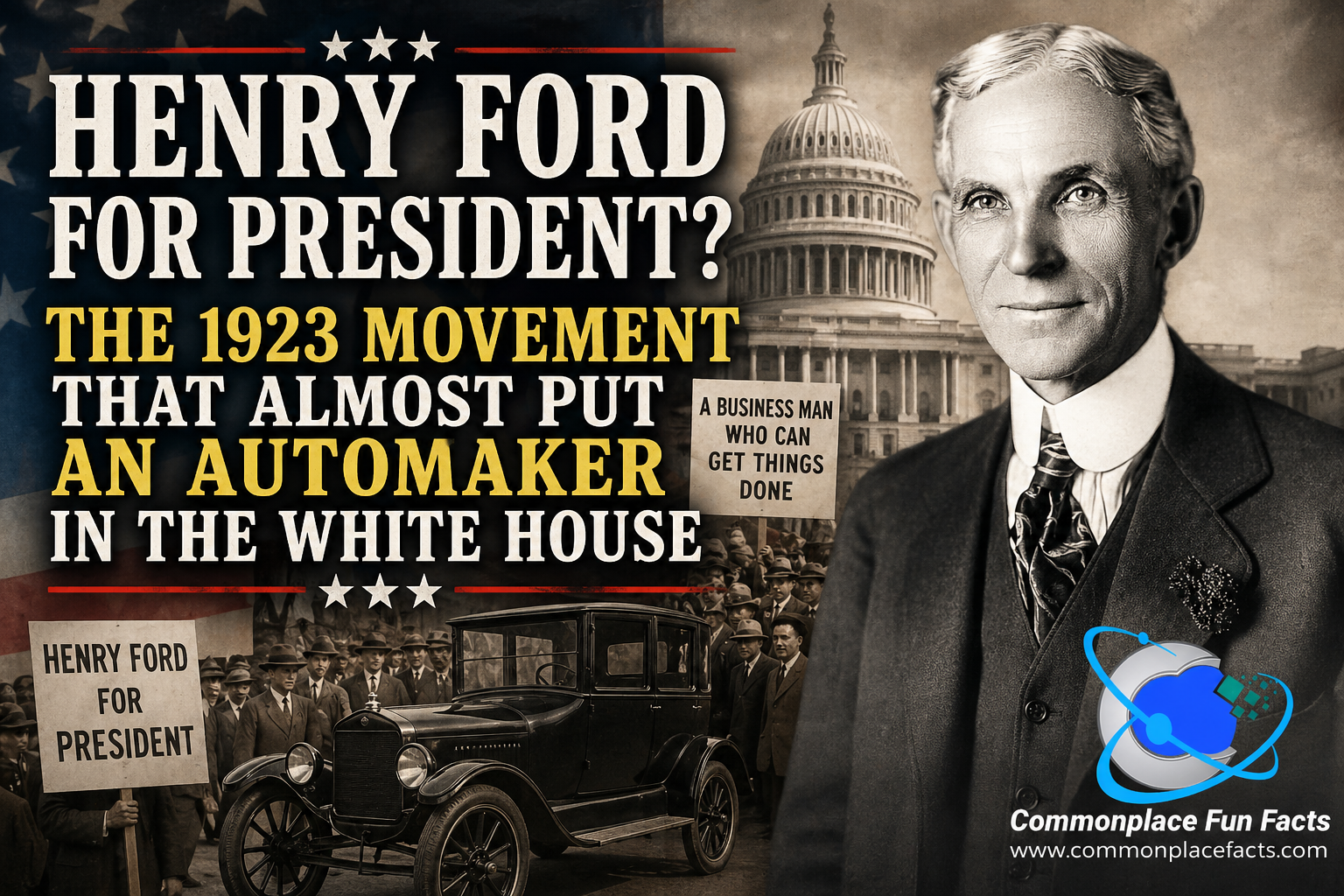

In the summer of 1923, the United States found itself contemplating a question that sounds like it was generated by a malfunctioning civics textbook: Should Henry Ford be president?
Not “Should Henry Ford build more cars?” Not “Should Henry Ford pay his workers well enough to buy the cars they were building?” Not even “Should Henry Ford please stop publishing anti-Semitic nonsense in his newspaper before someone takes away his printing press and gives it to an adult?” Those were all fair questions, naturally. But the one circulating through newspapers, political clubs, farm organizations, and national straw polls was whether the creator of the Model T should become the next occupant of the White House.
This wasn’t just idle speculation. For a brief moment, it looked like it might actually happen—putting a President Ford in office roughly fifty years ahead of schedule.
Why this was a thing, and how it abruptly stopped being a thing, is a story that blends politics, celebrity, and a well-timed intervention by fate. In other words, it is American government in its purest form.
Contents
Henry Ford: Industrial Genius, Political Question Mark
By the early 1920s, Henry Ford was one of the most famous men in the world. The Ford Motor Company’s Model T had changed American life. Ford’s assembly line had transformed manufacturing. His famous $5 workday had made him seem, at least to many workers and reform-minded observers, like a different kind of capitalist: rich, yes, but somehow less top-hatted and mustache-twirling than the standard Wall Street villain of political cartoons.

This image required some careful squinting.
Ford was brilliant, stubborn, suspicious, visionary, naïve, controlling, and spectacularly wrong about a number of things. He distrusted bankers, intellectuals, government experts, unions, politicians, and, on some days, probably the face staring back at him in the mirror. He had an instinctive appeal to people who believed the country was being run by insiders, elites, lawyers, financiers, and professional officeholders who had never gotten their hands dirty or punched a clock and therefore could not possibly be trusted with civilization.
To millions of Americans, Ford represented practical competence. He built things. He lowered prices. He paid wages. He made cars available to people who had previously viewed automobiles the way modern people view private islands: technically real, but not part of any reasonable life plan.
Along the way, he even helped create the charcoal briquettes that you use in your backyard barbeque. His ingenuity just didn’t seem to have a “pause” button.
These qualities made him political gold. Or at least political brass polished until it looked convincing.
Ford Had Already Tried Politics Once
Ford’s 1924 presidential flirtation did not come from nowhere. In 1918, President Woodrow Wilson encouraged him to run for the United States Senate from Michigan. Wilson wanted a pro-administration candidate who could support the war effort and the League of Nations. Ford agreed, which is one of those sentences that sounds normal until you remember that this was Henry Ford; politics was about to become less a campaign than an industrial stress test.
Ford entered both the Democratic and Republican primaries, because, apparently, choosing one party at a time seemed unnecessarily restrictive. He lost the Republican primary but won the Democratic nomination. In the general election, he faced Republican Truman Newberry, a former secretary of the Navy and a man whose campaign spending would soon become the stuff of legends.
Newberry defeated Ford narrowly, but the election became a scandal. Newberry’s campaign was accused of spending enormous sums to secure the seat. Legal proceedings followed. The Senate investigated. The controversy dragged on for years, and Newberry eventually resigned.
Ford lost the election, but he emerged with something almost as valuable as victory: proof that he could compete politically without being a conventional politician. He had nearly won a Senate seat in Michigan while running as an industrial celebrity with cross-party appeal. That made him dangerous. Not necessarily effective. Not necessarily qualified. But politically dangerous, which in Washington is often treated as a form of credentials.
The Mood of the Country Was Ready for an Outsider
The early 1920s were a strange time in American politics. The country had emerged from World War I exhausted, suspicious, and eager for what Warren Harding famously called “normalcy.” Harding’s word and his speeches in general were mocked by some grammar purists, but the voters understood what he meant: less crusading, less reform, less international drama, and ideally fewer government officials acting as if every policy dispute required a brass band and a moral emergency.
Harding won the presidency in 1920 by promising calm. Unfortunately, calm is difficult to maintain when your administration begins collecting scandals the way small children collect viruses.
The worst of the Harding scandals, including Teapot Dome, had not fully exploded by the time Ford’s boom gathered force in 1923, but the atmosphere was already sour. Many Americans distrusted political insiders. Farmers were struggling. The postwar economy had been uneven. Rural voters felt ignored. Progressives were frustrated. Labor activists were looking for alternatives. Conservatives were suspicious of Washington. Nearly everyone was ready to complain, which remains the one truly bipartisan American pastime.
Into that mood rolled Henry Ford, the man who had put America on wheels.
The Muscle Shoals Miracle Machine
One of the biggest reasons Ford became politically attractive was a place in Alabama called Muscle Shoals—a name that sounds like it belongs to a backup linebacker in an Archie comic book.
During World War I, the federal government had developed facilities at Muscle Shoals to produce nitrates, which were useful for explosives and fertilizer. After the war, the site became a political headache. What should be done with this massive federal project? Should the government operate it? Sell it? Lease it? Let it sit there as a monument to bureaucratic indecision, which is always an option?
Ford had an answer. He proposed leasing the facilities, completing the hydroelectric development, producing cheap fertilizer, and turning the surrounding region into a booming industrial center. He spoke grandly of creating a seventy-five-mile city and bringing prosperity to farmers. The plan sounded bold, modern, and practical. It also sounded suspiciously like giving an extremely valuable public resource to one of the richest men in America on terms he found agreeable.
Supporters saw Ford as the man who could rescue Muscle Shoals from congressional paralysis. Farmers especially liked the promise of cheap fertilizer. In an era when agricultural prices were depressed and rural voters felt squeezed by railroads, banks, middlemen, and the vague sense that someone somewhere was getting rich at their expense, Ford looked like a champion.
Critics saw something else. They worried about handing over public power resources to a private industrialist. They suspected Ford was less a public benefactor than a businessman who had noticed a bargain wearing patriotic bunting.
Both sides had a point, which is inconvenient but occasionally happens.
For Ford’s presidential prospects, Muscle Shoals was priceless. It gave him an issue. It made him look like a man of action. While Congress debated, Ford proposed. While politicians speechified, Ford promised cheap fertilizer and electric power. It was the kind of thing voters could understand without having to wade through tariff schedules, foreign policy doctrine, or whatever it was cabinet secretaries did when left unsupervised.
The Draft Ford Movement Begins to Roar
By 1923, “Henry Ford for President” was no longer just idle barbershop talk. Clubs formed. Petitions circulated. Newspapers covered the phenomenon. Farm and labor groups discussed him seriously. Political observers began measuring Ford not as a curiosity but as a potential disruption to both major parties.

The movement was odd because Ford himself remained coy. He did not launch a formal campaign. He did not build the normal political machinery. He did not barnstorm the country promising reform, prosperity, and a chicken in every garage. He simply allowed the speculation to continue.
This was politically useful. The less Ford said, the more people could imagine he agreed with them.
To farmers, he could be the man who would break the power of fertilizer monopolies and bring prosperity to rural America. To industrial workers, he was the employer who had once shocked the business world by paying high wages. To anti-bank populists, he was the rich man who disliked Wall Street. To efficiency enthusiasts, he was the master organizer who would make government run like a factory. To people who simply disliked politicians, he was not a politician, which was apparently enough.
That last point cannot be overstated. Ford’s greatest qualification, in the eyes of many supporters, was that he had never held office. This reflects a recurring American theme—one baked into the country’s founding assumptions—that the best person to lead a nation of the people, by the people, and for the people can legitimately be one of the people.
It does not always work out that way, but that has always been the idea.
The Straw Polls That Terrified the Professionals
The most dramatic evidence of Ford’s political strength came from straw polls. These were not scientific polls in the modern sense. They were reader surveys, magazine canvasses, newspaper ballots, and other instruments of public opinion that should be treated with caution, preferably using tongs and protective eyewear.

Still, they mattered.
In 1923, Collier’s magazine conducted a major national straw poll. The results were astonishing. Ford ran ahead of President Harding and far ahead of prominent Democratic possibilities such as William Gibbs McAdoo. In one large national canvass, Ford drew about 34 percent of the vote, compared to roughly 20 percent for Harding—meaning the sitting president was being outpolled by a man who had not even officially entered the race.
Again, these were straw polls. They did not prove Ford would win a general election. They did not account for ballot access, party conventions, regional organization, campaign discipline, or the small matter of whether Ford actually wanted the job badly enough to pursue it.
But they did prove something important: Ford’s appeal was not imaginary. People were willing to write down his name. Lots of them. Enough to make Republican leaders nervous and Democratic strategists curious. Enough to suggest that if Ford ran as an independent, or somehow captured a major-party nomination, he could scramble the 1924 election in ways no one could comfortably predict.
For a sitting president, being outpolled by the automobile man was not ideal. It was not quite being rear-ended by a Model T in the driveway of history, but one can see it from there.
Could Ford Have Won a Major-Party Nomination?
This is where things get complicated.
Ford’s popularity was real, but popularity is not the same thing as control of a political party. The Republican Party already had a sitting president in Warren Harding. Before Harding’s death, the party machinery was still oriented around him. Harding had weaknesses, certainly, but incumbents are hard to dislodge unless they are deeply unpopular, politically doomed, or caught doing something so embarrassing that even their allies start checking train schedules.
The Democratic Party was more open, but Ford was an awkward fit. He had run as a Democrat in 1918, but he was not a conventional Democrat. He was not especially interested in party platforms. He was not easily managed. He was not the kind of candidate party professionals could confidently surround with advisors, position papers, and carefully worded statements. Ford had a long history of saying exactly what he thought, which is admirable in private life and terrifying in national campaigns.
Then there was the third-party possibility. This may have been the most plausible route for a Ford candidacy if he had truly wanted one. The early 1920s were full of political restlessness. Farmer-labor groups, progressives, and anti-establishment voters were searching for alternatives. Robert La Follette would ultimately run as a Progressive candidate in 1924 and win a significant share of the vote. A Ford candidacy might have tapped into some of that same discontent, though with a very different personality and ideological profile.
Ford was not a doctrinaire progressive. He was more of a one-man contradiction factory. He could sound populist about banks and farmers, paternalistic about labor, conservative about social issues, utopian about technology, and utterly reckless about conspiracy theories. He was not a platform. He was a weather system.
The Problem of Ford Himself
The strongest argument against a Ford presidency was Henry Ford.
His admirers saw a practical genius. They were not wrong. Ford changed the modern world. He understood production, pricing, distribution, and publicity at a level few people in history have matched. He grasped that the automobile was not merely a luxury product but a tool that could reorganize daily life. He built systems that made that vision real.

But presidential leadership requires more than industrial efficiency. It requires judgment, patience, diplomacy, constitutional understanding, tolerance for disagreement, and the ability to distinguish between a complicated problem and a machine part that can be replaced with a cheaper one.
Ford’s record raised serious concerns. His 1915 peace mission, the famous “Peace Ship,” had been an embarrassing attempt to end World War I through moral enthusiasm, celebrity confidence, and insufficient planning. His newspaper, The Dearborn Independent, published vicious anti-Semitic material that damaged his reputation and spread conspiracy theories under the Ford name. His management style could be autocratic. His understanding of public affairs was often simplistic. His instinct was to reduce complex social and political problems to matters of production, discipline, and common sense.
Common sense is a fine thing. Unfortunately, it becomes less useful when applied to domestic and international issues that had a long history of operating with decidedly uncommon sense.
Harding’s Death Changes Everything
Then came August 2, 1923.
President Harding died suddenly in San Francisco while returning from a western tour. Vice President Calvin Coolidge became president. The political landscape shifted overnight.

Before Harding’s death, the Ford boom was aimed at a race in which Harding was the incumbent president and likely Republican nominee. After Harding’s death, Coolidge inherited the presidency and immediately became the central figure in Republican politics. He was quiet, restrained, business-friendly, and personally untainted by the worst scandals of the Harding administration. If Harding represented genial normalcy gone soft around the edges, Coolidge represented normalcy dried, pressed, folded, and placed in a drawer.
Coolidge also neutralized some of Ford’s appeal. Ford’s supporters wanted efficiency, economy, business competence, and freedom from political theatrics. Coolidge offered much of that, but with actual government experience and fewer headlines involving private newspapers distributing bigotry by the truckload.
Ford eventually endorsed Coolidge. The great presidential boom deflated. Ford did not run. The 1924 Democratic Convention descended into a chaotic chapter in political history known as the Klanbake. Coolidge won the Republican nomination and then the 1924 election. Robert La Follette carried the banner of progressive revolt instead, winning Wisconsin and a sizable national protest vote, but not the presidency.
The Ford presidency remained one of those political almost-events: not a campaign, not quite a fantasy, and not entirely impossible.
What the Ford Boom Revealed
The movement to make Henry Ford president tells us a great deal about the United States in the early 1920s. It shows a country fascinated by business success, frustrated with political institutions, and eager to believe that industrial competence could be transferred directly into government.
That belief has never really gone away.
Ford’s supporters were not fools. Many had real grievances. Farmers were struggling. Political corruption was real. Washington often did seem slow, self-protective, and allergic to practical solutions. The appeal of a successful outsider was understandable. When the machinery of government sputters, it is natural to look for someone known for building better machinery.
But the Ford boom also revealed a recurring weakness in American political culture: the temptation to confuse fame with wisdom, wealth with public virtue, and success in one field with competence in all fields. Ford knew cars. He knew factories. He knew how to bend production costs to his will. That did not mean he knew how to manage Congress, foreign policy, civil liberties, agriculture, race relations, monetary policy, or the thousand other problems that arrive at the president’s desk like uninvited relatives with luggage.
The presidency is not an assembly line. There is no single lever marked “efficiency.” There is no foreman who can shout at the Senate until it starts behaving. The Constitution, inconsiderately, does not come with interchangeable parts.
The Almost-President in the Garage of History
Henry Ford never became president. He never even formally became a presidential candidate in 1924. Yet for a brief moment before Warren Harding’s death, he was one of the most intriguing political possibilities in America.
He had money, fame, public admiration, rural support, national recognition, and the priceless advantage of not being a politician at a time when many voters considered politicians to be one of the less attractive byproducts of democracy. He also had liabilities large enough to require their own parking lot.
The Ford-for-president movement was not a joke, though it sometimes sounds like one from a distance. It was a serious expression of public frustration and public hope. It was a sign that many Americans believed the country could be fixed by someone who had mastered modern industry. It was also a warning that voters, when sufficiently irritated, will look at almost any successful man and wonder whether he might be the national mechanic.
In 1923, that mechanic was Henry Ford.
He stayed out of the race. The country got Calvin Coolidge instead. Ford went back to automobiles, factories, social experiments, and saying things that made his admirers wish he would spend more time with engines and less time with newspapers.
The episode remains fascinating because it feels both distant and familiar. A famous businessman with a massive personal brand, a reputation for practical genius, a distrust of elites, a devoted following, and no traditional political experience becomes a serious presidential possibility by appealing to voters tired of professional politicians.
Sometimes history does more than repeat itself. Occasionally, it is simply showing off.
You may also enjoy…

The Surprising Origin of Kingsford Charcoal: Henry Ford’s Forgotten Innovation
Discover how Henry Ford transformed wood waste into charcoal briquettes, creating the foundation for modern grilling and the Kingsford Charcoal brand.

Clyde Barrow Writes a Love Letter to Henry Ford: A Killer’s Tribute to Automotive Excellence
Discover Clyde Barrow’s obsession with the Ford V8—an engineering marvel that fueled his notorious crime sprees with Bonnie Parker. Learn about the car’s role in history and its lasting legacy

Klanbake: The Wild Story of the 1924 Democratic Convention
Explore the chaotic 1924 Democratic Convention, a 103-ballot political standoff remembered for bitter factional fights, the failed anti-Klan plank, and the rise of future leaders. Discover how this infamous “Klanbake” shaped American politics and exposed deep divisions within the party.



Leave a Reply