
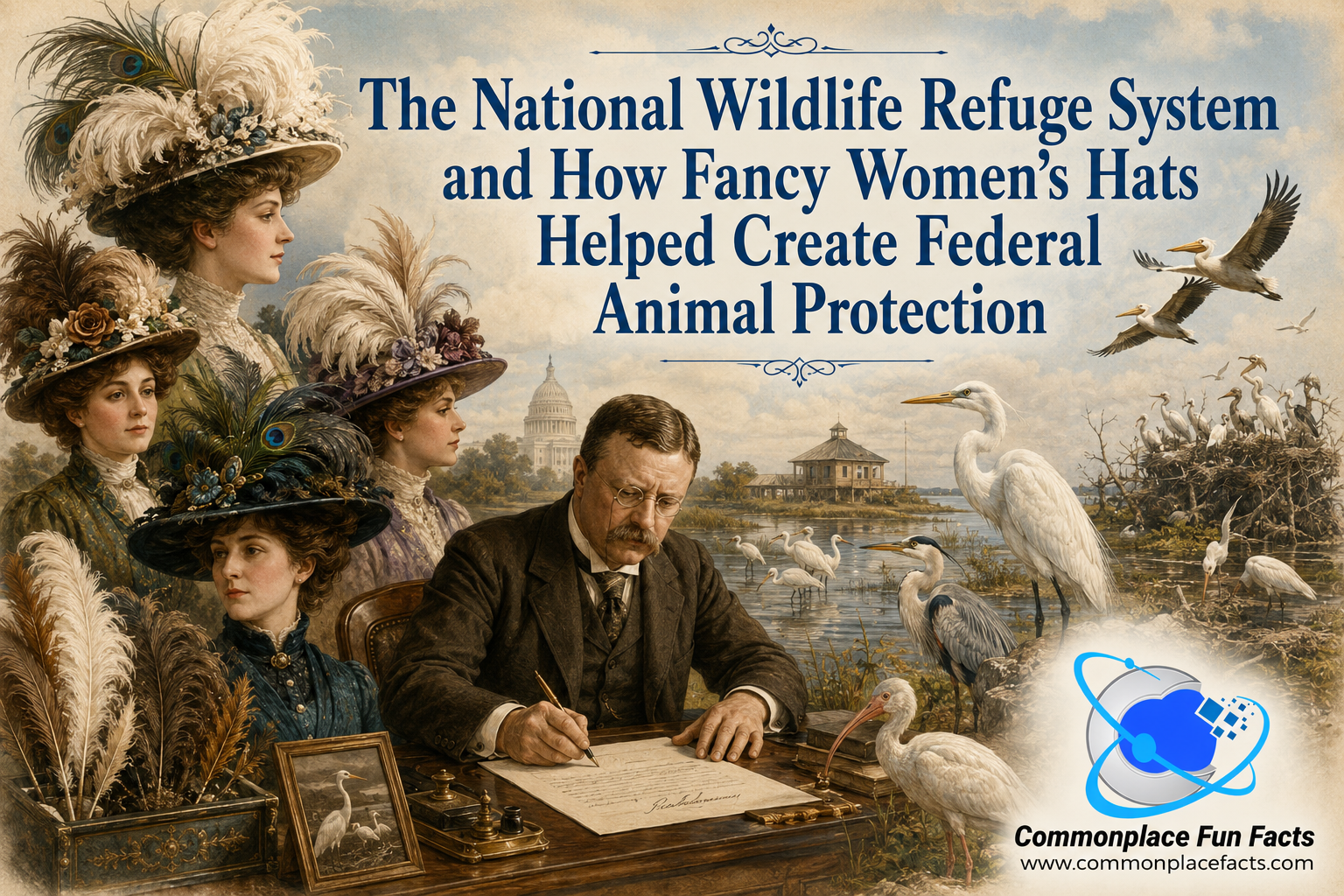

There are many noble reasons to preserve land and wildlife. Awe at the beauty of nature. Reverence for creation. A desire to protect fragile ecosystems for future generations.
Then there is the slightly less majestic but historically important reason: “Good grief, Mildred, your hat appears to be wearing an entire bird.”
At the turn of the 20th century, one of the great engines behind American conservation was not merely the poetry of wilderness or the rugged philosophy of Theodore Roosevelt standing heroically on a mountaintop, probably while posing for his Mount Rushmore visage. It was fashion. Specifically, women’s hats.
Very fancy women’s hats.
Hats so elaborate they could include wings, feathers, heads, tails, and sometimes entire birds arranged in ways that suggested either high society or a small avian traffic accident. These hats were fashionable, expensive, and deadly. They helped push egrets, herons, pelicans, and other birds toward catastrophe. They also helped inspire one of the earliest and most important federal acts of wildlife protection in American history.
Yes, dear reader: the road to the National Wildlife Refuge System runs, in part, through the millinery department.
Contents
The Age of the Murder Hat
In the late 1800s, elaborate hats were not just accessories. They were statements. They said, “I am fashionable.” They said, “I have disposable income.” They also occasionally said, “A small ecosystem died for this brim.”

The most prized decorations were feathers from birds with especially beautiful breeding plumage. The snowy egret was one of the unfortunate stars of this tragedy. During mating season, the bird grows long, wispy white plumes called aigrettes. They are delicate, elegant, and visually stunning, which is another way of saying they were doomed the moment someone in the fashion industry saw them and thought, “That would look splendid above a human forehead.”
The problem was timing. Egrets produced their most desirable plumes during nesting season. That meant plume hunters did not simply collect loose feathers like polite woodland hobbyists. They attacked rookeries, killed the adult birds, stripped them of their feathers, and left eggs and chicks behind to die.
It was not a charming Victorian craft project. It was industrialized bird mugging.
And it was lucrative. In 1903, egret plumes sold for about $32 an ounce, which was roughly twice the price of gold at the time. Adjusted for inflation, that comes to about $1,180 per ounce today. Some later reports put top plume prices as high as $80 an ounce, or nearly $3,000 in modern buying power. That sentence sounds like something from a fairy tale, except the fairy tale usually has fewer dead herons and fewer department stores.
When Fashion Became an Extinction Machine
The appetite for feathers was enormous. Hats could be adorned with plumes, wings, heads, or whole preserved birds. Some looked less like clothing and more like a bird had been startled mid-flight and decided to land permanently on Aunt Gertrude.

For birds, the fashion craze was disastrous. Snowy egrets, great egrets, herons, ibises, roseate spoonbills, terns, and pelicans were among the many species targeted. Rookeries that had once been full of nesting birds were destroyed. The adults were killed. The young were abandoned. Entire colonies could be wiped out in days.
This was not merely a matter of a few eccentric hunters wandering into the marsh with questionable priorities. It was a commercial trade. Feathers moved from remote nesting grounds to millinery centers in cities such as New York and London, where they were transformed into the kind of fashionable headwear that made one look sophisticated, wealthy, and vaguely like one had lost a fight with a bird sanctuary.
The snowy egret became one of the symbols of the crisis. Its white plumes were so desirable that the species was driven dangerously close to extinction. It is difficult to overstate how strange this is: a bird nearly vanished because people decided its mating-season outfit would make a terrific hat ornament.
Nature gave the egret elegant breeding plumage. Humanity responded, “Excellent. Fetch the scissors and ecological nearsightedness.”
The Audubon Movement Takes Flight
Public outrage grew as more people became aware of the scale of the slaughter. Naturalists, bird lovers, and reformers began speaking out against the plume trade. Women played a crucial role in this movement, which is fitting, since the reform effort was partly aimed at persuading other women to stop wearing the contents of a rookery to brunch.

In Massachusetts, Harriet Hemenway and Minna Hall helped organize women against feathered hats in the 1890s. They hosted teas, appealed to society women, and urged them to reject bird-killing fashion. It was a brilliant strategy: fight tea-party fashion with actual tea parties.
Their campaign helped build momentum for what became the Audubon Society. Local Audubon societies spread across the country, arguing that birds should not have to die so a hat could achieve vertical ambition. These groups lobbied for bird protection laws, hired wardens to guard nesting areas, and helped change public opinion.
This was conservation before conservation had the institutional muscle it would later develop. It was grassroots activism, moral persuasion, scientific concern, and social pressure rolled together into one great anti-hat-plume crusade.
Which, admittedly, sounds less dramatic than “the Battle of Gettysburg,” but did involve fewer cannons and roughly the same amount of feathers.
The name “Audubon” carries its own little historical irony. The National Audubon Society was named for John James Audubon, the famed naturalist and artist whose spectacular bird illustrations helped generations of Americans appreciate the beauty of avian life. But Audubon himself did not always grasp how quickly abundance could vanish.
When writing about the passenger pigeon—a bird that once darkened the skies in flocks so enormous they sounded like a meteorological event with feathers—Audubon suggested that hunting alone could not seriously diminish their numbers. He wrote, “But I have satisfied myself, by long observation, that nothing but the gradual diminution of our forests can accomplish their decrease…” This turned out to be one of history’s more tragic “well, actually” moments. Commercial hunting and habitat destruction worked together with horrifying efficiency, and by 1914 the passenger pigeon was extinct. So the bird-protection movement eventually took the name of a man who loved birds deeply, painted them beautifully, and still underestimated humanity’s remarkable ability to turn “limitless” into “none left.”
Enter Theodore Roosevelt, Bird Nerd with Executive Authority
Theodore Roosevelt is remembered as a champion of conservation, and fairly so. He created national forests, national monuments, game preserves, and bird reservations. He loved nature with the intensity of a man who regarded sitting quietly indoors as a suspicious personal failure.
Roosevelt was also a lifelong bird enthusiast. As a boy, he collected specimens and studied natural history. As an adult, he brought that interest with him into public life. This mattered because, by the time he became president, the federal government had begun to recognize that unregulated exploitation was not a terrific long-term plan. The bison had nearly vanished. Passenger pigeons were on their way to extinction. Wading birds were being slaughtered for the fashion trade.
Against this background, Pelican Island entered the story.
Pelican Island is a small island off Florida’s Atlantic coast in the Indian River Lagoon. It was a rookery for brown pelicans and other birds. It was also a target for plume hunters and egg collectors, because apparently there has never been a beautiful place on Earth without someone asking, “How can we monetize this until it screams?”
A local resident named Paul Kroegel became one of the island’s protectors. He watched over the birds, sometimes literally standing guard against hunters. Naturalists and conservationists took notice. Frank Chapman of the American Museum of Natural History and others helped bring the issue to Roosevelt’s attention.
Roosevelt’s response was refreshingly direct. On March 14, 1903, he signed an executive order establishing Pelican Island as the first federal bird reservation.
It was a tiny place. Just a few acres. It did not have the sweeping grandeur of Yellowstone or Yosemite. It did not feature mountains, geysers, or majestic vistas suitable for oil paintings and inspirational calendars.
It had birds.
And that was the point.
The First Federal Bird Reservation
Pelican Island was historically important because it marked the first time the federal government set aside land specifically for the sake of wildlife. Not scenery. Not timber. Not future settlement. Not mineral resources. Wildlife.
That was a major shift.

The creation of Yellowstone National Park in 1872 had already established the idea that the federal government could preserve extraordinary landscapes. But Pelican Island was different. It helped establish the idea that land could be protected because animals needed it.
That distinction matters. National parks often protected spectacular places. Wildlife refuges protected habitat. Sometimes those categories overlap, but the underlying purpose is different. Yellowstone says, “Behold the majesty of geysers, canyons, wildlife, and the occasional tourist making poor bison-related choices.” Pelican Island says, “Please stop killing these birds for feathered hats.”
From that humble beginning, Theodore Roosevelt went on to create dozens of federal bird reservations and game preserves. These became the foundation of what eventually developed into the National Wildlife Refuge System.
So while it is not quite accurate to say that women’s hats created the national parks, it is very fair to say that fancy hats helped inspire federal land protection for wildlife.
And honestly, that may be even better.
National parks were born from scenery, geology, tourism, and the growing realization that maybe America should not turn every beautiful thing into lumber, railroad grades, and hotel stationery. Wildlife refuges, meanwhile, were born partly from the realization that if fashionable people kept wearing birds on their heads, there might soon be no birds left except the ones already nailed to hats.
The Hat That Launched a Refuge System
The federal response did not stop with Pelican Island. Bird protection became a national issue. The Lacey Act of 1900 had already taken aim at illegal wildlife trafficking by restricting interstate shipment of unlawfully taken game. State-level bird protection laws also emerged. Audubon wardens patrolled rookeries. Conservation organizations pressed for broader reforms.
Then came stronger federal action. The Weeks-McLean Law of 1913 prohibited spring hunting and the marketing of migratory birds and banned the importation of wild bird feathers for women’s fashion. That same year, the Underwood Tariff Act also restricted feather imports. The Migratory Bird Treaty Act of 1918 later became one of the most important bird-protection laws in American history.
In other words, the government eventually concluded that letting the hat industry regulate bird survival was perhaps not ideal.
This was a turning point in American conservation. Wildlife was no longer treated simply as an endless supply of things to shoot, sell, stuff, or attach to formalwear. Birds were increasingly understood as part of a shared natural inheritance. Their survival was a public concern.
That idea seems obvious now, but it was radical in a world where market demand often decided whether a species got to continue existing.
The Strange Power of Public Shame
One of the fascinating things about the anti-plume movement is how much it depended on changing social attitudes. Laws mattered, of course. Wardens mattered. Presidential orders mattered. But fashion is social. It thrives on approval. It withers under ridicule.

Once reformers succeeded in making feathered hats seem cruel rather than glamorous, the trade lost much of its cultural power. Wearing egret plumes went from “elegant” to “possibly the reason that bird had a family and now does not.”
That is no small achievement. Fashion trends are notoriously stubborn. People have willingly worn powdered wigs, corsets, hoop skirts, leisure suits, neck ruffs, and whatever happened in men’s athletic shorts in the 1970s. Convincing society that a popular fashion is morally repulsive takes work.
The Audubon activists managed it. They appealed to conscience, science, aesthetics, and social respectability. They helped turn birds from accessories into living creatures worthy of protection.
This is one of the more encouraging parts of the story. Public opinion changed. Laws followed. Species recovered. Not perfectly. Not instantly. But enough to show that conservation can work when outrage, organization, and policy all flap in the same direction.
So, Did Hats Create National Parks?
Not exactly.
The national park idea predates the plume crisis as a federal conservation force. Yellowstone was established in 1872, long before Pelican Island became a federal bird reservation in 1903. The great national parks were primarily associated with preserving scenic wonders, wilderness landscapes, and places of national significance.
But if we broaden the question from “national parks” to “federal land protection,” then yes, the hat-plume crisis belongs right in the story.
Women’s hats helped drive the creation of protected bird reservations. Those reservations helped lay the groundwork for the National Wildlife Refuge System. Pelican Island stands as a landmark in the history of federal protection because it was not set aside for people to admire a grand landscape. It was set aside so birds could nest without being converted into retail inventory.
That is a remarkable development. Federal land protection did not grow only from panoramic views and presidential camping trips. It also grew from marshes, rookeries, reformers, wardens, and birds whose chief mistake was being gorgeous during mating season.
Beauty saved them eventually. But first, it nearly got them killed.
The Egret’s Revenge
Today, snowy egrets are no longer dangling from fashionable hats in respectable society, which is one of those sentences that makes us grateful for progress while also making us wonder what future generations will say about us.

The bird itself has become an icon of conservation. The National Audubon Society uses the great egret in its logo, a fitting tribute to the birds that helped inspire the movement. The same plumes that nearly doomed egrets became part of the story of their protection.
There is a satisfying historical symmetry in that. The egret was hunted because it was beautiful. Then people rallied to save it because they finally recognized that beauty belonged on the bird, not on Mrs. Vanderbilt’s hat rack.
The broader lesson is that conservation history is not always as tidy or noble as we imagine. Sometimes it begins with sublime landscapes and visionary ideals. Sometimes it begins with someone looking at a fashion statement and saying, “Nice hat, but is it worth the extinction of a species?”
Either way, the result mattered.
Pelican Island helped establish a new principle: the federal government could protect land for wildlife itself. That idea expanded into a refuge system that now protects millions of acres of habitat across the country.
And all because, at one point, Americans had to be persuaded that birds should remain in trees, marshes, and skies rather than being converted into luxury headgear.
History is strange that way. One century’s fashion emergency becomes the next century’s conservation milestone.
So the next time someone talks to you about making a statement with fashion, remember the snowy egret. Remember Pelican Island. Remember the plume hunters, the Audubon reformers, and Theodore Roosevelt signing a tiny island into federal protection.
And remember that somewhere in the tangled branches of American conservation history, there is a very fancy hat looking guilty about the consequences of its fashion statement.
You may also enjoy…

The Passenger Pigeon: How the Most Numerous Bird on Earth Became a Memory
Once numbering in the billions, the passenger pigeon dominated the skies of North America before vanishing in less than a century. Here’s the quirky, tragic, and oddly funny tale of their rise and fall.

Chairman Mao and His Disastrous War on Sparrows: How a Pest Control Campaign Led to Ecological Disaster
Discover how Chairman Mao’s war on sparrows, part of the Four Pests Campaign, triggered an ecological disaster and mass famine in China, leading to millions of deaths.

Behold Tibbles the Cat — Destroyer of a Whole Species
Learn how one cat named Tibbles was responsible for the extinction of an entire species of birds.






Leave a Reply