

There are moments in military history when the courage of fighting men is measured in steel, fire, sacrifice, and tactical brilliance.
Then there are moments when someone allegedly looks around a warship, discovers the nearest available ammunition is a pile of potatoes, and says, “Well, gentlemen, agriculture has entered the chat.”
Welcome to the story of the USS O’Bannon, a World War II destroyer with one of the most decorated combat records in the Pacific—and also, somehow, the ship forever associated with the possibility that it once fought a Japanese submarine using Maine potatoes.
Yes, potatoes.
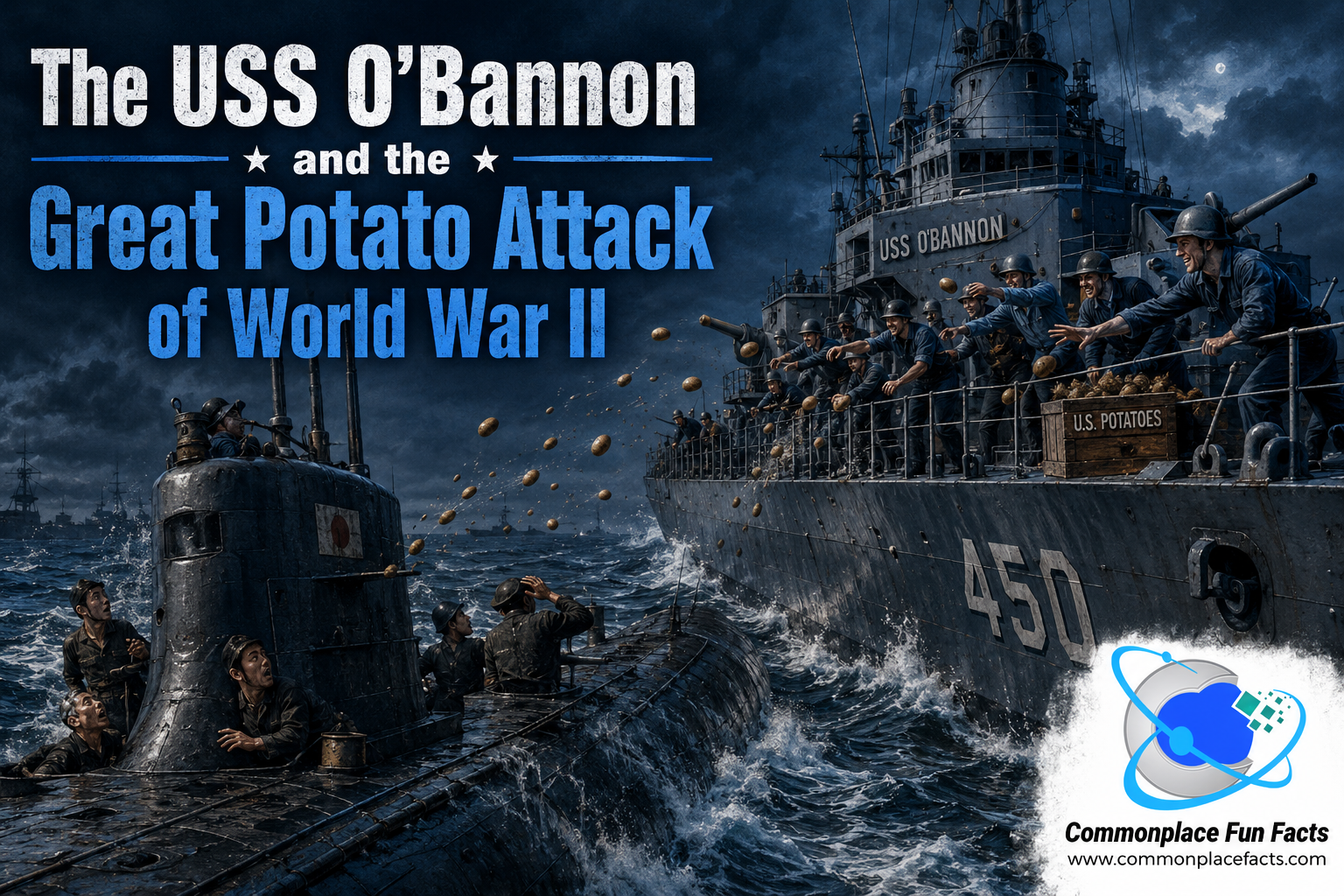
Not torpedoes. Not depth charges. Not the terrifying wrath of naval artillery. Potatoes. The humble tuber. The starchy little lump normally assigned to supporting roles in stews, casseroles, and Thanksgiving side dishes. According to one of the most beloved legends of the Pacific War, the crew of the USS O’Bannon found themselves too close to a Japanese submarine to use their guns, so they began hurling potatoes at the enemy sailors, who mistook them for hand grenades and were too busy tossing them overboard to man their deck gun.
It is a magnificent story. But is it true?
The fact that we’re asking that question suggests that we probably need to talk about it.
Contents
First, Meet the USS O’Bannon
Before we go any further, a word about the name. Presley O’Bannon was a genuine American hero—a Marine officer of the First Barbary War whose exploits at Derna helped give the Marine Corps Hymn its famous “shores of Tripoli” line. Admirable fellow. Excellent résumé. This article, however, is not about him.
Nor is it about the first USS O’Bannon (DD-177), a Wickes-class destroyer launched in 1919, or the third USS O’Bannon (DD-987), a Spruance-class destroyer commissioned in 1979. Worthy ships, both of them, and no doubt deserving of their own attention when the Commonplace Fun Facts Department of Naval Rabbit Holes determines we need a break from writing about axe murders and middle school humor.
Instead, this article is about the second USS O’Bannon (DD-450), the Fletcher-class destroyer whose distinguished World War II service somehow became forever entangled with one of the strangest legends in naval history: the claim that her crew once fought off a Japanese submarine with potatoes.

The USS O’Bannon was not some accidental comedy prop drifting around the Pacific looking for ways to turn produce into naval doctrine. She was a Fletcher-class destroyer, one of the hard-working, hard-fighting ships that did an enormous amount of the dirty work in World War II.
Laid down at Bath Iron Works in Maine on March 3, 1941, launched on March 14, 1942, and commissioned on June 26, 1942, O’Bannon entered service at exactly the sort of historical moment when a new destroyer was less a ship than an RSVP to chaos. The United States had been at war for only a few months. The Pacific was a vast, violent chessboard, except every square was on fire and several of the pawns were battleships.
The World War II O’Bannon would go on to earn a staggering combat record. She served at Guadalcanal, fought in the Solomon Islands, operated in some of the nastiest waters of the Pacific campaign, survived brutal night actions, escorted, bombarded, hunted submarines, and generally behaved like the naval equivalent of a terrier that had been handed a list of Axis shipping and told, “Fetch.”
By the end of World War II, O’Bannon had earned 17 battle stars and a Presidential Unit Citation, making her one of the most decorated destroyers of the war. That alone should be enough for immortality.
But history, being history, looked at all that valor and said, “Fine. But what if we remembered her mostly for potatoes?”
The Night Everything Got Very Close and Very Weird
The event behind the legend took place in the early morning hours of April 5, 1943, in the Solomon Islands area, near the Russell Islands. The Solomons campaign was one of the long, grinding struggles of the Pacific War, where American and Japanese forces fought over islands, airfields, sea lanes, and anything else that could be shelled, bombed, occupied, defended, or regretted later.
O’Bannon, under the command of Lieutenant Commander Donald J. MacDonald, was operating with Destroyer Squadron 21. The destroyers were returning from a night mission shelling Japanese shore installations in the New Georgia area when radar picked up a contact: a surfaced submarine.
The submarine was Japanese RO-34, a Kaichu-type boat of the Imperial Japanese Navy.

At first, this seemed like a golden opportunity. A surfaced submarine was vulnerable. Destroyers existed, in part, to make submarines have very short and unpleasant evenings. O’Bannon detached to investigate and moved in rapidly.
MacDonald considered ramming the submarine. That was not as wild as it sounds. Destroyers did ram submarines during the war, and if you are commanding a fast, heavily armed warship and you suddenly discover an enemy submarine on the surface at close range, the idea of simply running over the thing has a certain blunt appeal. It is not subtle, but neither is a depth charge.
Then MacDonald had second thoughts. What if the submarine was actually a minelayer? What if ramming it caused mines or explosives to detonate? What if the heroic attack turned his destroyer into an expensive cautionary tale?
So he ordered the rudder hard over and avoided the collision.
This decision saved O’Bannon from a potential disaster, but it also created a different problem. The destroyer passed so close to RO-34 that her guns could not depress low enough to fire at the submarine. This is one of those technical details that sounds absurd until you remember that naval guns are designed for certain angles, distances, and ranges—not for shooting something practically under your elbow.
Imagine standing on a balcony with a rifle while your enemy is directly below you against the wall. Now imagine the rifle weighs several tons and is bolted to a destroyer. That was the basic geometry problem, except with more seawater and significantly higher stakes.
Enter the Potatoes
Here is where the legend begins.
According to the famous version, O’Bannon was so close to RO-34 that the destroyer’s crew could see Japanese sailors moving on the submarine’s deck, possibly attempting to reach their deck gun. Since O’Bannon could not bring her own guns to bear, the American sailors supposedly grabbed the nearest available objects: potatoes stored on deck.
They began throwing them at the Japanese sailors.
The Japanese, seeing round objects flying toward them in the darkness, allegedly mistook the potatoes for hand grenades. Rather than manning the deck gun, they scrambled to throw the “grenades” overboard before they exploded. This gave O’Bannon time to pull away, get enough distance to use her guns, and resume the fight with conventional weapons, which naval historians tend to prefer over root vegetables.
It is an absolutely glorious image.

There is the Japanese submarine, startled and vulnerable. There is the American destroyer, too close to use its guns. There are sailors hurling potatoes with all the force and indignation of men who did not join the Navy to become lunchroom catapults. Somewhere in the background, one imagines a cook staring in horror and thinking, “Now I suppose I’ll have to use the grenades for Tuesday’s lunch.”
The story spread. It was repeated in newspapers, Navy circles, popular histories, and eventually the internet, where legends go to receive tenure. The Maine Potato Growers Association loved the tale so much that it presented O’Bannon with a commemorative plaque honoring the moment when America’s favorite side dish briefly enlisted in the Pacific War. That detail alone explains why the story survived. Once a state agricultural association gives you a plaque for weaponizing its crop, the legend has achieved institutional momentum. Unfortunately, the plaque disappeared from the Maine Maritime Museum sometime after the 1970s, which means the potato story now has everything: naval combat, disputed eyewitness testimony, agricultural pride, and a possible conspiracy theory about a missing artifact. It’s just waiting for the screenplay treatment as Indiana Jones and the Raiders of the Lost Starch.
The Problem: The Captain Said It Didn’t Happen
There is, however, a fairly significant obstacle to the potato attack story: Commander Donald MacDonald, the man commanding O’Bannon during the encounter, later said the potatoes were not actually thrown.
According to the more skeptical version, the real origin of the tale was a remark by the ship’s cook. The submarine had been so close that the cook said he could have thrown potatoes at it. From there, the story evolved—because of course it did. “We were close enough to throw potatoes” became “we threw potatoes,” which became “the Japanese thought the potatoes were grenades,” which became “the USS O’Bannon defeated a submarine with Idaho’s understudy.”

This is how legends work. They do not usually arrive fully dressed in mythological robes. They begin as a remark, a joke, an exaggeration, a good line repeated at the right bar by someone who knows how to tell a story. After that, the tale begins acquiring details the way a destroyer acquires barnacles.
But the case against the potatoes is not airtight. Several members of O’Bannon’s crew later recalled the incident as something that actually happened. Seaman First Class Ambrose Hardin, gunner Bud Moreau, and George Starkey, who was stationed aboard the amidships searchlight platform, were among those who reportedly gave firsthand accounts of crewmen throwing potatoes at RO-34. That does not automatically settle the matter—wartime memories, like wartime reports, can be slippery little beasts, and there is that psychological phenomenon known as the Mandela Effect to consider—but it does mean the story cannot be dismissed as merely one cook’s joke that escaped into the wild and started reproducing.
So where does that leave us? In the most historically inconvenient place possible: with conflicting testimony. The captain denied the potatoes were thrown. Several crew members remembered that they were. The commemorative plaque suggests the story became widely accepted early enough to be celebrated, but a plaque is not the same thing as a sworn statement taken under cross-examination, however much the Commonplace Fun Facts Legal Department may wish otherwise.
The cautious conclusion is that the potato attack should be treated as a famous Navy legend rooted in a very real, very close, and very dangerous encounter. It may have happened exactly as the sailors remembered. It may have been exaggerated from a smaller moment. It may have begun as a joke and then been reinforced by memory, retelling, and the irresistible human need to make war stories slightly more interesting and significantly more carbohydrate-based.
MacDonald reportedly spent years trying to correct the record. This must have been a strange burden. He commanded one of the great destroyers of the war. He faced enemy fire, made life-or-death decisions, and led men through the Pacific meat grinder. Yet people kept asking him about potatoes.
There are worse ways to be remembered, certainly. Still, one suspects it grew tiresome.
“Tell us about your combat leadership, Commander.”
“Gladly.”
“Specifically the part involving tubers.”
“I have regrets.”
What Actually Happened to RO-34?
Even without potatoes, the engagement was dramatic.
After avoiding the ram and passing too close to fire, O’Bannon moved away from RO-34 until she had enough range to bring her 5-inch guns to bear. The destroyer USS Strong was also involved in the action. Gunfire was directed at the submarine, and at least one hit was reportedly observed before RO-34 crash-dived.

O’Bannon then went into the work destroyers were built to do. She closed in and dropped depth charges. Sonar contact was lost, then regained. Another pattern of depth charges followed. The destroyer claimed the submarine as sunk, and an oil slick seen later seemed to support the claim.
For a long time, older accounts credited O’Bannon with sinking RO-34 on April 5, 1943.
The later reconstruction is murkier. Japanese records and modern historical research suggest RO-34 may have survived the April 5 encounter, though likely damaged, and was later sunk after another engagement involving USS Strong on April 7, 1943. RO-34 was ultimately presumed lost with all hands in the Solomons area.
Night naval combat in the Pacific was notoriously chaotic. Ships fought in darkness, bad weather, smoke, radar uncertainty, and the constant possibility that everyone involved was making decisions with incomplete information while large explosive objects attempted to clarify matters. It is not surprising that wartime claims and later records do not always line up perfectly.
What is clear is that O’Bannon encountered RO-34, nearly rammed her, fought her at close range, and participated in an action that became one of the strangest legends of the Pacific War.
The potatoes, if present, were supporting cast at best.
Why the Potato Story Refuses to Die
The potato story survives because it is almost too perfect.
It has everything a memorable war anecdote needs. It has danger. It has improvisation. It has comedy. It has a powerful enemy momentarily undone by confusion. It has ordinary sailors using the only thing available. It has the delightful absurdity of naval combat briefly turning into a cafeteria food fight with geopolitical consequences.
The potato legend also belongs to a surprisingly crowded little corner of military history: improvised food-based warfare. During the Paraguayan War, defenders reportedly fired a cannonball made of cheese, proving that when civilization collapses far enough, lunch stops being lunch and starts becoming ordnance. Potatoes, cheese, and naval combat may not belong together in a serious military manual, but history has always enjoyed making fools of filing systems.
It also fits a familiar pattern in military folklore: the underdog improvises, the enemy misunderstands, and quick thinking saves the day. Whether the object is a potato, a broomstick, a fake tank, or a wildly overconfident bluff, these stories are beloved because they suggest that ingenuity can matter as much as machinery.
Sometimes that is true. Sometimes it is only emotionally true. History is annoyingly picky about the difference.
The story also probably survived because it does not make the sailors look foolish. Quite the opposite. It makes them look resourceful, brave, and funny under pressure. Nobody hears the tale and thinks less of O’Bannon. If anything, it adds a layer of personality to a ship that already earned more than enough respect through actual combat.
There is also the simple fact that “destroyer attacks submarine with potatoes” is a headline no editor with a pulse could resist. The alternative—“Destroyer Makes Close Approach to Submarine, Avoids Ramming, Reengages with Gunfire and Depth Charges Amid Later Ambiguity Over Sinking Credit”—may be more accurate, but it does not exactly leap off the page wearing tap shoes.
The Ship Behind the Story
It would be a mistake to let the potato tale overshadow what O’Bannon actually did. This was a ship with a remarkable record.
She served in the Guadalcanal campaign, where American naval forces fought desperate actions to keep the Japanese from retaking the initiative in the South Pacific. She took part in night battles, bombardments, escort duties, and anti-submarine actions. She operated alongside other famous destroyers and became part of the brutal rhythm of the Pacific War: steam, fight, repair, refuel, repeat, and try not to think too much about tomorrow.
Destroyers were among the most versatile ships in the Navy. They screened larger vessels, hunted submarines, rescued survivors, fired on shore targets, launched torpedoes, fought aircraft, and occasionally found themselves in close-range surface actions where survival depended on speed, training, and an officer making the least terrible decision available.
They were called “tin cans” for a reason. They were fast and deadly, but they were not armored like battleships. A destroyer crew lived with the knowledge that one torpedo, one shell, or one unlucky moment could change everything.
O’Bannon endured all of that and kept fighting. She survived World War II, later served again during the Korean War and the Vietnam era, and remained in service until 1970. That is a long career for any warship, especially one that had spent her youth in the naval equivalent of a bar fight with radar.
The Real Lesson: History Is Better When It Is Honest
It is tempting to tell the potato story as fact because it is so wonderfully absurd. We want it to be true. We want to live in a universe where a U.S. destroyer once escaped danger because Japanese submariners mistook potatoes for grenades. We want that not because it changes the course of the war, but because it suggests that even in the middle of humanity’s most terrible conflict, history occasionally paused to write a scene for a dark comedy.

But wanting a story to be true is not the same as proving it. That is the historian’s eternal burden, right after “reading footnotes” and “trying not to scream at documentaries.”
The better version is not to debunk the potato story into oblivion, nor to repeat it uncritically. The better version is to tell it as a legend—and then explain the real event that produced it.
A real American destroyer really did come dangerously close to a real Japanese submarine in the dark waters of the Solomons. The destroyer really did have a moment when her guns could not bear. Her captain really did maneuver away and reengage. The ship really did fight the submarine with gunfire and depth charges. Later, a story really did spread that potatoes had been thrown, and it became part of the folklore surrounding one of the Navy’s most decorated destroyers.
That is still a pretty good story.
Frankly, if your “less exciting” version still includes a destroyer nearly ramming a submarine in the middle of the Pacific War, your story is doing just fine.
Final Thoughts From the Department of Weaponized Side Dishes
The story of the USS O’Bannon and the potato attack sits in that delightful borderland between fact and folklore. The responsible historian must say, “No, the evidence does not support the full tale.” The responsible storyteller must add, “But good grief, what a tale.”
It reminds us that history is not only a record of battles, dates, and official reports. It is also made of jokes, exaggerations, half-remembered comments, commemorative plaques, and stories sailors tell because the truth, while impressive, sometimes needs a better opening line.
The USS O’Bannon deserves to be remembered for her courage, her crew, her service, and her extraordinary combat record. She does not need potatoes to be interesting.
Still, there is something irresistible about the idea that, for one brief moment in the Pacific War, the line between naval warfare and produce distribution became dangerously thin.
And if nothing else, the legend gives us this important lesson: never underestimate a destroyer, never trust a wartime anecdote without checking the sources, and never stand too close to an American sailor who has run out of ammunition but still has access to the pantry.
You may also enjoy…

USS William D Porter: The Navy’s Unluckiest Ship
Discover the strange story of the USS William D Porter — the unluckiest ship in the US Navy.

The Day a Cheese Cannonball Was Fired in War (Yes, Really)
Yes, a cheese cannonball was really fired in war. Discover this bizarre moment and other strange facts from the devastating Paraguayan War.

Luxury Potato Chips Priced at $11 Each
When it comes to luxury items, things related to potatoes are no small potatoes. When we reported the $1 million sale of a potato photograph, we thought it was a fluke. Now we learn of another luxury item: the $11 potato chip. Just to be clear, we are not referring to a bulk supply of…





Leave a Reply