

Let’s talk a bit about St. Kilda. You remember Kilda, don’t you? She was the revered saint who… That is, Kilda is the heroic figure remembered for… Well, obviously, this is the same Kilda who…. OK, fine. We admit that we don’t know who Kilda was and why he or she was canonized. If you are similarly clueless, don’t despair. It turns out no one knows who Kilda was.
Now, let’s talk about St Kilda — not the person, but the island group with that name. The distinction can be seen in the absence of a period “St Kilda,” since “St” isn’t an abbreviation. The first time the name shows up in print seems to have been in Thresoor der Zeevaert (“Treasure of Navigation“), a pilot book published by Lucas Waghenaer in 1592. In it, we see “S. Kilda” on a map, suggesting that it was a typo of the word Skilda(r).

Is that the real origin of St. Kilda? Who knows? If there ever was a real Kilda, saint or otherwise, he or she seems to have been entirely forgotten. Sadly, that also seems to be the fate of St Kilda, a place remote in geography and whose history is distant in collective memory.
Located 40 miles (64 km) to the west of Scotland’s Outer Hebrides, St Kilda was inhabited for about 2,000 years. Hardy islanders called the archipelago home until the winds of change (and a lot of bad weather) conspired to bring about the evacuation of the entire population in 1930.
A Tale of Isolation and Survival
St Kilda’s history reads like a gritty novel. The islanders lived in extreme isolation. This was both a blessing and a curse. While they enjoyed a unique culture and a diet rich in seabirds, the isolation also meant they were cut off from basic amenities and, more critically, medical care. The community was largely self-sufficient, but the harsh conditions and the dwindling population began to take their toll.
Life on Hirta, the main island of St Kilda, was bearable by the grace of freshwater springs. The islanders survived on a diet of seabird meat and eggs, freshly caught fish, and whatever barley, oats, and potatoes they could coax from the stubborn soil to last through the long winters. As far as fuel to keep them warm during the cold winter months? They were a bit limited in their options since the last tree in St Kilda had been cut down centuries ago. They resorted to using oil from wildlife.
The St Kildans kept sheep on Hirta and its smaller neighbors, Soay and Boreray. These weren’t just any sheep. The Soay sheep, with their distinctive soft wool, were practically tailor-made for the harsh, steep terrain. Add a few cattle into the mix, and you have a rudimentary yet functional farming ecosystem.
Things seemed to be going well in 1885 when a surgeon named J. Acheson reported that while food was plentiful on St Kilda, it wasn’t exactly gourmet fare. The islanders’ diet was a monotonous mix of oatmeal, salted fowl, and seabird eggs in the summer, with salted mutton taking center stage in the winter. A report from 1764 records the islanders’ dietary habits were, let’s say, egg-centric. It recorded that each person consumed an astonishing 36 eggs and 18 birds daily, amounting to a staggering 3,240 eggs and 1,620 birds across the community.
“We do not ask to be settled together as a separate community, but in the meantime we would collectively be very grateful of assistance, and transference elsewhere, where there would be a better opportunity of securing our livelihood.”
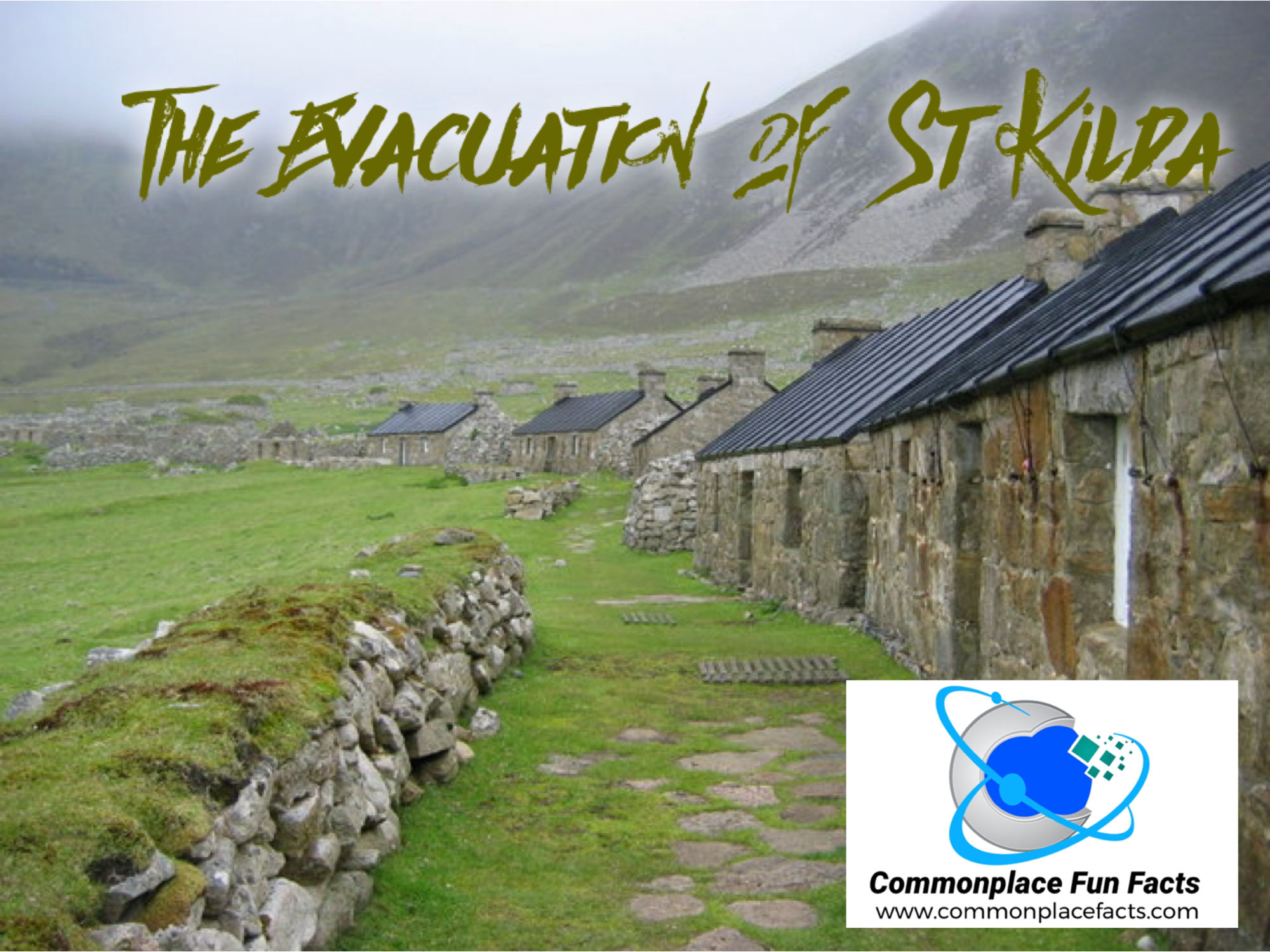
Despite their isolation, the islanders did have some interaction with the outside world. They traded with tourists for essentials like tea, sugar, flour, and tobacco. Their homes lined a quaint main street, with each house boasting a plot of land. In 1861, the traditional thatched “blackhouses” were replaced with single-story cottages featuring chimneys and slate roofs—a significant upgrade.
Life on St Kilda was always at the mercy of the elements. The weather could turn in an instant, threatening their food stores. Late summer of 1885, for example, a vicious storm decimated their corn, barley, and potato crops, leaving them on the brink of starvation. In a dramatic plea for help, the inhabitants sent a plea for help in a bottle. Miraculously, it was received, and the mainland sent help.
Population numbers on St Kilda were a rollercoaster, influenced by disease and migration. In the late 1600s, the island supported 180 inhabitants, but by the 18th and 19th centuries, numbers fluctuated wildly. A smallpox outbreak in 1727 slashed the population to 42. By 1758, only 88 islanders remained. A census from 1764, discovered in 2015, revealed 90 residents—38 males and 52 females, organized into 19 families and 9 individuals.
The population grew to 112 people by 1851, but one year later, 36 residents moved to Australia. The community never seemed to recover from that dramatic population drop. Between the years 1861 and 1921, the population remained fairly stagnant at about 71 people. The 1920s brought migrations and deaths, plummeting their numbers to only 43 inhabitants by 1927.
Life on St Kilda had become unsustainable. The younger generation saw no future on the islands and began to leave in search of better opportunities. The writing was on the wall, and it read something like, “Get ye to the mainland!”
By 1930, the St Kilda community was hanging on by its fingernails. Only 36 islanders remained: thirteen men, ten women, eight girls, and five boys. Survival became a daily struggle. The deaths of two young women that year underscored the islanders’ vulnerability and lack of medical care.
On May 10, 1930, the residents admitted things could not continue. On that day, twenty islanders petitioned the government for resettlement on the mainland.
St Kilda
Scotland
10 May 1930The Right Hon. W. Adamson M.P., Secretary of State for Scotland, Westminster
Sir,
We the undersigned the natives of St Kilda, hereby respectfully pray and petition H.M. Government to assist us all to leave the island this year and to find homes and occupation for us on the mainland.
For some years the man power has been decreasing, now the total population of the island is reduced to thirty six. Several men out of this number have definitely made up our minds to go away this year to such employment on the mainland. This will really cause a crisis as the present number are hardly sufficient to carry on the necessary work of the place.
These men are the mainstay of the island at present, as they tend the sheep, do the weaving and look after the general welfare of the widows. Should they leave the conditions of the rest of the community would be such that it would be impossible for us to remain on the island another winter.
The reason why assistance is necessary is, that for many years Saint Kilda has not been self supporting, and with facilities to better our position, we are therefore without the means to pay for the costs of removing ourselves and furniture elsewhere. We do not ask to be settled together as a separate community, but in the meantime we would collectively be very grateful of assistance, and transference elsewhere, where there would be a better opportunity of securing our livelihood.
We are Sir
Yours Respectfully,
Lachlan McDonald no16
Finlay Mackinnon no1
Donald E McKinnon no1
Norman McKinnon Sen no1
Norman McKinnon Jun no1
Finlay His mark Gillies no7
Finlay His mark MacQueen no2
Donald Gillies no13
Ewen McDonald no16
John R MacDonald no9
Neil Ferguson Jun no8
Neil Ferguson no5
Wid Christina McQueen no11
Wid Annie J. Gillies sen no18
Wid Annie D. Gillies no14
Mrs Rachel Ann Gillies no14
Mrs Rachel MacDonald 16
Mrs Wid N Gillies no7
Mrs Wid Ewen Gillies no12
Mary Ann Gillies no12We the undersigned testify that the foregoing statement is correct.
Signed
Doug. Munro (Missionary)
Williamina M. Barclay (Queen’s Nurse)
The Evacuation
The Secretary of State knew about the tenuous state of life on St Kilda. In response to the petition, he ordered an immediate evacuation of the island. On August 29, 1930, the remaining residents of St Kilda were evacuated. The final 36 islanders boarded the HMS Harebell, along with most of their 1,500 sheep. Left behind were their homes, their way of life, and their pets — but more about them later.

Most of the evacuees were settled at Lochaline near Oban. Some went to live at Strome Ferry, Ross-shire, Culcabock near Inverness, and at Culross, Fife. Government officials did their best to accommodate requests to be resettled near neighbors or family members.
Most of the men were given jobs in forestry. This is particularly curious since no tree had existed on St Kilda for centuries. The men were relocated to an alien environment, doing work that no St Kildan had done in the collective memory of the residents.
It was a poignant moment, marking the end of an era and the beginning of a new chapter for the St Kildans. For many of the evacuees, the transition was difficult. The pace of life on the mainland was vastly different from the slow, steady rhythms of St Kilda. Yet, they persevered, finding new communities and opportunities while keeping the memory of their island life alive.
It Was Even Worse For the Pets
The residents were able to take most of their sheep and cattle with them to their new homes. Sadly, their dogs and cats did not receive the same treatment. The islanders apparently thought their dogs were not worthy of transport, so they were thrown into the sea with rocks tied around their necks. A follow-up visit a few weeks later revealed a bay littered with the bodies of the dead dogs.
The cats were not drowned, but they didn’t fare much better. The felines were left behind to fend for themselves. They found the next winter difficult. Things were worse in 1931 when visitors to the island shot the remaining cats to protect the native birds and mice. Given the lessons learned on Stephen’s Island, when one cat destroyed an entire species, perhaps it was a wise move. Even so, for those of us who are particularly fond of our pets, we can’t help but think someone could have made room on the evacuees’ ship for a few dogs and cats.
A Place of Silence and Reflection
Today, St Kilda remains a place of silence and reflection. It stands as a symbol of the enduring spirit of its people and the harsh realities of life on the edge of the world. The islands continue to captivate the imagination of those who visit, drawing them into a world where nature reigns supreme and history whispers through the winds.
The islands are now a UNESCO World Heritage site, protected for their natural beauty and historical significance. Visitors to the islands can explore the remnants of the village, the ancient cleitean (stone storage huts), and the rugged cliffs that rise dramatically from the sea.
Although the climate was less than ideal for human residents, others have found it to be the perfect place to call home. St Kilda is now the home to more than one million seabirds, including the United Kingdom’s largest colony of Atlantic puffins. It also boasts its own distinct species of wren and a sub-species of mouse that is twice as large as a British field mouse.
In the almost century since the evacuation, St Kilda has become a top spot for adventure seekers and history buffs alike. The stunning natural beauty and rich historical significance of the islands draw in everyone from curious researchers to eager tourists and daring adventurers. The eerie silence stands in stark contrast to the incredible stories of its history.

Cayo Blanco Del Sur : I Gave East Germany An Island, and All I Got Was This Lousy Teddy Bear!
Learn how Cuba gave the island of Cayo Blanco del Sur to East Germany and only got a stuffed animal in exchange.

Hugo Gernsback and the Isolator: An Early Solution for Introverts
Learn about the Isolator — an invention by Hugo Gernsback to provide maximum protection from distractions.

How Did a 25-inch Parcel of Land Become New York’s Smallest Piece of Real Estate?
New York City is a place where everything is big. It is the Big Apple. It has enormous skyscrapers. It is the largest city in the United States. Its rental prices are through the roof. For all of its size, there just doesn’t seem to be room for anything associated with smallness. How did it…



Leave a Reply