
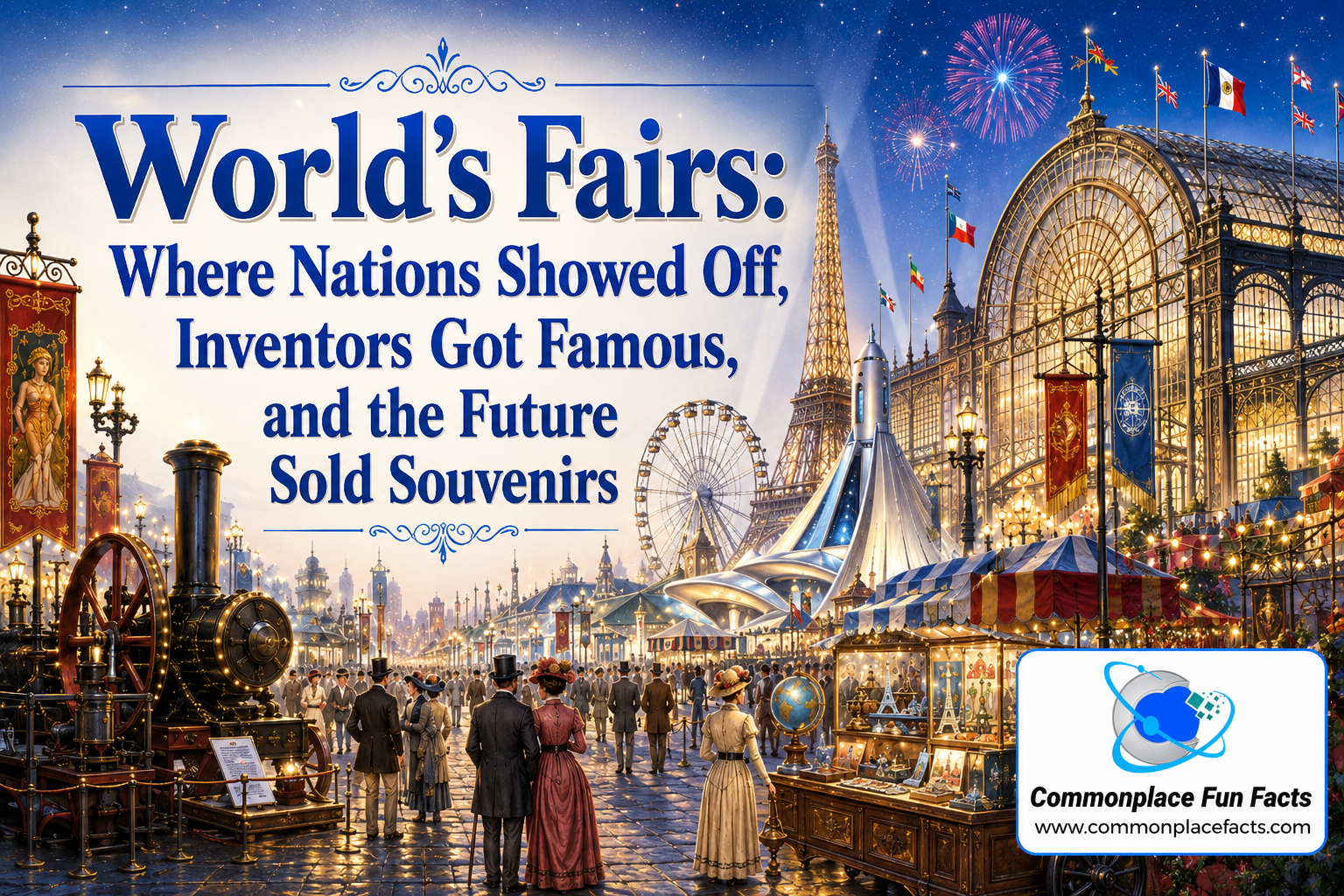

Before there was the Consumer Electronics Show, Disney’s EPCOT, TED Talks, corporate product launches, national branding campaigns, viral tech demos, or breathless videos explaining how a new phone case will “change everything,” there was the world’s fair.
For more than a century, if a nation wanted to prove it was modern, powerful, sophisticated, inventive, cultured, and definitely not overcompensating for anything, it built a temporary city, filled it with machines, statues, fountains, electric lights, exotic displays, national pavilions, questionable food claims, and buildings so large they appeared to be designed by architects who had recently been dared.
The result was the world’s fair: a global showcase of technology, culture, industry, architecture, nationalism, optimism, salesmanship, and the occasional monument to humanity’s ability to say, “Yes, this definitely needs to be 1,000 feet tall.”
World’s fairs introduced millions of people to inventions, architectural wonders, new foods, new ideas, and visions of the future. They gave us the Eiffel Tower, the Ferris wheel, the Space Needle, the Atomium, and a long tradition of governments using very expensive buildings to insist that everything was going splendidly.
They also gave us some of the strangest combinations in human history: industrial machinery next to fine art, colonial propaganda next to snack food, science exhibits next to souvenir spoons, and earnest declarations about world peace sponsored by companies trying to sell refrigerators.
So what were world’s fairs? How did they start? Why were they such a big deal? What happened to them? And why are they still around today, even though most people now experience the future by accidentally agreeing to a software update?
Let us step through the front gate.
Contents
What Is a World’s Fair?
A world’s fair, also known as a world exposition or World Expo, is an international exhibition where countries gather to show off technology, culture, architecture, food, industry, art, design, national identity, and whatever else they believe will make visitors say, “Well, clearly these people have mastered civilization.”

That is the dignified definition.
The less dignified but perhaps more accurate definition is this: a world’s fair is a global bragging contest disguised as an educational experience.
Countries build pavilions. Companies unveil products. Cities reshape themselves. Architects develop temporary cases of monument fever. Visitors walk through displays promising the future will be cleaner, faster, brighter, more efficient, and filled with appliances that somehow require only one smiling housewife and absolutely no visible maintenance.
Modern World Expos are overseen by the Bureau International des Expositions, the intergovernmental organization that supervises official international exhibitions. Today, World Expos are held every five years and usually last up to six months. They are organized around broad themes such as sustainability, mobility, life, design, technology, or humanity’s latest attempt to sound profound on a brochure.
World’s fairs are not merely trade shows. A trade show is where professionals in sensible shoes wander through carpeted convention halls exchanging business cards and pretending to be excited about software integration. A world’s fair is meant for the public. It is part museum, part festival, part theme park, part diplomatic showcase, and part architectural audition for future postcard immortality.
They are also different from the Olympics, although the distinction occasionally gets blurry—especially when the 1904 St. Louis World’s Fair and the 1904 Olympics were mashed together into one sprawling festival of civic ambition, athletic confusion, and questionable planning decisions. Still, in theory, the Olympics are about athletic competition, while world’s fairs are about countries showing off culture, technology, industry, architecture, and national optimism in buildings large enough to suggest someone had misplaced the concept of restraint.
Before the World’s Fair: The Industrial Revolution Needed a Showroom
The world’s fair was born in the 19th century, which is exactly when one would expect humanity to invent the phrase “progress” and then immediately start charging admission to see it.
The Industrial Revolution had transformed the world. Steam engines powered factories and trains. Telegraph wires made communication faster. Machines changed manufacturing. Cities grew. Empires expanded. Mass-produced goods reached consumers in new ways. Everybody with access to iron, glass, coal, and national ambition suddenly wanted to prove that the future belonged to them.
Before world’s fairs became international spectacles, there were local and national industrial exhibitions. These were events where manufacturers, inventors, artists, and governments displayed goods and machinery. They were practical, competitive, and educational. They were also a chance for industrialists to point at a machine and say, “Behold, this device will transform society,” while nearby workers quietly wondered whether that transformation included keeping all their fingers.
By the mid-1800s, Britain was the leading industrial power in the world. It had factories, colonies, trade networks, engineering confidence, and enough Victorian self-assurance to power a small locomotive. What it needed was a stage.
Enter Prince Albert.
The Great Exhibition of 1851: The Crystal Palace Starts the Parade
The first great world’s fair was the Great Exhibition of the Works of Industry of All Nations, held in London’s Hyde Park in 1851.
Even the name sounds like it should arrive in a top hat.
Prince Albert, husband of Queen Victoria, became one of its key champions. The idea was to gather the industrial, artistic, and technological achievements of nations in one massive exhibition. It would celebrate manufacturing, design, science, trade, and peace among nations. It would also unsubtly remind everyone that Britain was doing rather well, thank you very much.
The exhibition was housed in the Crystal Palace, an enormous iron-and-glass structure designed by Joseph Paxton. It looked like a greenhouse that had eaten several railway stations and developed imperial ambitions. Built quickly, filled with light, and vast enough to contain mature elm trees, the Crystal Palace was itself one of the greatest exhibits. At 990,000-square-foot (92,000 m2), it was, at the time, the largest glass building in the world.

Inside, visitors encountered machinery, textiles, tools, furniture, sculptures, raw materials, scientific instruments, fine art, and objects from across the globe. There were thousands of exhibitors and an astonishing number of items on display. The exhibition attracted about six million visitors, which was a staggering number in 1851 and a clear sign that people will absolutely show up if you give them enough glass, iron, machinery, and the vague promise of seeing tomorrow.
The Great Exhibition made a profit, and those profits helped fund institutions in South Kensington, including what became the Victoria and Albert Museum, the Science Museum, and the Natural History Museum.
That is a fairly impressive legacy. Most events today are considered successful if they leave behind an Instagram hashtag and no unresolved parking disputes.
The Great Exhibition established the basic formula: build something spectacular, invite the world, display progress, sell tickets, celebrate technology, promote national prestige, and let everyone leave with the feeling that the future is not just coming—it has rented exhibit space.
The Formula Spreads: Bigger Buildings, Bigger Crowds, Bigger Egos
Once the Great Exhibition proved that millions of people would pay to wander through a giant building looking at machines, fabrics, diamonds, and national self-congratulation, other countries noticed.
World’s fairs spread across Europe and North America. Paris held major expositions. Vienna hosted one. Philadelphia staged the Centennial Exhibition in 1876. Chicago built an entire dream city in 1893. St. Louis, Brussels, New York, Seattle, Montreal, Osaka, and many others followed.
The fairs became tools of national image-making. Host cities used them to rebrand themselves. Nations used them to project power. Companies used them to introduce products. Inventors used them to reach the public. Architects used them to test ideas. Visitors used them to gawk, learn, snack, flirt, buy souvenirs, and complain about crowds, because some human traditions are eternal.
World’s fairs also helped create a new kind of public experience. They were educational, but not in the “please sit quietly while a chalkboard happens to you” sense. They were immersive. Visitors could walk through full-scale environments, watch demonstrations, ride attractions, explore foreign pavilions, see machines in motion, taste unfamiliar foods, and feel as if they had traveled the world without needing steamer trunks, months of sea travel, or a flexible relationship with dysentery.
By the late 19th century, the world’s fair had become a theater of progress. Every host wanted to be bigger, brighter, more modern, and more memorable than the last.
Paris 1889: The Eiffel Tower Was Supposed to Be Temporary
If one structure symbolizes the age of world’s fairs, it is the Eiffel Tower.
The tower was built for the 1889 Exposition Universelle in Paris, which celebrated the 100th anniversary of the French Revolution. Designed by Gustave Eiffel’s firm, the tower was a masterpiece of iron engineering and a monument to industrial confidence.

It was also controversial.
Many artists and intellectuals hated it. They thought it was ugly, monstrous, mechanical, and entirely unworthy of Paris. This is one of history’s more entertaining examples of people looking at what would become one of the most beloved landmarks on Earth and saying, “No, thank you, we prefer our skyline less iconic.”
The Eiffel Tower was originally intended to stand for a limited time. Like many world’s fair structures, it was supposed to be temporary. But it proved useful for communications and wildly popular with visitors. It remained. It became the symbol of Paris. It became the symbol of France. It became one of the most recognized structures in the world.
Not bad for a temporary installation.
The Eiffel Tower also set a pattern. World’s fairs often built things meant to dazzle for a season. A few of those things refused to leave. The result is a global collection of landmarks that began life as exhibition architecture and somehow achieved immortality.
Every city should be so lucky. Most temporary structures leave behind traffic cones and regret.
Chicago 1893: The White City and the Giant People Wheel
If London’s Great Exhibition launched the world’s fair, and Paris gave it the Eiffel Tower, Chicago’s 1893 World’s Columbian Exposition turned it into an American epic.
The fair was intended to commemorate the 400th anniversary of Columbus’s 1492 voyage, although it opened in 1893 because missed deadlines are also part of the universal human experience. Chicago won the right to host after competing against cities such as New York, Washington, D.C., and St. Louis. This was no small thing. Chicago was still recovering its image after the Great Fire of 1871. It was known as an industrial, rough-edged, meatpacking, railroading, smoke-belching powerhouse.

Chicago wanted to show the world it was not merely a place where livestock went to reconsider their life choices.
The fairgrounds in Jackson Park became the “White City,” a dazzling collection of neoclassical buildings, lagoons, canals, statues, electric lights, and carefully arranged urban grandeur. The buildings were mostly temporary, but they created a vision of order and beauty that deeply influenced American architecture and city planning.
At night, electric lighting transformed the fair into a glowing wonderland. For many visitors, this was one of their first experiences seeing electricity used on such a large and theatrical scale. The effect was breathtaking. Imagine living in a world of gas lamps and candles, then walking into a city of light. It must have felt like stepping into a future where no one would be condemned to trip over a footstool at night.
Chicago also needed a signature attraction to rival the Eiffel Tower. Engineer George Washington Gale Ferris Jr. supplied the answer: a massive rotating wheel carrying passengers high above the fairgrounds.
The Ferris wheel was enormous, audacious, mechanical, and slightly ridiculous, which made it perfect. It was America’s reply to the Eiffel Tower, except instead of standing still and looking elegant, it spun people around in the sky like democracy had developed carnival instincts.
The fair attracted tens of millions of visits and helped establish Chicago as a major cultural and architectural city. It also left behind myths, legends, souvenirs, urban planning ideas, and one of the most famous amusement rides in history.
Paris had built a tower. Chicago built a wheel.
Nobody said national rivalry had to be subtle.

The Fair as Future Machine
One of the reasons world’s fairs mattered so much is that they allowed ordinary people to encounter inventions and technologies before those things became ordinary.
Today, the future arrives by pop-up advertisements while you are trying to watch dancing cat videos. A company announces something online, reviewers unbox it, influencers overreact to it, and within 48 hours everyone is either calling it revolutionary or complaining that it will require yet another different type of charging cable.
In the 19th and early 20th centuries, the future needed a physical stage.
World’s fairs provided that stage.
At Philadelphia’s 1876 Centennial Exhibition, visitors encountered Alexander Graham Bell’s telephone, one of those inventions that sounds obvious only after someone invents it. The fair also helped popularize products and brands that would become part of daily life. Later fairs displayed electric lighting, automobiles, motion pictures, television, modern appliances, aerospace technology, computers, and communication systems.
World’s fairs were where companies and governments said, “Here is what tomorrow may look like.”
Sometimes they were right. Sometimes they were spectacularly wrong. This is part of their charm.
The fairs produced visions of homes filled with labor-saving devices, cities shaped by highways and towers, people communicating by video, machines making life easier, and nations solving problems through science and cooperation. They also produced a lot of overconfident predictions about transportation, urban life, and the imminent arrival of household robots.
To be fair, we did eventually get household robots. They vacuum our floors, get stuck under furniture, and send us notifications asking for rescue. This may not be the gleaming utopia the fair planners imagined, but progress is a complicated animal.
Weird World’s Fair Facts, Because of Course There Are Weird World’s Fair Facts
World’s fairs were serious cultural events, but they were also magnets for weirdness. Put millions of people, international competition, giant architecture, inventors, snack vendors, politicians, and souvenir manufacturers in one place, and history begins making strange little popping noises.
Some Structures Were Built to Be Temporary and Then Became Immortal
The Eiffel Tower is the most famous example, but it is not alone. The Space Needle in Seattle, the Atomium in Brussels, and other fair structures became permanent landmarks. A world’s fair could produce a city’s defining image almost by accident.
This is like building a stage backdrop for a school play and having it become the official seal of the municipality.
The Fairs Helped Popularize Foods
World’s fairs often became associated with food folklore. Many claims about “first appearances” are exaggerated, because food history is where certainty goes to be beaten with a waffle iron. Still, fairs did help popularize many products and eating habits by putting them before enormous crowds.
The 1904 St. Louis World’s Fair is especially famous for its food legends, including stories involving ice cream cones, hot dogs, hamburgers, iced tea, and peanut butter. Not all of those claims survive careful scrutiny in their strongest forms, but St. Louis certainly helped expose huge numbers of people to foods that became American staples.
In other words, the fair may not have invented the snack table, but it gave the snack table excellent publicity.
They Were Souvenir Machines
Visitors bought guidebooks, postcards, medals, photographs, plates, spoons, ribbons, and all manner of commemorative objects. The fairs were not just exhibitions of industrial capitalism; they were participants in it.
Nothing says “I have seen the future” like returning home with a small spoon engraved with a building that no longer exists.
They Created Entire Temporary Worlds
World’s fairs often included artificial villages, reconstructed streets, national exhibits, amusement zones, theatrical displays, and elaborate landscapes. These were immersive environments before anyone used the word “immersive” to justify charging $49.95 to stand in a room full of projected sunflowers.
Visitors could stroll through idealized versions of foreign countries, futuristic cities, historical recreations, and industrial showcases. The problem, of course, is that many of these displays simplified, distorted, or exploited the cultures they claimed to represent. We will get to that in a moment, because history rarely lets us enjoy anything without throwing a storm cloud over the rainbow.
The Darker Side of Progress
World’s fairs celebrated progress, but progress often arrived carrying baggage.
Many fairs reflected the imperialism, racism, and social hierarchies of their time. Colonial powers used exhibitions to display the resources, people, and cultures of colonized regions in ways that reinforced ideas of European superiority. Some fairs included “human exhibits” or ethnological displays that treated people as living specimens rather than human beings with dignity, agency, and the understandable desire not to be turned into someone else’s educational attraction.

This is one of the reasons world’s fairs are historically fascinating and morally complicated. They were not just windows into technology. They were windows into power.
The same fair that introduced visitors to electric lighting or modern engineering might also present deeply racist displays. The same event that celebrated international cooperation might rely on colonial extraction. The same architecture that promised a harmonious future might be built on assumptions about who counted as “civilized” and who was expected to stand in a replica village while strangers stared.
That does not mean world’s fairs were unimportant. It means they were human institutions, and human institutions have a troubling habit of bringing both the orchestra and the skeletons.
World’s fairs reveal what societies admired, what they feared, what they misunderstood, what they wanted to sell, and what they preferred not to examine too closely.
They were showcases of progress. They were also showcases of prejudice.
Both things are true, which is inconvenient but historically necessary.
The Cold War Turns the World’s Fair Into Tomorrowland With Propaganda
After World War II, world’s fairs entered a new phase. The age of steam engines and imperial glass palaces gave way to the age of atomic energy, space exploration, corporate futurism, television, suburbs, highways, computers, and Cold War rivalry.
The fairs became stages where nations tried to prove not only that they were advanced, but that their system was the one best suited to lead humanity into the future.
Brussels hosted Expo 58, the first major world’s fair after World War II. Its most famous structure was the Atomium, a giant representation of an iron crystal enlarged to architectural scale. It was a monument to the atomic age, scientific optimism, and the remarkable human ability to look at nuclear technology and say, “Let’s make this family friendly.”

Seattle’s 1962 Century 21 Exposition leaned hard into the space age. It gave Seattle the Space Needle, a landmark that still looks like it was designed by someone who believed the future would involve jetpacks, orbital hotels, and extremely confident coffee consumption.
Montreal’s Expo 67 became one of the great fairs of the 20th century. Held during Canada’s centennial, it featured striking modern architecture, including Habitat 67, Moshe Safdie’s experimental housing complex, and Buckminster Fuller’s geodesic dome for the United States pavilion. Expo 67 projected a confident, international, modern vision at a moment when people still believed architecture might solve everything if only given enough concrete and optimism.
New York’s 1964–65 fair leaned into corporate futurism. Visitors saw exhibits about transportation, communications, consumer goods, automation, and the world of tomorrow. Companies promised convenience, mobility, abundance, and sleek machines that would improve everyday life.
Some of those visions came true. Others did not. The future, it turns out, is highly selective. It gave us video calls but not flying cars. It gave us global communication but also comment sections. It gave us household automation but made us update the refrigerator’s firmware.
Science fiction warned us about hostile artificial intelligence. Nobody warned us that the printer would be the real villain.
Why World’s Fairs Faded from the American Imagination
World’s fairs did not disappear, but they became less central, especially in the United States.
There are several reasons.
First, television changed everything. People no longer needed to travel across the country to see distant cultures, new technologies, or national spectacles. The world came into the living room, followed eventually by cable television, the internet, smartphones, livestreams, and the ability to watch a man in another hemisphere explain sandwich history at 2:00 a.m.
Second, air travel made the world feel smaller. International travel became more accessible. A national pavilion was less astonishing when more people could visit the actual nation, or at least look at it through travel documentaries while eating cereal.
Third, other institutions took over parts of the world’s fair function. Museums became more interactive. Theme parks became more immersive. Tech conferences became more important for product launches. The Olympics became the premier global mega-event. World expos still happened, but they no longer had the same monopoly on wonder.
Fourth, the fairs became expensive. Very expensive. Monumentally expensive. The kind of expensive that causes accountants to stare silently into the middle distance.
Hosting a world’s fair requires land, infrastructure, transportation, security, pavilions, promotion, operations, and a persuasive answer to the question, “What exactly do we do with all of this after everyone leaves?”
That last question matters. Some fairs transformed cities. Others left debts, abandoned sites, or buildings whose best hope was becoming a convention center with unusually dramatic bones.
Finally, the public became more skeptical. The 19th-century faith in inevitable progress took a beating from wars, depressions, environmental crises, nuclear weapons, and the general discovery that technology can improve life while also creating new and exciting categories of disaster.
The future was no longer something everyone automatically trusted just because it had chrome trim.
World Expos Today: Still Alive, Still Expensive, Still Building Pavilions
World Expos still exist. They are simply less dominant in American popular culture than they once were.
Today’s expos are organized around broad global themes: sustainability, mobility, health, design, technology, climate, life, food, energy, and international cooperation. Instead of displaying steam engines and imperial trophies, modern expos feature immersive pavilions, digital installations, sustainability messaging, cultural programming, national branding, and architecture that often appears to have been designed by someone asking, “What if the building itself looked like a TED Talk?”
Expo 2020 Dubai, delayed by the COVID-19 pandemic and held from 2021 to 2022, was the first World Expo in the Middle East, Africa, and South Asia region. It brought together countries from around the world and emphasized opportunity, mobility, and sustainability.

Expo 2025 Osaka, in Kansai, Japan, ran from April 13 to October 13, 2025, with the theme “Designing Future Society for Our Lives.” It welcomed more than 29 million visitors and marked a major post-pandemic World Expo.
The next World Expo is scheduled for Riyadh, Saudi Arabia, from October 1, 2030, to March 31, 2031, under the theme “Foresight for Tomorrow.”
The old fairs said, “Behold this engine.”
The modern expo says, “Please enter this immersive pavilion about planetary resilience, smart cities, inclusive design, and the future of human flourishing. Also, the mascot is available in plush form near the exit.”
Different century. Same basic instinct.
Why World’s Fairs Still Matter
World’s fairs matter because they show us how people imagined the future.
That is their real value.
The buildings are fascinating. The inventions are important. The crowds are impressive. The souvenir spoons are, depending on your household, either charming collectibles or a cry for help. But the deeper significance of world’s fairs is that they reveal what each generation believed progress looked like.
In 1851, progress looked like iron, glass, machinery, free trade, and industrial power.
In 1889, it looked like a tower of iron rising above Paris.
In 1893, it looked like a glowing White City beside Lake Michigan.
In 1958, it looked like atoms, optimism, and a future powered by science.
In 1962, it looked like space-age towers and rockets.
In 1967, it looked like experimental housing, geodesic domes, and international modernism.
Today, it looks like sustainability, digital technology, global cooperation, and carefully worded statements about humanity’s shared future.
Each era builds the future in its own image. Sometimes that image is inspiring. Sometimes it is naïve. Sometimes it is troubling.
World’s fairs are monuments to aspiration. They are also monuments to self-promotion. They show humanity at its most inventive, theatrical, hopeful, commercial, and occasionally ridiculous.
For more than a century, world’s fairs were where tomorrow put on a clean shirt, built a pavilion, turned on the lights, and invited everyone in to stare. They remind us that every generation imagines tomorrow in its own image—sometimes with iron and glass, sometimes with rockets and atoms, and sometimes with solar panels, touchscreens, and a carefully worded mission statement.
The future keeps changing costumes.
World’s fairs just gave it a stage.
You may also enjoy…

Relive the Wonder of the 1893 Chicago World’s Fair
In 1893, Chicago threw a big party in honor of the 400th anniversary of Christopher Columbus’ voyage to the New World. It was a spectacular affair. For five months, people from all over the world flocked to Chicago to take in the sights, which included such things as the first Ferris Wheel, cultural exhibitions, lectures,…

The 1904 Olympics: The Games That Got Lost at the St. Louis World’s Fair
The 1904 Olympics in St. Louis were swallowed by the World’s Fair, producing marathon mayhem, food legends, dazzling spectacle, and deeply troubling human exhibits.

The 1876 Centennial Exposition: The Weird Ways America Celebrated Its 100th Birthday
Step back in time and discover the weird, fascinating, and surprisingly modern ways America celebrated its 100th birthday at the 1876 Centennial Exposition—from telephones to towering machines.


Leave a Reply