
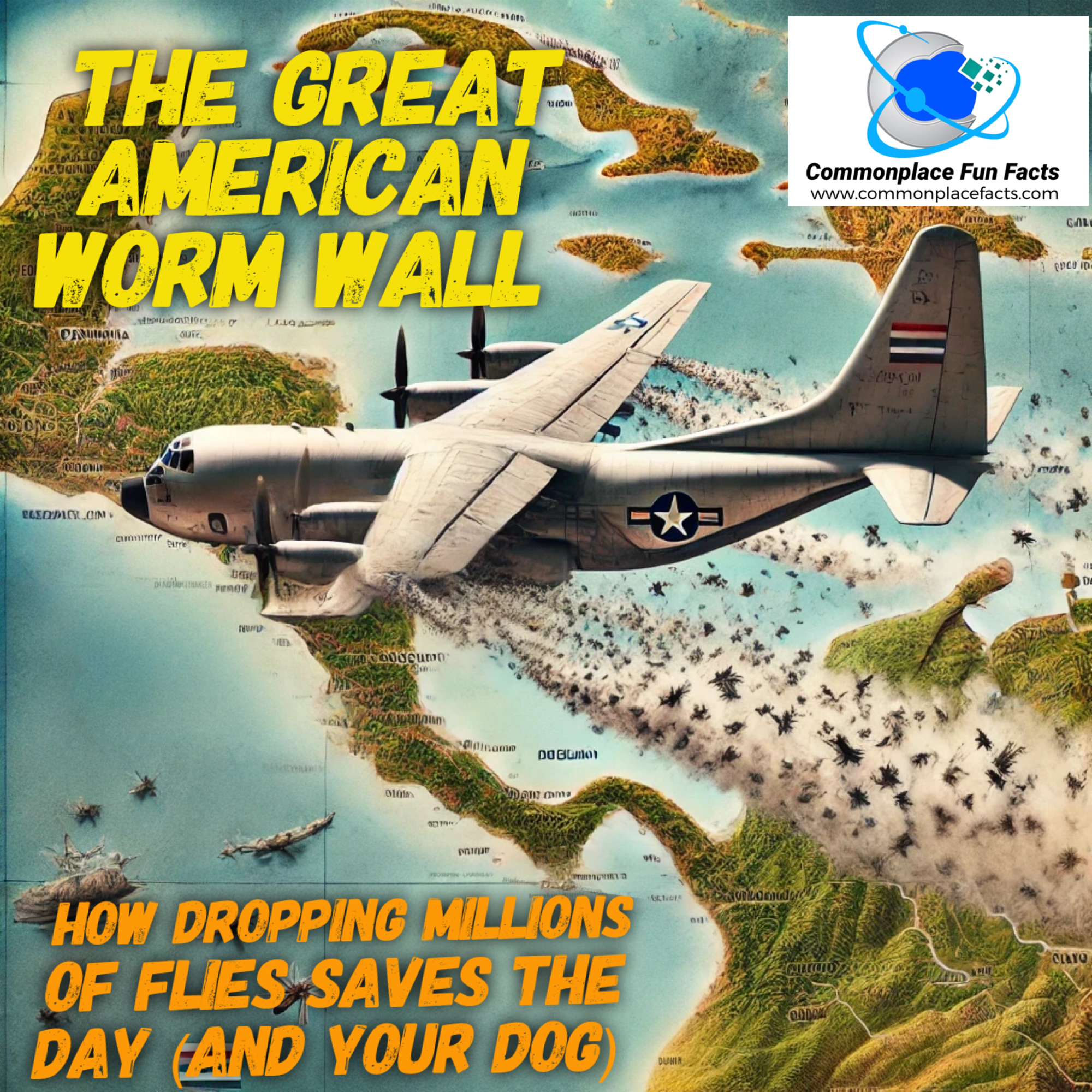

The Great American Worm Wall: How the U.S. and Panama Are Waging — and Winning — a Bug War You Didn’t Know About
Imagine that you are the Commander-in-Chief of the most powerful military in the world. You wake up in a playful mood, wanting to pull a prank on one of your pals. You have a brilliant idea! Why not order the Air Force to drop millions of bugs on a nearby ally? That would give you lots of stories to laugh about at the next United Nations sleepover, wouldn’t it?
What we’re about to tell you about may sound like a super power practical joke, but it is very serious business. We speak of the New World Screwworm Program. This is a decades-long collaboration to protect nearly all of North America from the scourge of one particular fly.
This is no ordinary fly. Welcome to the bizarre, intricate, and surprisingly successful world of what we can only describe as the Great American Worm Wall—a weirdly intricate plan of massive fly drop operations to achieve screwworm eradication. It somehow works wonders. How does one keep flesh-eating flies from decimating livestock across an entire continent? It involves a 24/7 bug factory, boats, planes, X-rays, cow blood, and yes—doughnut holes. Trust us — it’s a story you’ll want to hear.
Meet the Enemy: The New World Screwworm
First, let’s get cozy with the star of today’s nightmare: the New World Screwworm. If it sounds ominous, that’s because it is. Should these little horrors still be flying around the United States, farmers would lose about a billion dollars a year from dead livestock. It’s not just cows who are at risk. These parasitic menaces can infect any warm-blooded mammal, including—you guessed it—humans. Yes, dear reader, these flies could land on your dog, your grandma, or even Boo, the dog who earned the title of “Cutest Dog in the World.” And they wouldn’t even feel bad about it.

The New World Screwworm in its adult form is about twice the size of a regular housefly and a thousand times as rude. Their life cycle begins when the female screwworm lays hundreds of eggs in the open wound of a living animal. Tick bites, scratches, belly button piercings—any entry point will do. Once the eggs hatch, the larvae burrow into the flesh, and feast, eating their host alive. The process is excruciating and often fatal for the poor critter in question.
Now that you’re good and unsettled, let’s talk about how we stop these flesh-eating creeps. It doesn’t involve fly-sized baseball bats (though that would be oddly satisfying).
Edward Kipling and the Dawn of the Screwworm Apocalypse
Enter Edward F. Kipling. Kipling grew up on a farm overrun with screwworms. After a lifetime of wrestling with the things, he figured out a crucial weakness: female screwworms only mate once. Romantic, right? The downside for them is that if you can mess up that one-and-only mating session, they’re toast.
After years of research, Kipling cracked the code. It turns out, if you hit a fly with the right amount of radiation at the right stage of development, it becomes sterile. This was risky research, as any comic book lover knows. Radioactive screwworms could easily have produced yet another truly weird comic book character. Fortunately, Kipling’s research resulted in something good and became the cornerstone of the brilliant screwworm eradication program we now enjoy. You’ve heard of the Great Wall of China. Thanks to Kipling, we now have the Great American Worm Wall—an invisible, ever-present defense system made up of sterile flies.
The Bug Factory: Where the Magic (and Millions of Flies) Happen
Every heroic tale needs a fortress, and in this one, the stronghold is a fly factory in Pacora, Panama. Here, 115 people work to raise and sterilize 20 million screwworm flies every week. Yes, you read that right. There’s a fly farm where these parasites are raised in rooms that mimic the cozy, humid environment of an open wound. They’re fed a delightful mix of reconstituted milk, eggs, powdered cow blood, and cellulose. We suspect it is staffed by the lunchroom ladies who churned out our meals when we were in high school.

Once these worm babies are big and fat, they’re hit with a healthy dose of radioactive Cobalt-60. This sterilizes them, making them useless in the reproduction department, but still plenty capable of developing into millions of maniac fliers.
What better place for millions of fliers than the airport? That’s where our journey next takes us.
Fly Drop Operation: Screwworm Eradication From the Skies
Now, for the fun part. The flies—still larvae at this point—are packed into coolers and shipped to a sorting facility, where they’re placed in trays. After transforming into adult flies, they’re sent to a cold room to chill out. Literally. Once they’re sleepy and docile, they’re loaded into planes for what is surely the weirdest field trip any creature could ever take.
Here’s where COPEP (the Joint U.S.-Panama Commission for screwworm eradication) comes in. They’ve modified retired military planes to drop these sterile flies from the sky over the Panama-Colombia border. It’s a tactical strike of sorts—an airborne operation involving 2.1 million flies per flight, all destined to screw up the screwworm population in one way: by not reproducing.
Technicians used to chuck boxes of flies out of the plane’s belly, but that proved unreliable (turns out, cardboard boxes don’t always open on impact). Now, the flies are released through a sophisticated chute system that sprinkles them over the jungle, where they wake up mid-air and head off to eradicate their own kind. In other words, it’s a fly-on-fly crime spree that we should all be thankful for.
And by the way… bombing with animals — or animal parts — is nothing new, as we detailed in this piece about the great European Chicken Head Bombing Expedition.
Flies for Everyone: The Backup Plan
Here’s where the surplus comes in. Remember how the factory churns out 20 million flies a week, but the planes only drop 2.1 million per flight over six weekly flights? Well, those extra flies don’t go to waste. In fact, they’re dispatched to handle outbreaks elsewhere.
When screwworms turned up in places like Aruba in 2004 and 2011, or even the Florida Keys in 2016, the U.S. sent in waves of sterile flies to wipe them out. The Florida operation was particularly impressive: the USDA released a whopping 190 million flies, and in just three generations of screwworms, the infestation was eradicated. As a bonus, part of that Florida effort involved feeding anti-parasite medicine to infected deer using doughnut holes. This, of course, implies the existence of a Federal Doughnut Budget (FDB), which sounds even more exciting than the federal government’s secret strategic chicken stockpile.
On the Ground: Inspectors, Paint, and More Flies
The air war is only part of the solution. On the ground, COPEP employs 13 field teams who monitor livestock across the Darién Gap, the treacherous jungle region where screwworms are most likely to sneak through. These teams use boats, horses, and motorcycles to travel to at-risk farms, where they inspect animals for any signs of infection.
And what do they do when they find screwworms? They coat the infected wounds with anti-parasite paint, which kills the worms before they can spread. Meanwhile, cattle leaving the Darién are subjected to rigorous inspections to ensure they aren’t carrying any hitchhiking larvae.
The Cost of War: The Economics of Fly-Dropping
Let’s talk money. The entire screwworm program costs about $15 million a year, which, considering the billions it saves in livestock and medical costs, is an absolute bargain. To put it in perspective, this invisible fly wall has been in place for decades and works so seamlessly that most of us have never even heard of it. And that’s a good thing—when it comes to flesh-eating worms, ignorance truly is bliss.
From Mississippi to Mexico: Expanding the Worm Wall
The U.S. screwworm eradication effort started in 1957, east of the Mississippi, and by 1966, the U.S. declared itself screwworm-free. But holding the western border proved tricky, so in 1972, the U.S. made a deal with Mexico to jointly eradicate screwworms across their border, pushing the worm wall down to the Isthmus of Tehuantepec—a much narrower and easier-to-defend strip of land.
From there, the program expanded into Central America, with the U.S. footing 85% of the bill and partner countries covering the rest. By 2006, screwworms had been eradicated across Mexico and Central America, with only a small buffer zone left along the Panama-Colombia border. This buffer zone, while invisible to the naked eye, is the last line of defense keeping the rest of the continent screwworm-free.
A Quiet, Weird, but Necessary Success
The Great American Worm Wall is one of those success stories that flies (see what we did there?) under the radar. It’s a testament to what can happen when governments, scientists, and yes, even a few doughnut holes, come together to solve a big, weird problem. It’s effective, saves lives, and protects livelihoods—all while operating so smoothly that most of us don’t even know it’s there.
The next time you are troubled by inefficient government, take a moment to contemplate the Great American Worm Wall. It’s nice to see at least one example of your tax dollars accomplishing something good.
You may also enjoy…
All of the Other Reindeer Used to Mock His Nasal Microcirculation
Scientists studying the origin of Rudolph the Red-Nosed Reindeer’s most-distinctive feature believe they have figured out why his nose is so bright. The short story is that it is due to an over-abundance of red blood cells. More precisely, “detailed evaluation of adult reindeer’s nasal microcirculation revealed similarities with human nasal microvasculature, but also striking…
Fish Got Your Tongue?
There’s something fishy going on in the Gulf of California. The fish know about it, but they aren’t talking. You could literally say that something has their tongues. Cymothoa exigua is a species of undersea louse that has adopted a peculiar way to survive. It targets the rose snapper fish and enters its body through…
The Postage Stamp Responsible for the Panama Canal
The Panama Canal is so inseparably linked to the nation of Panama that it is difficult to imagine it existing anywhere else. As it turns out, the site for the canal was very nearly the nation of Nicaragua. When it came down to the moment of decision, it was a pretty tiny thing that decided…





Leave a Reply