
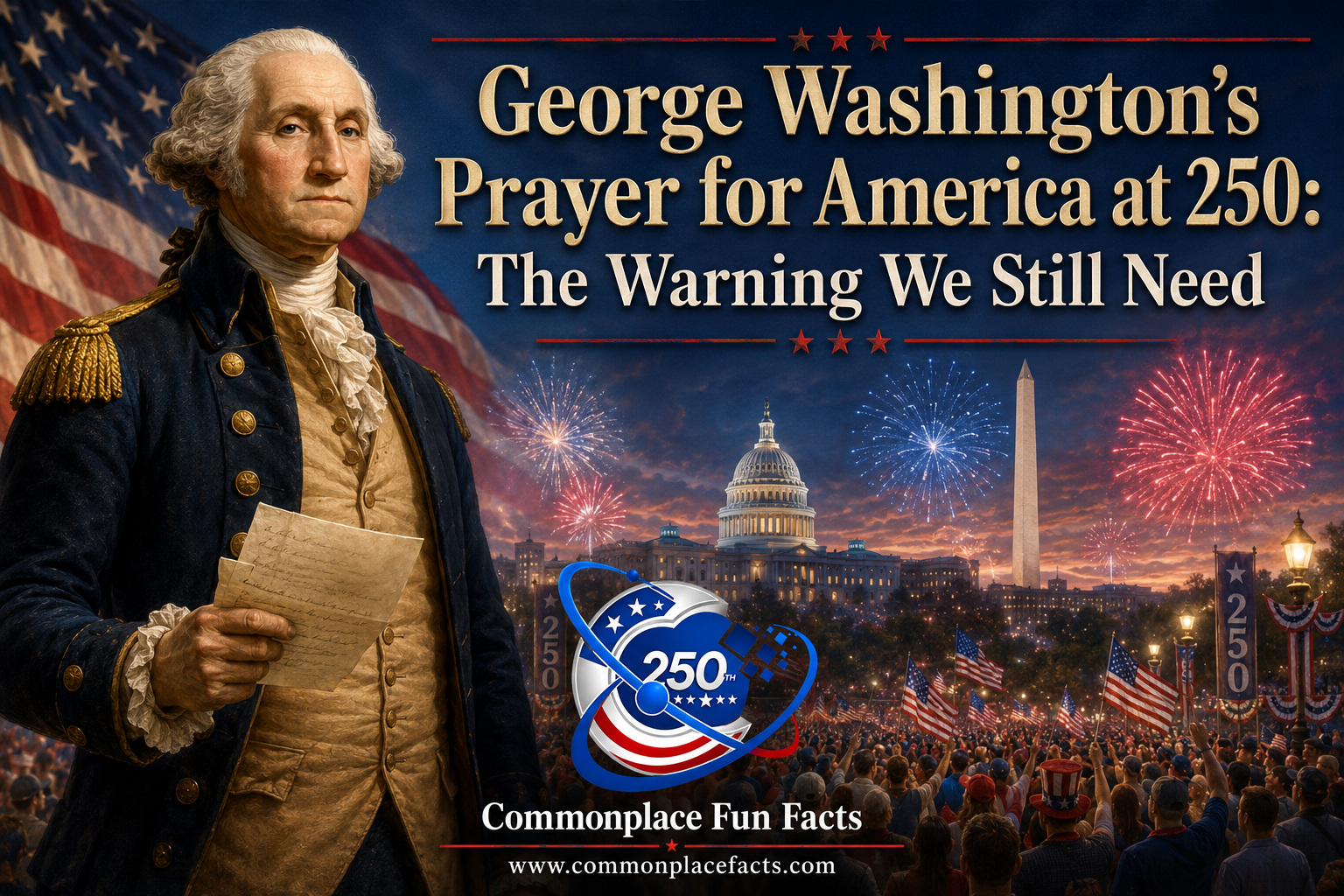

Today, July 4, 2026, America turns 250 years old. That is either impressively young for a nation or alarmingly old for an experiment, depending on whether you are looking at it through the eyes of a historian, a constitutional lawyer, or someone who has recently read the comment section under a political news story.
Two hundred and fifty years after the Continental Congress adopted the Declaration of Independence on July 4, 1776, the United States is celebrating its semiquincentennial. That word sounds like something Benjamin Franklin might have invented during a fever dream, but it simply means the nation has reached its 250th birthday. Congratulations, America. You made it to the quarter-millennium mark.
This is a good day for fireworks, flags, parades, questionable hot dog decisions, and arguments over whether it is really necessary to set off explosives until the neighborhood dogs begin drafting a petition for independence. But it is also a good day to look back at one of the most important prayers ever connected to the American founding: George Washington’s Prayer for the Nation.
Washington’s prayer is often quoted as a patriotic devotional. It is short, reverent, and suitable for framing, which is the highest honor Americans can bestow on any historical text not already printed on a throw pillow. But the prayer was not originally a stand-alone inspirational saying. It was the closing paragraph of Washington’s Circular Letter to the States, written on June 8, 1783, near the end of the Revolutionary War.
That makes it especially appropriate for America’s 250th birthday. Washington’s prayer was not merely a request that God bless the country. It was part of his final warning to a young nation that had won independence but had not yet proven it could survive itself.
In other words, George Washington did not just hand America a birthday card. He handed it homework.
Contents
America Was Born on July 4, But It Was Not Fully Housebroken
Americans celebrate July 4 because the Continental Congress adopted the Declaration of Independence on that date in 1776. The actual vote for independence happened on July 2, because history enjoys being technically correct at inconvenient moments. The familiar parchment copy was not signed by everyone on July 4, either. Delegates began signing the engrossed copy on August 2. Still, July 4 became the date fixed in national memory because that is the date on the Declaration itself.

And what a document it was. The Declaration announced that the thirteen colonies were no longer merely annoyed British subjects with increasingly aggressive social media posts. They were independent states, appealing to the world and to “the Supreme Judge of the world” for the rectitude of their intentions. It was bold, dangerous, eloquent, and just vague enough about future implementation to guarantee generations of argument.
But declaring independence and securing independence were not the same thing. The Declaration was the birth announcement. The Revolutionary War was the delivery room. And like many delivery rooms, there was yelling, blood, confusion, and quite a few nervous fellows who were sent to boil water so they would stay out of everyone’s way.
By the time Washington wrote his prayer in 1783, America had survived the war. Barely. The British were leaving. Peace was coming. The United States was independent. And yet the new country was still fragile, broke, divided, suspicious of central authority, and held together by a government under the Articles of Confederation that had all the coercive power of a strongly worded group text.
That is the world behind Washington’s prayer. It was written not in the glow of July 4, 1776, but in the uneasy aftermath of victory. America had been born. Washington was worried about whether it would grow up.
The War Was Ending. The Problems Were Not.
By June 1783, the American Revolution was effectively won. The preliminary peace had been announced, and the formal Treaty of Paris would soon recognize the United States as an independent nation. That was the good news.
The bad news was everything else.
The army had not been paid properly. Veterans were worried they would be sent home with promises, gratitude, and possibly a commemorative handshake. Congress had limited power to raise money. The states guarded their own interests. Public credit was shaky. The army was exhausted. The government was weak. The whole enterprise looked less like a confident new republic and more like a group project where everyone insisted they had done their part but somehow the slides were still missing.
Washington had seen the danger up close. Just a few months before writing the Circular Letter, he had faced the Newburgh Conspiracy, when angry officers in the Continental Army considered using pressure against Congress to secure their pay and pensions. The very army that had fought for republican liberty was now flirting with military intimidation of civilian government.
That is not a small problem. That is the kind of problem that makes historians reach for adjectives like “constitutional,” “existential,” and “please tell me George Washington is somewhere nearby.”
Fortunately, he was.
On March 15, 1783, Washington appeared before his officers at Newburgh and urged them to remain loyal to civilian authority. Then came one of the most famous moments of his life. He pulled out his spectacles and said, “Gentlemen, you will permit me to put on my spectacles, for I have grown not only gray, but almost blind in the service of my country.” The officers saw the toll the war had taken on him, and the emotional force of the moment helped defuse the crisis.
If you want the fuller story of this history-changing pair of eyeglasses, see Did George Washington’s Glasses Save American Democracy?. It is one of those rare historical episodes where constitutional order may have been preserved by eyewear. The republic has survived stranger things, but not many.
Washington’s Circular Letter Was His Exit Memo
After Newburgh, Washington began preparing to leave military command. His Circular Letter to the States was addressed to the governors, but it was meant for the country. It was his farewell counsel to the people and leaders of the United States before he resigned his commission and returned to Mount Vernon.
That matters because victorious generals are not supposed to go home quietly. History is filled with military saviors who discovered, with touching personal convenience, that the nation could not possibly survive unless they remained in charge permanently. Washington did the opposite. He won the war, strengthened civilian authority, warned the country not to ruin the victory, and then gave power back.
That act of restraint is one of the reasons Washington became more than a successful general. He became a model of republican virtue. He understood that the real test of power is not whether you can get it. Lots of people can get power. Some of them even do it while achieving admirable goals. The real test is whether you can give up that power.
Washington did. Twice, actually: first when he resigned his military commission, and later when he stepped away from the presidency after two terms. America’s birthday celebration would feel very different if its most indispensable man had decided indispensability was a lifetime appointment.
Instead, Washington used his farewell letter to tell the states what the young republic needed if it hoped to survive.
Washington’s Four-Part Survival Kit for America
Before he prayed for the nation, Washington warned it. In the Circular Letter, he identified four things he believed were essential to the existence of the United States as an independent power. These were not mild suggestions, like “consider rotating the tires” or “maybe do not store gunpowder next to the fireplace.” Washington called them the pillars on which American independence and national character depended.

- An indissoluble union of the states under one federal head.
- A sacred regard to public justice.
- The adoption of a proper peace establishment.
- A peaceful and friendly disposition among the people, strong enough to overcome local prejudice and private advantage.
That list explains what Washington feared. He was not worried that Americans lacked courage. He had seen their courage for eight miserable years. He was worried that courage without unity, justice, order, and restraint would produce a country that could defeat the British Empire and then immediately trip over its own furniture.
The first pillar was union. Washington knew that thirteen states acting like thirteen separate countries would invite foreign manipulation, internal conflict, and endless bickering. In other words, he had already imagined the future and was not comforted.
The second pillar was public justice. That meant paying debts, honoring obligations, and treating soldiers and creditors fairly. Washington had little patience for a nation that would ask men to bleed for liberty and then suddenly discover accounting complications when the bill came due. Everyone loves sacrifice until sacrifice submits an invoice.
The third pillar was a proper peace establishment. Washington was not calling for a military state. He had just worked to prevent one. But he knew the new country needed a sensible defensive structure instead of a national security plan built entirely around optimism and the hope that Britain would lose America’s forwarding address.
The fourth pillar may be the hardest: civic affection. Washington wanted Americans to set aside local prejudices, make mutual concessions, and sometimes sacrifice private advantage for the common good. This was a large request in 1783. It remains a large request in 2026, though now we also have social media to make it worse at broadband speed.
That is why Washington’s prayer feels especially relevant on America’s 250th birthday. The fireworks celebrate the Declaration. Washington’s prayer reminds us that declaration is not the same as preservation. A nation can be born in a moment. Keeping it alive takes character.
George Washington’s Prayer for the Nation
After laying out his warnings, Washington closed the Circular Letter with the passage now known as his Prayer for the Nation. In its commonly adapted national form, it reads:
I now make it my earnest prayer, that God would have the United States in His holy protection, that He would incline the hearts of the Citizens to cultivate a spirit of subordination and obedience to Government, to entertain a brotherly affection and love for one another, for their fellow citizens of the United States at large, and particularly for their brethren who have served in the Field, and finally, that He would most graciously be pleased to dispose us all, to do justice, to love mercy, and to demean ourselves with that charity, humility, and pacific temper of mind, which were the characteristics of the Divine Author of our blessed Religion, and without a humble imitation of Whose example in these things, we can never hope to be a happy Nation. Amen.
There is one small wording note. The version commonly recited today says “the United States.” Washington’s original letter was addressed to state executives, so he wrote, “that God would have you and the State over which you preside, in his holy protection.” The modern version adapts the wording for national use.
This is not a scandal. No one discovered that Washington’s prayer was secretly written by a committee of interns in 1927. The substance is Washington’s. The adaptation simply turns a letter to individual governors into a prayer for the country as a whole.
And on America’s 250th birthday, the adapted version lands with unusual force. Washington prayed that Americans would obey legitimate government, love one another, honor those who served, do justice, love mercy, practice charity, embrace humility, and live with a peaceable spirit.
That is not just a prayer. That is a national performance review.
“Do Justice, Love Mercy” Was Not Decorative Language
Washington’s closing language echoes Micah 6:8: “to do justice, to love mercy.” He then adds charity, humility, and a “pacific temper of mind.” The word “pacific” here means peaceable, not ocean-adjacent. Washington was not asking Americans to adopt a West Coast personality. He was asking them to cultivate the self-restraint needed for republican government.
That theme runs through the whole letter. Washington did not think national happiness would come automatically from independence. He believed liberty required character. The country needed citizens who could obey lawful government, love one another across divisions, honor veterans, and imitate the humility and charity of Christ.
That point is easy to miss when the prayer is treated as a nice patriotic quotation. Washington was not merely saying, “God bless America.” He was saying, “God form the kind of people who can handle America.”
A birthday party celebrates survival. Washington’s prayer asks whether the nation has matured. The cake may have 250 candles on it, but the real question is whether the guest of honor has learned anything since 1776. Some days, the answer is inspiring. Other days, the answer is available on cable news, and everyone should probably take a walk.
Washington Was Serious About Restraint
The prayer also fits what we see in other Washington stories. He was not perfect, and serious history should never turn real people into marble lawn ornaments. But again and again, Washington showed an unusual ability to restrain himself when pride, anger, ambition, or convenience might have pointed in another direction.
During the Battle of Germantown, for example, Washington returned a lost dog belonging to British General William Howe. That story is explored in George Washington and the Dogs of War: A True Story of Compassion During Battle. Even in wartime, Washington could recognize that a dog was not an enemy combatant. This is another reason dogs remain morally superior to most political systems.
As a young man, Washington also once allowed a heated argument with William Payne to escalate into violence. Payne knocked him down. Washington later apologized rather than turning the incident into a duel or a permanent feud. That episode appears in How George Washington Turned an Enemy Into a Friend With an Apology. It is a useful reminder that humility was not just a word Washington admired in other people. He occasionally had to practice it the hard way, which is usually how humility arrives.
Perhaps these qualities grew out of Washington’s lifelong attempt to live by principles he absorbed early. As a teenager, he copied out what became known as the Rules of Civility, a list of 110 maxims about manners, self-control, humility, and how not to behave like a feral raccoon in polite company. See George Washington’s Rules of Civility: The Complete 110 Rules in Plain English for a closer look at the principles impressed upon young Washington and, judging by much of his later life, not entirely wasted on him.
All of these stories help explain why the prayer matters. Washington’s request for charity, humility, and peace was not abstract. It reflected the kind of public virtue he believed the nation needed and the personal discipline he had spent a lifetime trying, sometimes imperfectly, to practice.
The Prayer Still Gets Read at Mount Vernon
Washington’s prayer did not vanish into the archives, where old documents go to be admired by scholars and ignored by nearly everyone else. It remains part of the public memory of Mount Vernon.
At Mount Vernon’s Tribute at the Tomb, visitors participate in a brief wreath-laying ceremony at the Washingtons’ Tomb. The ceremony includes the Pledge of Allegiance, General Washington’s prayer for his country, and the placement of a wreath.
There is something fitting about that. The prayer began as Washington’s farewell request to the states. Today it is read beside his tomb, where the man who repeatedly gave up power is honored by a country that still argues over what to do with the liberty he helped secure.
America is now 250 years old. It has survived civil war, depression, world wars, scandal, assassinations, economic crashes, constitutional crises, disco, and the existence of Christmas decorations that stay up forever. Through all of it, Washington’s prayer keeps asking whether the country can be not merely powerful, but good.
What About Washington Praying at Valley Forge?
No discussion of George Washington and prayer can avoid the famous image of Washington kneeling in the snow at Valley Forge. You have probably seen it: Washington alone in the woods, hat removed, horse nearby, heaven presumably listening attentively. It is one of the most enduring images of the American Revolution.

It is also historically tricky.
The story was popularized by Mason Locke Weems, the same early Washington biographer who gave us the cherry tree tale. That should immediately cause the historian’s eyebrow to rise. Weems was very good at creating moral stories about Washington. He was less committed to the modern historian’s tedious obsession with evidence, documentation, and not inventing scenes because they would look magnificent on a schoolroom wall.
The Museum of the American Revolution notes that Weems used stories often based on little or no evidence to present Washington as a heroic American. The Valley Forge prayer story belongs in that category of inspiring national memory that may tell us more about what later Americans wanted Washington to represent than about what can be proven happened behind a tree in the winter of 1777–1778.
This does not mean Washington never prayed. It means the famous kneeling-in-the-snow scene should be handled carefully. There is a difference between documented history and patriotic folk art wearing boots.
That is why the 1783 prayer is so valuable. We do not need to rely on legend. We have the words. We have the date. We have the letter. We have Washington, at the end of the war, telling America exactly what he hoped God would form in its citizens.
Washington’s Prayer and Religious Liberty
Washington’s public religious language was serious, but it was not narrow. He connected religion, morality, and civic virtue, but he also affirmed liberty of conscience.
One of the best examples came in 1790, when Washington responded to the Hebrew Congregation of Newport, Rhode Island. In that letter, associated with Touro Synagogue, Washington declared that the government of the United States “gives to bigotry no sanction, to persecution no assistance.” That remains one of the strongest statements of religious liberty from the founding generation.
That matters because Washington’s Prayer for the Nation was not a demand for religious coercion. He prayed that Americans would cultivate justice, mercy, charity, humility, and peace. Later, as president, he affirmed that the new government should protect religious freedom rather than treat tolerance as a favor handed down by the majority.
That was a radical idea in a world where governments had often treated religious minorities as problems to be managed, punished, or politely excluded from the good chairs.
At 250, America still wrestles with that inheritance. The country was founded with soaring claims about liberty while also tolerating terrible contradictions. That tension is not a reason to ignore the founding. It is a reason to understand it honestly. Washington’s prayer belongs in that conversation because it does not congratulate Americans for already being virtuous. It asks God to make them so.
From Washington’s Prayer to Thanksgiving
Washington returned to similar themes as president. In 1789, the First Federal Congress asked him to recommend a national day of thanksgiving. He issued a proclamation naming Thursday, November 26, 1789, as a day of public thanksgiving. This was the first Thanksgiving celebrated under the new Constitution.
The timing matters. The Constitution had only recently gone into effect. The federal government was still new enough that someone probably should have kept the receipt. Washington’s Thanksgiving Proclamation invited Americans to give thanks for the establishment of government, civil and religious liberty, and the peaceful creation of the constitutional order.
That connects directly back to the 1783 prayer. In both cases, Washington framed national success as more than military victory or political machinery. America needed gratitude, justice, humility, obedience to lawful authority, and a willingness to live together as one people. The Constitution could build the frame. Citizens still had to decide not to chew through the beams.
America at 250: A Birthday Party With Homework
America has had big birthdays before. The Bicentennial in 1976 came with tall ships, patriotic pageantry, commemorative everything, and enough red, white, and blue merchandise to make Betsy Ross quietly back away from the fabric table. For more on that national celebration, see The 1976 Bicentennial: Tall Ships, Freedom Trains, Beards, and America’s 200th Birthday Party.
The 250th birthday is different. A quarter-millennium gives a nation time to build institutions, fight wars, correct injustices, create new ones, expand rights, contradict itself, inspire the world, embarrass itself, and develop a suspicious number of regional opinions about barbecue.
That is why Washington’s prayer matters today. It does not ask us to pretend America’s history has been simple. It does not ask us to treat the founding generation as plaster saints. It does not require us to ignore the failures, challenges, or unfinished promises embedded in the American story.
Instead, it asks whether Americans can become the kind of people a free republic requires.
Can citizens cultivate brotherly affection when politics rewards contempt?
Can they honor lawful government without worshiping power?
Can they do justice and love mercy at the same time?
Can they remember those who served in the field, not merely with speeches and statues, but with actual public justice?
Can they practice humility in a culture where everyone has a platform, a microphone, and the serene confidence of a man who has read half a headline?
These are not small questions. They are the questions Washington left behind.
Washington’s Prayer Was Also a Warning About Power
The most striking thing about Washington’s prayer is where it appears: at the end of a letter written by a victorious general preparing to leave power.

Washington had power. He had prestige. He had an army that adored him. He had officers angry enough at Congress to consider drastic action. If he had wanted to become an American Caesar, the moment was available.
Instead, he used his influence to calm the army, strengthen civilian government, urge national unity, call for justice to soldiers and creditors, and then retire. His prayer was the final note of a larger act of restraint. The man who could have seized power prayed instead that Americans would learn humility.
That may be why Washington remains so difficult to replace in the American imagination. He was not flawless. No human being is, and the ones who claim to be should generally not be trusted with either power or small appliances. But Washington understood something many successful revolutionaries did not: winning power is one thing; giving it back is another.
The second part is where republics find out whether they are real.
This is also why Washington keeps showing up in the odd corners of American memory. Whether it is the 110 Rules of Civility that shaped him as a teenager, the eyeglasses that helped defuse the Newburgh crisis, or the lost dog he returned to an enemy general, Washington’s legacy keeps circling back to restraint, duty, and the strange power of doing the right thing when doing the selfish thing would be easier.
George Washington’s Prayer for America at 250
On America’s 250th birthday, Washington’s Prayer for the Nation reads less like a historical artifact and more like an open assignment.
He prayed for protection. He prayed for obedience to legitimate government. He prayed for affection among citizens. He prayed for justice, mercy, charity, humility, and peace. He prayed that Americans would imitate the character of Christ because, without that, he said, “we can never hope to be a happy Nation.”
That final phrase is worth holding onto: a happy nation.
Not merely a rich nation. Not merely a powerful nation. Not merely a loud nation, although we have certainly mastered that portion of the curriculum. A happy nation.
Washington understood that happiness in the civic sense does not mean constant cheerfulness or national self-congratulation. It means ordered liberty. It means justice and mercy living in the same house without throwing plates. It means citizens who can govern themselves because they have learned to restrain themselves and hold their leaders to the same expectations.
The Declaration of Independence gave America its birthday. Washington’s prayer reminds America what kind of maturity that birthday requires.
So light the fireworks. Wave the flags. Enjoy the parades. Eat the hot dogs. America is 250 years old, and that is worth celebrating.
But when the smoke clears, Washington’s prayer is still waiting.
Do justice. Love mercy. Practice humility. Cultivate peace. Love one another. Honor those who served. Give power back when duty requires it.
Two hundred and fifty years in, that is still the assignment.
You may also enjoy…

How a 22-Year-Old George Washington Accidentally Started the Seven Years’ War
Before George Washington led a revolution, he accidentally started a global war. Discover how a 22-year-old militia officer triggered the Seven Years’ War—and the chain reaction that led to American independence.

Skull-duggery at Mount Vernon: What Happened to George Washington’s Skull?
Few names are revered more than that of George Washington. As the father of his country and first president of the United States, he was, as Major General Henry Lee eulogized him, “First in war, first in peace, and first in the hearts of his countrymen.” That doesn’t mean everyone held him in complete respect.…

A Sailor, A Prayer, and a Purposeful Life
Lieutenant King heard the alarm and rushed to duty. It was December 1944. His ship was facing its biggest battle of World War II. The mighty USS Monterey had been in service for over a year and had been involved in several battles. Nothing compared to what the aircraft carrier was going through now as…




Leave a Reply