
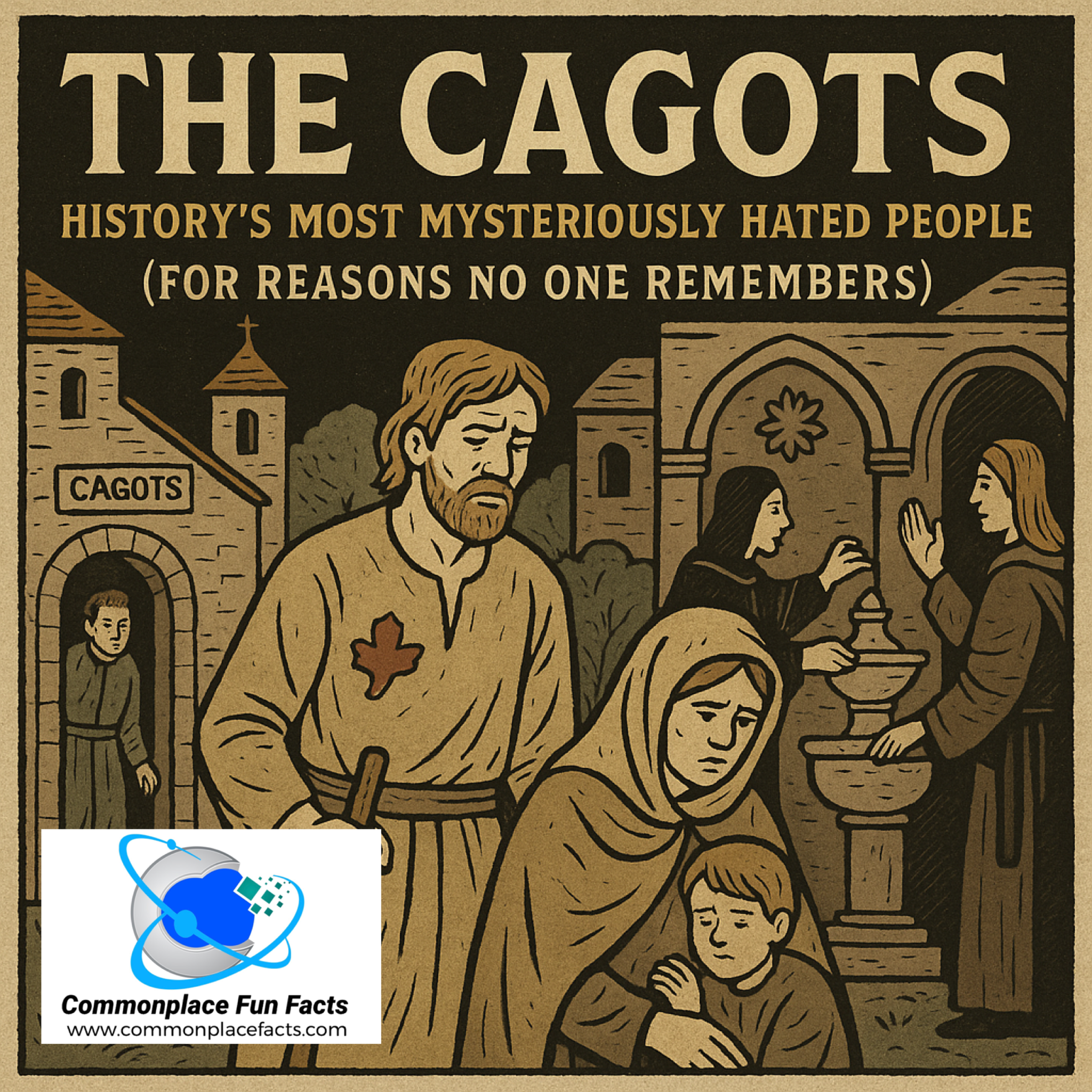

Picture this: You live in a picturesque village in the Pyrenees. You go to church, speak the local language, pay your taxes, build a decent bookshelf—and yet, you’re considered untouchable. Literally. You’re not allowed to drink from the town well, walk barefoot, or even use the same church entrance as everyone else. What did you do to deserve this treatment? Nothing. You were just born a Cagot. And why are the Cagots treated this way? No one really knows.
Long before high school culture invented the concept of being judged for things that make no sense, medieval Europe had perfected it with the Cagots—a group so relentlessly discriminated against that historians still can’t agree on why. That’s right: a millennium of social exile, and no one remembers the inciting incident. It’s like being permanently canceled over a tweet you never sent.
Join us as we delve into a long history of being bullied, without even a cool origin story to show for it.
Where Did the Cagots Come From?
If you’re hoping for a tidy origin story with dramatic flair—maybe a rebellious ancestor who insulted a bishop, or a magical goat that cursed their bloodline—sorry to disappoint. The truth is even murkier than medieval soup.

The Cagots (pronounced “ka-goes”) first show up in historical records around the 11th century, scattered along the Pyrenees mountains, which now form the border between southwestern France and northern Spain. That’s a lot of scenic isolation to work with, which, as it turns out, is perfect if you’re planning to invent a caste system no one can later explain.
They were known by different names depending on the region—“Cagots” in France, “Agotes” in Spanish Navarre, “Gafos” in Aragon, and a handful of other regional aliases that all basically meant: “Those people we avoid for reasons we can’t articulate.” But no matter what you called them, the treatment was the same—segregated neighborhoods, barred professions, and the kind of social distancing that made the Black Death look like a group hug.
“They are avoided as if they had the plague, although nobody can say why.”
— 17th century French observer
What’s strange is that the Cagots were completely indistinguishable from their neighbors. Same language, same religion (Roman Catholic), same ethnicity, same haircuts. They weren’t invaders or converts or aliens from the future. They were just… there. And apparently, that was enough to inspire a millennium of medieval side-eye.
Historians have combed through charters, church records, and more than a few passive-aggressive papal bulls, and while the paper trail shows the Cagots being treated like pariahs, it never quite gets around to explaining why. It’s like walking into a feud that’s already been going on for so long, nobody remembers who threw the first turkey leg.
Life as a Cagot: Medieval Misery Bingo
Let’s talk about what being a Cagot meant. First, you were born into it. There was no conversion, no application process, no reality show audition. Just bad luck in the gene pool lottery. Cagots were confined to their own neighborhoods, forbidden from owning land or weapons, and restricted to certain professions—mainly carpentry and other manual trades. So yes, they could build you a house, but heaven help them if they touched your bread.
In church, Cagots had to use a separate entrance, sit apart from everyone else, and avoid touching the holy water fonts. Some churches even installed a little spout just for them. It was the medieval equivalent to segregated drinking fountains in the pre-Civil Rights era.

They were also required to wear a badge, often depicting a goose foot. Nothing quite says “public shaming” like involuntary poultry symbolism. And no, nobody knows why a goose foot. It could just as well have been a pencil drawing of Charlemagne combing his hair with a hedgehog for all the sense that it makes.
Theories, Myths, and Medieval Shrugs
So why did everyone hate the Cagots? Excellent question. Here are some of the leading theories, each more speculative than the last:
- Descendants of Lepers: Some say the Cagots were linked to medieval leper colonies. The theory goes that even after they were cured, society just couldn’t let go of the stigma. But there’s no medical evidence—and even the Church eventually got over lepers. Not so with Cagots.
- Visigothic Descent: Others claim they were descendants of the Visigoths—those early medieval invaders who ruled parts of France and Spain. This would explain their outsider status, if not their bizarre treatment. But, again, Visigoth lineage was pretty widespread, and not everyone with a Gothic grandpa got banned from the baptismal font.
- Heretical Christians: Perhaps they were remnants of suppressed heretical groups, like the Cathars or Arians. That might explain the Church’s role in their segregation. But if heresy was the issue, excommunication would’ve done the trick. This was something deeper—and pettier.
- Jealous of Their Carpentry Skills? This one suggests the Cagots were just too good at woodworking, and local guilds were like, “No thanks, we prefer mediocre joinery.” It’s a bit of a stretch, but hey, unions get territorial.
In short, there’s no smoking goose foot. Just a lot of historical speculation wrapped in religious ritual and social inertia. As one 17th-century French writer put it: “They are avoided as if they had the plague, although nobody can say why.”
This Went On for How Long?
You’d think a mystery-based hate campaign would fizzle out after, say, the Enlightenment. Nope. The Cagot stigma persisted well into the 19th century, and in some parts of the Pyrenees, social discrimination continued into the 20th. Even after the French Revolution promised liberty, equality, and fraternity, Cagots got mostly continued weird looks and separate pews.

Over time, many Cagot families changed their names or moved to escape the stigma. Today, it’s likely that thousands of people have Cagot ancestry and don’t even know it—because their great-great-grandparents wisely decided to quietly rebrand as Mr. and Mrs. Definitely-Not-Cagot™.
Lessons From the Land of Forgotten Prejudice
So what does this tell us? For one, it’s a sobering reminder that discrimination doesn’t need a reason. Sometimes, all it takes is a rumor, a badge, and a lot of very bored medieval villagers. Once “the other” label sticks, it can outlast empires, plagues, and fashion trends.
It also shows how human beings can sustain generations of cruelty with astonishing bureaucratic flair—even when nobody remembers the original complaint. It’s like being grounded for life because your ancestor might have sneezed near a bishop in 1123.
Consider, after all, that students of Oxford had to swear an oath not to forgive Henry Symeonis in order to graduate. This was the practice for over 500 years, and no one is entirely sure who Henry was or what he did that warranted the drastic vow. This just goes to show that hatred doesn’t always have to have a reason.
And if you think we’ve moved on, ask yourself this: how many modern social divisions still exist with murky origins? Sometimes the “why” behind a prejudice is less important than the fact that we haven’t bothered to question it.
The Ultimate Historical Shrug
The Cagots may have been the most mysteriously maligned group in European history. They weren’t a different race. They weren’t heretics (that we know of). They weren’t criminals, rebels, or invading hordes. They were just there—and that, apparently, was enough to warrant a thousand years of “Don’t sit with us.”
So the next time your HOA gives you the side-eye for painting your shutters the wrong shade of beige, take heart: at least they’re not banning you from the community water fountain. But your great-great-great grandchildren might have to pay the price.
By the way, if you happen to be in the area, visit The Museum of the Cagots in Arreau, France, and learn more about the mysterious people called the Cagots.
You may also enjoy…

The Green Children of Woolpit: Medieval X-Files, But With Beans
Discover the strange tale of the Green Children of Woolpit—mysterious green-skinned siblings who appeared in medieval England speaking an unknown language and eating only beans. History, folklore, and extraterrestrial theories collide in this bizarre true story.

Debunking the Life Expectancy Myth: 2 Reasons Your Ancestors Lived Longer Than You Think
In the past, infant mortality heavily skewed average life expectancy, making it seem like our ancestors had short lives. However, if they made it past infancy, they could live to 70 or 80. Modern advancements have nearly doubled life expectancy and reduced infant deaths, challenging the myth of our ancestors’ short lives.

The Warwolf: The Medieval Shock-and-Awe Weapon Designed to Destroy and Terrify Scotland
Discover the story of Edward I’s Warwolf, the medieval trebuchet so massive it terrified armies before it even fired. Explore its role in the Stirling Castle siege and its place in medieval history.




Leave a Reply to Herald StaffCancel reply