
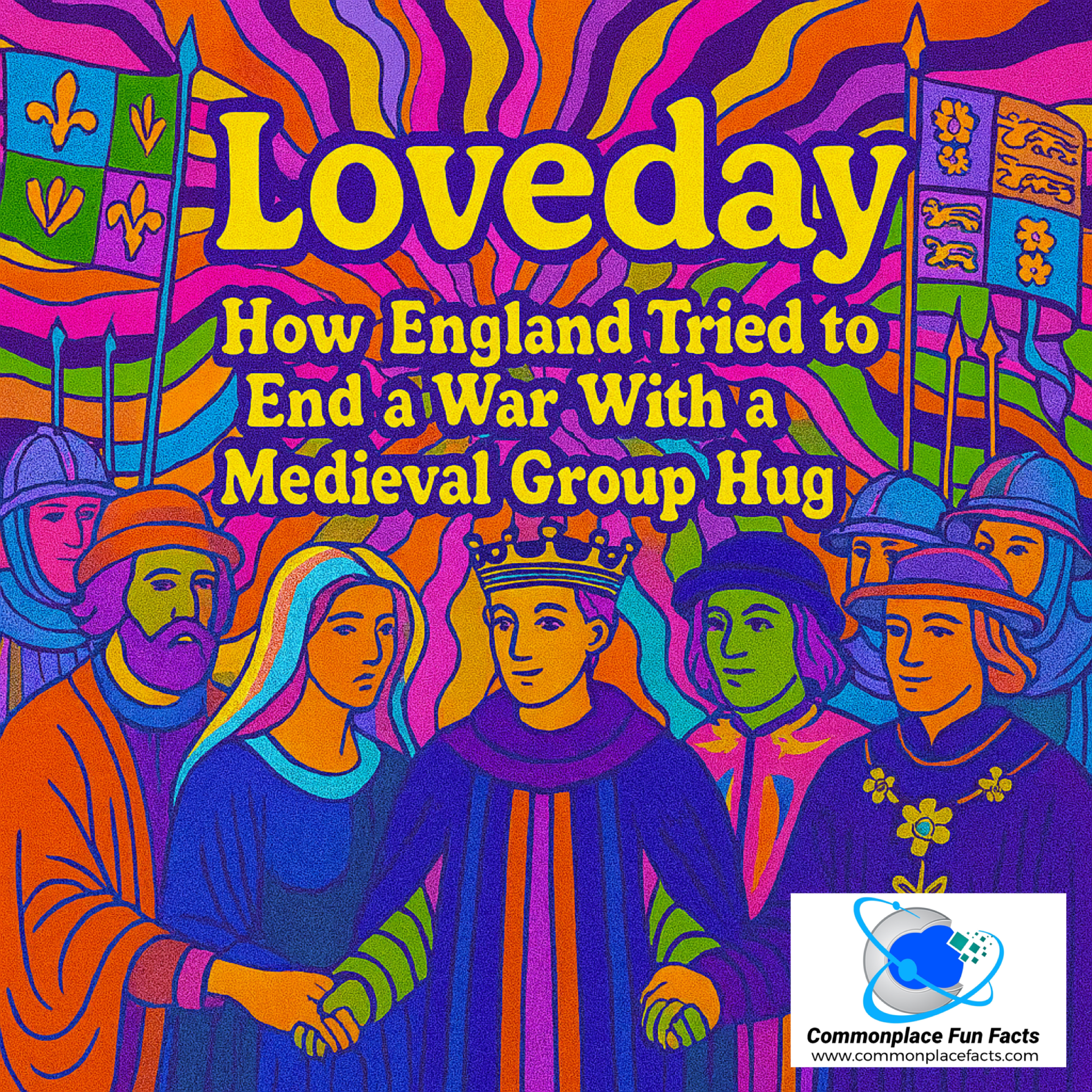

Close your eyes and picture it: London, 1458. Flower petals fall from cathedral balconies. Lutes are strumming. Somewhere, a monk is burning sage. And in the middle of it all, a bunch of murderous noblemen are awkwardly holding hands and pretending they don’t hate each other’s guts.
Welcome to Loveday — the most touchy-feely peace initiative ever attempted by a monarchy that normally solved its problems with swords. King Henry VI, England’s most famously gentle king decided to resolve the Wars of the Roses with vibes. No battle plans. No treaties. Just a forced stroll through London where everyone pretended everything was cool now.
The Royal Vision: Let’s Just Hug It Out
King Henry had a dream. To be fair, he had plenty of time to dream, since he literally spent an entire year of his reign sleeping. His was a dream where Lancastrians and Yorkists could join hands, gaze soulfully into one another’s eyes, and let the healing energy of public processions wash away the bloodshed. He couldn’t help but notice that people kept stabbing each other over who got to sit on England’s most aggressively uncomfortable chair, but he figured a nice walk and some prayer candles would fix it.
And so he invited — well, ordered — the kingdom’s top combatants to London. Among them: Queen Margaret (Henry’s more assertive half), Richard of York (Lord Protector, ambitious uncle energy), and assorted dukes, earls, and future battlefield casualties. It was less a political summit and more a medieval trust circle with crowns and unresolved trauma.
Loveday 1458: The Parade of Passive Aggression

On March 25, 1458, Londoners witnessed the most awkward procession in English history. Margaret of Anjou, whose hatred of York was so intense it probably radiated through her bodice, walked hand-in-hand with him down the streets. Behind them, other bitter enemies shuffled along in uneasy formation, forced to engage in what we can only describe as a forced group energy alignment.
There were church services. Public prayers. Possibly a tambourine. If you squinted, it looked like a royal wedding and a hostage situation at the same time. King Henry, beaming like a man who’d just discovered essential oils, declared this the rebirth of national harmony. Nobody had the heart to remind him what happened the last time someone suggested a ceasefire.
Terms, Conditions, and Cosmic Compensation
Now, this wasn’t just symbolic flower child fluff. There were terms. The Yorkists had to sort of admit they maybe, possibly, slightly helped kick off the whole “murder in the cathedral” situation at St Albans. Financial reparations were assigned. Prayers for the dead were scheduled. Some nobles were sentenced to go on pilgrimages — the 15th-century equivalent of a spiritual detox retreat.
It was peace by way of penance — a carefully stage-managed vibe shift designed to realign England’s chakras. Or at least its nobility’s political ambitions.
But Did It Work?
In a word? No. In several words: not even a little bit.
If this were a Hollywood movie, the closing scene would’ve been a soaring orchestral number and a hopeful pan to the cathedral. But real life isn’t so tidy. Within months, the nobles were brawling again—literally. Fistfights broke out in Westminster. Northern feuds reignited. By 1459, the only thing getting marched through England was another army.
Loveday’s group hug was as effective in negating negative feelings as when your mom forces you to hug your sister and tell her that you promise you won’t sneak glances at her diary again.
One Last Hand-Holding Thought…
Turns out, all the hand-holding in the world doesn’t mean much when one side still wants your head on a pike and the other side wants your title, lands, and pension. The only thing Loveday managed to unite was the general public’s opinion that the Crown had officially run out of ideas.
Loveday is what happens when your king is too gentle for civil war but too oblivious for politics. It was well-intentioned. It was very Instagrammable. And it failed spectacularly. But for one shining afternoon in 1458, England tried to heal its national wounds with spiritual hugs, awkward hand-holding, and the raw power of performative unity.
You have to give credit to King Henry VI for trying to do something—anything—to stop the kingdom from unraveling. Sure, it failed. Spectacularly. But it failed with flair. And that’s more than can be said for most policy decisions of the decade.
History may mock it, but let’s be honest: compared to all-out war, a little forced affection and group therapy doesn’t sound so bad. Just… maybe don’t count on it to replace your diplomatic corps — or your army.
Keep this in mind the next time someone suggests your workplace needs a team-building exercise. Maybe skip the hand-in-hand walk down the hallway. If the Wars of the Roses taught us anything, it’s that enforced group activities usually precede at least one person getting metaphorically—or literally—stabbed in the back.
You may also enjoy…

Henry VI: The King Who Slept for a Year
Learn about Henry VI, the sleeping king. He got his nickname because that’s exactly what he did — for a whole year.

The Warwolf: The Medieval Shock-and-Awe Weapon Designed to Destroy and Terrify Scotland
Discover the story of Edward I’s Warwolf, the medieval trebuchet so massive it terrified armies before it even fired. Explore its role in the Stirling Castle siege and its place in medieval history.

Shortest War Raged For 44 Minutes
What can you do with 45 minutes? You might watch an hour-long television program by skipping the commercials. You could walk three miles at an average pace. Your time could be spent whipping up a batch of chocolate chip cookies. You might choose to be truly creative and stage an accurate recreation of the Anglo-Zanzibar…


Leave a Reply