

The Warwolf: The First of the Mega-Weapons
Modern warfare is defined by mega-weapons. The 20th century gave us weapons so devastating that they’ve left permanent scars on human history. There were the chemical weapons of World War I and Hitler’s “wunderwaffe” (wonder weapons) that terrorized London in World War II. Atomic bombs can level entire cities, and smart bombs can strike with pinpoint precision from the other side of the globe.
As destructive and terrifying as our modern weapons are, those concepts are far from recent. Long before the fear of mushroom clouds signaling the end of civilization, there was a medieval weapon so massive and terrifying it sent armies running before it even fired a shot. Join us as we explore Edward I’s Warwolf, the mighty weapon that made the bravest of Highlanders shake in their kilts.
Contents
Meet Edward I: Hammer, Crusader, and General Buzzkill
Edward I of England, better known as Edward Longshanks or the Hammer of the Scots, was not a man to mess with. Towering at 6’2” (an NBA-worthy height in the 13th century), he combined his intimidating stature with a famously volcanic temper. On the surface, Edward seemed like your classic medieval king: devoutly religious, deeply charitable (to his church, at least), and all too eager to invade neighboring territories.

Edward wasn’t just a fan of smashing his enemies in battle; he also smashed royal precedents. He cleaned up the mess left by his father’s reign, strengthened Parliament, and pioneered new taxation methods. He was also responsible for the Edict of Expulsion in 1290, booting England’s Jewish population out of the country for nearly 400 years. His résumé is a study in contradictions: ruthless military leader, reformer, and crusader all rolled into one towering figure.
But Edward’s crowning achievement—at least in the “terrifying oversized toys” department—came during his campaign against Scotland.
Scotland: A Thorn in Edward’s Side
If social media had existed in those days, England and Scotland would have marked their status as “In a relationship — but it’s complicated.” After the death of the Scottish child queen Margaret, Edward was invited to help decide who should inherit the throne. Naturally, he saw this as an opportunity to slap a “Property of Edward I” sticker on Scotland. The Scots, being Scots, weren’t too keen on the arrangement, and rebellion followed. Thus began the Scottish Wars of Independence.
By 1304, Edward had crushed most of the resistance and turned his attention to Stirling Castle, one of the last holdouts. Edward wasn’t content with simply winning; he wanted to make a statement.
The Warwolf and the Siege of Stirling Castle
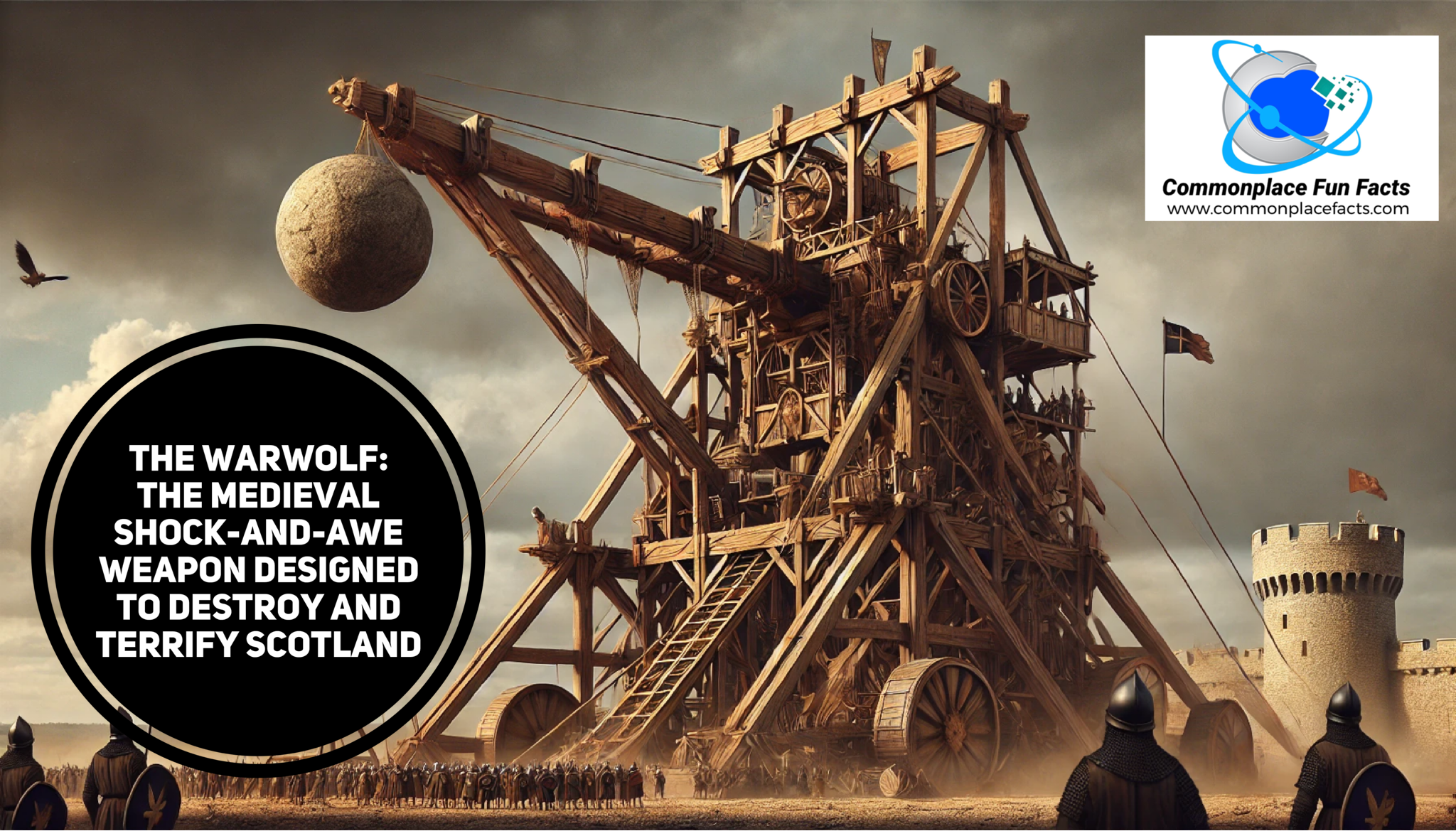
Edward’s plan for Stirling Castle was simple: hit it with everything he had, including a trebuchet so massive it would make the Death Star seem subtle. Dubbed the Warwolf, this beast of medieval engineering was reportedly the largest trebuchet ever built. Five master carpenters, 50 laborers, used 30 wagons of supplies and spent three months assembling the monstrosity.
When completed, the Warwolf stood as tall as 300 to 400 feet (depending on which dramatic medieval chronicler you trust). It could launch 300-pound projectiles at speeds of 120 mph, sending them hurtling up to 200 meters. The Warwolf wasn’t just a weapon; it was medieval shock-and-awe marketing.
The Siege of Stirling Castle
As the Warwolf loomed over the battlefield, the 30 Scots holed up in Stirling Castle quickly realized they were outmatched. Seeing the weapon’s massive frame being assembled, they decided surrender would be the prudent course of action.

Edward wasn’t about to let three months of carpentry go to waste. He refused the Scots’ surrender and reportedly sent them back into the castle, declaring, “You do not deserve any grace, but must surrender to my will.” Translation: “You’re not leaving until I get to play with my new toy.”
Once the Warwolf was finally unleashed, it smashed through Stirling Castle’s walls with ease. Only then did Edward accept the Scots’ surrender, promptly imprisoning the survivors.
Did It Really Happen?
Here’s where things get murky. While chroniclers of the time wrote glowing accounts of Edward’s triumph, modern historians are less convinced. Did the Warwolf actually exist? Was it really used at Stirling? And was it truly as massive as claimed?
No physical evidence of the Warwolf remains today, leaving us with only centuries-old Latin texts and a healthy dose of skepticism. The Scots’ surrender might have been motivated by starvation or sheer pragmatism, rather than a fear of Edward’s trebuchet. But the legend of the Warwolf endures, largely because it’s such a wonderfully absurd story.
Besides, the history of Scottish independence is filled with some extraordinary moments, such as when everything hung by a spiderweb or when it all came down to a broken axe.
Bigger Isn’t Always Better — But Sometimes It Is
Edward I’s Warwolf is a testament to the lengths (and heights) humans will go to assert dominance. It may not have the body count of modern weapons, but its sheer size and spectacle were enough to terrify enemies into submission—or at least make them question their life choices.
While nuclear bombs and wunderwaffe may dominate the history books, let’s not forget the Warwolf: the medieval mega-weapon that taught us one of history’s most important lessons: sometimes, size really does matter.
You may also enjoy…

A King So Nice They Crowned Him Twice
Robert the Bruce (1274 – 1329) was crowned King of Scots on March 25, 1306, by Bishop William de Lamberton at Scone, near Perth, Scotland. By tradition, the Earl of Fife had the role of placing the monarch on the Stone of Destiny, the ancient stone upon which the Scottish kings have been crowned. Duncan,…

Scotland’s Problem With Christmas
If you are looking for a traditional Christmas, Scotland has just about everything you could want. A deep reverence and emphasis on faith provide the religious elements. The pristine, snowy Highlands offer the perfect backdrop for an ideal white Christmas. A strong emphasis on family makes for festive and memorable holiday gatherings. Add Scottish pride…

Royal Regalia and Highlander Honours
The Honours of Scotland is the name given to the crown, sceptre, and sword of the Scottish monarchy. They are the oldest set of crown jewels in the British Isles, dating back to the coronation of Mary I in 1543. The Crown of Scotland The crown is the ancient symbol of supreme authority. Scotland’s crown…


Leave a Reply