
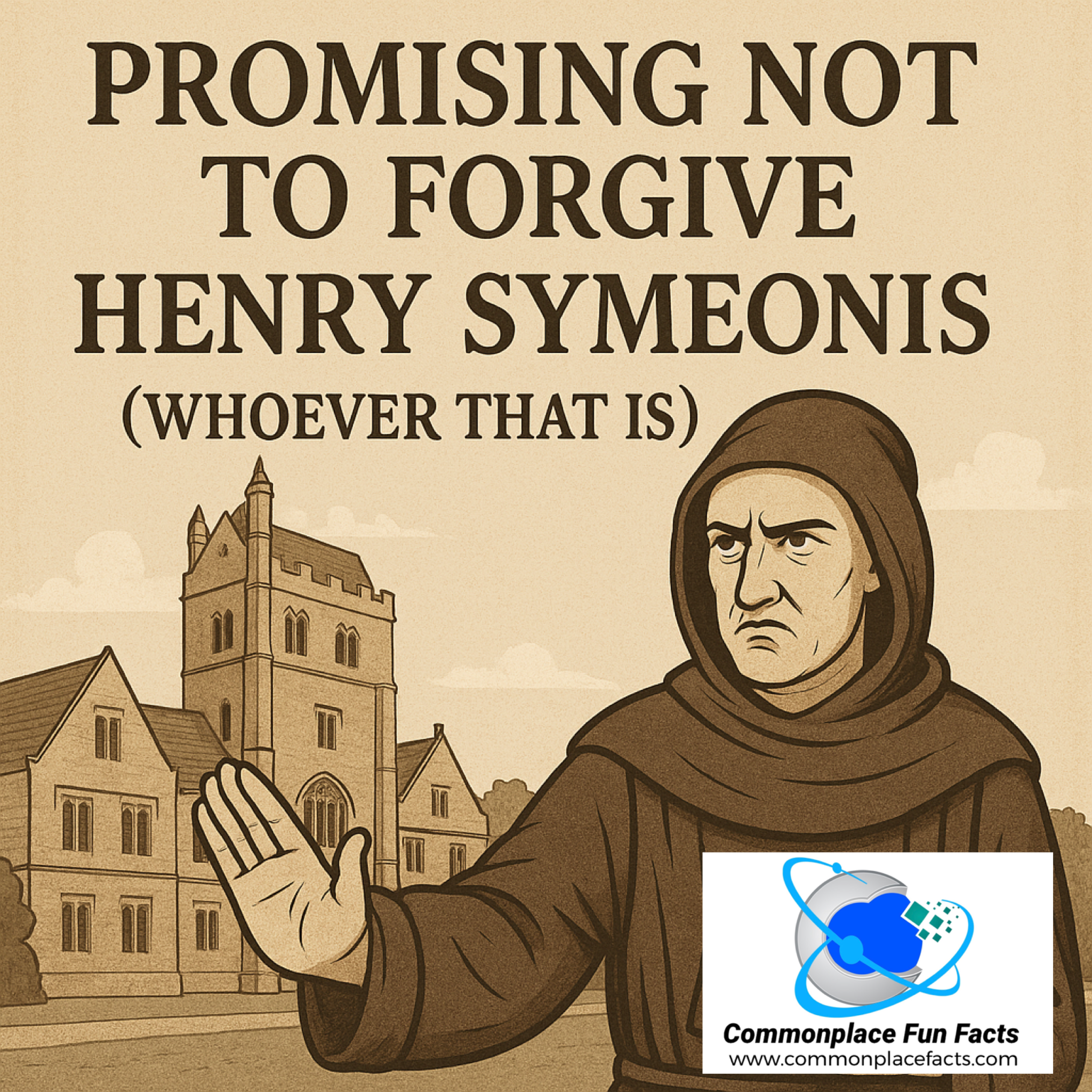

Oxford University’s Unsolved Mystery About Not Liking Henry Symeonis
There is a long tradition that connects advanced educational degrees to solemn oaths. Recipients of medical degrees take the Hippocratic Oath, promising to do no harm. Nurses take the Florence Nightingale Pledge to “practice my profession faithfully and abstain from whatever is deleterious and mischievous, and will not take or knowingly administer any harmful drug.” Lawyers (in Kentucky, anyway) have to promise not to engage in duels.
We feel compelled to also mention that those who testify in certain Burmese court cases have to take an oath that invites affliction by beasts, leprosy, wretchedness, and sea monsters if the witness doesn’t tell the truth. That’s unrelated to this article’s overall topic of education, but it happens to be one of our favorite oaths on record.
For more than 500 years, students of Oxford University, if they hoped to receive a Master of Arts degree, had to solemnly swear never to forgive Henry Symeonis. Who was this Henry fellow, and what heinous crime did he commit that required graduates of one of the world’s foremost educational institutions to vow they would never forgive him? Well, we’re not entirely sure. No one is. We’re pretty sure ol’ Henry must have done something pretty naughty. After all, despite its long history of food fights, Harvard University never seemed to do much more than suspend offending students.
Although we don’t know a lot about Henry Symeonis, the record is pretty clear about Oxford’s dislike for the chap. In 1264, Oxford’s statutes were amended to require Master of Arts students to vow they would never “agree to the reconciliation of Henry Symeonis.” Well, technically, they had to say, “quod numquam consencient in reconciliationem Henrici Symeonis.” Admittedly, people knew their Latin much better back then than we do, so we hope they knew what they were saying, but who knows? The statute remained on the books until 1827. During those 563 years, as the Oxford community refused to forgive Henry Symeonis, it also pretty much forgot who he was and what he did.

Although we don’t know what he did, we’re pretty confident he didn’t receive forgiveness from anyone.
It appears that as early as 1608 people were already wondering who Henry was and why it was such a big deal. Oxford’s Bodleian Library’s Archives and Manuscripts blog cites a “renowned antiquary,” who was obviously showing off by using a 17th-century version of Google Translate when he wrote:
[i]uramentis magistrorum de non resumendis (non dico Henrici Simeonis gradibus quem in artibus Oxoniae Regentem imperante Ioanne, ut apud exteros in monasterium cooptaretur, baccalaureum se finxisse ferunt) lectionibus alibi in hoc regno, quam hic Oxoniae et Cantabrigiae.
Using the 21st-century version of Google Translate, we interpret this to say, “by the oaths of the teachers not to resume (I do not mean the degrees of Henry Simeon, who in the arts of Oxford, while commanding John the Regent, in order to be admitted to the monastery among foreigners, they say that he forged a bachelor’s degree) from lessons elsewhere in this kingdom, than here at Oxford and Cambridge.”
In other words, he falsely claimed to have an Oxford BA so he could be admitted to a foreign monastery. The Library characterizes this as saying Henry “fraudulently claimed he had a BA in order to obtain admission to a foreign monastery.” This claim must be taken with a healthy dose of skepticism. Without citing any source for the claim, the author stuck his comment in parentheses. That comment was about something that was, by that point, 344 years in the past. For all we know, the author learned this tidbit of knowledge by reading bird entrails.
The Library also tells us there was a proposal to remove the anti-Symeonis oath from the university’s statutes in 1651. There is no surviving rationale for this move, and the efforts were defeated. Even so, it seems likely that by 1651 the original purpose for the oath had fallen out of collective memory.
For the next two hundred years, Oxford continued to churn out Master of Arts recipients who were firmly opposed to cutting Henry any kind of slack for his misdeeds — whatever they were. It wasn’t until 1827 that the oath was finally removed from the statutes. Again, there is no surviving record to show us the rationale. Does this mean the university had finally forgiven him, or that they got tired of having to explain the purpose of the oath to every graduating class?
Although the requirement for the oath was gone, the questions about Henry’s identity lingered. In 1912, after nearly a century after the oath was abolished, Reginald L. Poole, Keeper of the University Archives, published a short article in the English Historical Review on the subject. He stumbled across a 12th-century reference to a “Henry, son of Symeon.” That fellow had a son named “Henry, son of Symeon.” Henry the younger lived in Oxford in 1243, but apparently fled or was kicked out sometime after that. Poole found a record of King Henry III ordering Oxford to readmit the poor fellow in 1264:
[I]f it should appear … that the chancellor and university would be content that Henry son of Henry Simeonis, who withdrew for the death of a man, would return to Oxford and stay there, so that the university should not retire from the said town on account of his staying there, then they should permit him to return without impediment…. [T]he king … has pardoned the said Henry the said death, on condition that he stand his trial if any will proceed against him….
The specific relevant content for this request, if necessary, delimited with characters: In terms of royal edicts, it doesn’t seem to have a lot of oomph to it. The king phrased it more as a suggestion. On top of that, the king was taken prisoner by some rebels shortly thereafter. All things being equal, it appears that the powers that be at Oxford decided to disregard the monarch’s recommendation. Just to be sure everyone knew that they meant business, they modified the statutes at the same time so future Oxford executives would know this was some serious stuff.
Assuming Poole’s research points to the Henry Symeonis that we’ve been talking about, it would appear that Oxford considered the guy to be a common murderer and didn’t want the halls of Academia sullied by his presence. Ironically, by codifying their hatred for him in the university’s statutes, they guaranteed that people would talk about Henry for centuries — even when the name of his victim had completely been lost.
There are two clear takeaways from all of this uncertainty:
- Oxford students may finally forgive Henry Symeonis, regardless of who he was and what he did; and
- Despite being free to forgive Henry, in the two centuries since the non-forgiveness oath was repealed, there is no indication that anyone has actually forgiven him. If you have an M.A. from Oxford and want to be the first to go on record, feel free to leave a comment below.

22 of the Most Unusual College Courses You Won’t Believe Exist
Explore 20 of the most unusual college courses offered worldwide, from David Beckham Studies to the Science of Harry Potter. Find out which degrees might leave you scratching your head.

Surviving With This Degree May Require “A Little Help From My Friends”
If you are still trying to decide what you want to do when you grow up, and you don’t want to be a “Day Tripper” or a “Paperback Writer”, and if your idea of a perfect college experience is listening to a lot of music, you might consider getting a master’s degree as a Beatles…

Doctor of UFO’s
In 2008, the University of Melbourne awarded a doctorate in Ufology through their philosophy department. The degree focused on the belief in unidentified flying objects and aliens as a philosophy that many people believe in. Read about other strange college degrees you might want to pursue.




Leave a Reply