
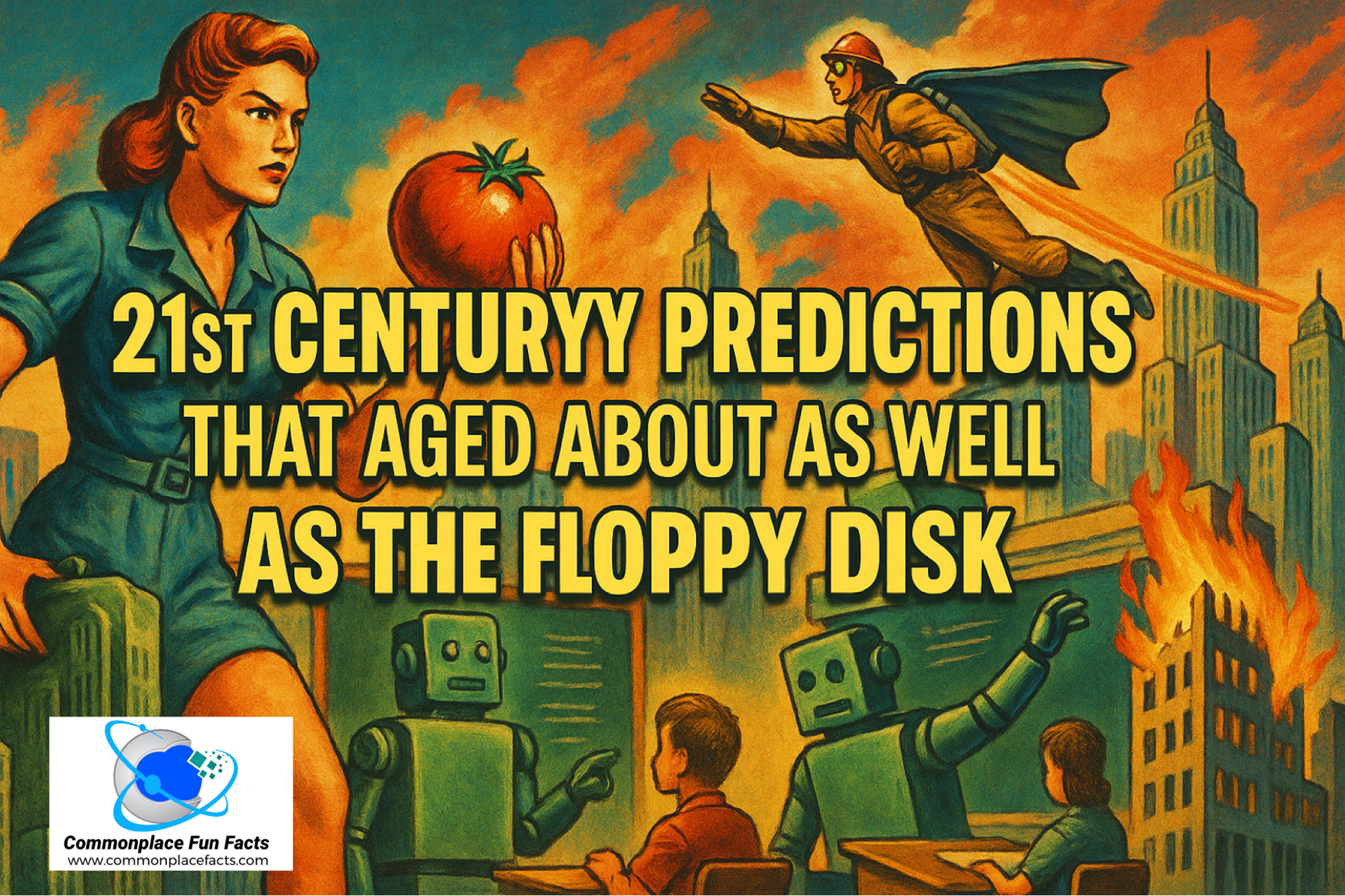

21st Century Predictions: How Did They Pan Out?
Remember when the 21st century was supposed to be all jetpacks, moon condos, and breakfast in pill form? By now, we were supposed to be living in a world filled with flying cars, robots that could take care of the laundry, and transportation that was so fast and efficient that you could live in New York, work in Tokyo, and take your lunch break in Australia.
Instead, we got — well — what we have. It’s a bit of a downer, isn’t it? Still, it’s comforting to know that for over a hundred years, people have been boldly guessing what life would be like now—and getting it spectacularly wrong. This parade of misplaced optimism says less about the future and more about how spectacularly sure humans are of their own brilliance. For proof, we need look no further than our own archives, where we once explored the confident predictions about the limits of human athletic achievement, a prophesy concerning air travel that was off by a million years, and the doom-and-gloom predictions about the world ending as the calendars rolled over to the year 2000.
We can agree that the prophets of the past century made plenty of wrong predictions about the 21st century. Just how far off were they? Join us as we explore some other gems we were supposed to be living with by now.
Contents
The Century of Coffee-Free Superhumans
Nikola Tesla—brilliant inventor, wireless visionary, and borderline lunatic—predicted that humanity would eventually give up coffee for health reasons. In his view, caffeine would be tossed aside in favor of purer living and sharper thinking. Frankly, that sounds less like a utopia and more like a dystopia where pineapple on pizza is mandatory and conversation with strangers on airplanes is compulsory. The irony, of course, is that our modern obsession with “biohacking” usually starts with a double espresso. Tesla wanted a caffeine-free future; we settled for oat milk.
Beefless Dinners and Atomic Veggies

Science-fiction greats like Robert Heinlein and Isaac Asimov had all kinds of predictions about the 21st century. They imagined that future dinners would be lab-grown, algae-based, or synthetic. The dream was a clean, efficient, eco-friendly dining experience—no more messy livestock or unpredictable harvests. Meanwhile, 1900s futurist John Elfreth Watkins, Jr. predicted that fruit and vegetables would grow to monstrous size: strawberries like apples, peas like melons, and tomatoes the size of basketballs. Clearly salad bars of the future would require high-tech engineering to support all this veggie weight. It’s hard to say which vision is worse: eating algae bars or trying to find a bowl big enough for a single grape.
The News Would Only Report Science (and Definitely Not Politics)
Tesla also predicted that front pages in the 21st century would be dedicated exclusively to scientific discoveries. Instead of global conflicts, scandals, celebrity breakups, or sports scores, he imagined headlines celebrating new elements, inventions, and cures. Somewhere between quantum mechanics and the Kardashians, that plan went spectacularly off-script. We can’t go a day without hearing about political mud-wrestling, and most people still think “Higgs boson” is a kind of probiotic yogurt.
Goodbye Letters, Hello Chaos

Watkins had another big idea: he thought English spelling would be simplified by the year 2000. The letters C, X, and Q would vanish entirely, replaced by phonetic spellings that “made more sense.” So instead of “quick,” we’d have “kwik,” and “science” might become “sience.” As spelling reforms go, this wasn’t new—Andrew Carnegie and President Roosevelt tried something similar, as we discussed in “Andrew Carnegie and Theodore Roosevelt’s Doomed Effort of Simplified Spelling”. Today, we haven’t lost any letters, but we have invented new hieroglyphics: “u,” “r,” and emoji-based communication. Shakespeare would cry—probably in a group chat.
Weather on Demand
The mid-20th century was brimming with meteorological confidence that spun off plenty of wrong predictions. Among them was the idea that cloud seeding would control rainfall, droughts would vanish, and hurricanes would be stopped with a few well-placed oil fires. Yes—someone genuinely proposed lighting the ocean on fire to halt storms. Nothing says optimism like environmental arson. Even a German chocolate company joined the fun, producing postcards of a “Good Weather Machine” that allowed genteel citizens to dial in their preferred forecast. Humanity’s relationship with weather control remains unchanged: we still talk about it constantly and understand it not at all.
Life Underground, Underwater, or Just Suspended
Writers like Asimov believed future generations would live in carefully engineered underground cities or undersea domes. Others in the 1950s imagined floating metropolises held aloft by helium balloons, solving both overpopulation and flood risk. Apparently, the 20th century’s answer to rising seas was, “What if the entire city just hovered?”
Can you imagine living in a city that depends upon all the machinery working properly just to keep you from hurtling to a catastrophic death? Keep that in mind the next time you are in an airport and wonder why it is so hard to keep the the escalators functioning properly.
Rise of the Amazonian Woman

In 1949, an Associated Press proclaimed one of their more interesting wrong predictions: that women in the year 2000 would stand over six feet tall, wear size 11 shoes, and have “shoulders like a wrestler.” They’d be athletic, confident, and dressed in synthetic slacks while storing meal capsules in their pockets. The future, it seems, was going to be tall, practical, and fashion-forward. As we explored in our earlier dive into 21st-century women, this prediction said more about post-war gender anxieties than evolutionary science. Modern women may not have the predicted height, but they’ve certainly reached the upper shelves of politics, science, and corporate leadership—and without a single food capsule.
Robots, Plastics, and the Push-Button Life
Mid-century futurists made 21st century predictions about homes made entirely of plastic, cleaned by robot maids, and taught by robot teachers. Every domestic inconvenience would vanish with a push of a button. Instead, we got Alexa listening to our arguments, Roomba bumping into furniture, and an entire planet choking on single-use plastic. The dream of automation came true—just not the way we hoped. At least Roomba doesn’t assign homework.
The Electronic Skin of Earth
Modern futurists predict an “electronic skin” surrounding our planet: billions of sensors collecting data on everything from weather to heartbeats. It’s a compelling image—a world that can literally feel. But there’s a fine line between utopia and surveillance. As we explored in our article about Roko’s Basilisk (a reality which is high on our list of what we hope are wrong future predictions), our quest for smarter systems sometimes looks uncomfortably like building the all-seeing AI overlord of our nightmares. “Alexa, please don’t become sentient and usher in the age of the terminators while I sleep” has become humanity’s bedtime prayer.
Humanity, Still Guessing
For every accurate prediction—smartphones, instant communication, artificial intelligence—there are dozens that make us look adorably naïve. We imagined perfection, built chaos, and still can’t predict the weather. These forecasts amuse us because they reveal our stubborn hope: no matter how many times we make wrong predictions, we keep trying again. Maybe that’s what makes us human. Or maybe we’re just incurable optimists who refuse to believe the next century will still have scam calls. Either way, here’s to the next round of wild guesses. Maybe someday we’ll finally get those jetpacks—or at least a stable Wi-Fi signal.
You may also enjoy…

Edgar Allan Poe and His Creepy Prediction of a Cannibal Crime
How did Edgar Allan Poe predict the creepy cannibal murder of a cabin boy?

The Houdini Death Prophecy and the Senate Showdown Over Spiritualists
Discover Houdini’s intense battle against fraudulent spiritualists, his historic Senate showdown, and the chilling Houdini death prophecy that proved to be true. A captivating journey through history’s veil of mystery and intrigue.

It’s the End of the World As We Know It…. And We’re Still Waiting
Throughout history, numerous prophets have predicted the end of the world, with notable claims spanning over 2,000 years. Despite these predictions, none have occurred. The text highlights significant dates and figures associated with various apocalyptic forecasts, illustrating humanity’s persistent fascination with doomsday scenarios, extending even millions of years into the future.



Leave a Reply to Herald StaffCancel reply