
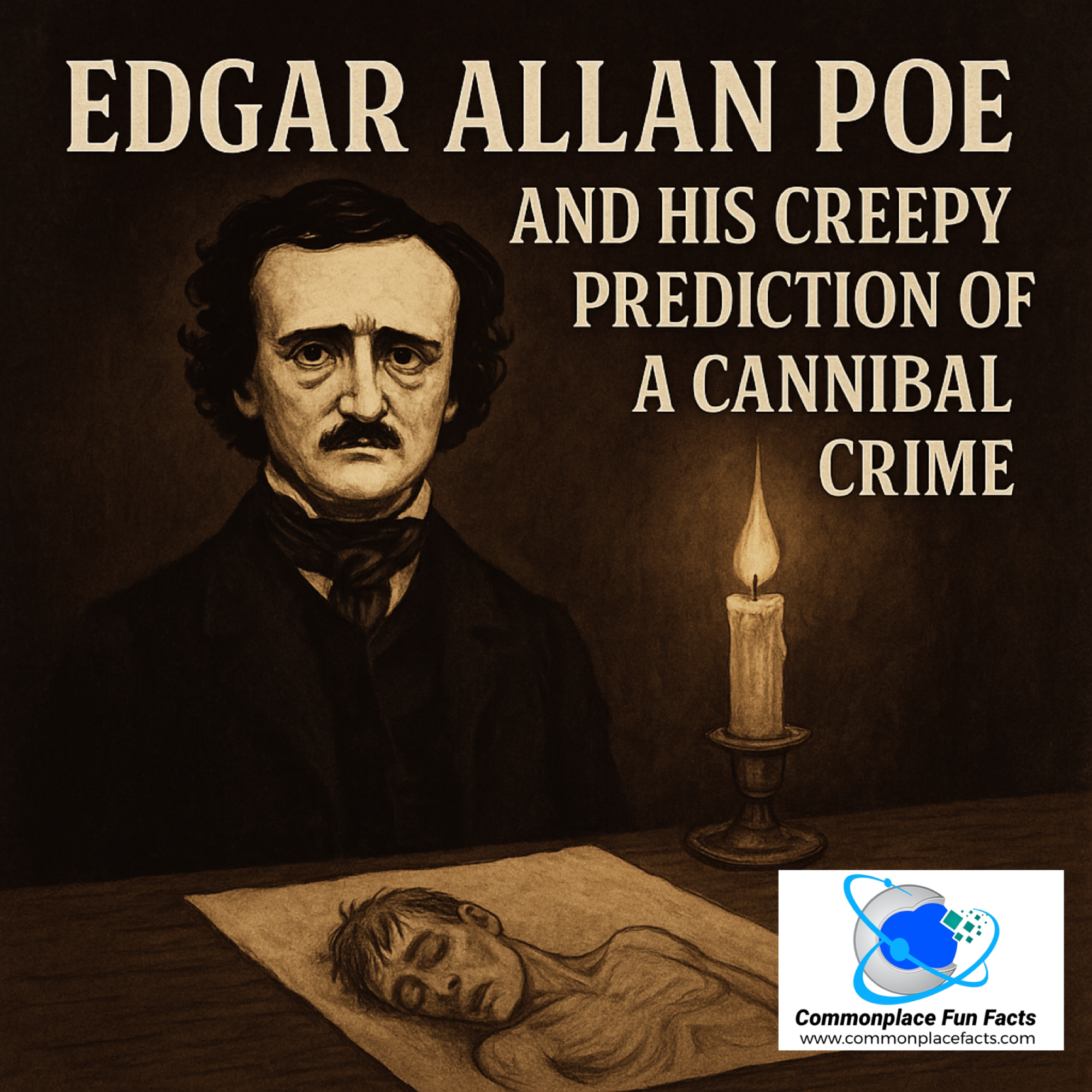

Edgar Allan Poe didn’t just write stories; he wrote nightmares with footnotes. The man gave us premature burials, talking ravens, and creepy guys who thought “you insulted me at a party once” was a good enough reason to brick someone up alive in the basement. But every now and then, Poe wandered beyond the usual literary terrors into territory that can only be described as deeply unsettling coincidence. One of the strangest examples comes from his only full-length novel, The Narrative of Arthur Gordon Pym of Nantucket (1838), where Poe didn’t just write horror—he seemed to predict it.
Contents

The Novel That Nobody Asked For (But Poe Wrote Anyway)
Poe’s novel follows the adventures of Arthur Gordon Pym, a young man who stows away on a whaling ship. From there, things get progressively worse—mutiny, shipwreck, starvation, and all the other cheerful topics you’d expect to find in a book by America’s reigning king of gloom. The book was marketed as a “true account,” and Poe insisted it was based on actual events. Spoiler: it wasn’t. At least, not yet.
One of the book’s most infamous episodes involves a shipwreck. Four starving survivors, adrift in the open sea with no food or water, face the ultimate question: “Who’s for dinner?” They draw straws, and the unlucky winner is a young cabin boy named Richard Parker. His crewmates eat him. Grim? Absolutely. Outlandish? Sure. Entirely fictional? Well… that’s where things get spooky.
Fast-Forward 46 Years: The Real-Life Richard Parker
In 1884, the luxury yacht Mignonette set sail from England, bound for Australia. On board were four men: Captain Tom Dudley, first mate Edwin Stephens, seaman Edmund Brooks, and a 17-year-old cabin boy named—wait for it—Richard Parker. Somewhere in the South Atlantic, a storm struck, and the yacht went down. The men escaped in a dinghy, but with no supplies and no fresh water, things looked bleak. Bleak quickly turned into “you’re eyeing me like I’m a rotisserie chicken.”
After weeks of starvation, the men did what Poe’s characters had done: they drew lots. The lot fell to Parker. He was killed, and the surviving men consumed his body to stay alive. Just like in Poe’s novel. Same scenario. Same method. Same name. At this point, you can practically hear the Twilight Zone theme playing in the background.
What elevates this from “horrifying coincidence” to “are we sure Poe didn’t own a crystal ball?” is the fact that Richard Parker wasn’t exactly the John Smith of the 19th century. Sure, there were a handful of Richard Parkers in England, but the odds that one with that exact name would be the victim of shipwreck cannibalism almost half a century after Poe invented the scenario? Slim enough to make statisticians twitch.
The Trial That Shocked the World
If the story had ended there, it would just be another gruesome tale of survival at sea. But the Mignonette case had an afterlife almost as unsettling as Poe’s novel. When the survivors were rescued and returned to England, they were put on trial for murder in a case that became the legal sensation of the 19th century: R v. Dudley and Stephens.
Their defense was basically, “It was him or us. Don’t judge until you’ve been starving at sea with only a 17-year-old intern between you and death.” The court, however, wasn’t in the mood to create a “cannibalism is fine if you’re really, really hungry” precedent. Dudley and Stephens were convicted of murder. They were sentenced to death, though the Crown later commuted their punishment to six months in prison. Edmund Brooks, who hadn’t participated in the actual killing, was let off.
This case still shows up in law school classrooms today as the definitive example of why “necessity” doesn’t work as a blanket excuse for murder. The ghost of poor Richard Parker—both the fictional and the real one—still haunts textbooks around the world.
Poe the Prophet?
So what’s going on here? Was Poe genuinely psychic? Did he dip his quill into some cosmic ink and scribble out a future he couldn’t possibly know? Probably not. (Although if you’re into seances, you could always ask him.) More likely, it was a coincidence—but the kind of coincidence that’s just eerie enough to make you squirm.
The sea, after all, has always been a dangerous place. Shipwrecks were depressingly common in Poe’s day, and cannibalism among stranded sailors wasn’t unheard of. But what transforms this from “grim realism” into “bone-chilling prophecy” is the name: Richard Parker. It’s like writing a story today about a fictional man named Elon Musk inventing a brain chip that lets you tweet with your mind, only for it to happen in 2070. Possible? Sure. But if the name and the details line up, people are going to whisper “prophecy.”
Wait, There’s More: The Curse of Richard Parker
If one Richard Parker wasn’t enough, history decided to pile on. Because this wasn’t the only nautical disaster involving a Richard Parker. In fact, the name has cropped up more than once in grim maritime history. In 1797, a Richard Parker led a mutiny in the Royal Navy, was captured, and was hanged for treason. Another Richard Parker drowned in the sinking of the Francis Spaight in 1846. It’s as though “Richard Parker” was the maritime equivalent of wearing a red shirt on Star Trek.
The name even made its way into fiction again in Yann Martel’s novel Life of Pi, where the main character’s lifeboat companion is—no kidding—a Bengal tiger named Richard Parker. The name was borrowed from Poe’s tale, which means even in modern fiction, Richard Parker is still doomed to float at sea, waiting for some cruel author (or fate itself) to decide his grisly end.
Poe’s Creepy Company: Other Literary Prophets
Poe wasn’t the only writer who seemed to dabble in accidental clairvoyance. Morgan Robertson’s 1898 novel Futility, or the Wreck of the Titan famously foreshadowed the Titanic disaster 14 years before it happened. The Titan was described as an “unsinkable” luxury liner that struck an iceberg in the North Atlantic and sank, killing most of its passengers due to an insufficient number of lifeboats. Sound familiar? Somewhere in the afterlife, Poe and Robertson are probably sharing a drink and smirking, “We told you so.”
Then there’s Jules Verne, who more or less invented science fiction by accurately predicting submarines, moon landings, and even aspects of modern space travel decades before they became reality. Compared to them, Poe’s prediction is less “visionary technology” and more “horrifyingly specific nightmare come true,” but it earns him a spot in the creepy coincidence club nonetheless.
Why We Love a Good Prediction
There’s something irresistible about the idea of writers predicting the future. On one level, it gives literature a sense of magic—that maybe, just maybe, books aren’t just stories but little time machines sneaking peeks at what’s to come. On another level, it’s just plain fun. We get to look back at old novels and say, “Hey, this 19th-century goth guy nailed it.”
Of course, skeptics will always point out that given enough stories and enough time, coincidences are bound to happen. The sea was full of disasters; cannibalism was a grim reality. It was bound to line up eventually. But the uncanny alignment of names, details, and timing ensures that Poe’s eerie tale will continue to unsettle readers and delight trivia buffs for generations.
The Final Word (and Possibly a Warning)
So was Poe a prophet, or just the literary equivalent of someone who bought every number in the lottery and happened to hit a winner? We’ll never know. But if you’re ever heading out on a sea voyage, and your name happens to be Richard Parker, maybe consider rescheduling. Just in case.
Poe’s creepy prediction still resonates because it blurs the line between fiction and reality in the most disturbing way possible. And for a writer who thrived on unsettling his readers, that might be his most haunting legacy of all.

The Incredible Web of History: Lincoln’s Widow, Wyatt Earp, John Wayne, and Reagan’s Survived Assassination Attempt
From Lincoln’s Secret Service order to Wyatt Earp, John Wayne, Jack Benny, and Reagan—trace the surprising web of history that ties them together.

Titan vs. Titanic: How a 19th-Century Novel Foreshadowed the World’s Most Famous Shipwreck
A 19th-century novel eerily foreshadowed the Titanic disaster. Explore the uncanny similarities between Morgan Robertson’s Futility and the real-life tragedy of the “unsinkable” ship.

Adolf Hitler Assassination Attempts: The Many Failed Chances to Rid the World of a Madman
Discover the true and mythical stories of the Adolf Hitler assassination attempts, from verified plots like Operation Valkyrie to bizarre, unverified tales of bombs, snipers, and missed chances.




Leave a Reply