
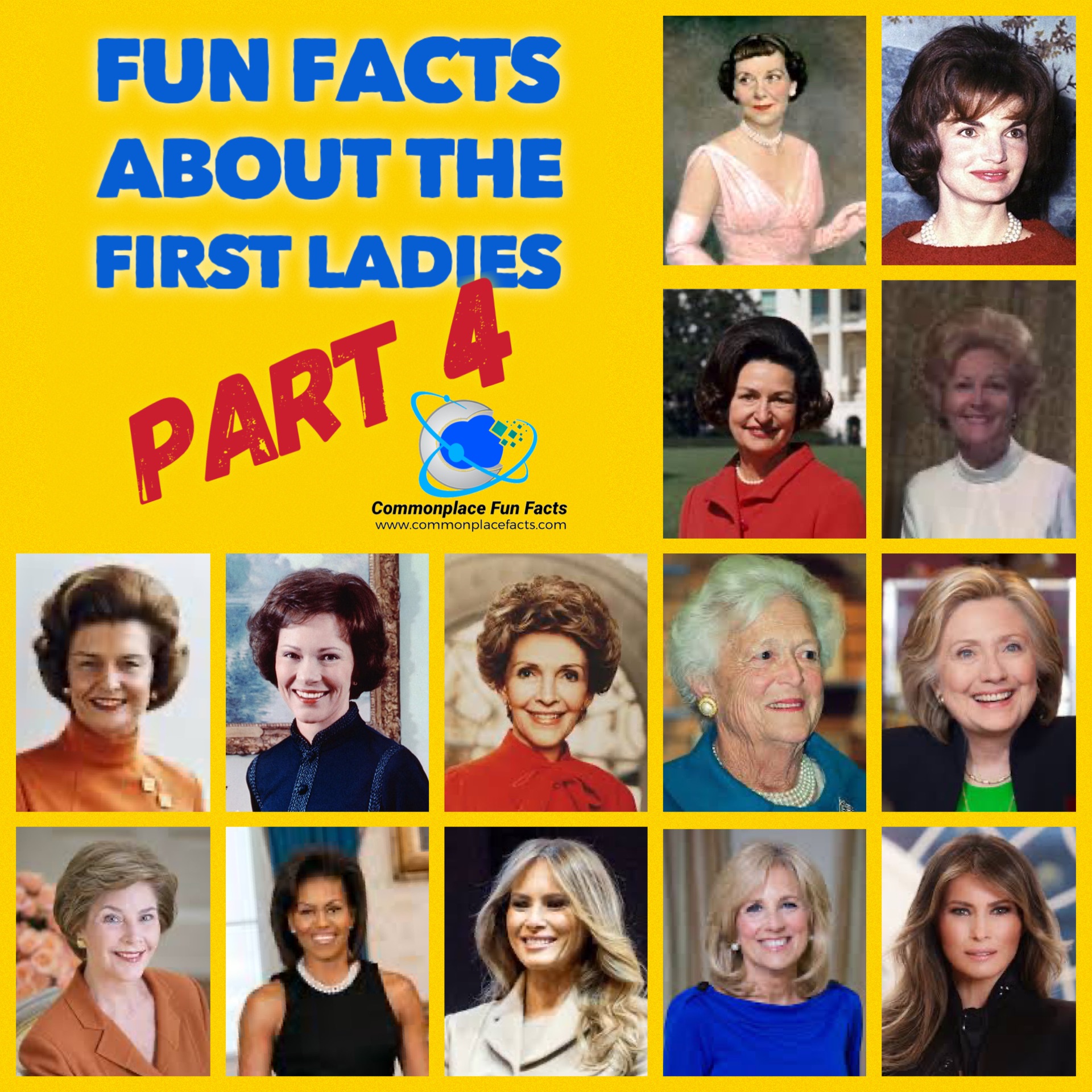

Fun Facts About the First Ladies – Part 4
Here we are at the final stretch of our First Ladies tour (see parts 1, 2, and 3, in case you missed them), the grand finale in a four-part series that’s been more fun than trying to explain the Electoral College to out-of-town relatives. We’ve already covered the trailblazers, the reformers, the reluctant public figures, and the women who somehow managed to smile politely while living in a house where strangers count your towels.
In this last installment, we jump into the modern era, where the job description expands faster than a White House press inbox. These First Ladies are campaigners, policy advocates, cultural icons, style-setters, and in at least one case, an Emmy winner. They juggle families, public scrutiny, official duties, and the eternal mystery of why the national media has such strong opinions about their choice of hair styles.
It has taken us five years to finish this series, which just so happens to match the average tenure of a First Lady. Please join us in pretending we planned it that way and weren’t simply procrastinating our way to the finish line.
So buckle in for one more round of stories, surprises, and utterly human moments from the women who shaped American history from the world’s most unusual side-office.
Contents
40. Mamie Eisenhower (1953–1961)

Mamie Eisenhower didn’t just move into the White House — she sprinkled it with pink. So much pink, in fact, that “Mamie Pink” became an actual national trend. Bathrooms, dresses, kitchen accessories, telephones — if you could tint it rosy, Mamie probably owned it.
She was also one of the most relatable First Ladies in presidential history. While Ike was busy running NATO and trying to prevent World War III, Mamie kept a tight household, loved a good soap opera, and insisted that guests enjoy themselves. She answered mail by hand, threw famously warm parties, and reportedly kept a standing rule that no one was allowed to disturb Ike while he was napping. This might be her greatest contribution to American domestic policy.
Also, Mamie’s bangs were a cultural event. America had opinions. Strong ones. Teenagers copied them. Magazines wrote about them. Historians still debate them. Truly, a woman ahead of her time.
41. Jacqueline Kennedy (1961–1963)

Jacqueline Kennedy didn’t walk into history — she glided, embroidered, restored, published, and curated her way into it. While the press obsessed over her clothes, Jackie was quietly reshaping the very concept of American cultural identity.
She became the first First Lady to hire both a full-time press secretary and a White House curator, because if the West Wing was going to get all the policy glory, she was at least going to make sure the East Wing didn’t look like a mid-century rummage sale. Her restoration of the White House was so thorough and so elegant that it earned her a spot on prime time television as she gave a tour and invited the entire nation into her home. For this, she won an Emmy — the award actors spend entire careers chasing. Jackie won hers by giving a tour.
She also charmed foreign leaders, fluently spoke French, and managed to look unflappable while living through one of the most stressful chapters of American history. If there were ever a First Lady who seemed like she stepped out of a novel and into the Executive Mansion, it was Jacqueline Kennedy.
42. Claudia “Lady Bird” Johnson (1963–1969)

Lady Bird Johnson didn’t just bring charm to Washington — she brought an entire wildflower meadow. While Lyndon B. Johnson specialized in legislative arm-twisting, Lady Bird became the nation’s champion of conservation, beautification, and anything that made highways less depressing.
Her “beautification” campaign wasn’t about planting petunias for fun. She pushed for cleaner cities, preserved historic landmarks, and launched efforts that eventually helped shape the modern environmental movement. Not bad for a nickname she acquired as a toddler because someone thought she was “pretty as a little lady bird.”
She also had political instincts sharper than a field of Texas cactus. During the 1964 campaign, she embarked on the “Lady Bird Special,” a whistle-stop train tour through the South, giving speeches on her own — the first First Lady to campaign independently. The crowds weren’t always friendly, but Lady Bird pressed on with grace, grit, and an accent that could melt butter.
43. Pat Nixon (1969–1974)

Pat Nixon had the sort of résumé that makes you wonder if she accidentally lived three separate lives before she ever set foot in Washington. Long before becoming First Lady, she worked as a teacher, a bank teller, a retail clerk, a nurse’s aide, and even a farmhand — usually all while taking college classes at night. This relentless determination paid off in history-making fashion: Pat became the first First Lady to earn a graduate degree, completing both her bachelor’s and master’s degrees at the University of Southern California in 1937.
Once in the White House, Pat Nixon continued her lifelong habit of actually doing things. She expanded public tours, added more historic art and furnishings to the building than any of her predecessors, and created programs to make the Executive Mansion more accessible to visitors with disabilities. She traveled farther than any First Lady before her, and during diplomatic trips she routinely insisted on visiting schools, hospitals, and orphanages — stops the official itineraries hadn’t exactly prioritized until Pat started reorganizing them with a smile.
Despite all her accomplishments, many people most easily remember her as probably the first First Lady to appear publicly wearing pants, a detail historians report with the solemnity usually reserved for constitutional amendments. Some fashion moments really do echo through time.
44. Betty Ford (1974–1977)

Betty Ford arrived in the White House with more rhythm, candor, and sheer courage than most public figures ever manage in a lifetime. Before politics swept her up, she trained with the Martha Graham dance company, performed with the Bennington School of Dance, and taught dance to children — so yes, the East Room was the first time the nation had a First Lady who could have corrected everyone’s posture on sight.
But Betty Ford’s most enduring legacy wasn’t ballet; it was blistering honesty. She spoke publicly about breast cancer when such things were whispered into handkerchiefs, advocated fiercely for women’s rights, and later founded the Betty Ford Center, which revolutionized addiction treatment. Americans weren’t used to First Ladies being this open about difficult issues. Betty politely ignored that fact and changed the national conversation anyway.
She also unintentionally revived one of the most persistent White House myths: that she “reunited” the presidential bedroom. In reality, the Fords didn’t start a new tradition — Betty was simply the first modern First Lady to say openly that she and her husband shared a room. The honesty was so refreshingly normal that everyone assumed she’d restored some grand marital custom, when all she really did was answer a question without blinking.
45. Rosalynn Carter (1977–1981)

Rosalynn Carter was the kind of First Lady who made efficiency look downright graceful. She set up an office in the East Wing — establishing the modern model of the “working First Lady” — and served as a key adviser to her husband, even attending Cabinet meetings. Her critics called it unusual. Rosalynn called it part of her marriage vows.
She was deeply committed to mental health advocacy long before it was considered a mainstream issue, and her work helped reshape public understanding of mental illness for decades to come. She also became the first First Lady to use a commercial VCR in the White House, a detail history absolutely insists on keeping, as if America collectively decided that recording Three’s Company was a pivotal moment in executive-branch evolution.
Rosalynn’s combination of warmth, competence, and steel-trap focus would eventually make her and President Carter one of the most admired post-presidential teams in history.
46. Nancy Reagan (1981–1989)

Nancy Reagan brought a touch of Hollywood polish to the White House, and not just because of her earlier acting career. She understood optics better than anyone in Washington. If the lighting wasn’t right, Nancy Reagan absolutely knew it — and probably fixed it.
Her most famous initiative, the “Just Say No” anti-drug campaign, started as a simple answer she gave to a schoolchild and snowballed into one of the most recognizable public-awareness efforts of the decade. She even appeared in the celebrity-studded anti-drug music video Stop the Madness — not as the star, but definitely as the person whose presence ensured everyone else behaved.
Nancy also modernized White House entertaining, championed Alzheimer’s research, and cultivated a long list of friends in fashion, diplomacy, and Hollywood. Whether or not you loved 1980s glam, Nancy knew exactly how to make a statement.
47. Barbara Bush (1989–1993)

Barbara Bush had the delightful energy of someone who could hand you a warm cookie one moment and level you with unimpeachable grandmotherly wisdom the next. She remains only the second woman in American history to be both the wife and mother of a president, a distinction previously held only by Abigail Adams.
Barbara was a fierce advocate for literacy, founding the Barbara Bush Foundation and speaking openly about the importance of reading with a kind of moral clarity that made even adults want to revisit The Cat in the Hat. She also authored several books, including a bestselling memoir written from the perspective of the family dog, Millie — proving she had both range and a sense of humor about the job.
Her white hair and fake pearls became iconic, her wit legendary, and her ability to disarm grumpy politicians practically supernatural.
48. Hillary Clinton (1993–2001)

Hillary Clinton didn’t just step into the role of First Lady — she arrived with a briefcase, a policy portfolio, and an unmistakable message that the East Wing was more than a social annex. She was the first First Lady to have a West Wing office, the first to lead a major policy initiative (health care reform), and the first to trigger congressional hearings simply by showing up to work.
She also hosted the first White House webcast, helping drag presidential communications into the digital age one dial-up tone at a time. After leaving the White House, Hillary made a habit of collecting historic firsts the way other people collect souvenir spoons: first First Lady elected to the Senate, first First Lady to serve in a president’s Cabinet, first woman nominated for president by a major party.
Whether admired or argued about, she permanently expanded the definition of what a First Lady could do — and occasionally set off an entire news cycle just by changing her pantsuit.
49. Laura Bush (2001–2009)

Laura Bush arrived in Washington with the serene calm of a woman who had already survived years of teaching elementary school. Dealing with unruly, spoiled children probably gave her the best possible preparation for living in Washington, D.C. A former librarian and lifelong reader, she championed literacy with the gentle determination of someone who’d really, truly like America to finish its book reports.
She is also the only First Lady to have given birth to twins, a fact that should earn her automatic diplomatic immunity in at least twelve countries. Laura supported women’s health and global education, helped launch major initiatives in Afghanistan, and once delivered the president’s weekly radio address — one of the few First Ladies to speak to the nation in an official presidential format.
Laura Bush never made a fuss. She simply did the work, calmly, steadily, and often more effectively than anyone realized at the time.
50. Michelle Obama (2009–2017)

Michelle Obama burst into the national spotlight like a one-woman leadership seminar with impeccable arms. As the first African American First Lady, she combined history-making significance with a sense of no-nonsense determination.
She launched Let’s Move!, took on childhood obesity, co-founded Joining Forces to support military families, started the Reach Higher initiative for education, and planted a vegetable garden that nearly caused a national kale shortage. She danced on TV, joked with late-night hosts, and delivered speeches that made half the country ask where she bought her earrings.
51. Melania Trump (2017–2021)

Melania Trump became the first First Lady who wasn’t born a U.S. citizen. Although Louisa Adams was the first First Lady born in a foreign country, she inherited U.S. citizenship from her father. Melania was born in Slovenia and naturalized in 2006. She brought an unmistakably international background to the East Wing — along with a fashion sensibility that launched a thousand think-pieces.
In 2018, Melania became the first First Lady to fly in a V-22 Osprey, which is the kind of aircraft that looks like it was designed by someone who lost a bet with gravity. Her solo trip to Africa included Ghana, Malawi, Kenya, and Egypt, emphasizing her interest in global outreach and giving photographers some of the most iconic First Lady images in decades.
Quiet in demeanor but unmistakably visible, Melania charted her own style of First Ladyship — elegant, reserved, and sometimes cryptic enough to spawn entire doctoral theses.
52. Jill Biden (2021–2025)

Dr. Jill Biden brought something brand-new to the role: she kept her job. As a community-college English professor with a doctorate in education, she became the first First Lady to continue a full professional career while living in the White House. Her students occasionally forgot who she was, which might be the most profoundly American anecdote in First Lady history.
Jill Biden’s relatable moments — from wearing a scrunchie while buying cupcakes to championing teachers with the energy of a caffeinated labradoodle — made her one of the most accessible First Ladies in recent memory. She introduced Willow, the White House cat, named for her hometown of Willow Grove, Pennsylvania, instantly restoring America’s balance of power between dogs and cats.
She drew both admiration and criticism for the influence she appeared to wield within her husband’s administration. In the final months of his presidency, as questions mounted about his physical and cognitive health, Jill Biden found herself compared to Edith Wilson — the First Lady who effectively managed presidential duties after Woodrow Wilson’s stroke — placing Jill among the most publicly scrutinized and unexpectedly powerful First Ladies in modern history.
53. Melania Trump (2025–Present)

With her return to the White House in 2025, Melania Trump became the first First Lady to serve non-consecutive terms, a historical footnote no presidential trivia buff would’ve predicted back when she was modeling in Milan. Her second stint has reinforced the same qualities that defined her first: a global perspective, an interest in child-focused initiatives, and a quiet, curated public presence that somehow manages to generate massive cultural conversation by doing very little.
If nothing else, Melania Trump now holds a distinction no one can argue with: she is officially the Grover Cleveland of First Ladies. History will decide what that means, but trivia lovers everywhere thank her for it.
Conclusion
After four installments, dozens of remarkable women, and more trivia than a Smithsonian gift shop could comfortably shelve, we’ve reached the end of our First Ladies tour. From wildflower campaigns to West Wing policy fights, from televised Emmy-winning tours to V-22 Osprey flights, each of these women left fingerprints on American history in ways both grand and delightfully unexpected.
If this series has taught us anything, it’s that the role of First Lady has never been a simple supporting act. It has been a platform, a classroom, a diplomatic mission, a national spotlight, a crisis-management center, and occasionally a stage for truly iconic bangs. These women shaped culture, steered conversations, influenced policy, and reminded the country — again and again — that leadership doesn’t only sit behind the Resolute Desk. Sometimes it sits in the East Wing, armed with determination, wit, and a very busy schedule of official china selections.
Thank you for taking this journey with us through the lives of America’s unofficial co-governors. The presidents may get the monuments, but the First Ladies get the better stories — and we can’t help but suspect they planned it that way.
You may also enjoy…

The White House Crisis that Left the President and First Lady Black and Blue
“Come up here right away!” The White House staff is accustomed to responding immediately to any request from the First Lady. This command caused more than the usual flurry of activity, however. For Mamie Eisenhower to be on the phone at 7:00 a.m., something big must be happening. Chief Usher J.B. West rushed from his…

When Mark Twain Needed the First Lady to Reassure His Wife
Mark Twain has a well-deserved reputation for not being intimidated by those in high authority. His self-assurance and disregard for the opinion of others allowed him to rub elbows with the most influential members of society and remain unaffected. That’s not to say he was unconcerned about everyone in his life. This fact came to…

The Surprising Time Abraham Lincoln Testified to Save His Wife
Did Abraham Lincoln defend his wife, Mary Todd Lincoln, against accusations of treason? Discover the remarkable moment when Abraham Lincoln testified to save his wife from treason.




Leave a Reply to cat9984Cancel reply