
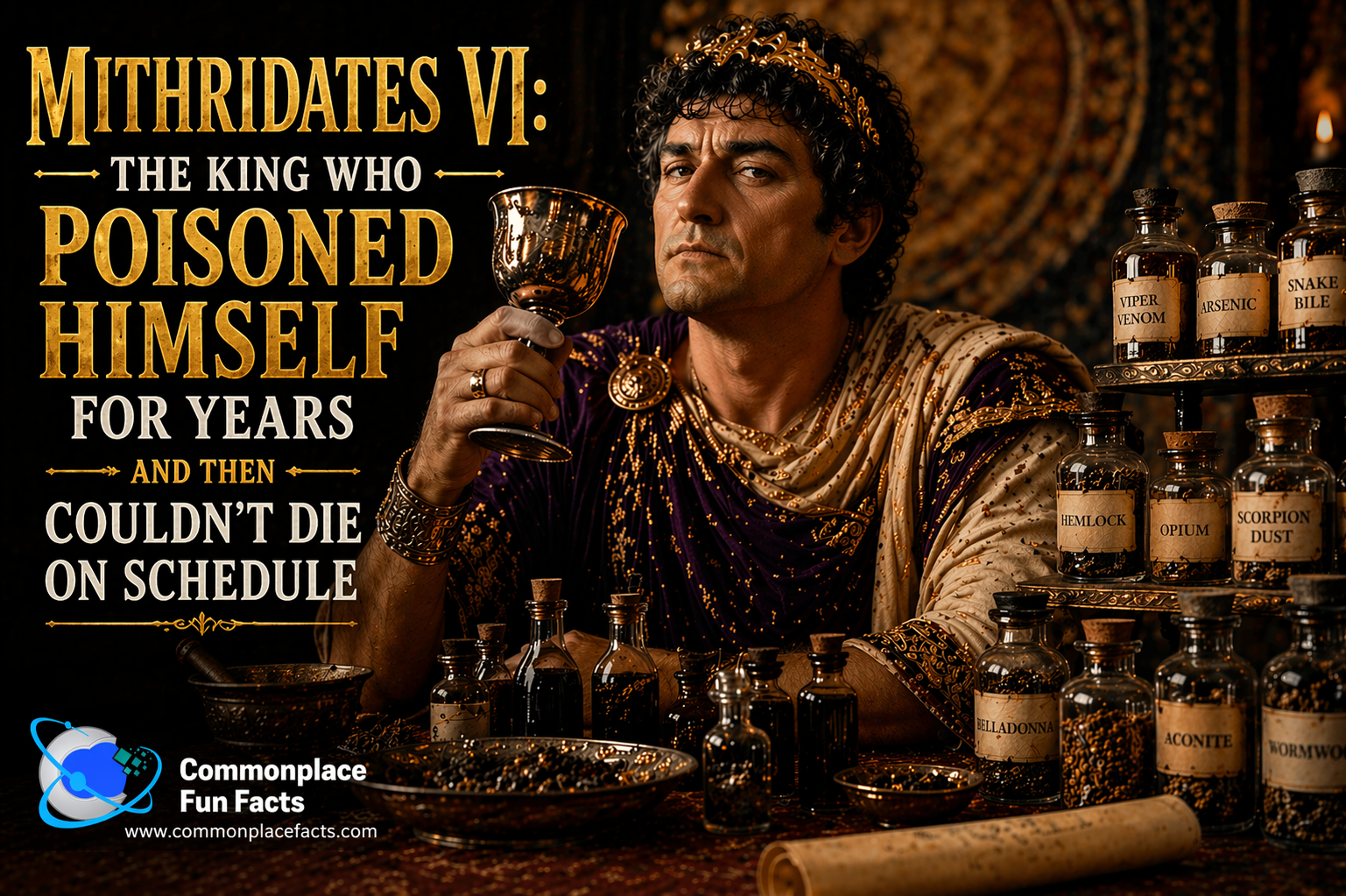

Some people respond to danger by avoiding it. Others respond by preparing for it. Mithridates VI Eupator looked at the very real possibility of being poisoned and decided the best solution was to beat his enemies to the punch by poisoning himself first—just a little, every day, for years.
Mithridates was a king, a formidable opponent of Rome, and a man who took the concept of “preventive medicine” to a level that would make even the most enthusiastic modern supplement enthusiast pause mid-capsule. His plan was simple in theory and alarming in practice: build up immunity to poison so thoroughly that assassination attempts would become little more than an inconvenience.
Does it sound crazy? Yes. Is it a practice we would recommend you not try to replicate? Most assuredly. Did it work? Surprisingly, yes. In fact, it worked a little too well—in a plot twist that sounds like something Hollywood would reject as too unrealistic.
Such is the life of Mithridates VI Eupator: king of Pontus, thorn in Rome’s side, ruler of real ability, political schemer, military strategist, reputed polyglot, and a man so deeply suspicious of poison that he responded by making it part of his daily wellness routine.
Contents
A Childhood That Did Not Encourage Relaxation
Mithridates VI was born around 135 BC and inherited the kingdom of Pontus, located in northern Asia Minor along the Black Sea. Pontus was not one of the giant superpowers of the age, but it was strategically placed and ambitious. Mithridates himself was even more ambitious. He would eventually become the most dangerous enemy Rome faced in the eastern Mediterranean before Rome did what Rome usually did and turned “dangerous enemy” into “historical footnote.”

He became interested in poison at an early age, and it wasn’t the result of idle curiosity. It came from the sort of family history that makes trust issues seem less like a personality flaw and more like basic common sense. His father, Mithridates V, was killed by poison, and the ancient world was not exactly known for its strict food safety standards or its robust anti-assassination protocols. That alone would make a person look at every meal as if it had been prepared by a stage magician with a grudge.
Matters did not improve at home. Ancient sources paint the young Mithridates as surrounded by intrigue, possibly threatened by rivals within his own household, and potentially endangered by a mother whose political calculations may not have included his long-term survival. Scholars are naturally cautious with every juicy ancient allegation, because ancient historians treated rumor the way modern cable news treats a blinking red banner. Still, the broad picture is clear enough: Mithridates grew up in an environment where poisoning was not some abstract fear. It was a job hazard.
So he did what any anxious Hellenistic monarch might do if he had enough time, power, and willingness to ignore every doctor with a conscience. He decided to become poison-proof.
The Ancient World’s Worst Wellness Trend
Mithridates is associated with a practice now called mithridatism, which is just history’s way of rewarding deeply unusual behavior by turning it into vocabulary. The basic idea is simple: if you expose yourself to small, nonlethal doses of certain poisons over time, you may develop resistance to them. It is not a universal principle, and one should not treat this as a charming life hack, but in the ancient world it had a certain brutal logic.

Mithridates reportedly consumed tiny doses of poison on a regular basis, especially substances such as arsenic. The goal was to train his body to survive assassination attempts that would kill a less neurotic monarch. One almost has to admire the commitment. Most people handle fear by journaling, taking long walks, or buying a better lock for the front door. Mithridates responded by turning himself into a chemistry experiment.
Mithridates did not merely fear poison—he studied it, experimented with it, and, when the opportunity arose, weaponized it. In fact, he even exploited naturally occurring toxins in ways that would make modern chemists pause. As we explored in our article on mad honey warfare, Mithridates’ forces are credited with using toxic, hallucinogenic honey to incapacitate Roman troops—proving that his interest in poisons extended well beyond personal immunity and into creative battlefield applications.
This is one of the reasons some writers describe him as something like an early toxicologist, albeit one operating under standards that would not survive a modern ethics review board for even eight seconds.
By “would not survive,” we mean he reportedly tested poisons and antidotes on condemned prisoners. Admittedly, he wasn’t the first or last monarch to use prisoners for experiments. At least when Sweden’s King Gustav III experimented on convicts, it was to find out whether coffee was safe to drink.
Building the World’s Most Famous Mystery Cocktail
At some point, Mithridates’ anti-poison program evolved into something even more elaborate: a famed compound antidote known as mithridate or mithridatium. The original formula is lost, which is probably for the best, because modern social media would absolutely have at least one corner devoted to influencers trying to recreate it in Mountain Dew cans.

Ancient and later writers described mithridate as a kind of universal antidote, a protective mixture containing numerous ingredients. Later versions became increasingly baroque, because human beings have never seen a dubious medical remedy without thinking, “What this needs is more ingredients and less restraint.” Some recipes associated with the tradition ran to dozens upon dozens of components. Herbs, minerals, resins, spices, and even odd animal-derived ingredients found their way into the legend.
The point was not merely to cure one specific poison. The dream was bigger than that. Mithridates wanted a catch-all defense, a personal shield against the oldest and sneakiest assassination method in politics. He effectively tried to turn himself into the one dinner guest who could not be dealt with by a corrupted cupbearer.
There is something weirdly modern about this. He was engaged in preventive medicine, personal optimization, chemical self-experimentation, and a slightly alarming belief that the right blend of exotic substances could solve a complex biological problem. He was, in short, a kingly prototype for every person who has ever stared at a shelf of vitamins and thought, “Surely one more supplement will do it.”
Mithridates the Overachiever
As if being Rome’s eastern nightmare and the ancient patron saint of poison tolerance were not enough, Mithridates accumulated other colorful details. Classical writers credited him with speaking the languages of the many peoples he ruled, allegedly without needing interpreters. Ancient numbers are often suspiciously impressive, but even allowing for exaggeration, he seems to have had a real reputation for linguistic ability.
That detail matters because it helps explain why he was such a formidable ruler. He was not merely a melodramatic king nervously sniffing goblets. He was shrewd, energetic, and capable. He built alliances, exploited Roman political turmoil, and presented himself as a champion against Roman domination. To his supporters, he was no eccentric sideshow. He was a serious monarch with real statecraft and military talent.
Unfortunately for everyone around him, serious monarchs with real talent are perfectly capable of also being spectacularly difficult human beings. Mithridates had the usual dynastic complications, shifting loyalties, family drama, rebellions, and betrayals that seem to come free with every ancient throne.
Family, Intrigue, and the Sort of Drama That Requires a Cast List
If Mithridates’ relationship with poison suggests a man who trusted no one, his family life confirms it. The court of Pontus was not so much a royal household as it was an ongoing exercise in strategic suspicion. Wives, sons, daughters, siblings, and assorted relatives all occupied a political landscape where loyalty was conditional, ambition was abundant, and retirement plans rarely included peaceful old age.

Mithridates himself had multiple wives, as was customary for a Hellenistic king, but these were not merely domestic arrangements. Marriages were political tools, alliances wrapped in ceremony and jewelry. Each union brought potential advantages—and potential complications. A spouse could strengthen a claim to power, produce heirs, or, in less convenient circumstances, introduce new factions into an already crowded field of people who might someday decide the throne looked better without its current occupant.
His children did not simplify matters. Mithridates had numerous sons and daughters, and while this might seem like a sign of dynastic strength, it also created a surplus of individuals with a vested interest in succession. Ancient history is filled with families where “family dinner” could just as easily be described as “a preliminary round of the succession crisis,” and Mithridates’ household was no exception.
As his fortunes declined, these tensions became more than theoretical. Some of his own children turned against him, most notably his son Pharnaces II, who eventually rebelled and aligned himself with Rome. This was not merely a disagreement over curfews or acceptable levels of daily poison intake. It was a full-scale betrayal with geopolitical consequences. When your son defects to your greatest enemy, it is generally considered a sign that family meetings have not been going well.
There are also accounts—filtered, as always, through the occasionally enthusiastic lens of ancient historians—that Mithridates took extreme measures to prevent betrayal within his own household. Stories suggest he may have had some of his relatives executed or otherwise removed when he suspected disloyalty. Whether every detail is accurate or somewhat embellished for dramatic effect, the broader picture is unmistakable: this was a court where trust was in short supply and preemptive action was often considered a reasonable management strategy.
All of this unfolded against the backdrop of constant war with Rome, shifting alliances, and the ever-present possibility that today’s ally might become tomorrow’s rival with only minimal notice. In such an environment, family members were not just relatives—they were political variables, each carrying their own ambitions, loyalties, and contingency plans.
It is tempting to view this as excessive drama, but in the ancient world, this level of intrigue was less of an anomaly and more of a job requirement. Still, Mithridates seems to have experienced it in particularly concentrated form. His story reads less like a straightforward royal biography and more like a long-running series in which every character is introduced with the quiet implication that they may not survive the season.
Which, in fairness, was often exactly the case.
Then Rome Showed Up, as Rome Usually Did
Mithridates spent much of his reign fighting the Roman Republic in what became known as the Mithridatic Wars. These conflicts stretched over years and involved shifting alliances, dramatic reversals, massacres, political theater, and the larger Roman habit of taking a regional dispute and escalating it into a lesson for the entire known world.
For a time, Mithridates genuinely threatened Roman control in the East. He was no mere nuisance. He was one of the few foreign rulers who gave Rome sustained trouble and looked, at moments, as though he might rewrite the map. That alone would have earned him a place in history.
But Rome, being Rome, eventually kept coming. Lucullus weakened him. Pompey finished the job. By the end of his career, Mithridates was cornered, reduced, and facing the sort of political collapse that tends to make rulers contemplate dramatic exits.
This is where all those years of poison research came back to bite him, or rather, failed to bite him when he most wanted them to.
The Suicide Plan, Ruined by Excellent Follow-Through
In 63 BC, after defeat, rebellion, and the collapse of his position, Mithridates found himself in desperate circumstances. His own son Pharnaces had turned against him. His plans were in ruins. The grand anti-Roman project was over. Capture loomed, and ancient kings generally preferred not to wait around and see what the victors had in mind.

So Mithridates turned to poison.
That sounds sensible enough, at least within the grim arithmetic of antiquity. Poison had haunted his life from the start. Poison had killed his father. Poison had shaped his habits, his fears, and probably several dinner conversations that made guests suddenly remember other engagements. Poison was the enemy he had studied more than any general. Poison was his old obsession.
And poison, in one of history’s most beautifully rude punchlines, apparently failed him.
According to the most famous version of the story, Mithridates took poison, but it did not work because he had built up immunity through years of careful exposure. One can imagine the pause that followed. There are few moments in history more awkward than the instant one realizes that one’s lifelong defensive strategy has become an obstacle to one’s exit strategy.
He had, in effect, become too successful at not being poisoned.
There are some variations in the ancient accounts. One report says his daughters took poison first, possibly leaving him with too little to finish the job properly. Ancient historians were not always in perfect agreement, largely because they were ancient historians. Still, the central point remains the same: poison did not provide the swift and tidy conclusion Mithridates had in mind.
This was not merely tragic. It was tragic in the way a dark comedy is tragic, where fate seems to be standing offstage muttering, “No, no, let’s make this a little more pointed.”
When in Doubt, Call the Bodyguard
With poison no longer doing what poison was supposed to do, Mithridates resorted to a more traditional solution. He asked a loyal bodyguard, often identified as the Gallic officer Bituitus, to kill him with a sword.

And so the king who had spent years making himself difficult to poison died the old-fashioned way: because somebody nearby had a blade and a sense of duty.
It is hard to improve upon that ending. It has the perfect architecture of irony. The man who feared poison most became the man least vulnerable to it, only to discover that this was wildly inconvenient once the political situation turned irreversible.
One suspects the Romans appreciated the symmetry. Roman writers did not exactly send Mithridates thank-you notes, but they certainly understood a moral when they saw one. Here was a formidable enemy undone, in part, by his own obsessive brilliance. For a Roman audience, the tale practically polished itself.
The Long Afterlife of a Very Nervous King
Mithridates died in 63 BC, but his peculiar legacy kept going. His name became attached to the concept of gradual poison resistance. The antidote tradition associated with him survived for centuries, evolving into later remedies and theriacs that enjoyed astonishingly long lives in medical history. For generations, people remained enchanted by the idea that somewhere in all the right proportions there might exist a master antidote, a chemical answer to treachery itself.
That idea outlived empires. It drifted through classical medicine, medieval pharmacology, and early modern thought. People argued over formulas, ingredients, preparation, authenticity, and effectiveness. Some treated mithridate as serious medicine. Others regarded it with increasing skepticism. Humanity, as always, proved willing to preserve a questionable remedy for hundreds of years if it came with a prestigious enough origin story and enough crushed spices.
Meanwhile, Mithridates himself remained a figure of fascination in literature and legend. Writers returned to him because he offered so much to work with: kingly grandeur, implacable resistance to Rome, family treachery, exotic medicine, and an ending that feels like it was drafted by a playwright who worried the audience might miss the irony unless he underlined it twice.
The Real Lesson Here
Mithridates’ story has everything: paranoia, science, drama, hubris, and the sort of ending that sounds almost too neat to be true. In other words, it is exactly the kind of story that history occasionally drops into our laps as an apology for all the dates and dynastic succession charts our teachers insisted were more important to learn.
It is tempting to laugh at Mithridates, and to be fair, history has handed us the material with both hands. A man spends years swallowing controlled amounts of poison so nobody can poison him, then tries to poison himself and discovers he has made himself annoyingly resilient. That is objectively funny in the same way Greek tragedy is funny once enough centuries have passed and no one in the audience is currently being stabbed by a usurping nephew.
But the deeper point is that Mithridates’ paranoia was not baseless. He lived in a world where rulers really were poisoned, families really did betray each other, and power often depended on surviving the schemes of people seated suspiciously close at dinner. His methods were extreme, but his fear was rational. The irony of his death works so well because his precautions were not insane—they were simply too effective in the least helpful possible way.
History has produced many conquerors, many kings, and many enemies of Rome. Very few, however, managed to leave behind both a geopolitical legacy and a toxicological cautionary tale. Mithridates did. He challenged the Roman Republic, terrified his enemies, fascinated later generations, and gave the world a story whose moral is both timeless and unusually specific.
Be careful what you optimize for.
Also, perhaps do not build your retirement plan around becoming immune to arsenic.
You may also enjoy…

Was Elizabeth I Poisoned By Her Makeup?
Was Elizabeth I poisoned by her own makeup? Discover the fascinating truth.

Mad Honey Warfare: The Strange History of Hallucinogenic Honey in Battle
Discover mad honey—how toxic rhododendron nectar creates hallucinogenic honey used in ancient warfare, medicine, and modern curiosity.

Was He Brilliant, Lucky, or Bonkers? The Eccentric Life of Lord Timothy Dexter
In the world of eccentrics, Lord Timothy Dexter stands in a class by himself. He made several fortunes through either the keenest business instincts in history or by the wildest strokes of good luck imaginable. He was mocked for his lowbrow intellect, yet he was a successful author and self-proclaimed philosopher. More than 200 years…






Leave a Reply