
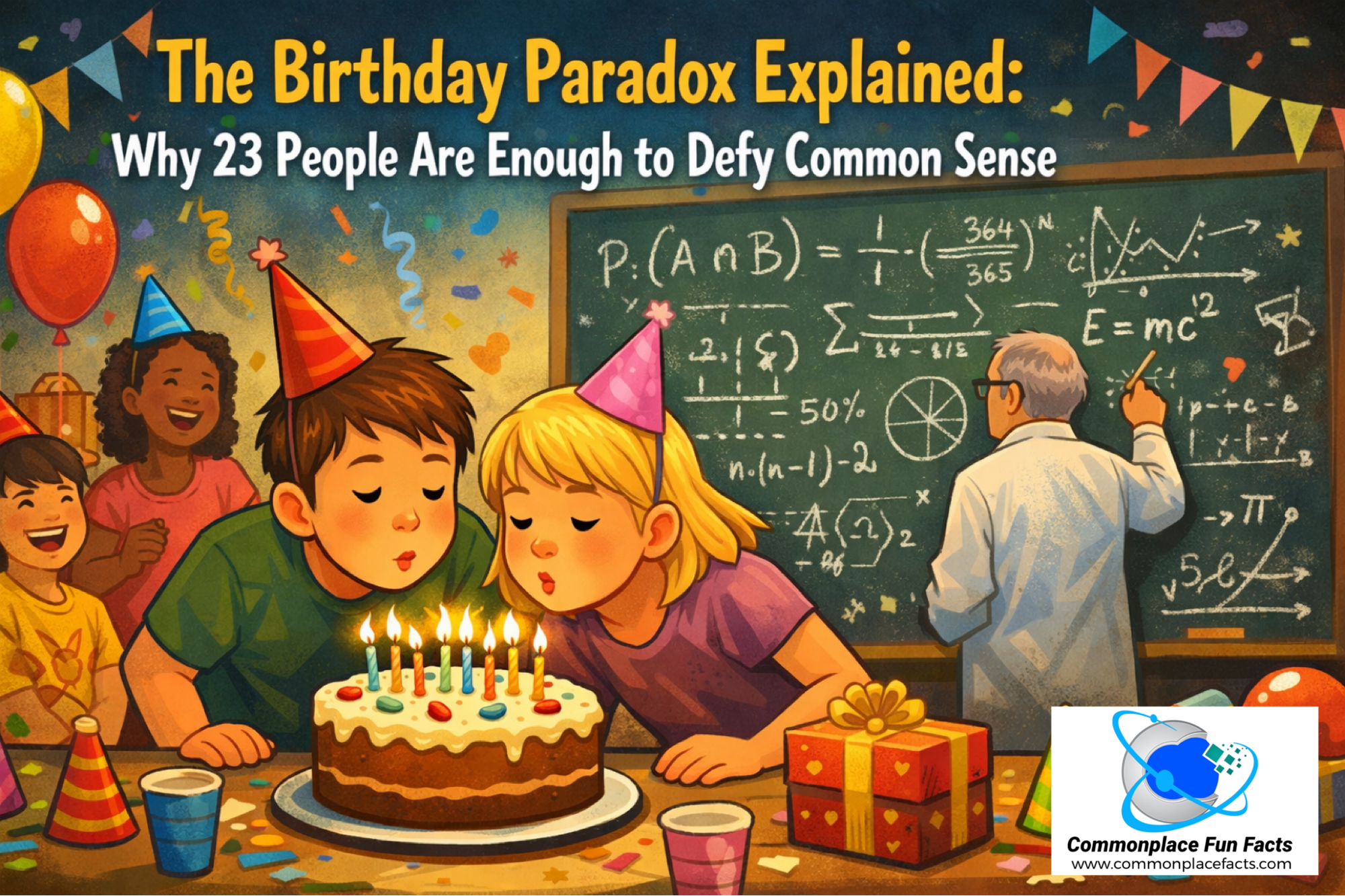

The Birthday Paradox (a.k.a. Your Brain vs. Basic Math)
Here is a small, unsettling fact you can deploy at parties when conversation stalls near the chips: if you gather just 23 people in a room, the odds are pretty good that at least two of them share a birthday.
That’s right. This group of 23 people may not have anything else in common. They could all have different tastes in food, entertainment, and widely divergent opinions about whether men ought to wear socks to a job interview (spoiler: unless the job is a lifeguard or an exotic dancer, socks are non-negotiable). Despite all of that diversity, somewhere in the room, two people almost certainly expect birthday cake on the same day, like members of a very small, very exclusive club. This result feels wrong in the same way optical illusions feel wrong. You know there’s a trick, but your brain still objects.
Welcome to the birthday paradox, one of probability’s favorite party tricks and a reliable way to make otherwise confident adults question their mental firmware.
Contents
What is the Birthday Paradox?
The claim is this: in a room with only 23 people, there’s about a 50/50 chance that two of them share the same birthday.
Twenty-three.
Not 200. Not 365. Not “the entire population of a cruise ship plus two clowns.” Just 23 ordinary humans standing around with their ordinary human skulls full of ordinary human thoughts, and suddenly the calendar starts repeating itself as if Marty McFly just recharged the Flux Capacitor.
If you’re thinking, “That’s nonsense,” congratulations: you are a normal person with a normal intuition that was not designed for probability. Your intuition evolved to keep you from petting bears and to make most warning labels unnecessary. It did not, however, evolve to correctly estimate collision rates in a finite sample space. That’s why it’s called a paradox—not because math is broken, but because we are.
The Real Question You’re Not Asking
Most people hear “birthday paradox” and immediately imagine walking into a room and thinking:
“What are the odds someone has my birthday?”
That is a very human thought. It is also the wrong thought for this problem. It’s like showing up to a chess tournament and asking where the bowling alley is. Respectable activity, wrong building.
The birthday paradox is not about your birthday. It’s about anyone matching anyone else.
So the actual question has nothing to do with the odds of someone sharing your birthday. What we’re interested in are the odds that at least one pair of people in the room share a birthday.
And the moment you ask that, the universe starts quietly building a large pile of possible pairings behind your back.
A Room Full of Comparisons
Here’s the part your brain misses because your brain is, frankly, a little self-centered. (This is not an insult. It is a job description.)
If there are 23 people, you might think, “Well, I can compare my birthday to 22 other people.”
True.
But you are not the only person in the room. Everyone else is also comparable, and they are doing it with or without your permission.
The number of pairs in a group grows fast. With 23 people, there are:
23 × 22 ÷ 2 = 253
…possible pairs.
That’s 253 chances for a match. Not 22.
This is the same reason family reunions spiral out of control, and why it’s mathematically likely that your friends have more friends than you do. The number of relationships grows way faster than the number of people. The math is basically gossip.
The Hook Wall Experiment (Backpacks and Doom)
Let’s make this visual, because probability becomes less terrifying when it’s a physical object you can trip over.

Imagine a wall with 365 hooks. Each hook is a birthday.
Every person walks into the room and hangs a backpack on the hook for their birthday.
The first person? No problem. They get a hook. Life is good.
The second person? Still fine. Plenty of hooks left.
But as people keep coming in, hooks start filling up. Eventually someone walks up, reaches for a hook, and finds a backpack already there.
That’s the birthday match.
No one had to aim. No one had to plan. You just gave randomness enough tries to do what randomness always does: repeat itself and act innocent about it.
The Sneaky Part: Exponents (and Why Your Brain Dislikes Them)
Here’s mistake number two, and it’s the one that makes the paradox feel like a prank: the probabilities stack up multiplicatively, not additively.
Humans think in straight lines. We are “twice as many apples” creatures.
Probability is often an “each time you add another person, you multiply the chance of no match” creature, which is much less friendly and also very rude.

Think about flipping coins:
- Chance of one head on one flip: 1/2
- Chance of two heads in a row: (1/2) × (1/2) = (1/2)2 = 1/4
- Chance of three heads in a row: (1/2)3 = 1/8
That’s an exponent. And exponents drop fast.
The birthday paradox has the same vibe. Each new person isn’t just “one more chance.” They create new comparisons with everyone already there, and those comparisons pile up like dishes in a sink you’ve been ignoring since Tuesday.
The Trick Math People Use: Stop Thinking About Matches
When probability problems get annoying, mathematicians will probably do something that seems improbable: They calculate the opposite.
Instead of asking, “What’s the chance of at least one match?” they ask: “What’s the chance of zero matches?”
Even for those of us who really struggle at math, “no matches” is easier to count.
Here’s what “no matches” looks like:
- Person 1 can have any birthday: 365/365
- Person 2 must avoid that birthday: 364/365
- Person 3 must avoid both: 363/365
- Person 4: 362/365
- …and so on
So the probability of no matches among 23 people becomes:
(365/365) × (364/365) × (363/365) × … × (343/365)
That number shrinks faster than your enthusiasm for an all-day “team-building retreat.”
And when you multiply all those fractions, it turns out the chance of no match is about 50%… which means the chance of at least one match is also about 50%.
Math has spoken. The calendar has repeated itself. Someone in the room is now forced into the small-talk ritual of saying, “No way! You’re March 14 too?”
The 75-Person “Guarantee” (and Why Crowds Are Statistical Menaces)
By the time you get to 75 people, the chance of at least one shared birthday is around 99.9%.
Which is basically certainty, unless the universe is having a very particular day.

This is why the birthday paradox is not just a party trick. It’s a reminder that collisions happen quickly in any system where:
- There are a limited number of “labels” (birthdays, ID numbers, usernames, etc.)
- And you’re picking labels randomly
- And you have lots of chances for overlap
It’s the same general reason two people on the internet both try to claim CoolGuy1997 and end up having to settle for CoolGuy1997_Real_Final2.
If you want to play with the math and probabilities, you can do it at WolframAlpha.
A Mental Shortcut: The Square Root Rule
If you want a quick way to estimate when collisions get likely, there’s a handy rule-of-thumb:
You start getting a 50/50-ish collision chance when the number of items is about the square root of the total possibilities.
There are 365 possible birthdays.
The square root of 365 is around 19.
The real “50% point” is 23, which is in the same neighborhood, just down the street past the house where your intuition lives and refuses to pay property taxes.
The point is: you need far fewer people than you think for overlaps to become likely.
Why It Feels Like Cheating (and Why It Isn’t)
The birthday paradox feels like cheating because your brain expects probability to behave politely.
Your brain expects:
- 365 days means you need “close to 365 people”
- Chance should rise slowly and neatly
- Randomness should be evenly spread out like a well-organized pantry
Instead, randomness behaves like a toddler with a Sharpie. It repeats itself immediately, loudly, and without apology.
Once you remember the two big truths—comparisons explode and probabilities multiply—the paradox stops being spooky and starts being… well… still spooky, but in a “the math checks out” kind of way.
So the next time you’re in a room with 23 people, look around. Someone shares a birthday with someone else. It’s practically a law of nature.
And if nobody matches? Enjoy your rare statistical unicorn moment. Then go buy a lottery ticket, because the universe clearly owes you something.
You may also enjoy…

The Friendship Paradox — Why Your Friends Have More Friends Than You Do
Why do your friends have more friends than you do? Welcome to the Friendship Paradox.

The Great Gamble: Lottery Odds, Luck, and the Improbable (But Inevitable)
From dictators “winning” raffles to mathematicians gaming the odds, lottery history is packed with absurd luck, jaw-dropping blunders, and fortunes gone spectacularly wrong. Here’s the hilarious, heartbreaking truth about lottery odds.

Can You Solve the Unexpected Hanging Paradox?
The Unexpected Hanging Paradox — also known by various names such as the Surprise Examination and the Surprise Drill — has stumped the most brilliant of thinkers. It has been debated in magazine articles, academic papers, and blog posts. Despite all the attention given to the topic, a definitive resolution of the paradox remains elusive.…





Leave a Reply to Commonplace Fun FactsCancel reply