

Soap has an excellent reputation.
It sits quietly on the sink like a small, fragrant ambassador of civilization. It promises cleanliness, refreshment, and the comforting illusion that life’s messes can be resolved with warm water and thirty seconds of responsible scrubbing. Soap is moral. Soap is respectable. Soap does not lurk.
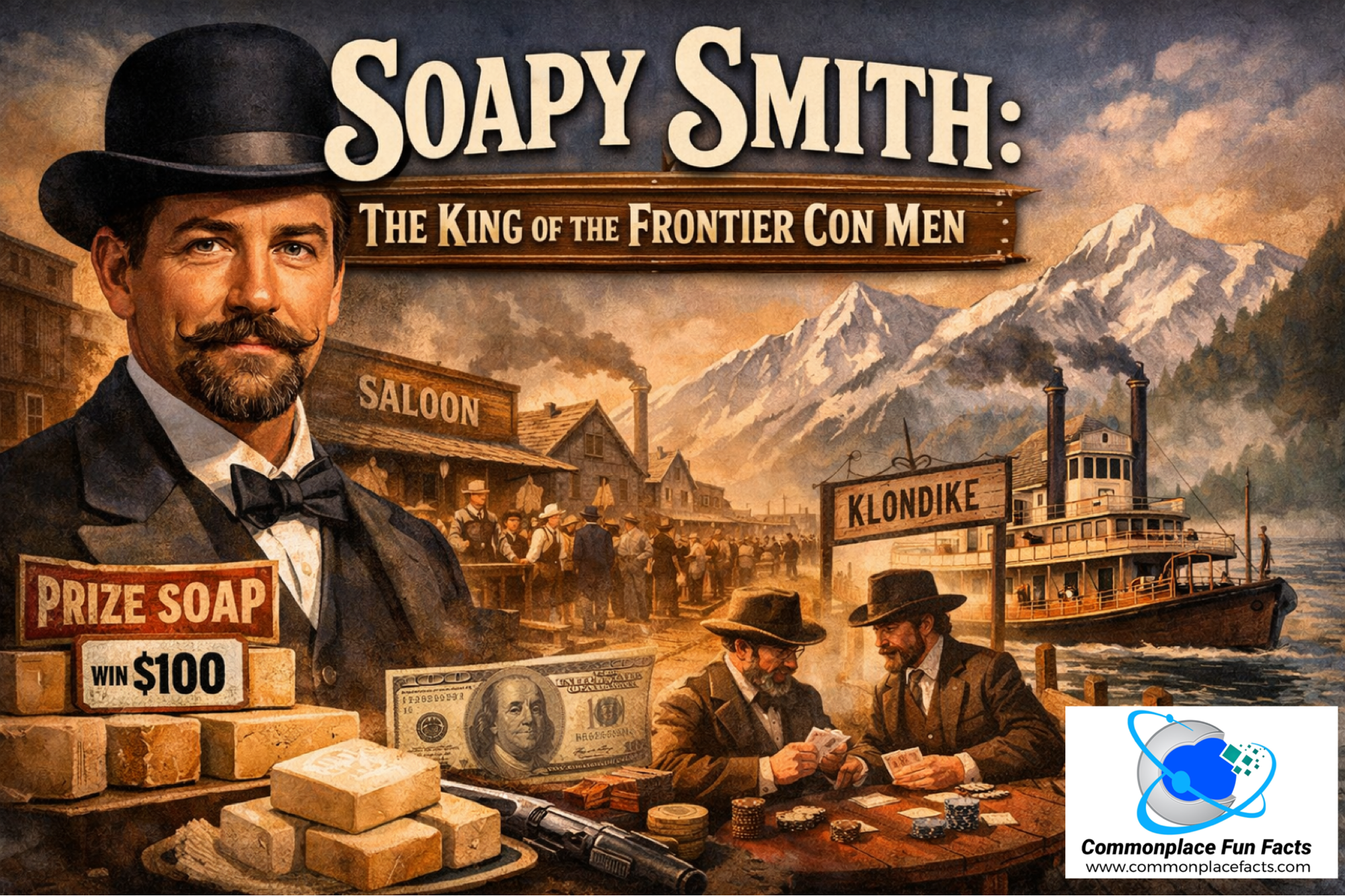
This story, unfortunately, is not about soap. Well, it is, but only as a product. The real subject of this tale is a man called “Soapy.” If actual soap removes grime, Jefferson Randolph “Soapy” Smith specialized in redistributing it — particularly into the civic bloodstream of boomtown America. His name suggests freshness. His career suggests the opposite.
He sold soap, yes. He sold many other things as well: hope, urgency, opportunity, carefully staged good fortune, and the persistent belief that you were just one transaction away from being the smartest person in the crowd.
Soap cleans up messes. Soapy Smith made them.
This is the story of a man who could wrap a brick in optimism, sprinkle it with applause, and leave you grateful for the opportunity to be financially mugged by theatre. It is a tale of boomtowns, gold rushes, fake telegraph offices, municipal improvisation, and one very brisk argument on a wharf that ended badly for everyone involved.
Contents
From Georgia to the Frontier Opportunity Ecosystem

Born in 1860 in Georgia, Jefferson Randolph Smith grew up in the aftermath of the Civil War. His family’s fortunes declined. The American frontier, however, was experiencing the opposite problem: too much opportunity and not nearly enough supervision.
The West was a laboratory experiment in rapid wealth generation. Mines opened. Railroads arrived. Boomtowns erupted from the ground like mushrooms after a rainstorm. Wherever money moved quickly and institutions lagged behind, there was room for a man with a persuasive smile.
Soapy moved west not to find himself, but to find his marks.
The Two-Decade Career Most People Compress into a Campfire Story
Soapy Smith’s criminal career did not happen in one flamboyant summer. It stretched over the last two decades of the 19th century across multiple states and territories. Georgia. Texas. Colorado. Alaska. Wherever money moved quickly and institutional oversight moved slowly, Soapy appeared like a subscription service no one remembered signing up for.
That longevity matters.
He was not a chaotic drifter improvising crimes between train stops. He was a systems builder. He experimented. He iterated. He scaled.
The legend often starts in Skagway and ends on a wharf. The paperwork begins much earlier.
Shell Games Before Soap: The Apprenticeship Years
Before the soap stunt, Soapy practiced more traditional street cons — shell games and other quick-hand tricks that rely on attention manipulation and practiced misdirection.
This is another place where the mythology flattens him into a cartoon villain. The reality is more mundane and therefore more unsettling: he learned his craft. He trained. He refined his timing.
Like Titanic Thompson—the legendary hustler who, decades later, reportedly managed to hustle Al Capone without incurring the mobster’s wrath—Soapy relied less on brute force and more on wiring. He possessed the trifecta that powers every successful con: natural charisma, razor-sharp observational skills, and a level of nerve that suggests he had never experienced a moment of fear in his life.
Confidence is a skill, and Soapy invested early.
King of the Frontier Con Men
Regarded by many as one of the more recognizable con men of the 1800s — which is a bit like being valedictorian at a school for professional liars — Soapy did not remain a solo act for long. He organized. He delegated. He professionalized. Before you could say “place your bets,” he had assembled a traveling cast of bunko men who specialized in shell games, crooked gambling tables, and assorted financial learning experiences. Names like Texas Jack Vermillion and “Big Ed” Burns floated through the lineup, along with a rotating bench of men who understood that chaos is more profitable when properly coordinated.
This was not random frontier mischief. It was infrastructure.
Soapy built a close-knit network of rogues who could descend on a town, set up shop, and extract optimism with remarkable efficiency. Short cons were the specialty — shell games, three-card monte, quick-turn swindles that could be completed before suspicion had time to lace up its boots. By the time anyone realized the pea had not, in fact, been under that shell, the gang was already evaluating the next promising location on the economic horizon.
The press and popular memory would later crown him the “King of the Frontier Con Men.” Monarchies in that era rose and fell quickly. Soapy’s lasted longer than most because he understood something essential: grift, like government, works best when organized.
What Could Possibly Go Wrong with Buying Soap from a Stranger on a Street Corner?
Picture a dusty Western street. A crowd gathers because crowds always gather. At the center stands a confident man atop a wooden crate, sleeves rolled, box of soap at his feet.

He announces that some of these ordinary-looking bars contain real money — paper bills wrapped inside. Tens. Twenties. Perhaps even a hundred dollars. He holds them up one by one, visibly sealing currency into select packages. He shuffles them with great ceremony, insists he isn’t looking, and invites the public to try their luck.
Someone steps forward.
A bar is purchased. The paper is torn open. Out slips a bill.
The crowd erupts.
At that exact moment, logic leaves town without filing a forwarding address.
This was the “prize soap” racket, the performance that earned Jefferson Smith his enduring nickname: Soapy. The soap was incidental. The commodity was hope — and hope, properly staged, turns out to be flammable, contagious, and extremely profitable.
How the Trick Actually Worked (A Brief Study in Human Nature)
The structure was disarmingly simple.
Soapy would openly display genuine bills, wrapping some inside soap in full view of onlookers. He mixed the bars with exaggerated fairness. Then a conveniently placed associate — known in the trade as a shill — would purchase one and “discover” a prize. The celebration was loud, convincing, and strategically timed.
Next came the crucial announcement: several high-value bills were still unclaimed.
This is where rational calculation quietly steps aside in favor of possibility.
Suddenly, a one-dollar bar of soap transforms into opportunity. It is no longer hygiene. It is potential wealth at a discount. It is the tantalizing whisper that you might be smarter than the crowd.
Eventually, the largest unclaimed bills would find their way back to Soapy. The audience would disperse slightly poorer, slightly embarrassed, and somewhat reluctant to discuss the experience at dinner.
The Business Model of Persuasion
A confidence man does not snatch a wallet. That would be impolite. He arranges events so that you voluntarily reach into your own pocket while feeling clever about it.
The product is trust. The packaging is charm. The distribution channel is group psychology.
Soapy did not operate alone. He employed shills who “won” at key moments, steerers who directed newcomers toward the action, and muscle to discourage immediate reconsideration of poor financial choices.
The soap was performance. The performance generated revenue. The revenue supported a network. And that network was scalable.
At no point did most participants consider themselves robbed.
They were persuaded.
As for how he sustained the operation for years, the explanation is simpler than the frontier legend would suggest. Embarrassment is one of the most effective silencers in American history. People will publicly recount failed business ventures and livestock mishaps. They are far less inclined to announce that they bought a bar of soap because a stranger promised guaranteed excitement.
The greatest accomplice in the soap box was not sleight of hand. It was human pride.
Denver: When the Con Goes Corporate
In Denver, Colorado, Soapy graduated from street performer to executive management.
He established himself rather than drifting. He opened and operated saloons and gambling houses, including the Tivoli Club, which functioned less like a casual gathering spot and more like a headquarters.
In a boom-and-bust environment full of new arrivals, miners, speculators, and the eternally optimistic, the opportunities multiplied. Rigged card games. Shell games. “Prize” schemes. Loan arrangements that had all the warmth of a winter night without a coat.
Soapy also understood something critical: if you can influence local politics — or at least make friends within it — you lower the cost of doing business. Enforcement becomes flexible. Oversight becomes philosophical.
The soap seller had evolved into a systems thinker.
Crime, Politics, and That Conveniently Flexible Definition of Philanthropy
Running a successful criminal enterprise in the 19th century required more than dexterity with cards and soap. It required relationships.
Soapy understood that if one intends to operate a steady stream of shell games, crooked gambling tables, and other educational programs for the financially optimistic, one must occasionally invest in goodwill. He provided kickbacks to saloon owners. He cultivated city officials. He focused his most aggressive swindles on travelers passing through town rather than locals who might hold grudges.
And when euphemisms ran out, he did what practical men with cash tend to do.
He began to bribe.
Influence, after all, is cheaper up front than legal defense later.

Within his own ranks, Soapy practiced a version of what might generously be called “honor among thieves.” He was known to be quick with financial assistance if one of his associates fell on hard times — or into police custody. Bonds were secured. Releases were expedited. Loyalty was cultivated not through terror alone, but through efficiency and attentiveness.
The philanthropic streak did not stop at the gang’s payroll. Soapy made charitable contributions to churches and to the city’s poor. Just as Al Capone was known to help charitable organizations, Soapy would go so far as to make his saloons available for Sunday services, allowing ministers to preach redemption in establishments that, hours earlier, had facilitated quite the opposite. To many locals, this blurred the line between crime boss and civic booster.
Public relations is not a modern invention.
His family soon became part of the operation. His younger brother Bascomb ran a cigar store that functioned as both legitimate storefront and gateway to less legitimate pursuits. His brother-in-law, William “Cap” Light — once a deputy marshal in Texas — found the entrepreneurial atmosphere irresistible and joined the enterprise. Crime, like most industries, benefits from vertical integration.
Although Denver remained the primary base of operations, Soapy expanded aggressively. In 1885, he partnered in Leadville, Colorado with a con artist known as Old Man Taylor, relieving miners of surplus cash through shell games conducted with remarkable smoothness.
One of the more conspicuous episodes occurred in 1891 when Soapy and Cap Light led an armed confrontation at the offices of the Glasson Detective Agency. The agency had allegedly attempted to coerce a confession from a young woman. Upon hearing of it, Soapy and his associates stormed the office, pistols drawn.
In most contexts, armed raids do not enhance a man’s reputation. In Denver’s complex civic environment, however, this episode was widely interpreted as a stand against abusive authority. It further cemented Soapy’s image not merely as a con man, but as a kind of frontier vigilante — a narrative he had every incentive to encourage.
From vigilante to political operator is a short walk.
Soapy became involved in local elections, influencing outcomes, manipulating votes, and running protection rackets under the thin veneer of civic participation. He maintained a reputation as a relatively nonviolent “gentleman-criminal,” preferring persuasion and organization over outright brutality.
But empires seldom plateau quietly.
By 1892, rival gangs were pressing into his territory. His temper reportedly frayed. Alcohol, never a stabilizing management tool, complicated matters. More importantly, Soapy’s notoriety had grown so great that politicians who had comfortably ignored him for years found it increasingly difficult to continue doing so in public daylight.
Influence works best in shadows. Soapy had become highly visible.
With pressure mounting and opportunity emerging elsewhere, he did what entrepreneurs in crowded markets have always done: he relocated.
The booming mining camp of Creede, Colorado, beckoned. And with it, another chance to reorganize optimism into revenue.
Creede: Silver, Strategy, and the Petrified Man
When Denver became inconvenient and new opportunity glittered in the San Juan Mountains, Soapy redirected his enterprise to the booming mining camp of Creede, Colorado. Boomtowns are nature’s way of asking whether optimism can outpace regulation. The answer, in Creede’s case, was yes.
He did not arrive quietly.

Among his more memorable innovations was the unveiling of what he called a “petrified man.” Affectionately named McGinty, this supposed prehistoric specimen was, in reality, a skeleton covered in concrete. It was less Smithsonian and more sidewalk renovation project. Nonetheless, for the modest admission fee of ten cents, citizens could gape in awe at a marvel of dubious geological provenance.
It was a sideshow. It was ridiculous. It was profitable.
And, most importantly, it brought customers through the door.
While the crowd inspected McGinty’s alleged antiquity, other, more traditional financial rearrangements could be conducted nearby. The petrified man may have been immobile, but the cash flow was not.
The larger objective in Creede was not novelty. It was influence.
Soapy persuaded his brother-in-law, William “Cap” Light, to accept a position as deputy marshal. It was a strategic appointment. With a friendly face inside the machinery of enforcement, Soapy could protect associates, expedite releases, and eject genuinely disruptive violence that threatened the stability of his own operations. Order, after all, is good for business — provided one helps define it.
Layered on top of this was the familiar pattern of civic generosity. Church donations reappeared. Assistance for the poor was visible. Contributions smoothed relationships. As in Denver, his combination of charm, charity, and carefully applied pressure blurred his identity in the public mind. Crime boss, booster, benefactor — the distinctions depended heavily on who was speaking.
Creede, however, suffered from a condition common to mining camps: impermanence. The boom cooled. The population shifted. Fortunes recalibrated downward.
With the local heat reduced and the silver excitement fading, Soapy returned to Denver to regroup.
Even during his Creede tenure, he remained restless. He traveled to Texas in search of fresh marks. He made regular trips to St. Louis to visit his wife and children — a biographical detail that sits awkwardly beside the image of the frontier kingpin but remains nonetheless true. Around this period, he also made his first trip north to Alaska, scouting what would soon become the most dramatic chapter of his career.
The petrified man of Creede eventually lost its novelty.
Soapy, however, was already looking toward colder and far more lucrative horizons.
Alaska: The Northern Experiment
If Creede was a proving ground, Alaska was an audition for something much larger.
In April of 1896, Soapy shipped out from Seattle, surfacing in Juneau, then Coal Bay (modern Homer), then back to Denver, then north again. His movements during this period resemble a man scanning a map for volatility. There are gaps in the record — entire stretches where historians shrug and gesture vaguely at the Pacific Northwest.
His first attempt to introduce the prize soap concept to Southeast Alaska did not go smoothly.
In Juneau, he tried the routine and was promptly arrested. He was operating under an alias, but anonymity is difficult when your business model involves theatrical charisma. He paid a $25 fine, cultivated a polite new acquaintance with local authorities, and moved along.
Next came the Kenai Peninsula, where rumors swirled that Hope, Alaska, might explode into the next great gold bonanza. Soapy did what he always did: he followed rumor before it solidified into fact.
The problem was that Hope was small. Very small. Small enough that scaling a con operation there would have required more optimism than even Soapy could manufacture. He assessed the situation, recalculated, and boarded a boat back south.
Hope, it turned out, was not his future.
Then word trickled down of something much larger: the Klondike.
Here is where the mythology gets interesting.
Soapy did not pack a pan and head for the Yukon to dig in frozen riverbeds. He understood leverage. Skagway — the port town serving as the primary jumping-off point for stampeders heading north — was the real opportunity. It was traffic. It was liquidity. It was chaos without infrastructure.
He arrived in 1898 and immediately built a saloon.
Short on law and long on gold dust, Skagway was a friction point in a gold rush supply chain. Miners and investors arrived flush with savings or newly acquired dust. Businesses sprang up overnight. Newspapers were established to report each fresh rumor of a strike.
Soapy purchased influence in the press, attempting both to mute criticism and to promote Skagway as something more stable than it was. Among his more creative adaptations was a telegraph office that charged customers to send messages to loved ones. The existence of an actual functioning line capable of transmitting those messages in any reliable way was… interpretive.
Clients would receive replies requesting funds. The ecosystem of urgency sustained itself.
When confronted, Soapy reportedly defended his operations as a kind of harsh frontier education. If you were foolish enough to be taken in, he implied, you were unlikely to survive the Yukon anyway.
This argument did not enhance his popularity among the town’s more established merchants.

If Skagway developed a reputation as a den of swindlers, it would repel precisely the kind of prosperous miners the town depended on. Respectable businessmen grew restless. A vigilante group formed: the “Committee of 101.”
Soapy responded in character, organizing his own counterweight, jokingly dubbed the “Committee of 303.” Where some saw necessary reform, others saw a power struggle.
The finale arrived in the summer of 1898.
Accounts diverge — as they often do when gunfire precedes documentation. Some suggest Soapy arrived at a Committee meeting intending to talk his way out of danger, as he had so many times before. Others argue he underestimated the temperature of the crowd. Still others suggest alcohol dulled what strategic instincts he normally possessed.
What is clear is this: on the Skagway wharf, weapons were drawn. Frank Reid, a local resident and member of the Committee, confronted him. Shots were exchanged.
Both men fell.
Soapy Smith died on the spot. Reid succumbed to his wounds days later.
Historians continue to debate the precise choreography of the final seconds. Some insist it was a near-simultaneous exchange. Others dispute who fired first. Legend, like a frontier telephone game, prefers dramatic clarity over evidentiary precision.
In a final note of irony that would not have been lost on observers, funeral services for Jefferson Randolph “Soapy” Smith were held in a Skagway church to which he had donated funds. The sermon text came from Proverbs 13:15:
“The way of transgressors is hard.”
For a man who had spent two decades persuading others to take the harder path financially, it was an appropriate closing line.
The Aftermath: From Man to Myth
After his death, Soapy’s network fragmented. Skagway continued. The gold rush moved on.
What endured was the story.
In some tellings, Soapy is a charming rogue who added color to frontier life. In others, a calculated manipulator who preyed on the desperate and the inexperienced.
The persistence of his legend says as much about us as about him.
We prefer villains with theatrical flair. We appreciate tidy arcs. We enjoy imagining that corruption has a face and that removing the face resolves the problem.
Why Soapy Still Feels Familiar
Soapy’s true skill was not brute intimidation. It was social engineering.
He leveraged urgency. He relied on planted testimonials. He exploited embarrassment and group psychology. He adjusted price points to match the surrounding economy. He understood that most people would rather double down on a bad decision than publicly admit it was one.
The tools may now be digital. The wiring remains identical.
Soap has kept its reputation for cleanliness.
Soapy’s career reminds us that names can mislead, applause can distort judgment, and optimism — while admirable — is a commodity someone is always trying to sell back to us at a markup.
In the end, Jefferson Randolph “Soapy” Smith did not invent greed, gullibility, or hope. He simply organized them.
And unlike soap, those elements are not easily rinsed away.
You may also enjoy…

Christopher Columbus: Explorer, Adventurer… and Con Man?
Uncover the untold story of Christopher Columbus, not just as the man who ‘discovered’ America, but as a master manipulator who used clever tricks and deception to complete his legendary voyage.

The Amazing Story of Titanic Thompson: The Legendary Hustler Who Tricked Al Capone
Meet the legendary hustler Titanic Thompson — a man who could out-golf the world’s best golfers and out-con the world’s greatest conmen.

Did Johannes Gutenberg Invent the Printing Press? The True Story of the Accidental Inventor Who Just Needed the Money
Johannes Gutenberg didn’t plan to change the world—he missed a deadline, ran out of money, and invented the printing press as Plan B.






Leave a Reply