
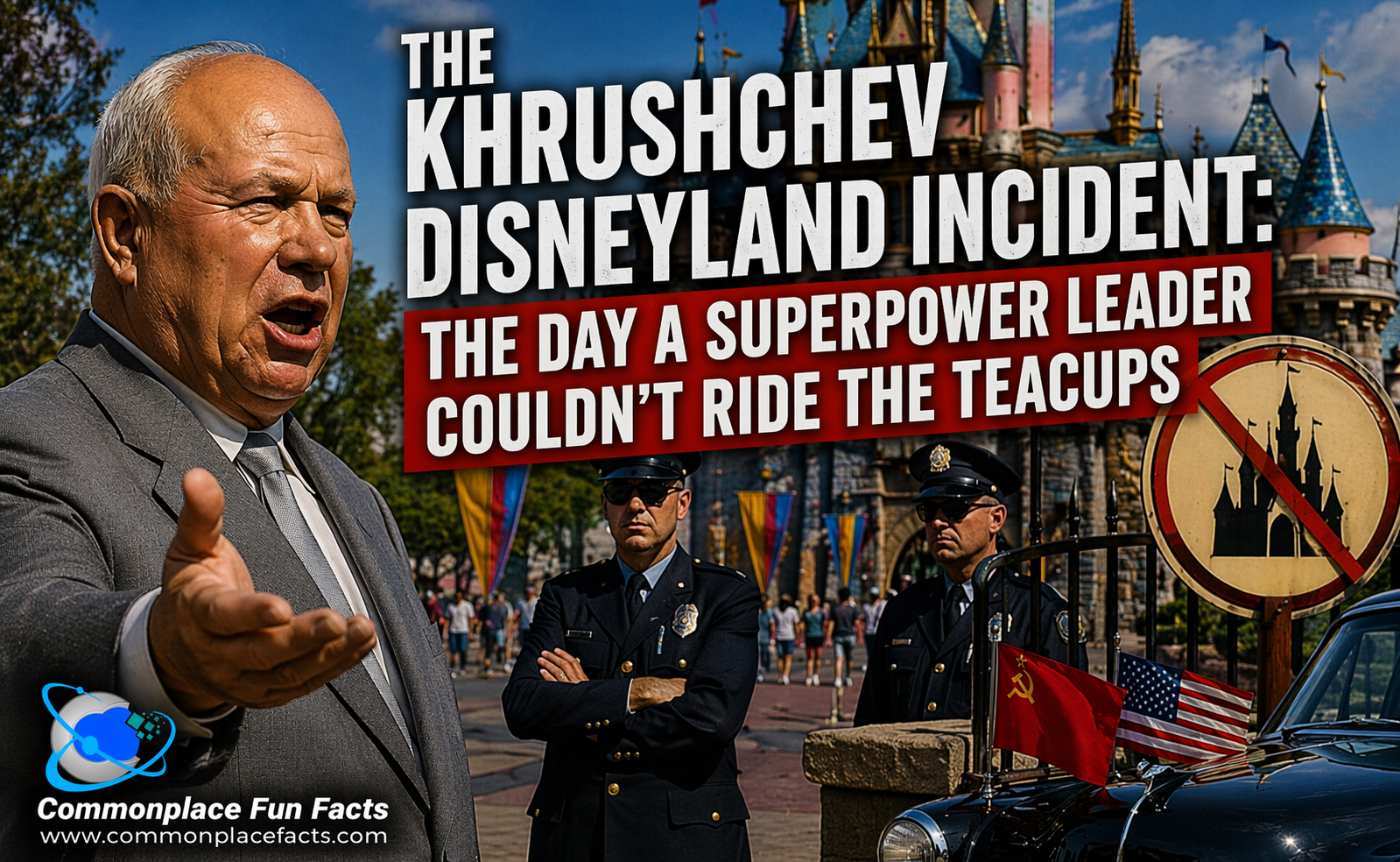

In the long and distinguished history of Cold War incidents, there are few moments more absurd than the time Soviet Premier Nikita Khrushchev came to America, got told he could not go to Disneyland, and reacted as though the United States was trying to hide the nuclear codes, the Ark of the Covenant, and possibly the good silverware.
This really happened.
It happened in September 1959, during Khrushchev’s highly publicized trip to the United States. This was the first visit to America by a Soviet leader, which meant it was already going to be awkward. The two superpowers were locked in a global ideological knife fight, both sides had enough nuclear weapons to turn the planet into a glow-in-the-dark nightlight for extraterrestrials. Now the man running the Soviet Union was flying over to shake hands, smile for the cameras, and see what capitalism looked like up close.
Which, as it turned out, included a very public dispute over Disneyland.
Contents
The Set-Up: Before Disneyland, There Was a Kitchen
To understand why Khrushchev’s trip mattered so much, it helps to start a couple of months earlier with one of the most famous staged arguments in modern history: the Kitchen Debate.

In July 1959, Vice President Richard Nixon visited Moscow for the American National Exhibition. There, inside a model American kitchen, he and Khrushchev got into an impromptu argument about capitalism, communism, consumer goods, and whose system was going to win the future. It was part ideological showdown, part appliance showroom, and part two men essentially saying, “Nice refrigerator. Be a shame if someone used it as a metaphor for civilization.”
The exchange put Khrushchev directly before an American audience as something more than a distant Soviet bogeyman. He was loud, combative, theatrical, witty, and very obviously confident that communism was on the march. He was not some silent Kremlin gargoyle sitting in a dark room stroking a cat with one hand and a missile with the other. He was a performer. He jabbed, joked, interrupted, argued, and sold his worldview with the energy of a man who believed history had personally signed over the deed to him.
The Kitchen Debate also helped set the mood for his arrival in the United States. Americans had already seen that Khrushchev was not merely a bureaucrat in a gray suit. He was a political street fighter who liked an audience, knew how to play to cameras, and had the self-restraint of a man trying to parallel park a tractor inside a china shop.
Khrushchev Was Not Built for Quiet Dignity
That personality was central to the whole trip. Khrushchev was not polished in the way Western diplomats usually preferred. He could be coarse, emotional, funny, impulsive, charming, bullying, folksy, and thin-skinned, sometimes within the same paragraph. American officials studying the visit later described him as extremely sensitive to slights, real or imagined, and noted his remarkable taste for humor and ham-acting as he tried to present himself as both human and formidable.
That was not accidental. Khrushchev understood showmanship. He knew that he was arriving in a country where many people pictured Soviet leaders as faceless monsters from a red-tinted nightmare. He leaned hard into a strategy of acting human, approachable, and disarmingly colorful. He joked, he bantered, he smiled, he brought family members, and he repeatedly emphasized that Americans could now see he did not have horns. There is something almost touching about that effort, in the sense that it is always nice when the leader of a nuclear superpower wants the public to know he is, at minimum, not literally a devil.
Arrival in America: The Curtain Goes Up
Nikita Khrushchev arrived in the United States on September 15, 1959, at Andrews Air Force Base, where President Dwight D. Eisenhower welcomed him. The event was heavy with ceremony and geopolitical symbolism, but Khrushchev, being Khrushchev, did not approach it like a man determined to disappear politely into the background.
From the start, he treated the trip as both diplomacy and theater. He joked, riffed, and worked the crowd with the instincts of a veteran vaudevillian who had somehow been handed an empire. Contemporary observers and later State Department assessments alike emphasized that he repeatedly used humor and exaggerated performance to make himself seem vivid and approachable. He wanted Americans to see a flesh-and-blood man rather than a cartoon villain. He also wanted them to see a tough, confident leader who believed the Soviet Union was destined to triumph. In other words, he was trying to be likable and intimidating at the same time, which is not easy unless you are a large dog wearing sunglasses.
Even before Disneyland entered the picture, the trip was already a giant media spectacle. The Khrushchev tour would include Washington, New York, California, Iowa, Pennsylvania, and Camp David. He visited farms and factories. He met businessmen, journalists, and politicians. He made speeches. He traded barbs. He alternated between friendliness and irritation with the speed of an angst-ridden teenager.
This was not diplomacy as a serene exchange of carefully polished talking points. This was diplomacy as live television.
Hollywood, Bob Hope, Frank Sinatra, and the Seed of an Idea
Then came Los Angeles.
On September 19, Khrushchev visited Hollywood and attended a luncheon at Twentieth Century-Fox. This gathering was a surreal little museum of mid-century celebrity culture. Movie stars, studio executives, and assorted glamorous Americans were brought together to meet the premier of the Soviet Union, which sounds less like foreign policy and more like someone let a screenwriter pitch directly to history.

At the luncheon, Khrushchev’s wife Nina was seated with Bob Hope and Frank Sinatra. That detail matters because later Bob Hope claimed that he was the one who planted the Disneyland notion by telling her that she ought to go. Hope, never a man allergic to improving a story, later said he suggested Disneyland to Mrs. Khrushchev and that she passed the idea along to her husband.
There does appear to be some truth in the general vicinity of that story, but not enough to award Bob Hope sole credit like he personally invented both Disneyland and Soviet tourism. The best-supported version is that Hope and Sinatra encouraged the idea at the luncheon, but other accounts indicate that Nina Khrushchev already wanted to see Disneyland and that the entourage had already expressed interest in going. So Hope and Sinatra were probably not the sole originators so much as a couple more cheerful Americans saying, “Yes, obviously you should see the place with the friendly rodent with massive ears.”
Regardless of who instigated the idea, the seed was clearly germinating and taking root in the Soviet premier’s head.
The Khrushchev Disneyland Incident: The Happiest Place on Earth Meets the Cold War
That brings us to the main event.
Khrushchev wanted to visit Disneyland during the California portion of the trip. The stop was discussed seriously enough that it became part of the day’s planning and then, suddenly, part of its collapse. The official reason for the cancellation was security. Los Angeles police told U.S. officials they could not guarantee Khrushchev’s safety at the park. One reported factor was a tomato thrown during the motorcade from the airport, which did not exactly reassure everyone that Southern California was prepared to host a Soviet premier with the required level of calm professionalism.
From the standpoint of local authorities, this was a security nightmare. From the standpoint of Khrushchev, it was absurd.
At the Fox luncheon, he learned the Disneyland visit was off. He was furious and made sure everyone on earth knew it:
“When I came here to the city, I was given a plan—a program of what I was to be shown and whom I was to meet here. But just now I was told that I couldn’t go to Disneyland. I asked, ‘Why not?’ And just listen to what I was told. For what reason? I was told that the American authorities cannot guarantee my security if I go there. What is it? Do you have rocket-launching pads there? I don’t know. What is it? Is there an epidemic or something? Or have gangsters taken hold of the place that can destroy me? I say I would very much like to go and see Disneyland. For me, such a situation is inconceivable. I cannot find words to explain this to my people. I thought I could come here and not have to sit in the sweltering heat in a closed car under your hot sun. I thought I could come here as a free man, as a guest of the free American people. This fact can evoke nothing but profound disappointment on my part.”
It is difficult to improve upon this statement. It has everything. Confusion. Suspicion. The dignity of a head of government. The disappointment of a child being told, “No.” The emotional energy of a father learning the roadside attraction closed twenty minutes ago.
Sinatra, for his part, remembered the moment with slightly less restraint and slightly more Sinatra. According to accounts from the luncheon, Nina Khrushchev mentioned how disappointed she was that the Disneyland visit had been canceled. Sinatra, never one to let logistics interfere with enthusiasm—or common sense—leaned over and suggested, in essence, that the solution was simple: ignore the authorities and go anyway. As one recollection puts it, he muttered to David Niven, “Screw the cops… we’ll take them down there this afternoon.”
This impromptu plan did not materialize, however, leading Khrushchev into an even darker mood. The day in Los Angeles had already been going badly. The reception was cooler than expected. Security was heavy. The crowds were sparse. A back-and-forth with studio boss Spyros Skouras turned public and awkward. The Hollywood entertainment arranged for Khrushchev’s benefit struck officials as tasteless. By the time the Disneyland cancellation hit, the whole day had become a stack of annoyances wobbling on one emotional toothpick.
That night, at a civic dinner, Khrushchev lost his temper even more dramatically. U.S. officials later described Los Angeles as the low point of the entire trip. Even Khrushchev’s wife reportedly admitted that he had completely lost his temper. Fatigue probably played a role. So did wounded pride. So did Khrushchev’s longstanding tendency to respond to slights as though they had been prepared by committee and personally approved by history.
Why Disneyland Mattered More Than It Should Have
On one level, the incident was silly. It was a grown man, albeit one with thermonuclear capabilities, becoming enraged over not getting to go to an amusement park.
On another level, it was not silly at all.
All of this was unfolding against the backdrop of a Cold War that was anything but whimsical. While Khrushchev was arguing about Disneyland, both superpowers were quietly contemplating ideas like Project Sundial, a proposed thermonuclear weapon so powerful it could have rendered entire continents uninhabitable. It is one of history’s more jarring contrasts: on one hand, leaders debating who had the better economic system, and on the other, seriously entertaining devices that could end the argument by ending everything else.
And if that sounds like theoretical overkill, the Soviets would later take their own turn at existential planning with systems like Dead Hand, an automated retaliation mechanism designed to launch nuclear strikes even if human leadership had been wiped out. It turns out that while diplomats were arguing over theme park visits, engineers on both sides were quietly designing ways to ensure that no one would be visiting anything ever again.
Disneyland was not merely a place with rides, smiling employees, and enough churro-adjacent optimism to power a small state. It was a polished showcase of American abundance, consumer culture, and cheerful mass entertainment. In the ideological competition of the Cold War, that mattered. The United States was not just selling missiles and alliances. It was selling a way of life. Khrushchev understood symbolism perfectly well, which is why being told he could not enter that symbol felt like both an insult and a missed opportunity.
There is also a plausible case that Khrushchev recognized how useful the moment was politically. Some diplomats later suspected he may have turned the Disneyland snub into a public relations weapon. Ask for something that sounds ordinary and harmless. Get denied. Then act amazed that the self-proclaimed land of freedom cannot even manage to take you to the teacups without a crisis. If that was the strategy, it worked beautifully.
It made the Americans look rattled. It made Khrushchev look animated, aggrieved, and somehow relatable. Plenty of people who disagreed with him on literally everything could still understand the basic complaint: if you invite a guest all the way across the world, perhaps do not bungle the field trip.
The Man Behind the Meltdown
The Disneyland episode also tells us a great deal about Khrushchev himself. He was not a calm, marble-sculpture type of statesman. He was emotional and intensely performative. He liked bluntness. He liked the attention of a crowd. He liked dominating a room. He enjoyed humor, but he also had a hair-trigger sense of insult. He could present himself as jovial one minute and affronted the next. He wanted to seem warm and human while also reminding everyone that he represented a superpower and expected to be treated accordingly.

That combination made him compelling and exhausting. He could be genuinely funny. He could also turn petulance into geopolitics before dessert.
In that sense, Disneyland was almost inevitable. Of course the most theatrical Soviet leader of the Cold War would eventually collide with the most theatrical American attraction of the postwar era. This was less a scheduling mishap than destiny putting on mouse ears.
The Aftermath
In the end, the Khrushchev Disneyland incident says less about theme parks and far more about people.
For all the towering rhetoric of the Cold War—mutually assured destruction, ideological supremacy, and the future of civilization—this particular moment turned on something far more familiar: expectations, pride, and the universal human dislike of being told “no.” Strip away the politics, and you are left with a scenario that plays out daily in far less dangerous settings. A guest arrives, looks forward to something, is told it cannot happen, and reacts with the emotional subtlety of a slammed screen door.
The difference, of course, is that this guest controlled a nuclear superpower and chose to express his disappointment in front of microphones.
That is what makes the story endure. It is not merely that Khrushchev was denied Disneyland. It is that, in that moment, the Cold War briefly stopped being an abstract struggle between systems and became a very public display of personality. It was theater, frustration, symbolism, and spectacle all wrapped into one, with a castle in the background that he never got to see.
One cannot help but wonder what might have happened if the visit had gone through. Perhaps Khrushchev would have ridden the Jungle Cruise, nodded approvingly at the efficiency of American animatronics, and still declared the inevitable triumph of communism slightly ahead of schedule. Or perhaps he would have simply enjoyed the day, bought a souvenir, and returned to geopolitics with one less grievance.
Instead, history gave us something better.
It gave us the image of a Cold War leader, standing in the California sun, demanding to know why he could not visit Disneyland—and unintentionally reminding everyone that even at the height of global tension, the world was still being run by very human beings.
And sometimes, those human beings just wanted to ride the teacups.
You may also enjoy…

Cayo Blanco Del Sur : I Gave East Germany An Island, and All I Got Was This Lousy Teddy Bear!
Learn how Cuba gave the island of Cayo Blanco del Sur to East Germany and only got a stuffed animal in exchange.

When POTUS Has to Ask for Mommy’s Help
He may have been the most powerful man in the world, but John F. Kennedy learned that there are some things even the President of the United States can’t do. He commanded a military of nearly 3 million people who would follow his orders without question, but there was one person to whom he needed to…

A Good Housekeeper Is Worth Her Weight in … Disney Stock
By all accounts, Thelma Pearl Howard was a woman of modest means. She died on June 10, 1994, just 16 days short of her 80th birthday. Her closest friends and family thought the most interesting thing about Thelma was the thirty years she served as housekeeper to Walt Disney. They never imagined that she was…


Leave a Reply