

The Time Zone Error That Doomed the Bay of Pigs Invasion
Time zones. They can be problematic, can’t they? Who hasn’t had a deep sleep interrupted by a phone call or text message from a well-meaning friend in another part of the country who forgets that you are in a different time zone? If you want to know how time zones got started, you’ll want to read this article. If you want to know how they caused a much bigger inconvenience than interrupted sleep, keep reading.
Yes, double checking time zones is a useful habit. It’s a small detail, easily overlooked, but as history has proven, it can be the difference between triumph and total catastrophe. Just ask the CIA, the Kennedy administration, and a group of Cuban exiles who, in April 1961, discovered that an hour can turn the tides of history.
Welcome to the story of the Bay of Pigs invasion, where a carefully planned mission to overthrow Fidel Castro went sideways faster than you can say “Daylight Saving Time” — a concept that was originally suggested in jest, incidentally. In what can only be described as a logistical faceplant, a one-hour time discrepancy played a crucial role in turning an already questionable plan into an unmitigated disaster.
Contents
The Plan: What Could Possibly Go Wrong?
The basic idea was classic Cold War cloak-and-dagger: the CIA, with the full backing of the U.S. government, trained and armed a brigade of anti-Castro Cuban exiles, hoping to spark a counter-revolution that would topple the communist leader. On paper, it was a simple three-step process:
1. Bomb Cuban airfields to cripple Castro’s air force.
2. Land a force of exiles at the Bay of Pigs, creating a foothold for a larger uprising.
3. Wait for the Cuban people and military to rise up in support of their liberators.
There were just a few teeny, tiny problems. The Cuban people weren’t exactly on board, Castro already knew about the invasion plans, and U.S. air support was severely limited because Kennedy wanted plausible deniability (because, naturally, a brigade of Cubans storming a beach with American-made weapons wouldn’t raise any red flags).
But the real kicker? A time zone mix-up that ensured the mission was doomed before it even started.
One Hour to Disaster

Here’s where things get hilariously tragic. The initial bombing of Cuban airfields was scheduled to neutralize Castro’s air force, giving the invasion force a fighting chance. The plan relied on follow-up airstrikes the next morning, just before the main landing.
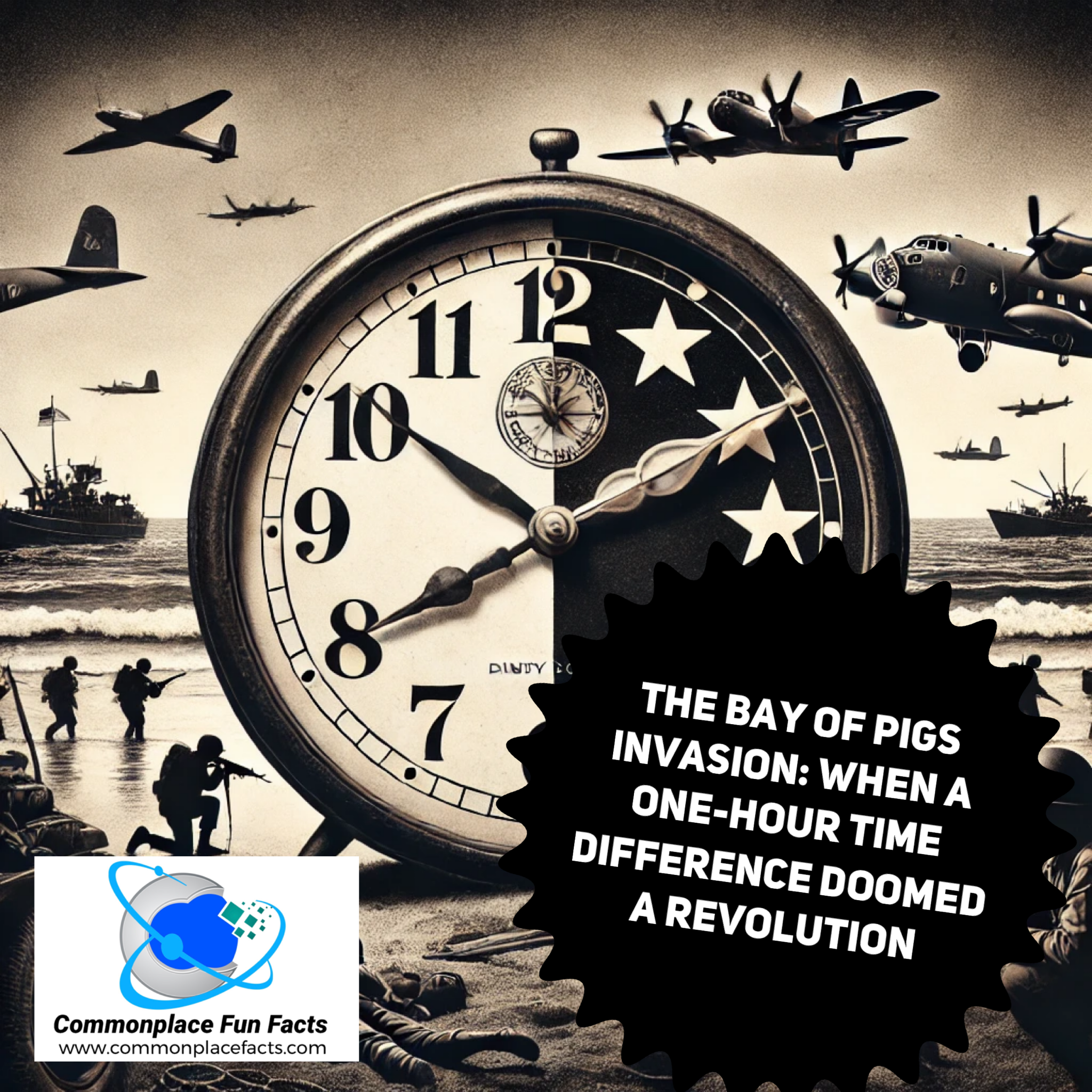
Enter the time zone mix-up. The bombers were supposed to strike at dawn, taking advantage of low light to avoid detection. The exiles had trained on Eastern Standard Time, but Cuba was operating on Daylight Saving Time. No, you didn’t read that wrong—somebody forgot to account for the one-hour difference, meaning the bombers arrived too late.
By the time they showed up, the sun was already high in the sky, Cuban defenses were on full alert, and any element of surprise had been obliterated. Instead of hitting airfields before planes could take off, the bombers found themselves dodging anti-aircraft fire and Castro’s fully operational air force.
Oops.
A Comedy of Errors (Without the Comedy)
Once the landing force hit the beaches, things went from bad to worse. Instead of meeting a weak, disoriented enemy, they found themselves under immediate attack from Cuban planes that should have been destroyed hours earlier. Reinforcements and supplies never made it to shore. The invaders, expecting local support, instead found themselves surrounded by Castro’s well-armed troops.
Within 72 hours, it was all over. The invading force suffered over 100 deaths, and more than 1,100 men were captured. Some were executed, others were imprisoned, and the entire episode became one of the most embarrassing foreign policy blunders in U.S. history.
The Fallout: Lessons in the Importance of Clocks
The Bay of Pigs failure was a wake-up call for the Kennedy administration, which promptly took a long, hard look at how it conducted foreign policy (and presumably how it scheduled things). It also led directly to Castro cozying up to the Soviet Union, which, in turn, led to the Cuban Missile Crisis, which, in turn, almost led to World War III.
Read the CIA’s declassified documents about the Bay of Pigs Invasion
Historians have pointed out many reasons why the Bay of Pigs invasion was doomed—poor planning, underestimating Castro’s forces, and wildly misjudging the support of the Cuban people. But let’s not overlook the sheer absurdity of losing an invasion to time zones.
If nothing else, it’s a reminder that in military operations, as in life, it pays to double-check the details. Because sometimes, victory and disaster are separated by just one hour.
You may also enjoy…

The IP Address Mapping Error that Made a Kansas Farmhouse a Major Criminal Hangout
Discover how a Kansas farmhouse became the target of FBI raids, angry calls, and scammers, all due to an IP address mapping error. Learn about one family’s geolocation digital nightmare.

USS William D Porter: The Navy’s Unluckiest Ship
Discover the strange story of the USS William D Porter — the unluckiest ship in the US Navy.

Cayo Blanco Del Sur : I Gave East Germany An Island, and All I Got Was This Lousy Teddy Bear!
Learn how Cuba gave the island of Cayo Blanco del Sur to East Germany and only got a stuffed animal in exchange.




Leave a Reply