
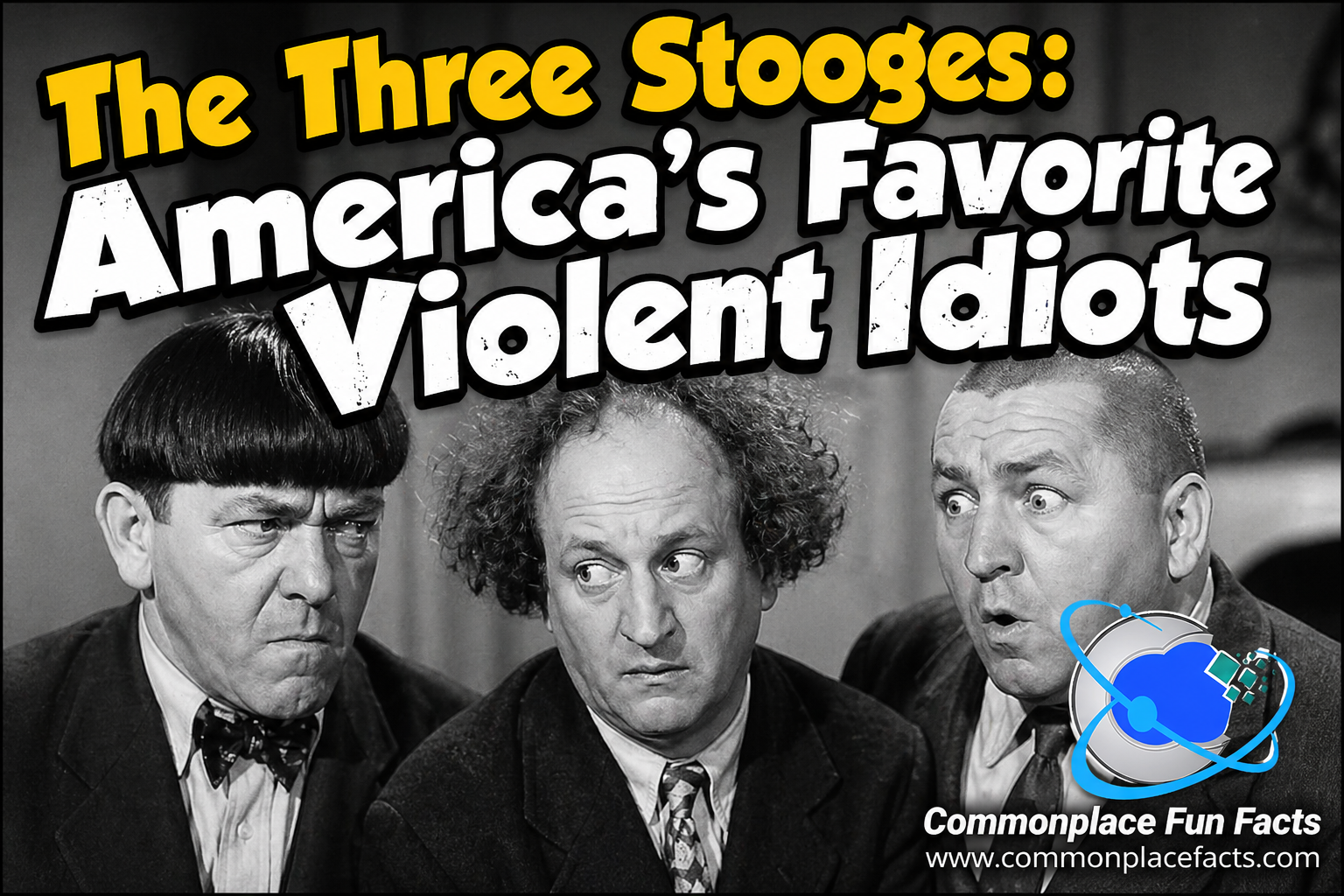

There are many ways to measure cultural greatness. Shakespeare gave us Hamlet. Beethoven gave us the Ninth Symphony. The Three Stooges gave us the eye poke.
This may not seem like an equal contribution to civilization, especially if you are the person receiving the eye poke. Still, few entertainers have lodged themselves in the American brain quite as stubbornly as Moe, Larry, Curly, Shemp, Joe, and Curly Joe. They were not elegant. They were not subtle. They were not the sort of performers one associates with drawing rooms, fine china, or anyone saying, “Ah, yes, the human condition.”
They were, however, hilarious and extremely durable.
The Three Stooges began in vaudeville, survived Hollywood, found new life on television, inspired generations of children to annoy their siblings, horrified generations of parents, and became a permanent part of American pop culture. Their comedy was loud, physical, chaotic, and frequently built around the proposition that every problem in life can be solved by hitting someone with a wrench.
That’s a proposition we’re increasingly inclined to concede.
Contents
Before They Were Stooges
The story begins not with three Stooges, but with a performer named Ted Healy. In the early 1920s, Healy was a vaudeville comedian whose act depended on being interrupted by unruly assistants. These assistants would heckle him, disrupt his songs, wreck his timing, and generally behave like the human embodiment of a migraine.

One of those assistants was Moe Howard, born Moses Horwitz in Brooklyn in 1897. Moe was the future bowl-cut dictator of the group, the man whose entire facial expression seemed to say, “I have discovered incompetence, and it insists on following me everywhere I go.”
Moe’s brother Shemp Howard soon joined the act. Shemp, born Samuel Horwitz, was funny, rubber-faced, and already experienced in vaudeville. His nickname supposedly came from the way his mother pronounced “Sam” in her accent, which turned into something closer to “Shemp.” Thus was a comedy legend born from maternal pronunciation difficulties, because show business is a dignified profession.
Larry Fine came later. Born Louis Feinberg in Philadelphia in 1902, Larry was a violinist and comedian whose wild hair looked as if it had been styled by an electrical accident. Larry became the essential middle Stooge: not quite the leader, not quite the lunatic, but the confused connective tissue between Moe’s rage and whatever disaster was currently unfolding.
For years, they performed as part of Ted Healy’s act under different names, including “Ted Healy and His Stooges.” The basic formula was already there: Healy tried to maintain order, and the Stooges destroyed it. Audiences loved the chaos. The question was whether the chaos could survive without Healy.
As it turned out, yes. Very much yes. Possibly too much yes, depending on your tolerance for cranial trauma as entertainment.
Hollywood Calls, Then Ducks
The Stooges made their first major screen appearance with Ted Healy in the 1930 film Soup to Nuts. The movie itself was not exactly a monument to cinema, but the Stooges stood out. That is one of the recurring themes of their career: the surroundings might be flimsy, the plot might be held together with dental floss and panic, but the Stooges themselves were impossible to ignore.
Eventually, the group broke away from Healy and signed with Columbia Pictures. In 1934, Moe Howard, Larry Fine, and Curly Howard appeared in Woman Haters, their first Columbia short under the name “The Three Stooges.” It was a 19-minute comedy spoken largely in rhyming verse, which is creative, but certainly not the reason people remember the Three Stooges.
The important part was not the poetry. The important part was that the Three Stooges had arrived.
Columbia put them to work making short subjects, the two-reel comedies that played before feature films in movie theaters. Between 1934 and 1959, the Stooges made 190 shorts for Columbia. That number alone explains much of their staying power. The Stooges did not merely make a few beloved films. They made an industrial quantity of mayhem.
Columbia’s short-subject department became their home, and it suited them. Other comedy teams, such as the Marx Brothers, Laurel and Hardy, and Abbott and Costello, often worked best in feature films. The Stooges were different. Their comedy thrived in short bursts. A Stooge short did not need elaborate plotting. It needed a premise, a few props, and enough room for three grown men to injure each other in full view of an appreciative audience.
The plot might be as simple as “the boys are plumbers,” “the boys are doctors,” “the boys join the army,” or “the boys attempt to enter polite society, and polite society immediately regrets the invitation.” That was enough. A Stooge short operated less like a traditional story and more like a controlled demolition of common sense.
The Classic Lineup: Moe, Larry, and Curly
For many fans, the definitive lineup was Moe, Larry, and Curly.
Curly Howard, born Jerome Horwitz, was Moe and Shemp’s younger brother. He entered the act after Shemp left to pursue his own career. Curly had no formal polish, and that was part of his genius. He was round, bald, childlike, explosive, and somehow graceful in the same way an unsteady refrigerator might be graceful if it suddenly learned tap dancing.
Curly was the emotional chaos engine of the group. Moe was the tyrant. Larry was the baffled intermediary. Curly was the innocent creature of appetite, panic, and strange vocal noises. His “nyuk-nyuk-nyuk,” “woo-woo-woo,” barking, spinning, floor-slapping, and high-pitched yelps created a private language of foolishness that required no translation.
The great Curly shorts of the 1930s and early 1940s remain the core of Stooge mythology. Punch Drunks, Hoi Polloi, Disorder in the Court, A Plumbing We Will Go, and others helped define the team’s style. In Punch Drunks, Curly becomes a ferocious boxer whenever he hears “Pop Goes the Weasel.” This is an absurd premise, obviously, but no more absurd than many things that have appeared in actual boxing promotion.
The Stooges’ comedy was physical, but it was not random. The violence had rhythm. Slaps came in patterns. Eye pokes were anticipated, delayed, interrupted, and delivered with the precision of a percussion section staffed entirely by munitions experts. Moe’s hand moved like a conductor’s baton, assuming the conductor hated his orchestra.
The sound effects did much of the work. A slap was not merely a slap. It was a theatrical event. A poke, bonk, plink, thump, or crash transformed physical punishment into cartoon logic. In the real world, a hammer blow to the skull is a medical emergency. In a Stooge short, it is punctuation.
Were the Stooges “Lowbrow”? Absolutely. That Was the Point.
Critics have never entirely known what to do with the Three Stooges. Their work is not subtle. It does not invite delicate analysis over espresso. It does not ask the viewer to contemplate alienation in modern society, except perhaps the alienation felt by Larry after being slapped for the sixth time before breakfast.
And yet the Stooges were not simply stupid. They were masters of timing, character, and escalation. Their comedy came from the old traditions of vaudeville, burlesque, pantomime, and slapstick. They inherited a world where comics did not merely tell jokes; they fell through doors, wrestled furniture, insulted authority, and made the human body look like defective machinery.
The Stooges were also funny because they were powerless. Their characters were rarely successful men. They were laborers, con artists, unemployed drifters, reluctant soldiers, fake aristocrats, terrible professionals, or victims of circumstances they had probably caused. They were the common man, if the common man had been hit repeatedly in the head with a pipe wrench.
They were often trying to enter a world of wealth, manners, education, or professionalism. They almost always failed. The butlers were humiliated. The professors were exasperated. The rich people were soaked, slapped, or covered in plaster. The Stooges did not overthrow the social order so much as drench it with spilled soup.
That was part of the appeal, especially during the Depression and wartime years. Audiences did not need the Stooges to be aspirational. They needed them to be indestructible.
The Stooges vs. Hitler
One of the more remarkable Stooge moments came in 1940 with You Nazty Spy!, a short that mocked Adolf Hitler before many American studios were willing to take direct aim at him. Moe played a Hitler-like dictator named Moe Hailstone, leader of the fictional country of Moronika. Larry and Curly joined him as the usual collection of fools, opportunists, and walking foreign-policy disasters.
It is easy to miss how bold that was. In 1940, the United States had not yet entered World War II. Hollywood was cautious about antagonizing Germany, partly for political reasons and partly because studios still cared about foreign markets. The Stooges, who were Jewish, went ahead and turned Hitler into a ridiculous little man with a toothbrush mustache and delusions of grandeur.
Was it sophisticated political satire? No. It was the Three Stooges. The satire came with funny names, broad accents, and the kind of diplomatic nuance usually associated with a custard pie. Two years later, Ernst Lubitsch would parody Der Fuhrer masterfully in To Be or Not To Be, but the Stooges, to their credit, did it first.
There is something satisfying about watching Hitler reduced to Stooge material. Tyrants build monuments to themselves. Comedians turn them into punchlines. History has room for both, but only one is good company.
Curly’s Decline
Behind the laughter, the work was hard. The Stooges produced shorts quickly, often under demanding schedules. The physical comedy took a toll, especially on Curly. He was beloved by audiences, but his health deteriorated in the 1940s. He gained weight, drank heavily, and suffered from high blood pressure.
In 1946, during the filming of Half-Wits Holiday, Curly suffered a serious stroke. He was only 43. He could no longer continue as a regular member of the team.

For fans, Curly’s departure marks the end of the classic era. That does not mean the later shorts were worthless, but Curly had been something rare: a comic performer whose very existence seemed funny before he did anything. Some performers tell jokes. Curly entered the frame and the laws of physics quietly loosened their necktie.
Curly made one memorable later appearance in Hold That Lion! in 1947, a brief cameo that marked the only time Moe, Shemp, and Curly — all three Howard brothers — appeared together in a Stooge short. It is a small moment, but for Stooge fans it carries a strange tenderness. There he is, briefly, almost like a ghost of the old chaos.
Curly died in 1952 at the age of 48.
The Return of Shemp
When Curly could no longer perform, Shemp Howard returned to the group. This was not a desperate random substitution. Shemp had been there in the beginning. In some ways, he was the original third Stooge.
Shemp’s style was different from Curly’s. He was less childlike and more nervous, sly, and streetwise. His face seemed constructed for panic. His hair looked permanently startled. His voice carried a trembling quality, as if he had just realized that the building inspector was coming and the building had been assembled from cheese.
Some fans divide the Stooges into Curly loyalists and Shemp defenders, as if discussing rival claimants to a medieval throne. This is unfair to Shemp, who was an accomplished comic in his own right. The Shemp shorts have their own flavor. They are often darker, stranger, and more verbal. Shemp could do physical comedy, but his greatest asset was his face — a mobile carnival of fear, confusion, and bad decision-making.
Shemp remained with the team until his death in 1955. Columbia still needed more shorts, and the studio used previously shot footage and doubles to complete several films. This practice later became known among fans as the “Fake Shemp” technique, a phrase that eventually escaped Stooge fandom and entered filmmaking slang. A “Fake Shemp” now refers to a stand-in used to complete a project when an actor is unavailable.
It is not every comedy team that contributes both eye pokes and production terminology to American culture. Credit where credit is due.
Joe Besser and the Difficult Job of Being Not Curly or Shemp
After Shemp died, Joe Besser joined Moe and Larry. Besser was an experienced comedian with a successful career of his own, including work with Abbott and Costello. He had a distinctive whiny persona and a catchphrase-like delivery that worked in other settings.
In the Stooges, the fit was awkward.
The problem was not that Besser lacked talent. The problem was that the Stooge machine had been built around a specific kind of punishment. Moe bullied. Larry absorbed. The third Stooge detonated. Besser’s comic personality did not invite the same level of physical abuse, and he reportedly did not want to take the kind of hits Curly and Shemp had taken.
This created a strange imbalance. A Three Stooges short where one Stooge cannot be properly clobbered is like a Western where the hero refuses to ride horses. One respects the boundary, but the genre has questions.
Besser appeared in the final Columbia shorts. By then, the short-subject market was dying. Television was changing entertainment habits, movie theaters no longer depended on the old short-and-feature format, and Columbia closed its shorts department. It looked as if the Three Stooges might finally be finished.
Television, however, had other plans.
The Television Resurrection
In the late 1950s, Columbia’s television subsidiary, Screen Gems, began syndicating the old Stooge shorts to television. This changed everything.
The Stooges had been popular in theaters, but television made them immortal. Their shorts were perfect for TV: short, visual, noisy, easy to understand, and requiring no previous knowledge beyond “that man is about to be hit.” Children discovered them. Parents rediscovered them. Local stations ran them again and again until the Stooges became less like old movie comedians and more like household companions.
This is one of the great ironies of their career. The Stooges became most familiar to later generations through reruns of films that were already old. A child in 1965, 1985, or 2005 could watch Moe slap Larry in a short filmed before World War II and still understand the joke immediately.
That is not always a compliment to humanity, but it is impressive.
The TV revival created a new wave of popularity. Moe and Larry, joined by Joe DeRita as “Curly Joe,” began making personal appearances, appearing on television, and starring in feature films. DeRita shaved his head to resemble Curly, which was a practical branding decision and also one of the few times in show business history when male pattern baldness became a marketing strategy.
The later feature films, including Have Rocket, Will Travel, The Three Stooges Meet Hercules, and The Three Stooges in Orbit, are not generally considered the team’s finest work. By then Moe and Larry were older, and the energy had changed. Still, the movies introduced them to children who did not care about critical standards because children are wise enough to know that a man being chased by a gorilla is sometimes all cinema needs.
The Six Stooges
Although popular memory often reduces the team to Moe, Larry, and Curly, there were six official Stooges across the act’s long history.

Moe Howard was the leader, disciplinarian, and chief distributor of violence. His bowl haircut became one of the most recognizable silhouettes in comedy. Moe’s character was bossy, angry, and convinced he was the only sane person in a world of idiots. He was usually wrong about the sane part, but not always wrong about the idiots.
Larry Fine was the frizzy-haired middleman. He was often the least defined character, but that was part of his function. Larry bridged the extremes. He could be dim, sarcastic, musical, cowardly, or oddly practical depending on what the scene required. He was the Stooge most likely to look as if he had wandered into the wrong sketch and couldn’t quite find the exit.
Curly Howard was the volcanic man-child, the most beloved Stooge and the one whose mannerisms became most iconic. His physical comedy was astonishing because it seemed both uncontrolled and perfectly timed. Curly gave the impression that his body and brain had reached a custody arrangement and neither side was honoring it.
Shemp Howard was the anxious original who returned. His comedy was twitchier, more verbal, and more grotesque than Curly’s. Shemp was not a substitute Curly. He was Shemp, which is both a name and, somehow, a complete personality diagnosis.
Joe Besser was the whiny, fussy Stooge of the late Columbia period. He had the bad luck to join after two beloved performers and near the end of the theatrical shorts era. That is a little like being hired as the new drummer for a famous band just as the building catches fire.
Joe DeRita, known as Curly Joe, joined during the television revival. He helped keep the act visible for a new generation, especially through personal appearances and feature films. He was not Curly, despite the shaved head and name, but he was part of the team’s final public chapter.
Why Children Loved Them and Adults Worried
The Three Stooges have always had a special relationship with children. This is not difficult to understand. Children appreciate directness. A pie in the face does not require a graduate seminar. A grown man making a bird noise after being struck with a board is comprehensible across cultures.
Adults, meanwhile, often worried that children would imitate them. This was also not unreasonable. The Stooges made violence look painless, rhythmic, and hilarious. A child who watches Moe poke Curly in the eyes may not immediately grasp the distinction between theatrical slapstick and a trip to urgent care.

And, as it turns out, children absolutely imitated them—if elementary school playgrounds are to be believed, the eye poke enjoyed a long and vigorous afterlife.
For that reason, the Stooges became part of a long-running argument about media influence. Were they harmless fun? Were they bad examples? Were they responsible for siblings everywhere discovering that two fingers could be weaponized? The answer is probably yes, in several directions.
The important distinction is that Stooge violence was cartoon violence performed by humans. It existed in a world without consequences. Nobody suffered lasting injury. Nobody learned anything. Nobody improved. This was essential. The Stooges were not realistic people. They were live-action cartoon characters trapped in cheap suits.
That is also why the comedy still works. Reality would ruin it. In real life, Moe would be facing multiple civil suits, Larry would need reconstructive therapy, and Curly would have a neurologist on retainer.
The Stooges and the Comedy of Failure
One reason the Stooges endured is that they understood failure better than almost anyone.
The Stooges were not clever schemers like the Marx Brothers. They were not romantic underdogs like Chaplin. They were not elegant craftsmen like Keaton. They were incompetence made flesh. If they installed plumbing, the house flooded. If they practiced medicine, the patient was safer before they arrived. If they entered high society, high society immediately began checking the exits.
Their world was one where every ladder collapses, every machine explodes, every disguise fails, and every attempt at dignity ends with someone’s pants on fire. This is funny because it is exaggerated, but also because it is recognizable. Most of us are not chased through mansions by angry millionaires after impersonating professors. Still, most of us know what it feels like to be underqualified, overconfident, and moments away from disaster.
The Stooges took ordinary incompetence and turned it into ballet.
A violent ballet, yes. A ballet where the dancers hit each other with shovels. But ballet nonetheless.
Cultural Legacy: Nyuks, Pokes, and the Immortality of Dumb
The cultural legacy of the Three Stooges is larger than their filmography. Their phrases, sounds, gestures, and rhythms became part of American comedy. “Nyuk-nyuk-nyuk,” “Why, I oughta…,” “Soitenly,” and the two-finger eye poke became instantly recognizable bits of comic language.
They influenced later comedians, filmmakers, animators, and television writers. Their DNA can be found in cartoons, sketch comedy, sitcoms, gross-out humor, buddy comedies, and any scene where stupidity escalates faster than reason can file a complaint.
The Stooges also became a kind of cultural shorthand. Calling a group “the Three Stooges” usually means they are incompetent, chaotic, and likely to make matters worse through teamwork. This is not always fair to the original Stooges, who demonstrated an extraordinary level of competence to be able to appear to be so inept.
Their work has also received institutional recognition. Punch Drunks was added to the Library of Congress National Film Registry, a reminder that cultural importance does not always arrive wearing a tuxedo. Sometimes it arrives wearing boxing gloves and waiting for someone to play “Pop Goes the Weasel.”
There have been revivals, tributes, documentaries, merchandise, fan clubs, books, festivals, and attempts to bring the Stooges to new audiences. The 2012 feature film The Three Stooges, directed by the Farrelly brothers, tried to recreate the team’s rhythm for modern viewers. That was always going to be difficult. The original Stooges belonged to a very specific comic universe — one where human bodies were indestructible, authority figures were ridiculous, and the plot could be safely abandoned if someone found a cream pie.
Why They Still Matter
It is tempting to dismiss the Three Stooges as dumb comedy. This is understandable, because much of it is proudly, aggressively, magnificently dumb. But dumb is not the same as easy.
Bad slapstick is just noise. Good slapstick is timing, trust, movement, character, editing, and rhythm. The Stooges made violence musical. They made repetition funny. They made failure reliable. They made stupidity into a craft.
They also survived because they asked almost nothing of the audience. You do not need historical background, emotional investment, or a detailed understanding of character motivation. You need only understand that Moe is angry, Larry is confused, and Curly should not be trusted with tools.
That simplicity is powerful. Comedy dates quickly when it depends on topical references, fashionable attitudes, or delicate social cues. A ladder falling on someone is more durable. It may not be noble, but neither is most of human behavior before coffee.
The Final Slap
The Three Stooges were never respectable in the usual sense. They were too loud, too crude, too violent, too repetitive, and too proudly ridiculous. They were also brilliant performers who understood something fundamental about comedy: sometimes the shortest distance between setup and laughter is a frying pan.
Their career stretched from vaudeville to sound films, from theatrical shorts to television reruns, from Depression-era movie houses to modern streaming clips. The lineup changed. The medium changed. The audience changed. The basic joke did not.
Three idiots walk into a room. They misunderstand everything. They insult authority. They injure each other. They destroy the furniture. They leave no wiser than they arrived.
It should not have lasted.
And yet, nearly a century after Woman Haters, people still know Moe’s haircut, Larry’s frizz, Curly’s “nyuk,” Shemp’s panic, and the sacred choreography of the eye poke. The Three Stooges remain proof that American culture may occasionally appreciate sophistication, but it will always save a place in its heart for a grown man getting bonked on the head with a pipe.
Some legacies are carved in marble.
This one came with sound effects.
You may also enjoy…

Abbott and Costello’s Who’s On First — The Greatest Comedy Routine in History
Learn about Abbott and Costello’s classic skit Who’s On First — the greatest comedy routine of all time!

Charlie Chaplin: The Superstar Who Made the World Laugh (Then Got Himself Kicked Out of America)
Discover the extraordinary life of Charlie Chaplin — from global fame as the world’s most beloved silent film star to political scandal, exile from the United States, and even a posthumous grave robbery. Explore how The Tramp conquered hearts, mocked dictators, and left a legacy that still shapes comedy and cinema today.

Jackie Coogan: The Child Star Who Lost It All and Crawled Back to Fame
Jackie Coogan, the world’s first child superstar, experienced the highs of fame and the lows of loss. From performing as a child in Vaudeville to starring in classic films, he faced financial exploitation and personal tragedy. Despite this, he found a second wave of fame as Uncle Fester in The Addams Family, leaving a lasting…



Leave a Reply to lumandabnerCancel reply