
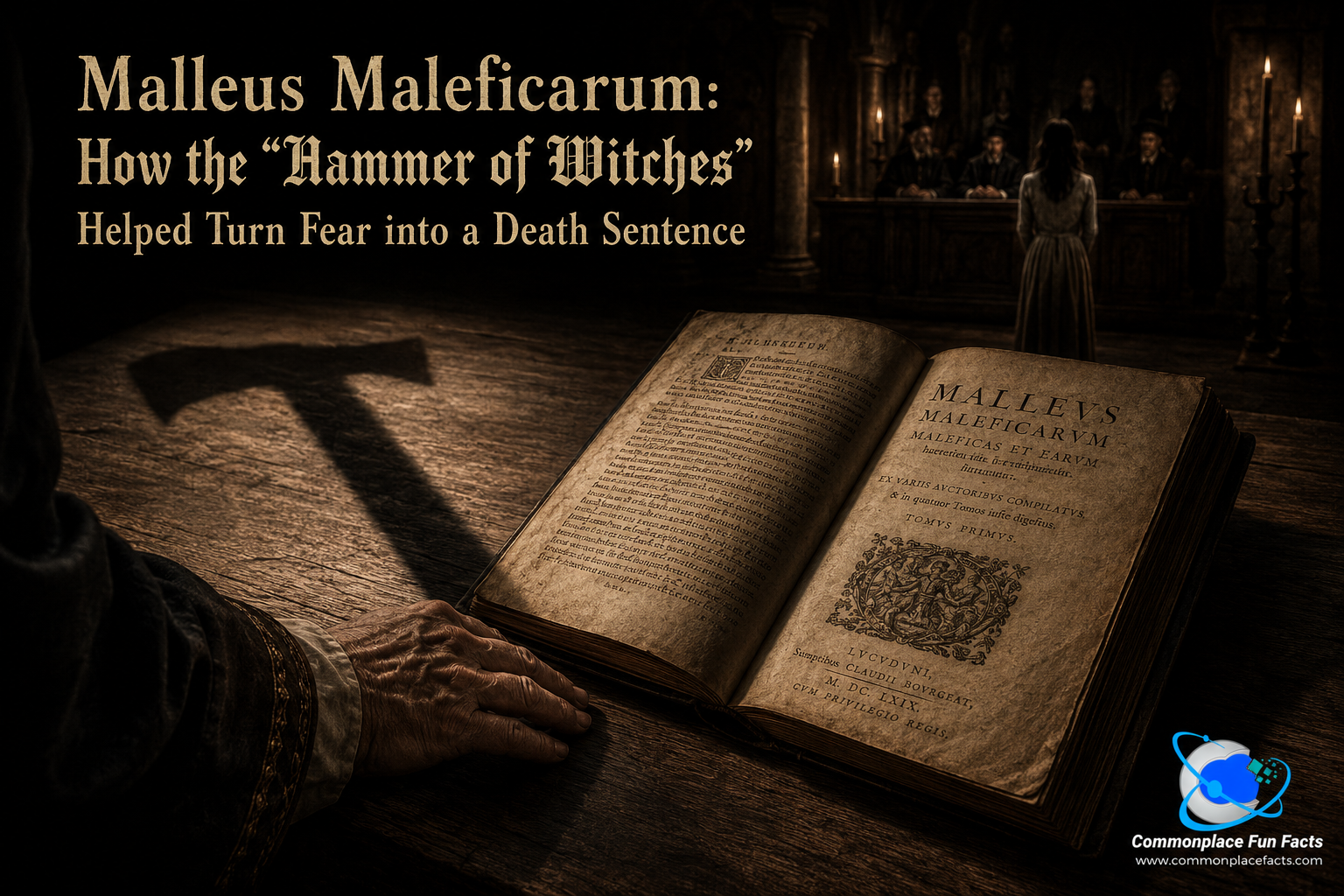

Some books change history by introducing a brilliant new idea. Others accomplish the same thing by collecting old fears, personal grudges, faulty assumptions, theological speculation, and questionable legal procedures, binding them together, and giving the result an impressive Latin title.
The Malleus Maleficarum belongs firmly in the second category.
Usually translated as The Hammer of Witches, the book appeared in the late fifteenth century and became one of history’s most notorious works on witchcraft. It explained why witches supposedly existed, why most of them were women, what they were allegedly doing with the Devil, and how judges could identify, interrogate, torture, convict, and punish them.
It was theology, demonology, criminal procedure, and one man’s unresolved issues with women, all conveniently packaged for the busy fifteenth-century professional.
Contents
The Woman Who Told the Witch Hunter What She Thought of Him
The story of the Malleus Maleficarum begins with Heinrich Kramer, a German Dominican friar and papal inquisitor. Kramer was also known by the Latin form of his name, Henricus Institoris, because medieval scholars apparently believed that an argument became more persuasive if everyone involved had at least two names—and that future researchers deserved a challenge.
In 1485, Kramer traveled to Innsbruck, in modern-day Austria, intending to investigate reports of witchcraft. Among the women he accused was Helena Scheuberin, an independent and outspoken resident who had already made her opinion of Kramer reasonably clear.
According to surviving notes from the proceedings, Helena once passed Kramer in the street, spat, and called him a “bad monk.” She also encouraged others to stay away from his sermons and publicly accused him of being the one who was preaching heresy.
This was not the customary way to build a productive relationship with the visiting inquisitor. Still, as every pastor currently reading this article will testify, there is always at least one in every congregation.
Kramer accused Helena of using witchcraft to cause the death of a nobleman. During her interrogation, however, he became increasingly preoccupied with her sexual history. His questions became so intrusive and irrelevant that the other officials present began to question whether the proceeding had wandered away from theology and into territory more appropriately discussed with Kramer’s confessor.
Georg Golser, the bishop of Brixen, eventually halted the proceedings. He complained that Kramer had presumed things that had never been proved, described his conduct as foolish, and ordered him to stop troubling the people of Innsbruck and leave the area.
Some people respond to professional criticism by reconsidering their methods. Heinrich Kramer responded by writing a large book explaining why everyone else was wrong.
Enter the Hammer of Witches
The Malleus Maleficarum was first printed in Speyer, Germany, in 1486 or 1487. Its title is usually translated as The Hammer of Witches, although Hammer Against Witches better captures its intended purpose. The Latin title uses the feminine form, leaving little doubt about whom Heinrich Kramer expected the hammer to strike.

The feminine form of the title was deliberate. Kramer acknowledged that men could practice witchcraft, but he regarded women as its most natural recruits. In his view, women were more gullible, more emotional, more lustful, less intellectually capable, and more easily led into dealings with demons.
It is difficult to avoid noticing that this theory was published shortly after a woman publicly insulted him, challenged his preaching, resisted his prosecution, and watched while church authorities ordered him out of town. This may be a coincidence. History contains several of those, although usually not this conveniently arranged.
The Coauthor Who May Not Have Coauthored It
The book has traditionally been attributed to Kramer and another Dominican friar named Jacob Sprenger. Sprenger was everything Kramer needed on a title page: a distinguished theologian, a respected professor, a former dean of the theology faculty at the University of Cologne, and a man who had not recently been asked to stop harassing the residents of Innsbruck.
Modern scholars, however, doubt that Sprenger contributed much to the book itself. He appears to have written the prefatory “Author’s Apology,” but the work’s unified style, recurring arguments, and distinctly Kramer-like preoccupations suggest that Kramer composed nearly all of the main text. Sprenger’s principal contribution may therefore have been allowing his excellent reputation to sit beside Kramer’s name.
It was the fifteenth-century equivalent of putting “with a foreword by a respected professor” on a book written by a man whose last project had ended with security escorting him out of the workplace.
How to Make a Book Look More Official Than It Is
One enduring misconception is that the Malleus Maleficarum was issued as the official witch-hunting manual of the Catholic Church. It was not.
In 1484, Pope Innocent VIII issued a papal bull called Summis desiderantes affectibus. It acknowledged reports of witchcraft in parts of Germany and confirmed Kramer’s and Sprenger’s authority to investigate such offenses.
The bull was issued before the Malleus was written and did not approve the book. Kramer nevertheless printed it near the beginning, where it created the useful impression that the pope had personally reviewed the manuscript and written, “Excellent work, Heinrich. Particularly enjoyed the torture section.”
Kramer also printed documents associated with theologians at the University of Cologne. The first endorsement, signed by four faculty members, approved the book’s theological arguments but accepted its procedural recommendations only insofar as they complied with canon law. A second, broader endorsement has generated a long scholarly dispute over how Kramer obtained it and whether he presented it honestly. At minimum, the documents did not amount to an uncomplicated university-wide approval of everything in the book.
The finished publication therefore arrived wearing an impressive collection of official-looking credentials: a papal bull, academic endorsements, royal protections, ecclesiastical titles, and enough Latin to discourage casual fact-checking.
The technique has remained surprisingly durable.
What Is Actually in the Malleus Maleficarum?
The book is divided into three major parts, each devoted to one of the questions Heinrich Kramer believed needed urgent attention. First, are witches real? Second, what are they supposedly doing? Third, how should authorities investigate, prosecute, and punish them?
Kramer’s answers are, respectively: absolutely; nearly anything unpleasant; and with considerably less concern for due process than modern readers—or most reasonably competent fifteenth-century defendants—might have preferred.
Part One: Witches Are Real, and Doubting Them Is Suspicious
The first part argues that witchcraft is real, that witches cooperate with demons, and that denying their existence comes dangerously close to heresy.
This is a useful debating technique because it eliminates the need to answer skeptics. Anyone questioning the theory could simply be accused of assisting the conspiracy. The absence of evidence did not weaken the case; it merely demonstrated how cleverly the Devil had concealed the evidence.
Kramer devoted particular attention to explaining why women supposedly became witches more often than men. He collected disparaging statements from classical authors, Scripture, theology, and apparently every unpleasant marital anecdote available within walking distance.
“Since through this defect she is an imperfect animal, she always deceives.”Malleus Maleficarum, Part I, Question VI
The “defect” in question was the creation of Eve from Adam’s rib. Kramer reasoned that because a rib is curved, women were naturally contrary, morally unreliable, and inclined to deception.
This is not generally included in modern anatomy textbooks, possibly because medical schools and seminaries have become skeptical of moral conclusions based on geometry.
Kramer also offered a completely fictional Latin etymology for the word femina, claiming it came from words meaning “less faith.” It does not. The standards for etymology become more flexible when the desired conclusion is already waiting at the end.
Part Two: Everything That Witches Were Supposedly Doing
The second part describes the activities Kramer attributed to witches. According to the book, they could cause storms, destroy crops, injure livestock, create disease, interfere with reproduction, kill infants, travel through the air, transform people into animals, and enter into sexual relationships with demons.
In other words, if something went wrong and there was no immediately obvious explanation, the Malleus encouraged the reader to look for an unpopular woman living nearby.
The book also spends an unexpected amount of time discussing the possibility that witches could make a man’s reproductive organ disappear. Kramer assured readers that the missing anatomy was usually an illusion, but he included the story of a man who asked a witch to restore what he had lost.
She directed him to a nest in a tree containing several replacements. When he reached for the largest one, the witch warned him, “You must not take that one,” adding that it belonged to a parish priest. Malleus Maleficarum, Part II, Chapter VII
This raises a number of questions about parish administration that the book regrettably leaves unanswered.
It also reveals something important about the Malleus. The book was not merely a dry theological argument. It gathered rumors, folktales, confessions obtained under coercion, local gossip, and stories Kramer had heard during his travels, then treated them as mutually reinforcing evidence.
Once the reader accepted the original premise, virtually any misfortune could be fitted into the system. A cow stopped producing milk. A storm destroyed the harvest. A child became ill. A man experienced difficulties of a personal nature and preferred not to discuss his diet, age, or general health.
Somewhere, presumably, a witch was responsible.
Part Three: Bad Theology Puts on a Judge’s Robe
The third part is the most consequential. It provides instructions for investigating, arresting, interrogating, torturing, trying, and sentencing suspected witches

The book discusses who could testify, whether witnesses’ identities should be concealed, how defense attorneys should be managed, what kinds of suspicion justified imprisonment, and how a judge could obtain a confession.
Taken together, the book’s rules and assumptions created a system in which nearly every response could be interpreted against the accused:
- If the accused confessed, the confession could be treated as proof of guilt.
- If she denied the accusation, the denial could be dismissed as deception.
- If she remained silent or endured torture unusually well, demonic assistance could be suspected.
- If she cried, her tears could be dismissed as performance; if she could not cry, the absence of tears could be treated as a sign of witchcraft.
- If she confessed under torture and later withdrew the confession, she could face renewed interrogation or torture.
This was less a search for truth than a procedural hallway in which every door opened into the same room.
“Let her be often and frequently exposed to torture.”Malleus Maleficarum, Part III, Question XIV
The judge was advised to begin with milder methods before proceeding to more severe ones, a qualification that sounds reassuring only until one remembers that the subject under discussion is how gradually to torture someone into confirming a predetermined theory.
The accused could theoretically receive an advocate, but the lawyer’s role was restricted. Witnesses’ names could be hidden or deliberately rearranged. The judge could make promises of mercy without necessarily intending to keep them. The entire process rested on the assumption that witchcraft existed and that the defendant was probably concealing it.
As legal systems go, it lacked several features that attorneys traditionally value, including reliable evidence, meaningful cross-examination, impartial decision-making, and an outcome that had not already been selected.
The Printing Press Gives Witch Hunting an Upgrade
The Malleus Maleficarum appeared at an ideal time for a dangerous book. Movable-type printing was transforming Europe, allowing ideas to spread faster, farther, and more cheaply than ever before.
By 1500, eight editions of the Malleus had appeared. Five more followed by 1520. After a long pause in new editions, the book experienced another surge of popularity, with sixteen editions published between 1576 and 1670.
The printing press gave Europe wider access to Scripture, classical literature, scientific discoveries, political arguments, and educational material. It also permitted mass distribution of unsupported claims, conspiracy theories, personal grievances, and instructions for mistreating strangers.
The Malleus did not create belief in witchcraft. Europeans had feared harmful magic for centuries, and witch trials had occurred before Kramer began writing. Nor was it the only influential demonological book. Later writers produced works that were more current, more detailed, and sometimes even more enthusiastic.
What the Malleus did was organize scattered beliefs into a single, confident system. It brought together theology, folklore, misogyny, demonology, and criminal procedure. It told readers what witches were, why they were dangerous, how they could be recognized, and what authorities should do about them.
Most importantly, it made aggressive prosecution look learned, responsible, and orthodox. Cruelty could now be presented as vigilance. Doubt became weakness. Mercy risked allowing Satan to escape on a procedural technicality.
How Many People Did the Malleus Maleficarum Kill?
This is the obvious question, and it does not have a satisfying numerical answer.
No reliable figure exists for the number of people executed specifically because of the Malleus Maleficarum. Trial records rarely identify which books a judge had read, which sermon influenced a witness, or which combination of local rumor, religious anxiety, political conflict, personal resentment, crop failure, and judicial ambition produced a particular prosecution.

A judge may have read the book directly. He may have relied on a later author who borrowed from Kramer. He may have absorbed ideas that had become part of the general culture without knowing where they originated.
Determining a precise death toll would require historians to know which executions would not have occurred in an alternate timeline where Kramer never published the book. History has preserved court records, letters, sermons, diaries, and account books, but unfortunately not access to the multiverse.
The book’s influence was nevertheless substantial. It helped standardize the idea that witchcraft involved a deliberate pact with the Devil, that witches formed part of a hidden conspiracy against Christian society, and that women were especially likely to participate. It also gave judges a respected reference work for procedures that made acquittal exceedingly difficult.
The Malleus was not the single match that set Europe on fire. Europe already contained plenty of dry timber: religious conflict, war, disease, local feuds, economic disruption, weak legal protections, and a distressing willingness to torture people until they agreed with the authorities.
Kramer supplied an influential manual explaining why the fire was necessary.
How Many People Were Executed as Witches?
Modern historians generally estimate that between 40,000 and 60,000 people were executed for witchcraft during the main era of European witch hunting, conventionally dated from approximately 1450 to 1750. Nearly all of those executions occurred in Europe, with a much smaller number taking place in European colonies.

The exact number cannot be known. Many records have been lost, some jurisdictions kept incomplete accounts, and unofficial violence did not always appear in court documents. The frequently repeated claim that nine million women were killed is not supported by modern historical research.
Women made up roughly 70 to 80 percent of those convicted during the most intense periods of persecution, although the percentage varied significantly from one region to another. Men made up a substantial portion—and sometimes a majority—of the accused in several places, including Iceland, Finland, Estonia, and parts of Russia.
Nor were all accused witches burned. Punishment depended on local law. Some were hanged, beheaded, strangled before burning, or subjected to other forms of execution that demonstrate humanity’s regrettable ability to innovate when innovation was least needed.
The persecutions were also not exclusively Catholic. Catholic and Protestant territories both conducted witch trials, and many prosecutions took place in secular rather than ecclesiastical courts. Fear of witches was one of the few subjects upon which Christians emerging from the Reformation could occasionally find common ground.
Did the Hammer of Witches Reach Salem?
The Salem Witch Trials occurred in 1692, more than two centuries after Kramer wrote the Malleus. There is no evidence that the judges or accusers in Salem opened the book each morning and followed it page by page.
There was, however, an intellectual connection.
The ideas assembled in the Malleus passed through generations of theologians, ministers, legal writers, and later demonologists. Increase Mather, one of New England’s most influential Puritan ministers and the president of Harvard College, explicitly cited “Sprenger” in his writings about witchcraft. That was a recognized reference to the supposed coauthor of the Malleus Maleficarum.
Increase Mather believed witchcraft was real, although he eventually warned that spectral evidence—the claim that an accused person’s invisible spirit had attacked someone—was too unreliable to support a conviction by itself. This was a sensible limitation, although it arrived after New England had already committed itself rather heavily to the original theory.
The relationship between the Malleus and Salem is therefore not a straight line. It is an intellectual family tree, with Kramer standing several generations back and looking disapprovingly at everyone.
For more about the Salem witch trials and a surprising connection to one of the nation’s founding fathers, read “The Salem Witch Trials and Its Surprising Influential Witness.”
Friedrich Spee Notices a Slight Problem with Torture
Not everyone accepted the logic of the witch trials.
In 1631, a German Jesuit priest named Friedrich Spee anonymously published Cautio Criminalis, or A Book on Witch Trials. Spee had ministered to accused women and wrote from close knowledge of witch-trial procedure and the effects of torture.
He recognized the problem that authorities somehow continued to miss: torture did not reliably identify witches. It created confessions.
An innocent person placed under unbearable pain would eventually say whatever the interrogator wanted. Once she named supposed accomplices, those people would be arrested and tortured until they identified still more witches. The resulting network of confessions appeared to prove the existence of a conspiracy, even though the conspiracy had been produced entirely by the investigation.
It was the judicial equivalent of setting a building on fire and then citing the flames as evidence that the building had always been dangerous.
Spee’s criticism required courage. Witch hunting had become an established religious and governmental enterprise, and questioning it could make the critic appear sympathetic to witchcraft. Still, he insisted that a legal system unable to distinguish innocence from guilt was not defending society. It was manufacturing victims.
You Can Read the Malleus Maleficarum Yourself
The first complete English translation was published in 1928 by Montague Summers, an eccentric English writer who took witches, vampires, werewolves, and similar matters considerably more seriously than most twentieth-century scholars.

His translation is outdated and sometimes unreliable, but it remains widely available and is in the public domain. The entire text can be read and searched online at the Internet Sacred Text Archive.
A scanned copy of the 1928 edition can also be viewed or downloaded from the Wellcome Collection.
Readers seeking the most reliable modern English version should read Christopher S. Mackay’s The Hammer of Witches: A Complete Translation of the Malleus Maleficarum. Readers merely wishing to confirm that the book really contains a story about a tree full of misplaced male anatomy will find any of these translations adequate for that limited purpose.
The Most Dangerous Part Was the Permission
Heinrich Kramer did not invent belief in magic, fear of demons, hostility toward women, judicial torture, or the human habit of blaming an unpopular neighbor when something inexplicable happens. Humanity had already completed the preliminary research.
His achievement was to bring those things together, arrange them into a seemingly coherent system, dress the result in impressive credentials, and distribute it through the most powerful new communications technology of his age.
The Malleus Maleficarum told frightened people that their fears were reasonable. It assured suspicious people that their suspicions were evidence. It told judges that procedural restraints protected the guilty, and it gave persecutors permission to regard cruelty as faithfulness.
Helena Scheuberin escaped Kramer’s prosecution. Thousands of later defendants were not so fortunate.
Kramer never proved that an organized army of witches was conspiring with Satan to destroy Christian society. He did prove something considerably less supernatural: a bad idea becomes far more dangerous when it is printed in a confident tone, endorsed by impressive names, and handed to people with the power to punish anyone who asks inconvenient questions.
The original Latin text and Montague Summers’s 1928 English translation are now safely in the public domain, where anyone can read them without being arrested because a neighbor’s cow stopped producing milk. That may be a low standard by which to measure human progress, but after reading Kramer, even modest progress deserves a little celebration.
You may also enjoy…

The Salem Witch Trials and Its Surprising Influential Witness: Bathshua Pope
The Salem Witch Trials in 1692 were marked by mass hysteria in Salem, Massachusetts, leading to the imprisonment of over 150 people and the execution of nineteen. Central to the trials was Bathshua Pope, whose accusations influenced many executions. The trials ended when Governor Phips intervened, recognizing the injustice.

The Night Witches of WWII: The Soviet Women Who Turned Bad Planes Into Psychological Warfare
Meet the Night Witches, brave all-female pilots of the Soviet Union who inflicted terror on the Germans during WWII.

Mass Hysteria in the Middle Ages: The True Tale of the Meowing Nuns With Biting Issues
The Middle Ages saw a peculiar outbreak of meowing nuns who started biting everyone. Find out about this weird case of mass hysteria in this fascinating article.





Leave a Reply