
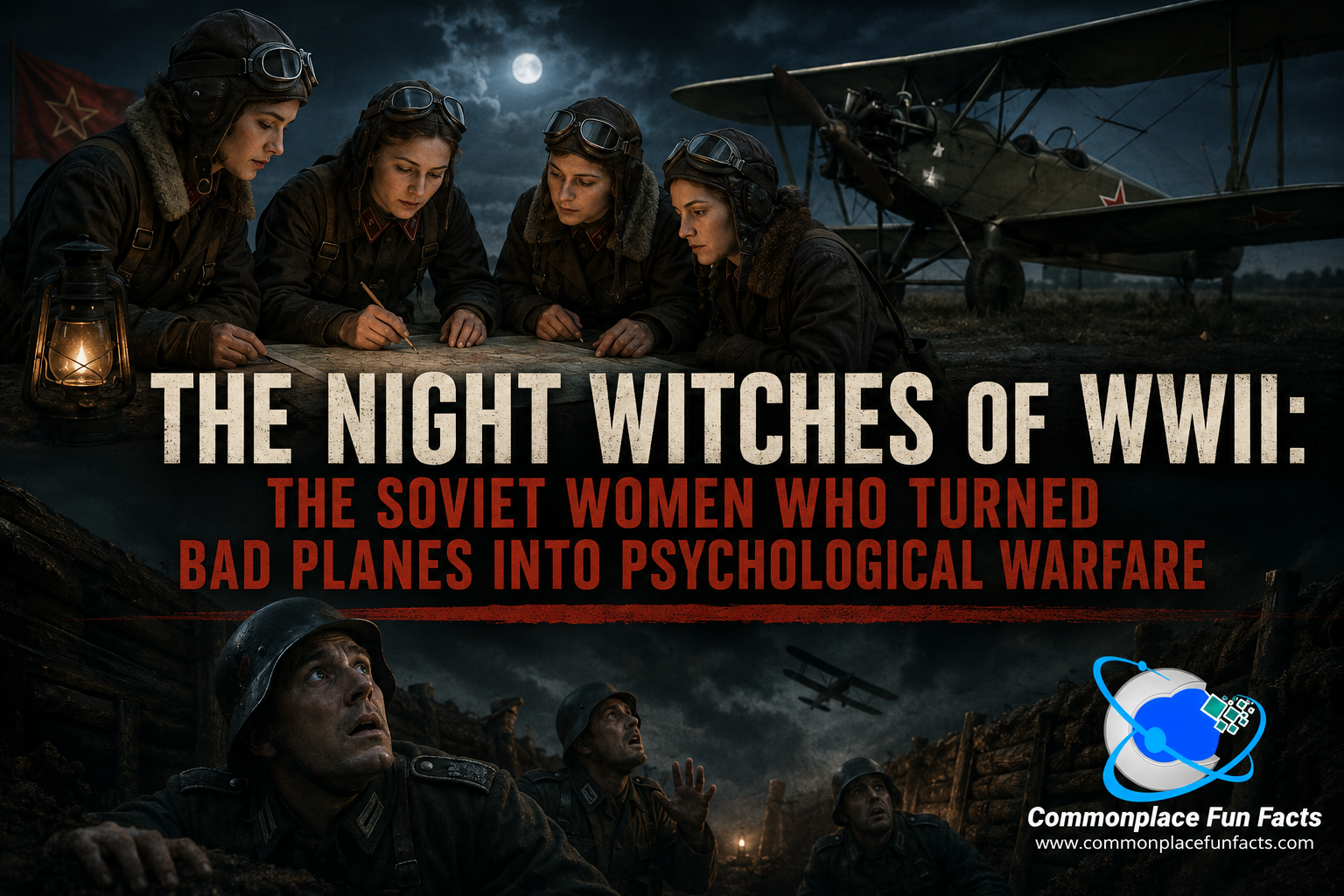

There are many ways to describe the Polikarpov Po-2 biplane. “Advanced” is not one of them.
It was made largely of wood and fabric. It had an open cockpit, minimal instruments, little protection, and roughly the combat presence of a lawn chair with wings. It was designed as a trainer and agricultural aircraft, which is a polite way of saying that if you looked at it and thought, “That seems ideal for flying over a heavily armed German army at night,” you may have been overusing the glue in the maintenance shed.
And yet, during World War II, the Soviet Union gave these obsolete aircraft to an all-female aviation regiment and sent them into combat. The result was one of the most remarkable stories of the Eastern Front: the 588th Night Bomber Regiment, later honored as the 46th Guards Night Bomber Aviation Regiment, better known by the nickname reportedly given to them by terrified German soldiers: the Nachthexen, or “Night Witches.”
The nickname came from the sound their planes made when they cut their engines and glided toward a target. In the darkness, German troops heard only the wind passing through the wires and struts of a slow Soviet biplane. To them, it sounded like a broomstick.
That was bad news, because broomsticks usually do not drop bombs.
Contents
The Worst Planes in the Air Force
The best way to understand the Night Witches is to begin with the insult disguised as equipment.

The Soviet Union was not handing these women shiny new fighters or sleek bombers. The 588th Night Bomber Regiment flew the Polikarpov U-2, renamed the Po-2 in 1944 after designer Nikolai Polikarpov’s death. It was a two-seat biplane that had first flown in the late 1920s and was widely used for training, liaison, reconnaissance, and agricultural work. In other words, the airplane had a résumé that said, “Teaches beginners, dusts crops, occasionally annoys Nazis.”
The Po-2 was slow. Very slow. Depending on load and configuration, sources give different speeds, but everyone agrees on the important point: your grandmother’s Buick might have asked it to move over in the left lane. It had no armor. It had no enclosed cockpit. It had no meaningful defensive firepower for most of its night-bombing work. Early in the war, the crews often flew without parachutes, partly because parachutes were scarce, partly because every pound mattered, and partly because at the low altitudes they flew, a parachute might have been less “lifesaving device” and more “optimistic accessory.”
The plane could carry only a small bomb load, which meant the crews could not simply fly out, flatten a target, and call it a night. They had to return to base, reload, refuel, and go back out again. Night after night. Sometimes many times in a single night.
If this sounds like a terrible idea, congratulations. You have passed Introduction to Bare-Bones Aviation Warfare Strategy.
But the Po-2 had advantages, most of them accidental. It could take off and land from rough fields near the front. It was simple to repair. Its wood-and-fabric construction made it harder for some detection systems to pick up. Most importantly, it could fly extremely slowly, which made it surprisingly awkward for faster German fighters to attack. A Messerschmitt or Focke-Wulf was built for speed and firepower. Trying to shoot down a Po-2 could be like trying to joust a mosquito from a sports car.
The Soviet Union gave these women the wrong tool for the job, and they turned the wrongness into doctrine.
Enter Marina Raskova, Soviet Aviation Celebrity and Bureaucratic Menace
The Night Witches did not appear out of nowhere. They were the product of war, desperation, and one extraordinarily determined woman: Marina Raskova.

Before the war, Raskova was already famous in the Soviet Union. In 1938, she served as navigator on the record-setting long-distance flight of the Rodina, alongside Valentina Grizodubova and Polina Osipenko. The flight did not end with a graceful landing and polite applause. It ended with bad weather, a forced landing, and Raskova bailing out and surviving for days in the wilderness before rescue. As aviation publicity went, this was not exactly a ribbon-cutting ceremony, but it worked. The three women became national heroes.
When Nazi Germany invaded the Soviet Union in June 1941, many Soviet women who had learned to fly in civilian and paramilitary aviation programs wanted to serve. They wrote to Raskova, who had fame, connections, and the kind of personality that makes a bureaucrat suddenly remember an appointment elsewhere.
Raskova petitioned Joseph Stalin to allow women to fly combat missions. In October 1941, the Soviet government authorized the creation of three women’s aviation regiments: the 586th Fighter Aviation Regiment, the 587th Bomber Aviation Regiment, and the 588th Night Bomber Regiment.
This was not because Stalin had experienced a sudden enlightenment about workplace equality. The Soviet Union was fighting for survival. Millions of men were dead, captured, wounded, or urgently needed elsewhere. The demographic reality was brutal: of Soviet males born in 1923, only about one-third were still alive by 1946, a catastrophe produced by war, famine, repression, disease, and the general life-shortening charm of Stalin’s Soviet Union.
Stalin was desperate for combat aviators and anyone else who could help keep the Soviet war effort alive. In war, even deeply entrenched prejudice can occasionally be shoved aside by the more persuasive argument of “we are running out of people.”
The women who came to train were often young, many in their late teens or early twenties. Some had extensive aviation experience. Others had just enough to be useful after a brutally compressed training program. They arrived at Engels, on the Volga River, where they were issued uniforms and boots designed for men, because apparently the Soviet quartermaster corps had decided the female form was a rumor requiring further study.
The more experienced pilots generally went to the fighter and bomber regiments. The 588th received many of the least experienced recruits and the least glamorous aircraft. This is the point in the story where history clears its throat, adjusts its spectacles, and prepares to humiliate expectations.
How to Bomb the Enemy With a Flying Farm Implement
The Night Witches’ mission was not strategic bombing in the sense of huge aircraft flattening industrial cities. They flew harassment and tactical bombing missions. Their job was to attack German positions, depots, bridges, rail lines, supply areas, and troop concentrations near the front. Just as importantly, they were there to make sure German soldiers did not sleep.
Sleep deprivation is not glamorous, but neither is trench foot, and both have a way of changing military outcomes. Soldiers who are exhausted make mistakes. Officers who cannot rest lose judgment. Men who spend night after night listening for the soft approach of unseen aircraft begin to develop an intimate relationship with dread.
The Night Witches developed a tactic that was simple, dangerous, and psychologically brilliant.
They flew at night, often in small groups or in sequence. Near the target, the pilot would idle or cut the engine. The plane would glide in almost silently. The navigator, who also acted as bombardier, would release the bombs. Then the pilot would restart the engine and get out, ideally before German anti-aircraft crews recovered from the unpleasant realization that the sky had just whispered at them.
Sometimes one aircraft would draw searchlights and anti-aircraft fire while another slipped toward the target. The decoy crew had the delicate job of making itself visible enough to attract German attention but not so visible that it became a burning punctuation mark over the Eastern Front. This required nerve, coordination, and a disturbing amount of faith in plywood.
After dropping their bombs, the crews returned to their forward airfields, where mechanics and armorers reloaded the planes. Then they took off again. A typical mission might last thirty to fifty minutes, and crews could fly numerous sorties in one night. Some pilots and navigators eventually completed hundreds of combat missions. A few exceeded 800.
This was not cinematic combat with one dramatic mission and a swelling orchestra. It was repetitive terror. Take off. Fly through darkness. Avoid searchlights. Dodge flak. Glide in. Drop bombs. Return. Reload. Do it again. Then again. Then again. Then try not to fall asleep standing next to a plane that looked like it had been assembled by a barn with ambition.
The Sound of a Broomstick
The Germans reportedly called them “Night Witches” because of the sound their aircraft made during those engine-off gliding attacks. The whoosh of air through the bracing wires and fabric wings suggested a witch’s broom passing overhead.

This is one of those details that feels almost too perfect, the sort of thing history includes to make fiction writers mutter darkly about realism. But whether every part of the nickname’s origin story can be nailed down with courtroom precision, the name stuck because it captured the effect. These women haunted the German night.
Their attacks were rarely about one massive explosion. They were about persistence. A bomb here. A fuel dump there. A bridge damaged. A rail line interrupted. A headquarters startled awake. A troop column forced to scatter. A soldier wondering whether that faint sound in the dark was wind, imagination, or incoming explosives delivered by women in obsolete biplanes.
That last part mattered. Nazi ideology was not exactly famous for its generous view of women’s competence. The idea that Soviet women were attacking German troops from the air was humiliating, unnerving, and useful. Some stories claim German soldiers spread rumors that the Soviet women had been given special pills to see in the dark. This was nonsense, of course, but militaries under stress often turn confusion into folklore. It is easier to believe your enemy has witchcraft than to admit she is simply better trained, more determined, and currently bombing you from a glorified kite.
Nadezhda Popova and the Human Scale of the Legend
One of the best-known Night Witches was Nadezhda “Nadia” Popova. Like many of the women who served, she had personal reasons to fight. Germany’s invasion had shattered lives across the Soviet Union. Popova’s brother was killed, her home region was overrun, and the war was not some distant geopolitical argument conducted by men with maps. It was personal.

Popova went on to fly 852 combat missions, an astonishing number that begins to lose meaning simply because the human mind was not designed to picture doing something deadly 852 times. Fly one night mission over enemy territory in a wood-and-fabric biplane with no parachute and you have earned a lifelong right to be insufferable at dinner parties. Do it 852 times and dinner parties should simply form a respectful queue.
One famous story says Popova returned from a mission to find her aircraft riddled with bullet holes, including damage to her helmet and map. This is the sort of anecdote that makes the phrase “lucky to be alive” seem wildly underdressed for the occasion.
Another often-repeated detail is that Popova once flew eighteen sorties in a single night. Even allowing for the short duration of the missions and the nearby forward bases, that number is exhausting to read, much less perform while being shot at. It turns the usual image of air combat upside down. The heroism was not just in one spectacular moment. It was in climbing back into the same vulnerable machine again and again, knowing exactly what could happen.
Popova survived the war, became a Hero of the Soviet Union, and lived long enough to see renewed interest in the women whose story had too often been treated as a sidebar. She died in 2013 at the age of 91.
The Regiment Was Not Just Pilots
It is tempting to talk only about the pilots, because pilots get the dramatic silhouette against the moon and the leather flying helmet. But the 588th was more than women in cockpits. It included navigators, mechanics, armorers, drivers, clerks, commanders, and other support personnel. The regiment’s all-female identity mattered because the entire machine of war around the aircraft was also being run by women.
That means women maintained the planes, loaded the bombs, repaired damage, planned missions, navigated in the dark, and kept the operation functioning close to the front. When aircraft came back torn by flak or bullet holes, it was often women who patched them up and sent them back out.

This was not symbolic service. It was not a morale poster with cheekbones. It was combat aviation conducted under primitive conditions with inadequate equipment and a relentless mission schedule. The women of the 588th were not proving they could “help.” They were proving they could fight.
Their commander, Yevdokiya Bershanskaya, led the regiment through the war and helped shape it into an elite unit. In 1943, the regiment received the prestigious Guards designation and became the 46th Guards Night Bomber Aviation Regiment. It later earned the honorific “Taman” for its role in operations on the Taman Peninsula.
That promotion matters. “Guards” status was not a participation trophy. It meant the regiment had distinguished itself in combat. The Soviet military, not generally known for gentle encouragement and feelings-based affirmation, had to acknowledge that the women flying the bad planes were doing extraordinary work.
The Numbers, Without the Fog Machine
The Night Witches are often credited online with flying 30,000 missions. That number appears frequently, but it can blur together the achievements of several Soviet women’s aviation units. A more careful figure for the 588th/46th Guards is more than 24,000 combat missions or sorties from 1942 to 1945.
That is still staggering. There is no need to inflate the legend. The truth is already standing on the table waving both arms.
Over those years, the regiment fought across major campaigns on the Eastern Front, including operations in the Caucasus, around the Black Sea, in Crimea, in Belarus, in Poland, and ultimately toward Germany. They attacked supply lines, warehouses, railways, bridges, vehicles, troop positions, and other targets that kept the German war machine functioning.
The cost was real. Thirty-two members of the regiment died in wartime service. More than twenty were awarded the title Hero of the Soviet Union, the country’s highest honor. Many others received decorations for bravery and service. The regiment became one of the most highly decorated women’s units in the Soviet armed forces.
And yet, the most impressive statistic may be the most ordinary one: they kept going. The Night Witches flew under conditions that should have made their mission impossible, or at least ridiculous. Instead, they made the ridiculous operational.
Why the Night Witches Worked
The Night Witches worked because they understood their aircraft and mission. They did not try to make the Po-2 into a heavy bomber. That would have been like trying to make a soup ladle into a broadsword. Admirable energy, poor metallurgy.
Instead, they used the plane’s actual strengths. It was slow, so they flew low and quietly. It was small, so they used darkness and surprise. It could operate near the front, so they flew repeated short missions. It could not deliver one massive blow, so they delivered many small ones. It was vulnerable, so they avoided daylight and used tactics that made German defenses react too late.
This is what makes the article angle so strong: the Soviet Union gave women some of the worst aircraft in the inventory, and they turned them into psychological warfare. Not by magic. Not by myth. By disciplined adaptation.
The Germans could shoot them down, and sometimes did. Searchlights could find them. Flak could tear through canvas and wood. Weather could kill them. Mechanical failure could kill them. Navigation errors could kill them. The Po-2 was not secretly invincible. It was fragile, slow, and dangerous.
But the women flying it made it useful in precisely the way a bad tool can become useful in the hands of someone who understands both the tool and the job. The Po-2 could not dominate the sky. It could, however, make the night miserable.
And sometimes making the enemy miserable is the job.
The Postwar Vanishing Act
After the war, the Soviet Union did what governments often do after women prove themselves indispensable in an emergency: it thanked them, decorated some of them, and then began nudging them back toward the roles it preferred them to occupy.

This is one reason the Night Witches story has such power. It is not only about courage. It is about what institutions do when they are desperate, what people prove when given a chance, and how quickly official memory can become selective once the crisis passes.
During the war, these women were useful because they could fly. After the war, their example was inconvenient because they had flown too well.
They Were Not Witches. That Is the Point.
The nickname “Night Witches” is irresistible, and there is no reason to resist it too hard. It is vivid, memorable, and just theatrical enough for a story involving silent biplanes, terrified Nazis, and bombs falling from the dark. History occasionally hands us branding, and it would be rude not to use it.
But the danger of the nickname is that it can make the women seem supernatural. They were not. They were pilots, navigators, mechanics, armorers, commanders, and support personnel. They trained hard, worked constantly, adapted intelligently, and flew missions that would have terrified anyone with a functioning imagination.
Their achievement was not that they were magical. Their achievement was that they were not magical and did it anyway.
The Soviet Union gave them obsolete biplanes, ill-fitting uniforms, limited equipment, and one of the most dangerous jobs in the war. The Germans gave them a nickname meant to explain the fear they caused. History gave them a legend.
But the women themselves supplied the important part.
They took the worst planes in the air force and made them into weapons of exhaustion, anxiety, and dread. They turned crop-dusters into combat aircraft. They turned weakness into method. They turned a whoosh in the dark into something German soldiers feared.
Not bad for a flying lawn chair.
You may also enjoy…

The Christmas Bullet: How One Man’s Audacity Built the Worst Plane in Aviation History (And Somehow Got Away With It)
The history of aviation is dotted with triumphs and failures, and the Christmas Bullet stands out as a pinnacle of terrible design, catastrophic execution, and sheer audacity. Crafted by the questionable figure Dr. William Whitney Christmas, this ill-fated aircraft led to the deaths of two pilots, leaving a cautionary tale of unchecked ambition in early…

The Crazy Story of Aimo Koivunen, the Soldier Who O.D.’d on Speed, Stepped On a Mine, Skied 250 Miles, and Outmaneuvered the Soviet Army
Discover the extraordinary survival story of Aimo Koivunen, the Finnish soldier who skied 250 miles under the influence of amphetamines during WWII.

The Scary Story of Soviet Male Mortality: Why Two-Thirds of Soviet Males Born in 1923 Did Not Live to the End of World War II
Discover why 68% of Soviet males born in 1923 perished by 1946. From WWII to Stalin’s Great Terror, uncover the untold story of Soviet male mortality.






Leave a Reply