
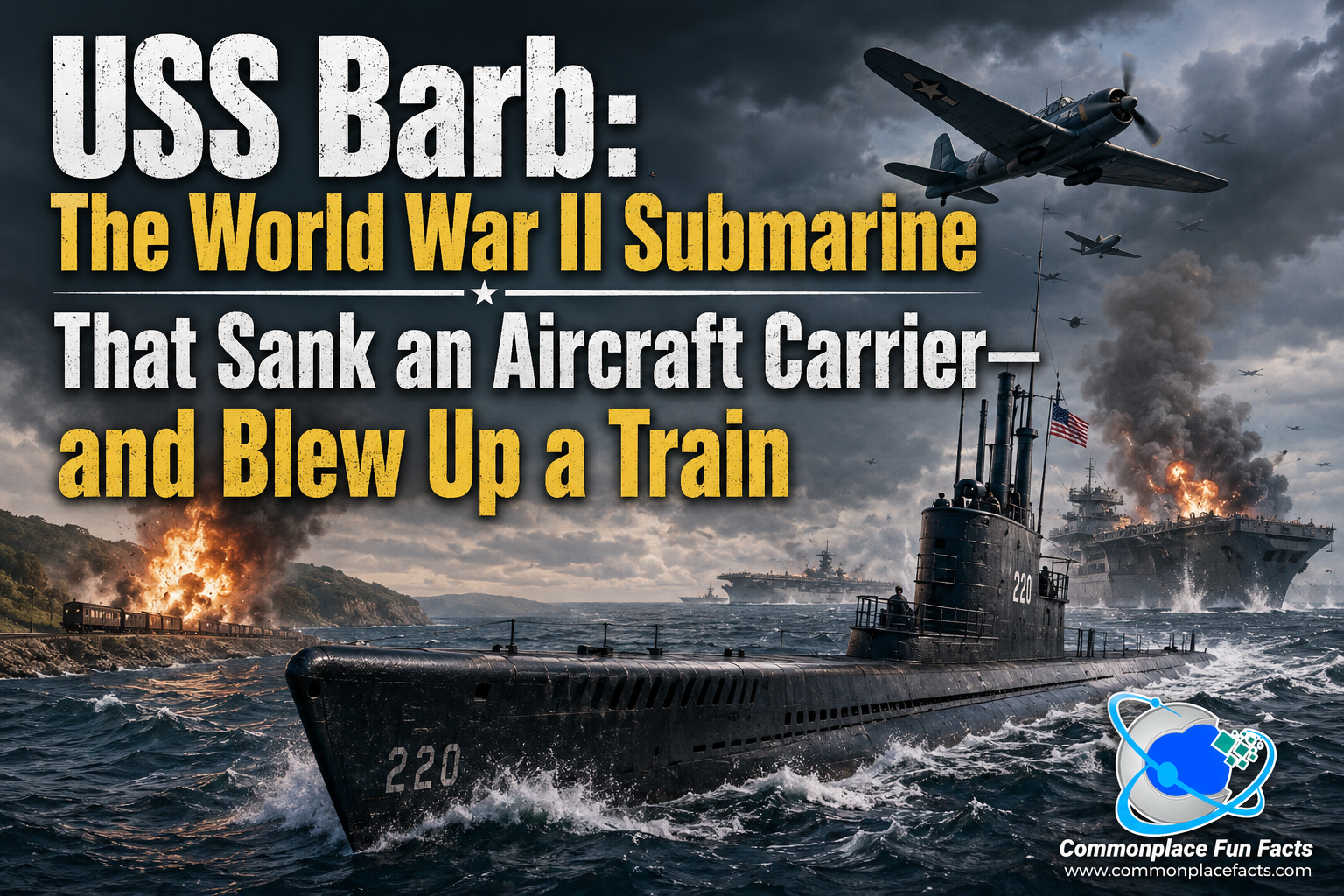

Shortly before 2:00 a.m. on July 23, 1945, eight American sailors were paddling two rubber boats away from Japanese territory as quickly and quietly as they could.
Behind them, a locomotive was approaching along a coastal railroad. Beneath the tracks sat a 55-pound explosive charge connected to a homemade pressure switch. The sailors had planted it only minutes earlier, after crossing crackling reeds and hiding while another train passed close enough to give everyone involved an opportunity to reconsider several recent career choices.
The second train rolled over the switch.
The resulting explosion hurled pieces of the locomotive approximately 200 feet into the air. Twelve freight cars, two passenger cars, and a mail car piled into the wreckage. Five minutes later, all eight sailors were safely back aboard the submarine USS Barb.
Submarines traditionally attack things found in water. Commander Eugene “Lucky” Fluckey regarded this less as a rule than as a general suggestion left over from a less imaginative era.
The destruction of the train became the most famous episode in the career of USS Barb, but it was hardly the strangest thing the submarine did. Under Fluckey’s command, Barb sank an aircraft carrier, entered a harbor crowded with enemy ships, rescued Allied prisoners of war, launched rockets at Japanese coastal targets, bombarded shore installations, and rammed an enemy vessel when more conventional methods proved insufficient.
It also completed five extraordinarily aggressive patrols under Fluckey without any member of the crew receiving a Purple Heart.
USS Barb was not merely one of the most successful American submarines of World War II. It was the submarine that repeatedly expanded everyone’s understanding of what a submarine was supposed to be.
Contents
The Early Career of USS Barb
USS Barb was a Gato-class diesel-electric submarine built by the Electric Boat Company in Groton, Connecticut. It was launched on April 2, 1942, and commissioned on July 8 of that year.

The Gato-class submarines were designed for long-range operations in the Pacific, but Barb began its wartime service in the Atlantic. British Prime Minister Winston Churchill had asked President Franklin Roosevelt to provide American submarines with the endurance to patrol the eastern Atlantic, where they might help locate and destroy German U-boats.
During its first war patrol, Barb supported Operation Torch, the Allied invasion of North Africa in November 1942. It conducted reconnaissance, provided navigational beacon services, and landed a five-man team of Army Rangers near Safi, Morocco.
That last assignment offered a small preview of things to come. Even before anyone thought about destroying a railroad, Barb was already showing a willingness to drop people off in places where the local authorities were unlikely to welcome them.
The submarine completed five patrols connected with European operations before being transferred to the Pacific. Its Atlantic career was useful but relatively uneventful. No aircraft carriers were sunk, no harbors were invaded, and no locomotives were harmed.
That changed after Eugene Fluckey arrived.
Meet Eugene “Lucky” Fluckey
Eugene Bennett Fluckey graduated from the United States Naval Academy in 1935. After serving aboard the battleship USS Nevada and the destroyer USS McCormick, he transferred to submarine duty. He served aboard the submarines USS S-42 and USS Bonita before reporting to Barb as its prospective commanding officer during the submarine’s seventh patrol.

Fluckey formally assumed command on April 27, 1944.
His nickname, “Lucky,” might suggest that he drifted through the war protected by some unusually cooperative guardian angel. Luck certainly played a role in submarine warfare, as it does whenever men spend several weeks inside a steel tube while people outside drop explosives on it.
Fluckey’s success, however, depended much more on preparation, intelligence, aggressiveness, and an unusual willingness to listen to ideas from his crew. He encouraged enlisted sailors to suggest solutions. Rank determined who made the final decision, but it did not determine who was permitted to have a good idea.
That leadership style mattered. Some of Barb’s most inventive operations began with someone other than Fluckey saying, in effect, “Captain, this may sound crazy, but…”
Fluckey was bold, but he was not careless. His plans could sound reckless when summarized afterward, largely because summaries tend to omit the days spent studying tides, routes, schedules, radar contacts, enemy patrols, and escape options. He sought opportunities other commanders might have dismissed, then tried to remove as much uncertainty as possible before acting.
What remained was merely the normal uncertainty associated with attacking heavily defended enemy territory in a machine that could be sunk by one well-placed depth charge.
The Transformation of USS Barb and Sinking an Aircraft Carrier
Fluckey’s first patrol in command was Barb’s eighth war patrol, which began in May 1944. The submarine operated near the Kuril Islands, northern Hokkaido, and the Sea of Okhotsk.
The results were immediate. Barb sank five substantial Japanese ships and two smaller sampans. Its victims included the cargo ships Koto Maru, Madras Maru, Toten Maru, Chihaya Maru, and Takashima Maru. The submarine received credit for sinking 15,472 tons of enemy shipping during that patrol alone.
During its ninth patrol, Barb operated with USS Queenfish and USS Tunny in a coordinated attack group known as “Ed’s Eradicators.” The name lacked subtlety but accurately described the group’s general intentions.
At one point, while preparing an attack on the cargo ship Okuni Maru, Fluckey raised the periscope and discovered that a bird had landed on it. More specifically, the bird had positioned its tail feathers directly over the viewing glass.
The crew lowered the periscope and raised it again. The bird returned.
Apparently unfamiliar with naval rank, wartime priorities, and the general expectation that wildlife should not obstruct torpedo attacks, the bird continued interfering. The crew finally raised both periscopes, deceiving it long enough for Fluckey to obtain a firing solution. Barb launched three torpedoes, broke Okuni Maru in two, and escaped.
The story serves as a useful reminder that even the most carefully planned military operation can be disrupted by a small creature with no understanding of rank, military strategy, or personal boundaries.
In September 1944, Barb encountered a Japanese convoy that included the escort aircraft carrier Unyo. The carrier detected incoming torpedoes and attempted to maneuver away, but it was too late. Barb’s torpedoes struck the ship, and the roughly 20,000-ton carrier went down.
The sinking of Unyo would have been enough to make the patrol memorable. Aircraft carriers were valuable, heavily protected targets, and submarines did not encounter them every afternoon while casually checking the neighborhood.
The patrol soon took a very different turn.
Rescuing Fourteen Prisoners of War
On September 12, 1944, USS Sealion torpedoed and sank the Japanese transport Rakuyo Maru. Unknown to the attacking submarine, the ship carried more than 1,000 British and Australian prisoners of war who were being transported from Singapore to Japan.
The Japanese escorts rescued some of their own personnel but left many Allied prisoners in the water. Several days later, Barb was ordered to assist in the search for survivors.
The crew found men clinging to makeshift rafts after days of exposure, hunger, and thirst. Barb rescued fourteen British and Australian prisoners.
The episode stood in stark contrast to the rest of the patrol. The same submarine that had recently destroyed an aircraft carrier now turned its attention to keeping a handful of exhausted men alive. Submarine warfare frequently reduced results to numbers—ships, tonnage, torpedoes, and confirmed sinkings. The prisoners climbing aboard Barb were a reminder that every number represented human beings caught inside circumstances they had little power to control.
Fourteen white crosses were later placed on Barb’s battle flag to commemorate the men it rescued.
The Harbor No Submarine Was Supposed to Enter
Barb’s eleventh war patrol began on December 19, 1944. It would become the patrol that earned Fluckey the Medal of Honor.
While operating along the Chinese coast, Fluckey deduced that Japanese ships were hiding at night in the lower reaches of Namkwan Harbor. The harbor was shallow, surrounded by dangerous rocks, believed to contain mines, and protected by enemy vessels.

It was an excellent place for Japanese shipping to hide because no reasonable submarine commander would voluntarily enter it.
Fluckey entered it.
In the early hours of January 23, 1945, Barb found a concentration of roughly thirty enemy ships. The harbor was only five fathoms—30 feet—deep. A Gato-class submarine drew about 15 feet 3 inches while surfaced, leaving less than 15 feet beneath its keel. Diving was not an escape plan so much as an unusually complicated method of running aground.
Fluckey ordered battle stations.
Barb fired its remaining forward torpedoes, swung its stern toward the targets, and launched four more. The crew observed eight hits against six ships. One target erupted in a tremendous explosion that sent ammunition and debris flying through the harbor.
Then came the difficult part.
Barb turned toward the open sea and ran at full speed on the surface for approximately an hour. Fluckey pushed the submarine to about 21 knots as it raced through the shallow harbor entrance.
The Medal of Honor citation later praised his decision to penetrate the enemy screen, attack at close range, and guide the submarine safely through the mined and obstructed waters.
Postwar Japanese records did not confirm all the destruction the crew believed it had witnessed. Barb received official credit for sinking the 5,224-ton freighter Taikyo Maru during the attack. The difference illustrates one of the recurring problems with wartime claims. Submarine crews assessed damage through darkness, smoke, explosions, brief glimpses through a periscope, and the distracting realization that several angry ships were now trying to kill them.
Whatever the final accounting, the essential facts were beyond dispute: Barb had entered a harbor thought to be safe, fired ten torpedoes into a gathering of enemy ships, and escaped on the surface through water that offered almost no margin for error.
Adding Rockets to a Submarine
Following the eleventh patrol, Barb returned to the United States for an overhaul at Mare Island Naval Shipyard. Fluckey requested that the submarine be fitted with a launcher for five-inch unguided rockets.
This was not a standard accessory.
Submarines carried torpedoes for attacking ships and deck guns for targets that could be engaged on the surface. Fluckey wanted the ability to strike installations several miles inland. The Navy agreed to the experiment, perhaps concluding that once a commander has successfully invaded a hostile harbor, it becomes increasingly difficult to tell him his next idea sounds unconventional.
On June 22, 1945, Barb approached the Japanese town of Shari on Hokkaido. The submarine surfaced at night and fired twelve rockets toward coastal installations.
The Japanese assumed the attack was coming from aircraft. Searchlights swept the sky while Barb withdrew across the water.
During its final patrol, Barb conducted additional rocket attacks against targets on Hokkaido and Karafuto. It also used its deck guns against canneries, factories, air installations, lumber facilities, and small vessels.
It became the first American submarine to employ rockets successfully against Japanese shore targets. Torpedoes, deck guns, rockets, and landing parties were now all included in Barb’s operating philosophy, which had begun to resemble less a submarine doctrine than an aggressively curated collection of available options.
A Railroad Beside the Sea
On July 19, 1945, Fluckey noticed a railroad running close to the eastern coast of Karafuto.

Karafuto was the southern half of Sakhalin Island. It is now part of Russia, but in 1945 it was Japanese territory. The distinction is worth noting because the train attack is sometimes described as an invasion of the Japanese mainland. It was an armed landing on Japanese soil, but not on one of Japan’s four principal islands. History is sufficiently impressive without making geography fill out an expense report for something it did not do.
The crew watched the railroad for several days and established the train schedule. The line appeared to carry military supplies and personnel along the coast.
Fluckey and Chief Gunner’s Mate Paul “Swish” Saunders considered whether a landing party could reach the tracks and plant explosives. A simple timed charge presented a problem. If the train arrived late, the explosion would produce a dramatic hole beneath an otherwise unoccupied stretch of railroad.
Electrician’s Mate Billy Hatfield supplied the solution.
Hatfield had experience with railroads. He proposed placing a microswitch between two ties and connecting it to the charge. The weight of the locomotive would depress the rail, close the circuit, and detonate the explosives.
The train, in other words, would blow itself up.
It was an elegant solution to a highly inelegant problem.
Choosing the Eight-Man Team
Volunteers were not difficult to find. Fluckey later remembered men offering substantial portions of their pay for the opportunity to go ashore.
He wanted the team to represent different departments aboard the submarine and favored men with scouting or outdoor experience. He also preferred unmarried sailors, although Hatfield received an exception. When a man has devised the device intended to keep everyone from being blown up prematurely, marital status becomes a slightly less important qualification.
The eight selected men were Chief Gunner’s Mate Paul G. Saunders, Electrician’s Mate Billy R. Hatfield, Signalman Francis N. Sevei, Ship’s Cook Lawrence W. Newland, Torpedoman’s Mate Edward W. Klingesmith, Motor Machinist’s Mate James E. Richard, Motor Machinist’s Mate John Markuson, and Lieutenant William M. Walker.
Fluckey reportedly wanted to join the landing party himself, but his officers firmly rejected the idea. It was essentially the World War II submarine version of Commander Riker reminding Captain Jean-Luc Picard that commanding officers were not supposed to wander off on away missions simply because that was where all the interesting things were happening. Like Picard, Fluckey had the authority to overrule them. Also like Picard, he was forced to endure the indignity of his subordinates making an entirely reasonable point.
The Night USS Barb Attacked a Train
Shortly after midnight on July 23, Barb surfaced approximately 950 yards from shore. The eight men climbed into two rubber boats and began paddling toward Japanese territory.
The operation ran into trouble almost immediately. Navigational errors brought the boats ashore about fifty yards from a house. The men entered a thicket of waist-high reeds that crackled whenever they moved, which was not an ideal feature for vegetation being used to conceal an armed sabotage team.
The sailors divided into groups. Two remained with the boats, three acted as guards, and the remaining men went to work beneath the tracks.
Before they could finish, a train approached.
The men hid while the locomotive passed only a few feet away. Once it disappeared, they returned to the tracks, dug holes for the explosives, installed Hatfield’s switch, and connected the circuit.

Then they began the long trip back to the submarine.
While the boats were still between the beach and Barb, another train approached. The sailors could hear it gathering speed along the coast.
At 1:47 a.m., the locomotive passed over the microswitch.
The explosion sent wreckage high into the air. The locomotive and fifteen cars derailed in a tangled heap beside the tracks. Flames illuminated the shoreline as the eight sailors continued paddling toward Barb.
All eight were aboard by approximately 1:52 a.m.
Fluckey allowed members of the crew to come topside and watch the wreck burn. After months of attacking ships through periscopes, listening to distant explosions, and studying damage reports, the men could see one result directly.
The submarine had destroyed a train.
When Ammunition Fails, Use the Submarine
The train raid was not quite the final unusual act of Barb’s last patrol.
On July 26, the submarine bombarded Japanese facilities at Shibetoro, destroying an oil tank, a lumber mill, and a sampan-building yard. It then attacked a trawler near the coast.
The trawler caught fire but refused to sink. Barb had exhausted most of its useful ammunition, leaving Fluckey with a stubborn enemy vessel and a diminishing selection of conventional remedies.
He ordered the submarine to ram it.
Barb struck the burning trawler and pushed it beneath the surface.
Having used torpedoes, deck guns, rockets, explosives, and a shore party, Fluckey finally employed the last remaining weapon aboard: the submarine itself.
The Remarkable Battle Flag of USS Barb
The battle flag of USS Barb may be the most visually crowded résumé in naval history.
It includes symbols representing merchant ships and warships sunk or damaged, shore bombardments conducted with guns and rockets, the aircraft carrier Unyo, and the fourteen Allied prisoners rescued from the sea.

Across the flag appear the decorations earned by the ship and its crew. These included one Medal of Honor, six Navy Crosses, twenty-three Silver Stars, and twenty-three Bronze Stars. Fluckey personally received the Medal of Honor and four of the Navy Crosses.
Barb received four Presidential Unit Citations—one for each of its eighth through eleventh patrols—a Navy Unit Commendation for its twelfth patrol, and eight battle stars for World War II service.
Then, positioned near the bottom center of the flag, is the locomotive labeled “Karafuto Exp.”
It is not the largest emblem. It does not represent the greatest enemy tonnage. It does not signify the most dangerous operation. It is simply the one that causes viewers to stop, lean closer, and ask why a submarine has a locomotive on its battle flag.
At that point, they have voluntarily entered the story, and it is far too late to escape.
How Successful Was USS Barb?
The United States Navy officially credited USS Barb with sinking seventeen enemy ships totaling 96,628 tons. That placed it third among American submarines in the tonnage of Japanese shipping destroyed during World War II.
The official total does not tell every story. During its tenth patrol, Barb torpedoed the 5,396-ton cargo ship Gyokuyo Maru, which remained afloat and was later finished off by USS Spadefish while under tow. Some later analyses have argued that Barb should receive the sinking credit, but the Navy’s official postwar assessment did not assign it to Barb.
The battle flag presents an even broader record because it includes vessels damaged, smaller craft destroyed by gunfire, shared claims, and wartime assessments that were later adjusted. That is why one account may refer to seventeen ships officially sunk while the flag displays symbols for dozens of ships damaged or destroyed.
Naval accounting is complicated. It becomes especially so when the receipts have been sunk, burned, torpedoed, or last seen exploding in a harbor before dawn.
The Decoration Fluckey Was Proudest Not to Receive
Fluckey became one of the most highly decorated American naval officers of World War II. The numbers alone are extraordinary: one Medal of Honor and four Navy Crosses for five consecutive patrols.
He consistently redirected attention toward his crew. After receiving the Medal of Honor, he regarded himself as its caretaker on behalf of the officers and enlisted men who had made the patrol possible.
Yet the distinction that pleased him most was not represented by any medal on his uniform.
Despite the harbor penetrations, depth-charge attacks, surface battles, shore bombardments, rockets, ramming, and the late-night visit to a Japanese railroad, no member of Barb’s crew received a Purple Heart while Fluckey commanded the submarine.
That fact helps explain why his men were willing to follow him into operations that sounded impossible. Fluckey was not interested in taking risks merely to create a dramatic story. He was aggressive because he believed aggression could surprise the enemy, seize the initiative, and sometimes be safer than remaining where the enemy expected a submarine to be.
He wanted results, but he also intended to bring his people home.
What Happened to USS Barb?
USS Barb arrived at Midway on August 2, 1945. It was there when Japan announced its surrender on August 15.
The submarine returned to the United States and was decommissioned in February 1947. It was recommissioned in 1951, modernized, and eventually transferred to the Italian Navy in December 1954.

Italy renamed it Enrico Tazzoli and continued operating it until the early 1970s. The submarine was ultimately sold for scrap.
That was an unremarkable ending for a vessel that had spent much of its wartime career being aggressively remarkable.
The steel disappeared, but the battle flag survived. So did the photographs, official records, and memories of the sailors who served aboard it. Most of all, the train survived—not physically, which was rather the point, but as the little locomotive painted along the bottom of the flag.
The Submarine That Refused to Stay in Its Lane
The attack on the train remains USS Barb’s most famous exploit because it is so wonderfully improbable. A submarine destroying a locomotive sounds like the beginning of a joke, a confused military report, or a child’s attempt to combine two favorite toys into one battle.
Yet the train was not an isolated stunt. It was the natural culmination of the way Fluckey and his crew operated. They studied the enemy, invited ideas from every level, improvised new weapons, and questioned limitations that others accepted without examination.
When ships hid in a harbor, Barb entered the harbor. When targets moved inland, it acquired rockets. When supplies traveled by railroad, eight sailors paddled ashore and placed explosives beneath the tracks. When a trawler refused to sink, the submarine ran into it.
USS Barb officially sank seventeen ships, including an aircraft carrier, and ranked third among American submarines in enemy tonnage destroyed during World War II. Its crew collected enough medals to make its battle flag look as though someone had attempted to summarize the entire Pacific conflict on one piece of fabric.
Still, the tiny locomotive remains the detail everyone remembers.
Most submarines are remembered for what they sank at sea. USS Barb became legendary because eventually the ocean simply did not contain enough targets.
You may also enjoy…

USS William D Porter: The Navy’s Unluckiest Ship
Discover the strange story of the USS William D Porter — the unluckiest ship in the US Navy.

The SS Meredith Victory Christmas Miracle: How a Cargo Ship Pulled Off the Greatest Humanitarian Rescue in History
A ship built for fewer than 100 people rescued nearly 14,000 civilians during the Korean War. The Christmas miracle of the SS Meredith Victory and the lives it saved.

How Pepsi Once Had the 6th Largest Navy in the World: Cola Wars at a Whole New Level
Discover the unbelievable true story of how Pepsi once owned the world’s 6th largest navy. From Cold War diplomacy and vodka-for-cola trade deals to submarines flying Pepsi flags, this tale proves capitalism can be stranger than fiction.





Leave a Reply