

Few companies seem more modern than Nintendo.
Its best-known products involve animated plumbers leaping between platforms, sword-wielding heroes saving princesses, pocket-sized creatures being forced to fight one another for the amusement of children, and motion-sensitive controllers that have caused untold thousands of people to punch their televisions.
Nintendo is so firmly associated with electronic entertainment that it seems natural to assume the company began sometime around 1978, when a group of engineers connected a joystick to a television and discovered that children would happily spend six consecutive hours trying to move a square through a maze.
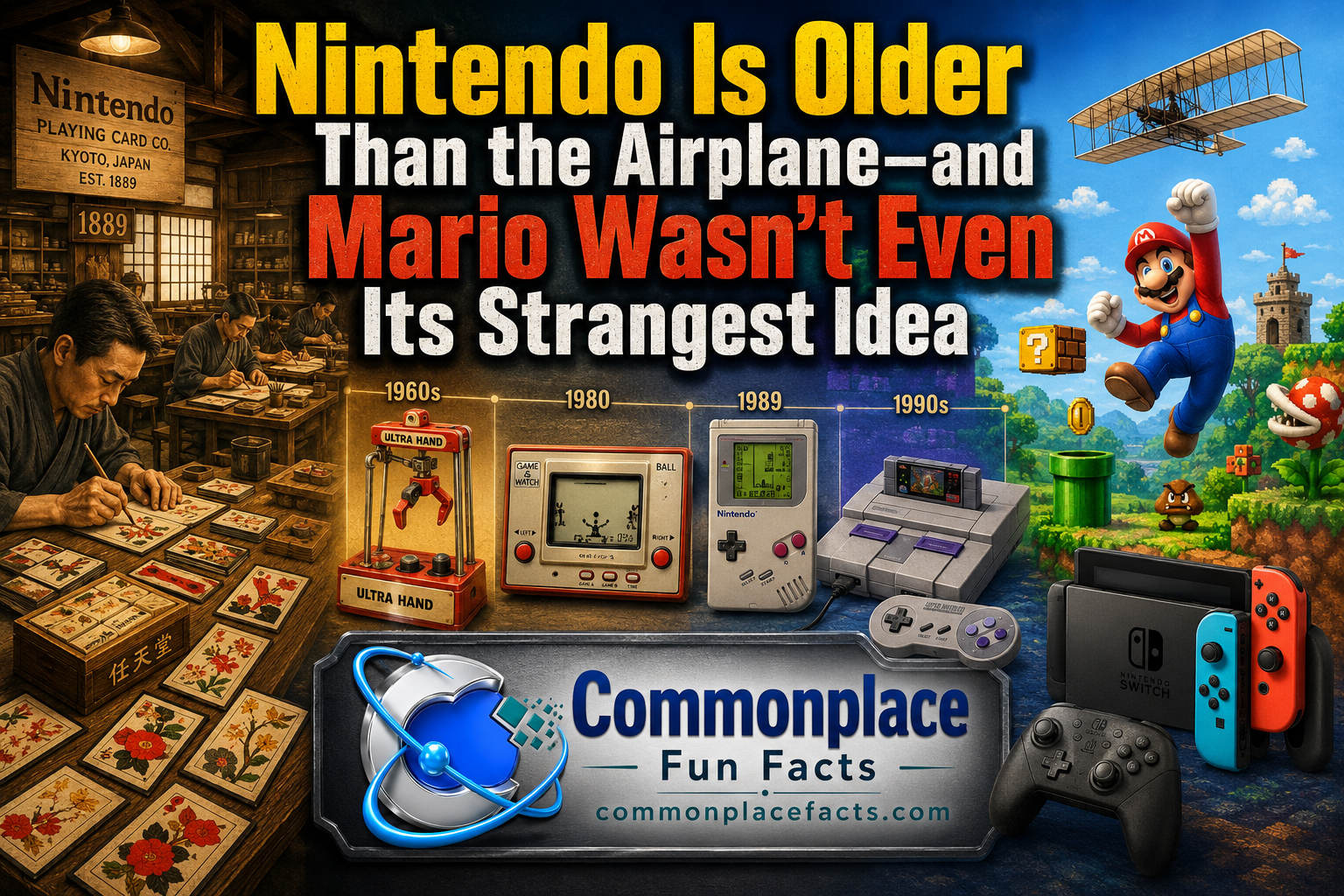
In reality, Nintendo was founded in 1889.
That was not a typo. There is no missing “19” at the beginning.
When Nintendo opened for business, the Ottoman Empire still existed. Queen Victoria was on the British throne. Benjamin Harrison was president of the United States. The Eiffel Tower was the exciting new attraction in Paris, Vincent van Gogh had completed The Starry Night earlier that year, and Wilbur and Orville Wright were young men still fourteen years away from achieving powered flight.
Nintendo was fourteen years old when the first successful powered airplane flew. It was thirty-three years old when the Ottoman sultanate was abolished. It had been operating for nearly four decades when commercially sliced bread appeared in 1928.
Nintendo is, quite literally, older than sliced bread.
Mario may represent the cutting edge of family entertainment, but the company behind him began during an era when the cutting edge was something a person might use to trim the corners of a playing card.
Contents
The Original Nintendo Entertainment System
Nintendo was founded in Kyoto, Japan, in September 1889 by Fusajiro Yamauchi. Its original product was not a console, arcade machine, or electronic device of any kind. Yamauchi manufactured traditional Japanese playing cards known as hanafuda.
The name means “flower cards,” and the cards are considerably more decorative than the standard decks familiar to most Western players. A hanafuda deck consists of forty-eight cards divided into twelve groups, one for each month of the year. Instead of numbered hearts, diamonds, clubs, and spades, the cards depict seasonal plants, ribbons, birds, animals, and other images.

In other words, Nintendo’s first game system consisted of painted pieces of cardboard. It had no screen, no batteries, no downloadable updates, and no lengthy user agreement requiring players to surrender their legal rights before being allowed to match a chrysanthemum with a sake cup.
The cards were handmade and sold through Yamauchi’s shop. They became popular enough that Nintendo eventually had to hire assistants to keep up with demand.
Hanafuda cards were closely associated with gambling. Japan had spent centuries banning and unbanning various card games, which caused gamblers to respond in the traditional manner: by inventing slightly different cards and pretending the law had been defeated by graphic design.
Some gambling houses reportedly preferred to open a fresh deck for each game, partly to prevent players from recognizing marks or wear on the cards. This was an excellent arrangement for Nintendo, since a product that customers throw away after one use is generally regarded as the business equivalent of finding a pipe that pumps money directly into the building.
Nintendo therefore began not merely as a manufacturer of playing cards, but as a gaming company. The electronics came much later. The basic business model—creating attractive objects that established rules, encouraged competition, and persuaded people to try “just one more game”—was already in place.
Several Decades of Being Extremely Card-Shaped
For many years, Nintendo remained almost entirely a playing-card company.
In 1902, it began producing Western-style playing cards, becoming one of the first Japanese companies to manufacture them domestically. Over the following decades, the business expanded its distribution network and went through several corporate reorganizations and name changes.

These details are important, but not especially dramatic. Nintendo spent much of the first half of the twentieth century making cards, selling cards, distributing cards, and occasionally reorganizing the people responsible for making, selling, and distributing the cards.
Meanwhile, the rest of the world inconveniently continued inventing things.
Radio broadcasting appeared. Motion pictures learned to talk. Commercial aviation developed. Television arrived. Two world wars came and went. Rockets began reaching into space. Through it all, Nintendo continued producing small rectangular objects decorated with pictures.
In 1951, the company changed its name to Nintendo Playing Card Co., Ltd. Two years later, it became the first Japanese company to successfully mass-produce plastic playing cards.
Plastic cards were durable, washable, and resistant to bending. They represented a legitimate technological advance, although it was not yet the sort of innovation that caused children to line up outside stores at midnight.
Hiroshi Yamauchi Decides Cardboard Is Not Enough
The transformation of Nintendo began under Hiroshi Yamauchi, the founder’s great-grandson.
Yamauchi became president of the family business in 1949 while still in his early twenties. He would remain in charge for more than half a century, overseeing Nintendo’s evolution from a regional playing-card manufacturer into one of the most recognizable entertainment companies in the world.

He was not known for governing by gentle consensus.
Yamauchi reportedly removed older managers who questioned his authority and consolidated control over the company. His leadership style might best be described as “firm,” provided the word is being used by someone standing a safe distance away.
He also recognized a problem. There were only so many playing cards the public needed. Even the most dedicated card player eventually reaches the point where another deck would merely provide a few dozen additional objects to lose under the sofa.
In 1959, Nintendo reached a licensing agreement with Disney and began selling playing cards decorated with Mickey Mouse and other familiar characters. Until then, playing cards in Japan had largely been associated with adults and gambling. The Disney cards helped reposition them as entertainment for children and families.
The result was a major sales success and an early demonstration of a principle Nintendo would later perfect: consumers become much more interested in an ordinary product when a beloved fictional character is staring at them from the packaging.
In 1963, the company dropped “Playing Card” from its corporate name and became simply Nintendo Company, Ltd.
This was the business equivalent of removing “Horse-Drawn Carriage” from the company letterhead. Nintendo was preparing to become something broader, although no one was entirely certain what that something would be.
Nintendo Tries Several Things That Are Not Video Games
During the 1960s, Nintendo experimented with businesses far removed from playing cards.
It operated a taxi company. It experimented with instant rice and other food products. It pursued various ventures that seemed to have been selected by opening a newspaper, pointing at a random industry, and saying, “We could probably do that.”
A frequently repeated story claims Nintendo also operated short-stay “love hotels.” The tale has appeared in numerous accounts of the company’s history, but reliable documentary evidence is surprisingly difficult to locate. It is therefore best treated as a colorful possibility rather than an established fact.
This is unfortunate for anyone hoping to write the sentence, “Before Nintendo produced Mario, it rented rooms by the hour,” but history occasionally insists on spoiling perfectly good jokes.
Most of Nintendo’s diversification efforts failed or were abandoned. The taxi business faced labor problems. The instant-food venture did not transform the grocery industry. Nintendo discovered that being reasonably good at making playing cards did not automatically qualify it to operate taxis, manufacture food products, or master every other object found in modern civilization.
The company needed a new direction, but its successful future would not come from abandoning entertainment. It would come from expanding its definition of what a game could be.
The Maintenance Engineer With the Extendable Arm
One of the most important developments in Nintendo’s history began when a maintenance engineer named Gunpei Yokoi was amusing himself at work.
Yokoi had joined Nintendo to maintain the machinery used in its card factories. During his spare time, he constructed a simple mechanical device with crossed plastic pieces that could extend outward and grab objects.

Hiroshi Yamauchi saw the device and asked Yokoi to turn it into a commercial product.
The result was the Ultra Hand, released in 1966. The toy allowed users to extend a plastic arm, grab an object, and pull it back toward them. It was not complicated, but it was fun, which would prove to be a recurring Nintendo strategy.
The Ultra Hand sold more than a million units and helped establish Nintendo as a toy company. Yokoi was moved from maintaining factory equipment to developing new products, demonstrating the professional advantages of playing with homemade contraptions when the company president happens to walk past.
Yokoi and Nintendo followed the Ultra Hand with a series of toys.
The Ultra Machine was a small indoor pitching device that launched plastic balls for users to hit. This allowed children to enjoy baseball inside the home while allowing their parents to enjoy the thrilling uncertainty of wondering which lamp would die first.
The company also released the Love Tester, an electronic device that supposedly measured the romantic compatibility of two people holding hands. It did not actually detect love, but it could determine whether two people were willing to touch one another while being evaluated by a plastic box, which is at least adjacent to the subject.
Nintendo also developed light-gun toys that used electronic sensors. Players aimed a gun at a target and fired a beam of light, causing the target to react when struck.
The company was moving steadily from paper cards to mechanical toys and then to electronic entertainment. Video games had not yet arrived, but Nintendo was approaching them one flashing plastic object at a time.
Nintendo Slowly Adds Electricity
In the early 1970s, Nintendo expanded its light-gun technology into the Laser Clay Shooting System.

The company converted unused bowling alleys into indoor shooting galleries where customers fired electronic rifles at projected targets. The system initially appeared successful, but the oil crisis of 1973 caused customers and investors to lose enthusiasm for expensive leisure projects.
Nintendo was left with considerable debt and another reminder that diversification is much more enjoyable before the invoices arrive.
Still, the company had accumulated valuable experience with electronics, interactive targets, amusement venues, and game design. It began distributing and developing electronic arcade games during the 1970s.

In 1977, Nintendo released the Color TV-Game 6 in Japan. The home console contained six variations of a simple tennis-style game. Players moved paddles up and down the screen while attempting to bounce a square past one another.
It was not exactly The Legend of Zelda. There were no kingdoms, quests, magical swords, or elaborate stories. There were two vertical lines and a moving dot, and everyone was expected to use a considerable amount of imagination.
Nevertheless, Nintendo was now officially in the home video-game business.
The transformation had taken almost ninety years.
An Idea From a Bored Commuter
Gunpei Yokoi’s next major contribution reportedly came after he noticed a businessman on a commuter train passing the time by pressing buttons on a pocket calculator.
Yokoi wondered whether the same inexpensive liquid-crystal display technology could be used to create a portable electronic game.
The result was the Game & Watch series, launched in 1980. Each handheld unit contained a single game along with a digital clock and alarm.
The clock gave the device a thin layer of respectability. It was not merely an electronic toy that distracted people from work and school. It was also a timekeeping instrument that distracted people from work and school.
The Game & Watch systems were simple, portable, affordable, and highly successful. In 1982, the Multi Screen line introduced Nintendo’s cross-shaped directional pad, allowing players to control movement with one thumb.
That design became standard on later controllers and remains recognizable today. Nintendo had begun with cards that fit in a pocket. Nearly a century later, it was still making games that fit in a pocket. The principal difference was that losing one under the sofa had become considerably more expensive.
A Carpenter, an Ape, and Several Barrels
Nintendo’s breakthrough in the American arcade market came in 1981 with Donkey Kong.
The game was created by a young designer named Shigeru Miyamoto. The player controlled a character originally called Jumpman, who had to climb a construction site, avoid barrels, and rescue a woman from a large ape.
Jumpman was depicted with a cap because animating hair was difficult. He received a mustache because the limited graphics made it hard to draw a recognizable mouth. His overalls helped distinguish his arms from his body.
Technical limitations therefore produced one of the most recognizable characters in popular culture. This should provide comfort to anyone whose greatest creative achievement began because the preferred option was unavailable.
Jumpman was later renamed Mario. Although he would become famous as a plumber, he was initially portrayed as a carpenter because Donkey Kong took place at a construction site.
His career path therefore progressed from carpenter to plumber to doctor, race-car driver, professional athlete, boxing referee, business owner, and occasional savior of the universe. Mario has apparently spent his entire adult life ignoring the recommendation to choose a marketable specialty.
Donkey Kong became an international hit and demonstrated the importance of characters, personality, and storytelling in video games. Nintendo was no longer merely producing electronic diversions. It was building worlds and filling them with figures people would remember.
Nintendo Enters the American Living Room
In 1983, Nintendo released the Family Computer, commonly known as the Famicom, in Japan.
The timing was less encouraging in the United States. The American video-game industry had collapsed under the weight of too many consoles, too many terrible games, and too many executives who assumed consumers would purchase anything placed inside a colorful box. Read “The Search to Uncover the Legendary Secret Graveyard of Video Games” for more about that chapter in gaming history.
Retailers had little interest in another video-game system. Nintendo therefore redesigned the Famicom for the American market and presented it as the Nintendo Entertainment System.
The American console looked more like a piece of household electronics than a toy. Its cartridges were inserted behind a small door, similar to loading a videotape. Nintendo also packaged it with accessories such as the Zapper light gun and R.O.B., a small plastic robot that helped persuade retailers that the system was something new.
It was, of course, still a video-game console. Nintendo had responded to the public’s distrust of video games by placing a video-game console inside a gray box and introducing it while standing next to a robot.
The strategy worked.
The Nintendo Entertainment System helped revive the American home-console market. Nintendo tightly controlled which games could be released for the system and used its Seal of Quality to reassure buyers that the cartridges had met the company’s standards.
In 1985, Super Mario Bros. transformed Mario from a successful arcade character into the face of a global entertainment empire.
Nintendo had arrived at the identity most people now associate with the company. It had taken only ninety-six years.
Nintendo’s Peculiar Definition of Cutting Edge
Nintendo is often described as a technology company, but it has rarely succeeded by producing the most powerful machine available.
Gunpei Yokoi became associated with a design philosophy commonly translated as “lateral thinking with withered technology.” The idea was to take familiar, inexpensive, well-understood technology and use it in an imaginative way.
The Game & Watch used calculator-style screens. The Game Boy, released in 1989, had a monochrome display just as color handheld competitors were beginning to appear. Its screen was less impressive, but the device was affordable, durable, and capable of running for hours on a set of batteries.
More technologically advanced competitors discovered that their magnificent color screens were less entertaining after the batteries died.
The Game Boy became a worldwide phenomenon, helped enormously by Tetris, a puzzle game about arranging falling blocks. Nintendo had created a portable entertainment empire using hardware that displayed several shades of gray and a game that resembled construction work viewed from directly above.
The same philosophy appeared repeatedly in later products.
The Nintendo DS used two screens, including a touchscreen, instead of competing solely through graphical power. The Wii used motion-sensitive controllers and attracted people who had never considered themselves gamers. The Switch combined a home console with a portable device.
Nintendo’s central question was rarely, “How many processors can we fit into this object?”
It was, “What interesting thing can people do with it?”
This approach sometimes made Nintendo appear technologically behind its competitors. It also repeatedly allowed the company to change how games were played while other manufacturers competed over how realistically they could render individual blades of grass.
Nintendo Never Really Left the Card Table
Nintendo continues to manufacture hanafuda cards.
That may seem like a quaint tribute to its origins, but the cards reveal something important about the company’s history.
Nintendo did not spend decades making one product and then abruptly become an entirely different business. It has always been in the entertainment industry.
The hanafuda deck, the Ultra Hand, the Love Tester, the light gun, the Game & Watch, the NES, the Game Boy, the Wii, and the Switch look like wildly unrelated products. They are, however, different answers to the same basic question: Would this be fun?
The materials changed from paper to plastic to liquid-crystal displays and computer processors. The table became a television screen. The illustrated figures became animated characters. The person sitting across from you became an opponent on the other side of the world.
But Nintendo’s essential product remained play.
That is what makes the company’s age more than a piece of trivia. Nintendo is not simply an old corporation that managed to survive long enough to stumble into video games. It was making games before video games existed.
It was making games before the airplane, before radio broadcasting, before television, and before anyone could walk into a grocery store and purchase a loaf of pre-sliced bread.
Nintendo did not begin at the cutting edge of technology. It began with flowers painted on cards.
More than a century later, the technology has changed dramatically. The company’s objective has not. It is still trying to convince people to sit down, learn the rules, and play one more game.
You may also enjoy…

The Search to Uncover the Legendary Secret Graveyard of Video Games
It was April 2014, and the excavators approached the rumored burial site with high hopes. Many expressed doubt that the place even existed. Those who were in the best position to know had publicly stated that the site was an urban legend. Despite the naysayers, there was a loyal group of true believers who were…

Magic: the Gathering: The World’s Most Complex Game is Too Complicated for a Computer
Discover why Magic: The Gathering* is officially the most complex game ever created—so intricate that even computers can’t calculate a winner. From Captain Kirk’s fake Fizzbin to CIA training decks, explore how games outsmart logic and intelligence alike.

How Lincoln’s Beard Led to One of the Best-Selling Board Games
In 1860, Milton Bradley initially profited from selling lithographs of a clean-shaven Abraham Lincoln but faced financial ruin when Lincoln grew a beard. Learn how Lincoln’s beard prompted Bradley to create “The Checkered Game of Life,” a successful board game that eventually led to the founding of the Milton Bradley Company, shaping family entertainment.






Leave a Reply