

Psychology has a remarkable talent for taking something everyone already recognizes and giving it a name that requires three semesters of graduate school to pronounce.
Then, every once in a while, psychologists come up with something magnificent.
The Dark Triad.
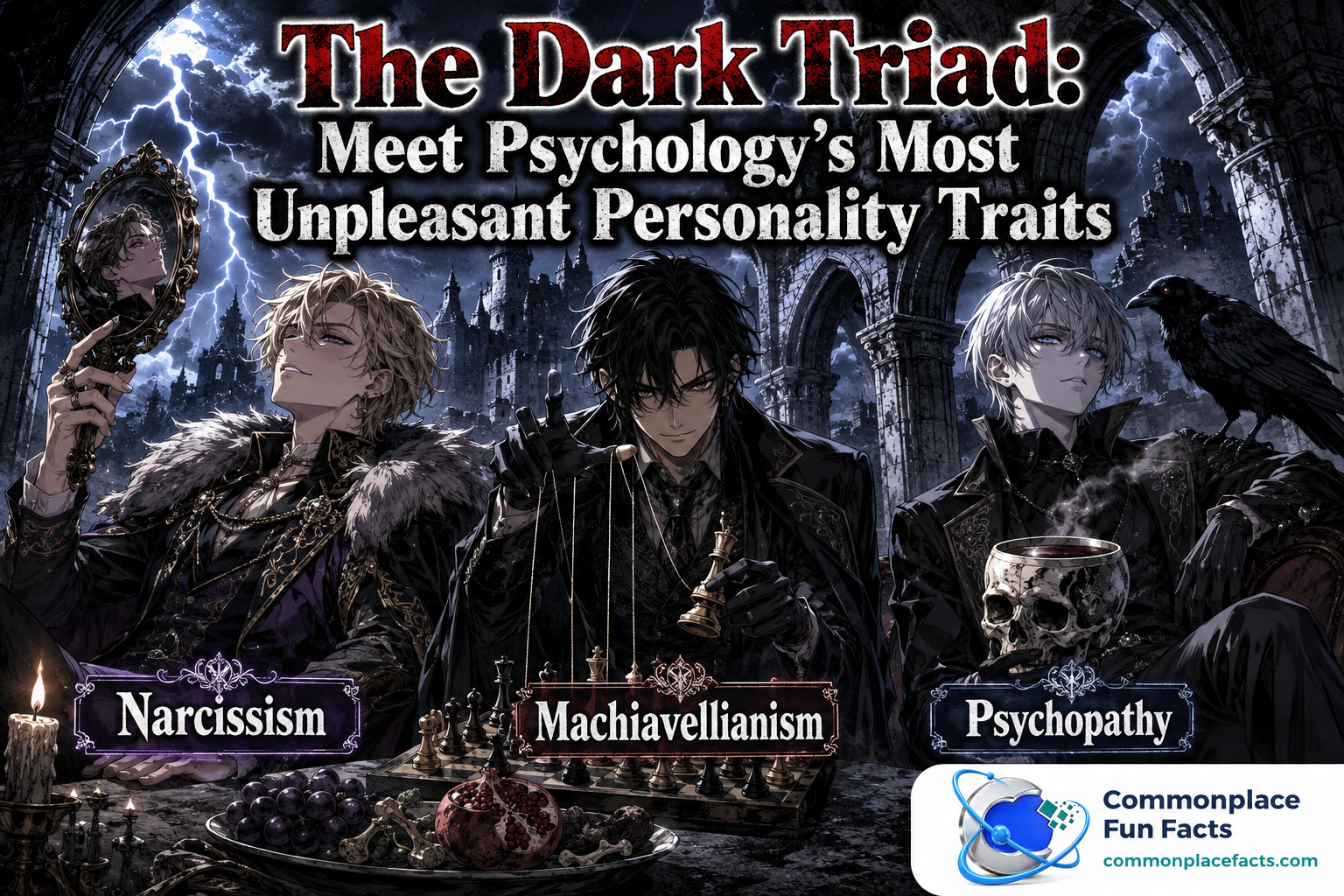
That does not sound like a personality theory. It sounds like three hooded figures who meet beneath an abandoned castle to discuss the final destruction of mankind. There should be lightning. Someone should have a raven. At the very least, refreshments should be served from a human skull.
Instead, the Dark Triad is a psychological concept describing three overlapping personality traits: narcissism, Machiavellianism, and psychopathy. Psychologists Delroy Paulhus and Kevin Williams grouped them together in an influential 2002 paper in the Journal of Research in Personality, asking a deceptively simple question: Were psychologists really studying three different kinds of unpleasant personalities, or had different researchers merely invented three names for essentially the same guy nobody wants on the homeowners association board?
The answer turned out to be: a little of both.
The three traits were related, but they were not identical. They seemed to share a common unpleasant core while retaining personalities of their own. That finding launched more than two decades of research into what makes people manipulative, self-important, callous, exploitative, charming, cruel, socially successful, romantically appealing, and occasionally willing to put a bug named Muffin into what appears to be an industrial killing machine.
Yes, we will get to Muffin.
Contents
What Is the Dark Triad?
The Dark Triad consists of three personality traits described by psychologists as socially aversive and described by some of us as college dating experiences:

- Narcissism — grandiosity, entitlement, self-importance, and a strong desire for admiration and status.
- Machiavellianism — strategic manipulation, cynicism, emotional detachment, and a willingness to use other people to achieve personal goals.
- Psychopathy — callousness, low remorse, emotional coldness, impulsivity, and reduced concern about harming others.
Before proceeding, however, we need to install a rather large warning label.
The Dark Triad is not a three-part psychiatric diagnosis. In this context, researchers are studying personality traits, generally in ordinary populations. Paulhus and Williams specifically investigated subclinical narcissism, Machiavellianism, and subclinical psychopathy. These characteristics exist along continua. A person can possess some narcissistic traits without having narcissistic personality disorder. Someone can score relatively high on a measure of psychopathic traits without secretly keeping a chainsaw in the garage for recreational purposes.
This distinction is important because the internet has taken approximately twelve minutes to turn virtually every psychological term into a method for diagnosing people we dislike. If your coworker takes credit for your idea, your former spouse forgets your birthday, or your uncle refuses to return the leaf blower, Google will happily provide a path toward concluding that you are surrounded by malignant narcissistic sociopaths.
This is roughly the psychological equivalent of the problem we explored with the Dunning-Kruger Effect: once people learn the name of an interesting phenomenon, they have an almost irresistible desire to apply it to everyone except themselves.
Narcissism: But Enough About Me; What Do You Think About Me?
Narcissism is probably the most familiar member of the Dark Triad, largely because the word has escaped from psychology and now roams freely through social media, relationship advice, political arguments, and family group texts.

In Dark Triad research, narcissism generally refers to the grandiose variety: an inflated view of one’s own importance, entitlement, status-seeking, dominance, and a hunger for admiration. It is not merely liking yourself, wanting recognition, posting a flattering photograph, or believing you are good at your job. Healthy self-confidence and pathological self-absorption are not the same thing, despite what your most pessimistic friend may insist.
The narcissistic personality does something more interesting. It does not merely think highly of itself; it tends to organize social interactions around maintaining that favorable view. Recognition matters. Status matters. Being regarded as impressive matters. If reality fails to cooperate, reality may find itself placed on a performance improvement plan.
Paulhus and Williams found narcissism associated particularly with self-enhancement. In other words, narcissistic individuals were especially inclined to see themselves through favorable lenses.
That sounds like an obvious social disadvantage. Who wants to spend time with someone convinced he is the most fascinating person in the room?
Well, inconveniently, quite a few people — at first.
Machiavellianism: Everyone Else Is a Chess Piece
Machiavellianism has the distinction of being both a psychological personality construct and a 500-year public-relations problem for a dead Italian.

Niccolò Machiavelli was a Florentine diplomat, political thinker, and author whose name became permanently associated with ruthless political manipulation, largely because of The Prince. The actual political philosophy of Machiavelli is considerably more complicated than “lie, cheat, murder, repeat,” but history had already made its branding decision.
Machiavelli died in 1527, which prevented him from filing a complaint when psychologists Richard Christie and Florence Geis later borrowed his name for a personality construct.
Beginning in the 1960s, Christie and Geis studied differences in people’s willingness to endorse cynical and manipulative approaches to human relationships. Their work eventually produced the Mach IV scale and the 1970 book Studies in Machiavellianism.
Someone high in Machiavellianism tends to approach relationships strategically. Other people are not necessarily companions, enemies, or moral equals. They are variables. They have motivations, weaknesses, loyalties, ambitions, and buttons that can be pressed.
The stereotypical Machiavellian does not kick down the door. He gets someone else to open it, convinces that person it was his own idea, and is waiting in the conference room when everyone arrives.
This is where Machiavellianism differs conceptually from psychopathy. Machiavellianism is supposed to be more calculated. The person delays gratification, studies other people, manages impressions, and manipulates strategically. Psychopathy, by contrast, generally has a stronger component of impulsivity and disinhibition.
The distinction between manipulation and brute coercion matters well beyond personality questionnaires. In our look at Edward Lansdale and psychological warfare, for example, we saw how understanding another person’s beliefs and fears can become a remarkably powerful tool. Knowing what makes someone tick is morally neutral information. What you decide to do with the clockwork is another matter.
Psychopathy: Not Necessarily the Fellow With the Chainsaw
Of the three Dark Triad terms, psychopathy carries the most cultural baggage.
Say “psychopath,” and most of us immediately picture serial killers, horror villains, unnervingly calm criminals, or someone Anthony Hopkins could play while making uncomfortable eye contact.

Dark Triad researchers are talking about something broader. They measure psychopathic traits in noninstitutionalized populations: callousness, reduced remorse, emotional detachment, impulsivity, thrill-seeking, and willingness to violate social norms for personal benefit.
Violence is not required. Neither is criminality. Neither is an underground room that the neighbors somehow failed to notice.
This matters because personality traits occur by degree. Most people display some characteristics associated with the Dark Triad at some point. We can be selfish, manipulative, vain, emotionally cold, reckless, or insufficiently concerned about somebody else’s interests without receiving membership cards and matching robes.
The scientific question is not whether you have ever behaved badly. That would be the world’s shortest research project. The question is whether these tendencies form relatively stable patterns and how strongly they predict behavior across situations.
How Do You Measure How Dark Someone Is?
Once psychologists decided that narcissism, Machiavellianism, and psychopathy belonged in the same general neighborhood, they faced a practical problem: measuring them.
Psychology has a long history of producing experimental methods that make ordinary people wonder whether the researchers were properly supervised. We have previously encountered this in the Little Albert experiment, where the research question was essentially, “Can we deliberately teach a baby to be terrified?” and apparently nobody in 1920 was assigned the follow-up question, “Should we?”
Dark personality research is usually considerably less dramatic. Much of it begins with questionnaires.
In 2014, Daniel Jones and Delroy Paulhus published the Short Dark Triad, which is not, sadly, an offbeat comedy starring Danny DeVito, Peter Dinklage, and Warwick Davis. Commonly called the SD3, it contains 27 statements — nine aimed at each of the three traits. Participants rate how strongly they agree or disagree with statements reflecting manipulation, entitlement, grandiosity, callousness, cynicism, or related attitudes.
The researchers validated the measure across four studies involving a total of 1,063 people.
There is something wonderfully counterintuitive about this method. To determine whether people are manipulative, deceitful, self-serving, and inclined to misrepresent themselves, psychology gives them a form and asks them to describe themselves accurately.
This is less absurd than it sounds. Good psychological instruments are tested for reliability, correlations with other measures, predictive usefulness, and consistency across populations. Researchers can also compare self-reports with peer reports and observed behavior.
Still, measurement is where the Dark Triad story begins to get messy. The more closely researchers examined the three supposedly separate forms of darkness, the more they noticed that some of them kept wearing each other’s clothes.
Are There Really Three Different Kinds of Darkness?
This question has haunted the Dark Triad from the beginning.
In the original 2002 study, Paulhus and Williams examined 245 university students and concluded that narcissism, Machiavellianism, and psychopathy were moderately related but not interchangeable. The only Big Five personality characteristic shared by all three was low agreeableness — or, translated rather loosely into everyday language, a certain difficulty embracing the proposition that other people have needs, too.
Yet Machiavellianism and psychopathy, in particular, have always presented a problem. If one person manipulates others coldly because he is calculating and another manipulates them coldly because he is callous, how different are those personalities once we try to measure them with a questionnaire?
Researchers continue debating that issue. There is evidence that the traits have distinct features, but there is also substantial overlap. Human beings, inconsiderately, have refused to arrange their moral shortcomings into three perfectly labeled storage bins.
Maybe There Is Just One Big Dark Thing Underneath
By 2018, psychologists Morten Moshagen, Benjamin Hilbig, and Ingo Zettler proposed another possibility.
Perhaps narcissism, Machiavellianism, psychopathy, sadism, spitefulness, entitlement, egoism, and several other unpleasant traits all share an underlying psychological core.
They called it the Dark Factor of Personality, or simply D.
At its heart is the tendency to pursue one’s own interests while accepting, disregarding, or deliberately causing costs to other people — combined with beliefs that justify doing so.
That final part is important. Darkness is not merely selfishness. Most of us occasionally put ourselves first. D involves a broader willingness to treat somebody else’s loss as an acceptable price for our gain while developing a story explaining why this is perfectly reasonable.
Instead of narcissism, Machiavellianism, and psychopathy being three unrelated villains who happen to attend the same meetings, the Dark Factor model suggests there may be a central office issuing all their identification badges.
A 2023 study in Scientific Reports pushed the question further by examining how many aversive traits are needed to approximate this broader dark core. One intriguing conclusion was that the famous Dark Triad—or even the later Dark Tetrad—does not possess some magical monopoly on capturing human unpleasantness. In fact, the standard Dark Triad and Dark Tetrad produced systematically poorer approximations of the broader dark core than many other combinations containing the same number of aversive traits. Apparently, human nastiness not only refuses to stay in three convenient boxes; psychology may not even have picked the optimal boxes.
In other words, the Dark Triad may be famous partly because it is genuinely useful and partly because “Dark Triad” is an absolutely fantastic name.
Marketing matters, even in personality psychology.
The Annoying Part: Dark Traits Can Sometimes Work
If narcissism, manipulation, and callousness are socially undesirable, an obvious question follows: Why do these traits persist?
One possible answer is uncomfortable. Under some circumstances, at least some of them can be useful.
Not morally admirable. Not good for everyone around them. Useful.
Narcissists Can Be Charming — At First

A 2010 study by Mitja Back, Stefan Schmukle, and Boris Egloff examined what happened when strangers met narcissistic individuals for the first time.
The narcissists tended to be popular.
They presented themselves confidently. They were expressive. They appeared socially bold and entertaining. Even some of the narcissistic characteristics that become unpleasant in established relationships could contribute to favorable first impressions.
This makes intuitive sense once you think about it. Confidence and arrogance are difficult to distinguish during the first ten minutes. Charm and manipulation can use much of the same equipment. Someone who enters a room utterly convinced that everyone will find him fascinating may behave very much like someone who is genuinely fascinating.
Time eventually supplies additional evidence.
Other research has found that narcissists themselves appear to have at least some awareness of this phenomenon. A 2011 series of studies found that narcissistic individuals understood, to some extent, that they tended to make favorable first impressions that deteriorated as people got to know them.
There are, unfortunately, no laws of psychology requiring difficult personality traits to come equipped with an audible warning buzzer.
And Then There Is the “Bad Boy” Problem
In 2014, researchers tested whether women found a male character displaying high Dark Triad traits more attractive than a low-Dark-Triad version of the character. They did.
The study found greater attractiveness ratings for the high-Dark-Triad personality, even though physical appearance was held constant.
This is precisely the sort of study that the internet receives with all the restraint of children discovering an unattended cotton-candy machine. Within minutes, a careful experimental finding becomes “SCIENCE PROVES WOMEN WANT PSYCHOPATHS.”
No.
One experiment involving particular character descriptions does not explain female attraction, human mating, Western civilization, why your last date went badly, or whatever argument someone is currently having on Reddit. Other studies have produced more complicated or conflicting results, including research finding women disliked some Dark Triad characteristics in prospective partners.
The interesting point is narrower: traits that carry substantial long-term social costs can nevertheless produce short-term advantages under some conditions. Boldness can look like confidence. Self-promotion can look like competence. Emotional detachment can look like composure. Manipulation can look like social skill when you have not yet noticed the manipulation part.
Personality traits were not handed out based on whether they would make everyone pleasant at brunch.
What About Empathy? Meet the “Dark Empath”
A common assumption is that dark personalities simply lack empathy.
That turns out to be too simple.
Empathy itself has multiple components. Affective empathy involves sharing or emotionally responding to another person’s feelings. Cognitive empathy involves understanding what another person is thinking or feeling.
You can probably already see the problem.
Understanding exactly what another person feels does not guarantee that you intend to help.
Knowing where the emotional buttons are is useful information whether your intention is to comfort someone or press all of them in the most efficient possible sequence.
Questions about where empathy comes from and what it actually does have occupied philosophers and psychologists for centuries; they even surface in stories such as the strange case of Victor of Aveyron, the feral child who became an accidental experiment in language, society, and human nature.
In 2021, Nadja Heym and colleagues published a study involving 991 participants and identified a group they called Dark Empaths: people who scored relatively high on Dark Triad traits while also showing comparatively high empathy.
Compared with the traditional high-Dark-Triad group, the Dark Empaths were less indirectly aggressive, more extraverted, and generally showed better well-being. They nevertheless retained some of the antagonistic characteristics associated with dark personality.
This is interesting research. It is not, however, a newly discovered psychiatric species.
“Dark Empath” has since acquired an enormous pop-psychology life of its own, complete with articles explaining how to identify one across the dinner table before dessert. The original research does not justify treating it as a clinical diagnosis or a sinister Pokémon evolution of narcissism.
It does make a valuable point: empathy and goodness are not synonyms. The ability to understand another mind can support kindness, cooperation, counseling, diplomacy, friendship, parenting, salesmanship, manipulation, interrogation, or the devastatingly accurate observation your spouse has been saving since Tuesday.
Apparently Three Weren’t Enough: The Dark Tetrad

Psychologists spent years studying the Dark Triad and eventually reached the conclusion apparently inevitable in all successful franchises:
We need another villain.
The proposed fourth member was sadism—the tendency to derive pleasure from cruelty or from causing or witnessing another person’s suffering. We call such persons “law professors.” Psychologists use the term “everyday sadism.”
This produced the Dark Tetrad: narcissism, Machiavellianism, psychopathy, and sadism.
And this is where Muffin enters our story.
The Bug-Killing Experiment, Because Psychology Was Having a Day
In 2013, Erin Buckels, Daniel Jones, and Delroy Paulhus published a study with the reassuring title “Behavioral Confirmation of Everyday Sadism.”
Participants were given a choice among unpleasant tasks. One option involved exterminating live bugs.
Those choosing bug extermination were presented with a modified coffee grinder designed to sound horrifying. Nearby were cups containing pill bugs.
The bugs had names: Muffin. Ike. Tootsie.
This was presumably because grinding an anonymous insect was insufficiently disturbing for whatever research meeting produced this protocol.
Participants believed they were dropping the bugs into the machine and killing them. In reality, a barrier protected the insects, so Muffin, Ike, and Tootsie survived their contributions to psychological science. They were presumably unavailable for comment.
The interesting result was that people scoring higher in everyday sadism were more likely to choose the apparent bug-killing task. In a second experiment, sadism uniquely predicted willingness to expend effort for an opportunity to harm an innocent person.
The researchers concluded that everyday sadism added something not completely captured by the original Dark Triad.
Science therefore gave us the Dark Tetrad.
Four personality traits. Four horsemen of the socially awkward apocalypse. One grateful pill bug named Muffin.
Science Investigates Internet Trolls and Discovers Exactly What You Expected
If everyday sadism genuinely describes a tendency to enjoy causing distress, researchers immediately had access to the largest natural habitat of gratuitous irritation ever constructed.
The internet.
In 2014, Buckels, Paulhus, and Paul Trapnell investigated the relationship between dark personality traits and internet trolling. Their paper was titled, with admirable restraint, “Trolls Just Want to Have Fun.”
Trolling was associated with Machiavellianism, psychopathy, and especially sadism. Of the personality measures examined, sadism showed the strongest relationship with trolling behavior.
Humanity spent centuries developing the scientific method. We mapped the genome. Split the atom. Landed spacecraft on other worlds. Measured the age of the universe.
Eventually science turned its attention to the question that really mattered: What is wrong with the people in the comments section?
Apparently, we have data now.
Psychology Finally Gave the Nice People a Team
After nearly two decades of narcissists, manipulators, psychopaths, sadists, trolls, and researchers asking university students increasingly concerning questions, someone finally seems to have looked around the psychology department and said, “Should we perhaps investigate whether anyone is nice?”
In 2019, Scott Barry Kaufman, David Yaden, Elizabeth Hyde, and Eli Tsukayama introduced the Light Triad.

It consists of three characteristics:
- Faith in Humanity — believing people are generally good.
- Humanism — valuing the dignity and worth of other people.
- Kantianism — treating people as ends in themselves rather than merely as tools for getting what you want.
The last one gets its name from philosopher Immanuel Kant. This also gives psychology students access to an entire category of jokes unavailable to the general population, beginning with “There’s no ‘can’t’ in Kantianism.” We have now provided the joke. Understanding why anyone would make it is between you and your academic advisor.
Importantly, the Light Triad was not simply the Dark Triad with all the scores reversed. Light and dark characteristics overlap with other personality dimensions in different ways. A person can possess mixtures of both.
This brings us to perhaps the most reassuring finding in the entire field. In Kaufman and his colleagues’ samples, people’s average balance leaned substantially toward the light side. Extreme malevolence was comparatively uncommon.
After spending this entire article examining manipulation, narcissism, callousness, bug extermination, and internet trolling, we are pleased to report that the average participant in these studies was apparently not terrible.
Not consistently, anyway.
So How Dark Are You?
At this point, you may be mentally calculating your own Dark Triad score.
Or, much more likely, someone else’s.
This is where caution becomes useful. Personality psychology deals largely in dimensions and tendencies. Human beings are not assigned to permanent houses at age eleven: Narcissist, Machiavellian, Psychopath, Hufflepuff.
You can enjoy attention without being pathologically narcissistic. You can strategically persuade another person without qualifying as Machiavellian. You can remain calm during a crisis without being psychopathic. You can laugh when a particularly obnoxious fictional villain falls into an open sewer without needing to alert a sadism researcher.
The important questions concern degree, consistency, motivation, and behavior.
The Dark Triad is useful because it gives researchers a framework for studying recurring patterns in how people pursue status, manipulate others, respond to empathy, behave aggressively, form relationships, and make moral choices. It becomes considerably less useful when converted into a label for anyone who annoyed us this week.
Your boss may be a narcissist.
He may also simply be a jerk.
Psychology contains considerably more paperwork for distinguishing the two.
The Dark Triad Is Really a Story About Human Nature
When Paulhus and Williams published their Dark Triad paper in 2002, the question looked relatively tidy. Psychology had three prominent socially aversive personality constructs. Were they really different?
More than two decades later, the answer remains wonderfully inconvenient: Yes, but.
Narcissism, Machiavellianism, and psychopathy can be distinguished, but they overlap. Some of their supposedly undesirable qualities can generate short-term social advantages. Empathy can coexist with dark characteristics. Sadism adds something the original trio may miss. The Dark Factor suggests that all of these traits may emerge from an even broader common core. The Light Triad reminds us that human personality contains prosocial tendencies that are not merely the absence of darkness.
In short, psychology tried to organize human unpleasantness into three convenient categories, and human beings responded by being considerably more complicated.
That may be the most useful lesson of the Dark Triad. Personality is not divided neatly between heroes and villains. We all occupy different places on a great many scales. A little self-regard does not make you Narcissus. Strategic thinking does not make you Machiavelli. Emotional toughness does not make you Hannibal Lecter.
And laughing when Wile E. Coyote falls off a cliff does not necessarily establish everyday sadism.
Probably.
Although if you volunteered to put Muffin through the bug grinder, psychology would still like a word.
You may also enjoy…

If You Like Strong Coffee, You Might Be a Psychopath
If the findings of a recent study are accurate, the next time you order strong coffee, you might be asked if you want cream, sugar, or anti-psychotic medications to go with it. According to researchers from the University of Innsbruck, those whose tastes favor black coffee and other bitter flavors, such as dark chocolate and…

Pelican Bay: The Prison With Its Own Psychological Disorder
Pelican Bay Prison: The Most Indimidating Prison in the USA Certain prisons take on certain notoriety because of their reputation or place in history. Alcatraz, Sing Sing, and San Quentin all evoke images of forbidding institutions that have housed the most violent prisoners society can produce. Out of all of them, there is only one…

30 Phobias You Won’t Believe Actually Exist (But Totally Do!)
Ever wondered what it’s like to fear ants, clothes, or even words? From the quirky to the downright bizarre, here’s a deep dive into 30 phobias you didn’t know existed—until now! 🐜👗📚 Explore the wild world of fears with a side of humor! #Phobias #FunFacts






Leave a Reply