

Headaches are a fact of life. We get them from illness, fatigue, dehydration, poor decisions, and occasionally from prolonged social interaction with certain people who possess a remarkable natural talent for producing them.
Most of us have a reasonably simple mental filing system for headaches. There is the mild headache, the ordinary run-of-the-mill headache, and the bad headache. Standing in a category all by itself is the migraine. For most of us, “migraine” is the term used for the headache that looks at its competitors and says, “That’s cute.”
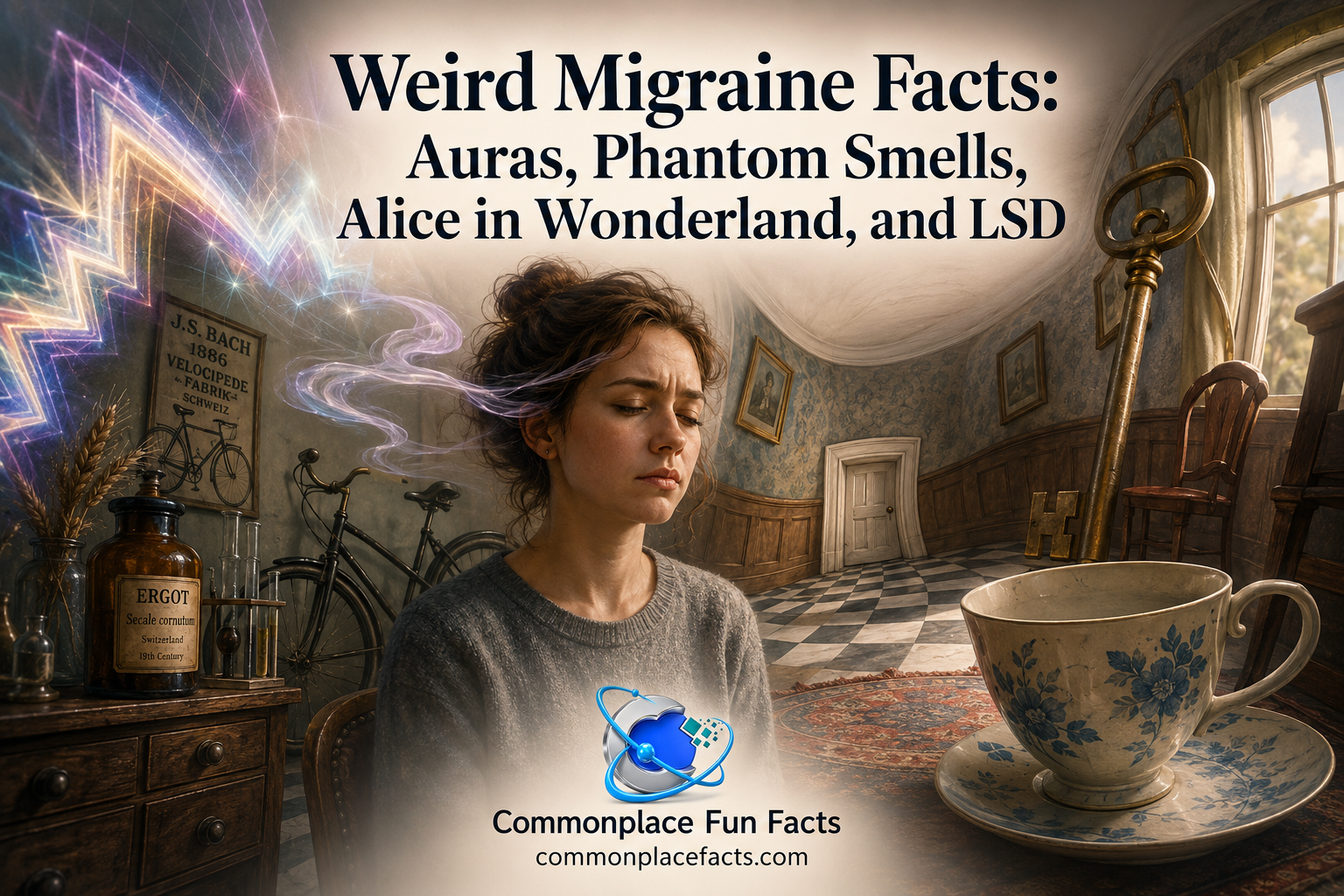
This classification misunderstands a fundamental fact. The migraine is not merely an especially enthusiastic headache. It is a complex neurological disorder that can affect vision, hearing, smell, touch, balance, speech, digestion, mood, concentration, and even the way a person perceives the size of his or her own body. Some migraine attacks do not include a headache at all. Others can make harmless contact with the scalp hurt, create the smell of smoke where there is no smoke, or turn an ordinary room into something that feels as though Lewis Carroll has taken over the interior decorating.
It is also extraordinarily common. Global Burden of Disease estimates put the number of people living with migraine at roughly 1.2 billion in 2021, and the World Health Organization ranks it among the major causes of neurological disability worldwide. This is a massive health problem that also happens to be neurologically fascinating, allowing us to tentatively attach the adjective “fun” to the words “migraine facts.”
A brief advisory from the Commonplace Fun Facts Legal Department: Migraines can produce symptoms that resemble other serious neurological conditions. If you experience sudden new weakness, speech difficulty, vision loss, confusion, or an unfamiliar severe headache, do not assume it is a migraine based on a fun-facts article on the internet, even one that has gone to the trouble of linking the subject to Alice in Wonderland and LSD.
Instead, please consult a qualified medical professional. This article is intended to inform and entertain, not to diagnose, treat, or replace professional medical advice. If the Commonplace Fun Facts lawyers were capable of experiencing human emotion, they would express appreciation for your cooperation in allowing actual medical professionals to handle the medical part.
Contents
So What Exactly Is a Migraine?
Before we get too far into the strange symptoms, historical detours, and neurological special effects, it would probably be useful to answer a fairly basic question: What exactly is a migraine?
The short answer is that a migraine is a neurological disorder that produces recurring attacks involving the brain and nervous system. Head pain is common and may be severe, throbbing, and concentrated on one side of the head, but the headache is only part of the story. A migraine can also bring nausea, sensitivity to light and sound, dizziness, numbness, visual disturbances, speech problems, and an assortment of other symptoms that suggest the nervous system has temporarily decided to experiment with alternative operating procedures.
Scientists are still sorting out exactly what starts a migraine attack, but several parts of the nervous system appear to be involved. These include the trigeminal nerve, the brain’s pain-processing pathways, and chemical messengers such as calcitonin gene-related peptide, which everyone sensibly calls CGRP after saying the full name once and deciding life is too short. In people who experience aura, a slowly spreading wave of altered electrical activity across part of the brain may also be involved.
The important point is that the headache is not the migraine itself. It is one possible symptom of a much larger neurological event. Calling a migraine “a really bad headache” is therefore a little like describing the flu as “a particularly ambitious runny nose.” Technically related, perhaps, but leaving out quite a bit of the experience.
Migraine Symptoms: It Can Start Before the Headache Does
One of the stranger things about migraine is that the attack may already be underway long before the sufferer feels head pain. The first stage, called the prodrome, can begin hours or even days beforehand. Symptoms can include fatigue, neck stiffness, mood changes, difficulty concentrating, increased urination, fluid retention, food cravings, and repeated yawning.

Yes, yawning.
This produces a particularly interesting problem when people try to identify their migraine “triggers.” Suppose you suddenly develop an overwhelming craving for chocolate. You eat several pieces, and a few hours later a migraine arrives. The obvious conclusion is that chocolate caused the migraine. It certainly looks guilty. It was at the scene, it had opportunity, and there is probably still a wrapper in the wastebasket.
But researchers have pointed out that the craving itself may have been part of the migraine prodrome. In that case, the migraine caused the desire for chocolate rather than the chocolate causing the migraine. Reviews of the evidence have found surprisingly weak support for chocolate as a universal migraine trigger.
This does not mean food never triggers attacks. Migraine triggers differ dramatically from one person to another, and sleep changes, stress, hormonal changes, skipped meals, weather, odors, flashing lights, and other factors may play a role. It does mean that migraine occasionally gets to commit the crime and frame the chocolate.
The Brain Can Add Special Effects Before the Main Feature
Some people experience migraine aura, a set of temporary neurological symptoms that usually develops gradually and may precede or accompany the headache. Visual aura is the best known. People may see flashing lights, shimmering lines, blind spots, stars, geometric patterns, or jagged shapes that slowly expand across the visual field.

If you have read our articles about impossible colors or tetrachromacy, you know vision is not simply the eye photographing the world. The brain constructs what we see. Migraine aura is a dramatic reminder that the construction department occasionally goes off-script.
One classic visual phenomenon is the fortification spectrum, sometimes called teichopsia. It consists of zigzagging or angular shapes resembling the walls and bastions of an old fortified city. This wonderfully specific comparison did not originate with a modern neurologist staring at a PowerPoint presentation. Physicians and scientists were describing it centuries ago.
In 1870, British physician Hubert Airy published a remarkably detailed account of his own visual disturbances. He drew the shimmering, expanding pattern he saw and compared it to a fortified town with bastions. His illustrations became some of the most influential images in the history of migraine research.
Decades later, psychologist Karl Lashley timed the movement of his own visual aura and used it to estimate how quickly the underlying disturbance moved through the visual cortex. His observations helped support the idea of a slowly spreading wave of altered brain activity. Today, cortical spreading depression—a propagating wave of neuronal and electrical change followed by reduced activity—is strongly associated with migraine aura. Apparently suffering was no reason to waste perfectly good data.
You Can Have a Migraine Without the Headache
Here is where the phrase “migraine headache” starts becoming misleading. Migraine is the disorder; headache is one possible part of an attack.
Some people experience aura without the later head pain. This is sometimes informally called a “silent migraine,” although formal diagnostic terminology is more precise. A person may experience visual disturbances, sensory changes, nausea, or other migraine-related symptoms and then have the whole production shut down without the supposedly mandatory headache ever arriving.
That can be confusing because migraine symptoms—including visual disturbances, numbness, speech problems, and, in rarer forms, weakness—can overlap with stroke or other neurological conditions. An unfamiliar episode deserves medical evaluation rather than a confident announcement that “the internet says it’s probably migraine.” The internet also says a surprising number of things about Bigfoot.
Migraine Can Make Your Hair Hurt
A person in the middle of a migraine may complain that even touching his or her hair hurts. That sounds anatomically suspicious, since hair itself has no nerves. The problem is not the hair. It is the nervous system’s interpretation of harmless contact with the scalp.
The phenomenon is called cutaneous allodynia—a term that seems to be designed to trigger headaches simply by trying to pronounce it. It is pain caused by a stimulus that normally should not hurt. During migraine, ordinary sensations such as brushing the hair, wearing glasses, touching the face, resting the head on a pillow, or exposing the skin to temperature changes can become painful or intensely unpleasant.
It is an example of sensory pathways becoming sensitized, essentially turning up the gain on signals that the brain would normally regard as unimportant. We previously explored just how weird pain perception can become in our look at the Honeybee Sting Pain Index, in which one unusually committed researcher arranged to be stung repeatedly on 25 different body parts. Migraine does not require that level of voluntary poor judgment. The nervous system is perfectly capable of creating its own unreasonable pain policy.
A Migraine Can Make You Smell Things That Do Not Exist
Visual disturbances receive most of the publicity, but migraine can meddle with other senses as well. Rarely, patients experience phantosmia—the perception of an odor that has no external source. Reports often involve unpleasant smells such as smoke, burning, chemicals, or something rotten. That description also covers the dorm room across the hall from this writer in college, which may help explain why a migraine diagnosis did not happen sooner.
Olfactory hallucinations are rare in migraine and can have other causes, but case reports and reviews have documented them. This creates the peculiar possibility of someone developing a migraine and urgently searching the house for a fire that exists only in the neurological budget. Distortions of touch and body perception have also been reported.
Migraine Has a Genuine Connection to Alice in Wonderland
One of the most irresistible migraine rabbit holes is Alice in Wonderland syndrome, a neurological phenomenon in which perception becomes distorted. Objects may appear much larger or smaller than they really are. Distances can seem altered. Parts of the body may feel disproportionately large, tiny, close, far away, or otherwise profoundly wrong.

The condition was named in 1955 because those experiences sound remarkably like Alice growing, shrinking, and navigating Lewis Carroll’s magnificently uncooperative universe. Migraine is frequently associated with the syndrome, particularly in adults, although it has other causes.
Longtime readers may remember that we briefly visited this subject back in 2014. At the time, we repeated the popular suggestion that Lewis Carroll’s own migraine experiences may have inspired Alice’s Adventures in Wonderland. It is an intriguing theory, and Carroll did record experiences consistent with migraine. The stronger claim—that his fictional imagery can confidently be diagnosed as autobiographical migraine aura—is much harder to prove.
That distinction is worth keeping. Historical diagnosis is great fun right up until confidence exceeds evidence, at which point we have stopped doing history and begun writing fan fiction with footnotes.
Children Can Get “Migraines” in Their Stomachs
If migraine without headache sounds contradictory, consider abdominal migraine. It occurs mainly in children and involves recurring episodes of moderate to severe abdominal pain, often accompanied by nausea, vomiting, loss of appetite, or pallor. Between attacks, the child may be completely well.
Estimates vary, but reviews have placed abdominal migraine in roughly 0.2% to 4.1% of children. Many affected children later develop more conventional migraine headaches as they grow older.
The name can be confusing because nobody is suggesting that a tiny headache has crawled into the abdomen and rented an apartment. Abdominal migraine belongs to a broader family of episodic syndromes associated with migraine, including recurrent vertigo and, in young children, episodes of involuntary head tilt. Apparently migraine objected to being confined to one department.
Sometimes the Room Spins Instead
Vestibular migraine can produce vertigo, dizziness, motion sensitivity, balance problems, and nausea. Admittedly, so does watching the live-action movie adaptation of Cats, so be careful about jumping to conclusions. Some attacks occur with headache; others do not. For patients whose main complaint is that the room has begun behaving like a carnival ride, the migraine connection may not be obvious.
The vestibular system is the network involved in balance and spatial orientation, and its disputes with the eyes are also what help produce motion sickness. We encountered an especially memorable example of that system failing to maintain diplomatic relations in the story of astronaut Jake Garn and the Garn Scale of space sickness.
Migraine and motion sensitivity are closely associated, and vestibular symptoms can occur independently of head pain. Once again, the recurring lesson is that the headache is merely one member of a much larger and more dysfunctional family.
“Migraine” Literally Comes From “Half a Skull”
Humans have been describing migraine-like attacks for a very long time. Ancient medical writers recorded one-sided head pain accompanied by visual symptoms, nausea, vomiting, and sensitivity to light or odors. Galen, the enormously influential second-century physician, used the term hemicrania for pain affecting half the head.
That word went on a linguistic journey. The Greek hēmikrania passed into Late Latin as hemicrania, which was reshaped in French into forms such as migraigne and migraine. English eventually borrowed related forms as both megrim and migraine. Strip away two thousand years of linguistic wear and tear, and the word ultimately takes us back to the idea of pain affecting half the skull.
Ancient and medieval physicians recognized the condition, but their explanations reflected the medicine of their eras. Treatments included herbs, purging, and bloodletting from the arm, forehead, or temple. Astrological rules could determine when bleeding was advisable, because apparently having a migraine was not enough; one also needed to check what Aries was doing before reaching for the lancet.
People in the past recognized recurring migraine patterns remarkably well. They simply had the misfortune of possessing a medical theory in which removing blood from somebody with a pounding head could seem like a sensible next step.
Hildegard of Bingen May Have Had Migraine Aura — Or Maybe Not

The medieval abbess, composer, theologian, and visionary Hildegard of Bingen described extraordinary luminous visions. In the twentieth century, physician and historian Charles Singer argued that some of her imagery resembled migraine aura, and Hildegard consequently became a regular on lists of famous historical migraine sufferers.
There is, however, a problem. Historian Katherine Foxhall has shown how much the modern “Hildegard had migraine” story depends upon retrospective interpretation. Hildegard understood her visions within a religious and theological framework, and we cannot place a medieval woman in a modern neurology clinic, ask follow-up questions, order imaging, and then send the bill to the twelfth century.
So the responsible conclusion is not “Hildegard definitely had migraine aura.” It is “some of Hildegard’s descriptions have been interpreted that way.” This is admittedly less satisfying, but history is under no obligation to cooperate with our desire for tidy diagnoses.
Botox Became a Migraine Treatment Almost by Accident
Botulinum toxin is produced by the bacterium responsible for botulism, a potentially deadly disease. Naturally, modern medicine looked at this and thought, “Perhaps we should inject carefully measured amounts of that into people.” Against the odds, this turned out to be useful.
Botulinum toxin was first used medically for abnormal muscle contraction, and cosmetic use followed. In the early 1990s, physician William Binder noticed that some patients receiving facial injections also reported improvement in migraine. Those observations led to formal studies, and in 2010 the FDA approved onabotulinumtoxinA—Botox—for prevention of headaches in adults with chronic migraine. Its effect is not simply cosmetic muscle relaxation; it alters signaling from nerve endings involved in pain pathways.
There is something wonderfully on-brand about migraine medicine producing a treatment history in which a dangerous bacterial neurotoxin, repurposed to treat muscle disorders and wrinkles, unexpectedly became useful against chronic headaches. Medical progress does not always travel in a straight line. Sometimes it wanders into the cosmetic clinic and comes back carrying data.
Migraine Medicine Helped Put LSD on the Map
And now we arrive at the rabbit hole that every respectable article about migraine ought to resist for at least several seconds before plunging into headfirst: ergot fungus.
Ergot is a fungus that infects grains such as rye and produces powerful alkaloids. Ergot poisoning has a grim history involving convulsions, hallucinations, restricted blood flow, gangrene, and outbreaks of mass illness. It has also been proposed—sometimes more enthusiastically than the evidence allows—as an explanation for assorted historical episodes of bizarre behavior. We encountered the theory in our article about the Dancing Plague of 1518.
But ergot compounds also became important medicines. In 1918, chemist Arthur Stoll isolated ergotamine, which was later used in migraine treatment. At Sandoz Laboratories, Swiss chemist Albert Hofmann continued investigating compounds derived from lysergic acid, part of ergot chemistry.
In 1938, Hofmann synthesized lysergic acid diethylamide, designated LSD-25 because it was the twenty-fifth compound in that particular series. At first, it did not seem especially remarkable and was set aside. Five years later, Hofmann revisited it, accidentally absorbed a small amount, and discovered that the compound had rather more personality than the initial laboratory notes had suggested.
Three days later, on April 19, 1943, he deliberately took 250 micrograms and bicycled home while experiencing the first intentional LSD trip. The anniversary became known among psychedelic enthusiasts as “Bicycle Day.”
The connection needs care: LSD was not simply “invented as a migraine drug.” Hofmann was exploring medicinal ergot derivatives and circulatory compounds within a broader research program. Still, the same fungal chemistry that produced important migraine medicines also led directly into the history of LSD.
Thus, if you follow migraine research far enough, you eventually find yourself on a Swiss bicycle in 1943. This is why we have trust issues with rabbit holes.
Modern Migraine Science Has Moved Beyond “Dilated Blood Vessels”
For much of the twentieth century, migraine was popularly explained as primarily a vascular problem: blood vessels constricted, then dilated, and pain followed. Blood vessels are involved in migraine, but the old simple vascular model has been replaced by a much more complicated neurological picture involving networks of nerves, brain regions, inflammatory signaling, and the trigeminovascular system.
One especially important molecule is calcitonin gene-related peptide, or CGRP, which participates in pain signaling during migraine. Research showing that CGRP could provoke migraine attacks helped lead to an entirely new generation of medications designed to block CGRP itself or its receptor.
The result is a pleasing contrast with the old bloodletting era. For centuries, medicine knew migraine was real but had only a vague idea why it happened. Today researchers can identify specific signaling molecules, deliberately use them to provoke migraine under controlled conditions, and then design drugs to interrupt those pathways.
Progress sometimes consists of replacing “the humors are angry” with “we have isolated the neuropeptide responsible for part of the signaling cascade.” The second explanation is harder to fit on a medieval astrology chart, but this is probably for the best.
Migraine Facts: The Headache Was Never the Whole Story
Migraine is one of those subjects that becomes stranger the closer you examine it. It can begin with yawning or a craving for chocolate. It can create flashing fortifications across the visual field, make a pillow hurt, produce imaginary smoke, distort the apparent size of your hands, turn a child’s stomach into the main event, or send an otherwise stationary room spinning around you.
Humans have been trying to understand these attacks for at least two thousand years. Along the way we have blamed bodily humors, opened veins, interpreted medieval visions, drawn shimmering zigzags, poisoned fungi into medicine, turned a deadly neurotoxin into a treatment, and accidentally opened the door to psychedelic history.
Calling all of that a “bad headache” is a little like calling a hurricane “an inconvenient breeze.” The pain can certainly be terrible, but it is only one part of a much larger neurological event. Migraine does not merely hurt. It demonstrates, with considerable flair and absolutely no respect for scheduling, just how much of ordinary reality depends upon the brain quietly doing its job.
You may also enjoy…

Honeybee Sting Pain Index: Exploring the Most Painful Places on the Body to Get Stung
Discover Michael L. Smith’s research on the Honeybee Sting Pain Index, ranking pain from stings on different body parts. Find out which sting hurts the most.

Struck by Turtle: The Funny Medical Codes That Prove Life Is Ridiculous
Funny medical codes prove life is stranger than paperwork, from turtle attacks and flaming kayaks to burnout, bad bosses, and chicken coops.

Breakfast Cereal Killers: How 3 Health Fanatics Unleashed Sugary Cereal Chaos
Breakfast cereal’s history is surprisingly disturbing. Dr. James Caleb Jackson’s tough “granula” kickstarted the trend, followed by Kellogg’s granola and Post’s Grape-Nuts. With sugary evolution, kid-oriented marketing, and health concerns, the legacy of cereal is complex. While convenient, its health benefits are dubious, urging us to reconsider its place in our breakfast routine.






Leave a Reply