
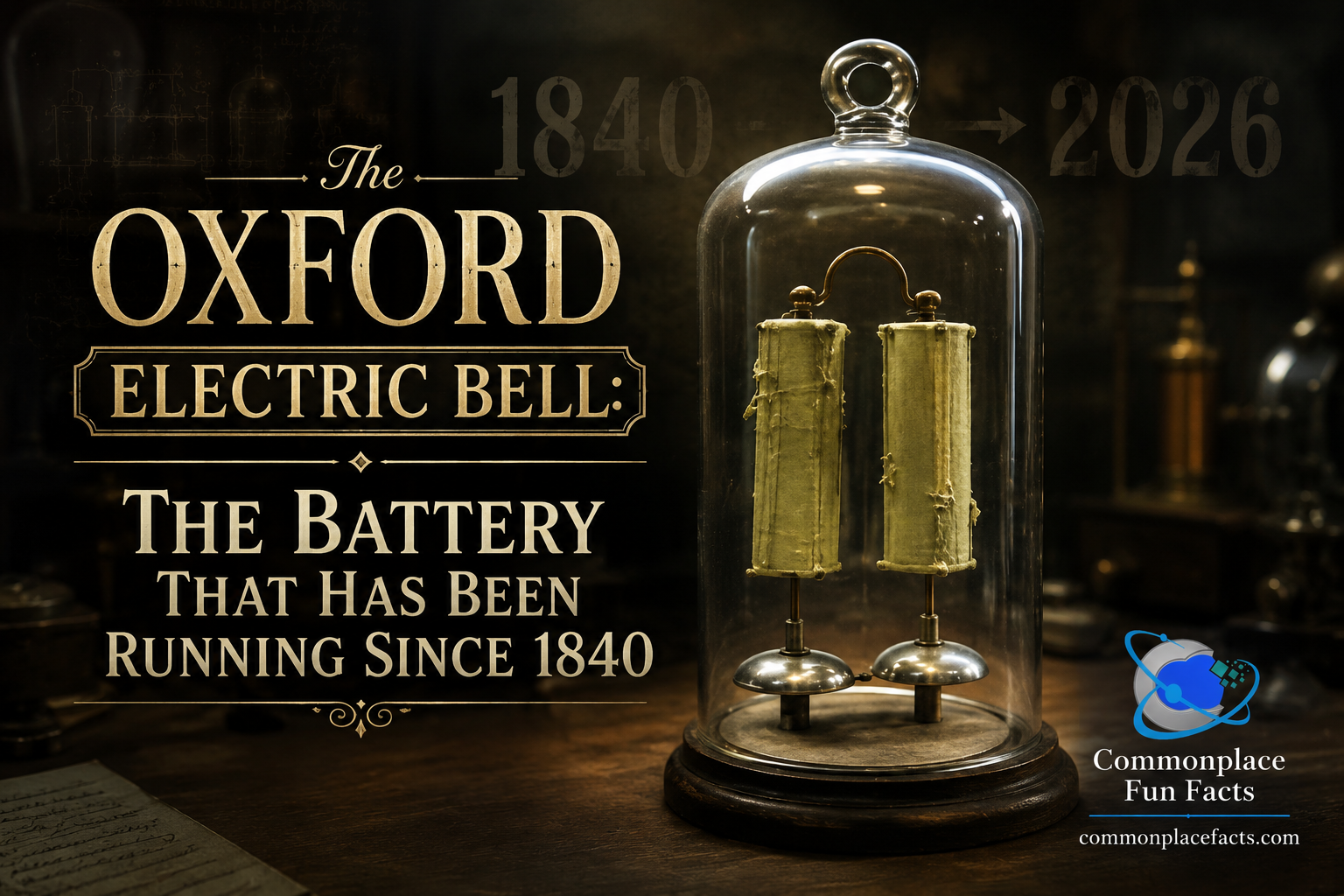

Somewhere inside the University of Oxford, a tiny metal ball is bouncing back and forth between two bells. It has been doing this since 1840.
The apparatus known as the Oxford Electric Bell, or the Clarendon Dry Pile, has been operating almost continuously for more than 185 years using the same pair of batteries.
Oxford estimates that the bell has been struck on the order of 10 billion times.
For comparison, the battery in your smoke detector is currently plotting to begin chirping at 2:47 tomorrow morning.
Contents
A Battery From the Age of Queen Victoria
The Oxford Electric Bell is housed at the University of Oxford’s Clarendon Laboratory. It sits behind glass and looks considerably less dramatic than an electrical device that has outlived generations of the people assigned to keep an eye on it.

The apparatus was purchased by Robert Walker, an Oxford physicist, and carries a handwritten label from him reading “Set up in 1840.” Oxford’s own archives add an intriguing qualification: another note suggests the device itself may have been constructed approximately 15 years earlier.
That means the batteries powering it could conceivably date from the 1820s.
To put that into perspective, when Walker set up the bell, Queen Victoria had been on the British throne for only three years. Charles Dickens had not yet published A Christmas Carol. The American Civil War was more than two decades in the future, the telephone was not even an especially ambitious hallucination, and nobody had yet been forced to explain why a printer suddenly refused to work because it had detected an unauthorized cyan cartridge.
The bell has seen all of those developments come and go while quietly continuing its assigned task.
Or, more accurately, silently continuing it. The apparatus is enclosed in a display cabinet, so although the bells are still being struck, visitors cannot hear them.
How the Oxford Electric Bell Works
The machine is wonderfully simple.
It consists of two small brass bells, each positioned beneath a tall electrical battery known as a dry pile. Suspended between the bells is a tiny metal sphere about four millimeters in diameter.
One dry pile charges one bell positively relative to the other. The little metal ball is attracted toward a bell, touches it, picks up its charge, and is immediately repelled. Now carrying that charge, it is attracted toward the opposite bell.
It crosses the gap, strikes the second bell, transfers charge, reverses its electrical allegiance, and heads back toward the first one. Then it does it again and again, approximately twice every second.
It is the electrical equivalent of giving a toddler two equally interesting objects on opposite sides of a room and somehow persuading him never to get tired.
The secret is not that the batteries contain an unimaginable amount of stored energy. Quite the opposite. Each movement transfers an extraordinarily tiny amount of electrical charge. The system operates at high voltage but minuscule current, allowing the dry piles to surrender their stored energy with almost geological reluctance.
Before Batteries Came in AA, AAA, and “Of Course We Don’t Have That Size”
To understand why the Oxford Electric Bell is so remarkable, it helps to go back to the beginning of the battery.
In 1800, Italian physicist Alessandro Volta announced the invention of the voltaic pile, the first device capable of producing a continuous electrical current. Volta stacked alternating discs of zinc and copper separated by material soaked in an electrolyte such as salt water.
It worked, but it had drawbacks. Wet electrolytes have an irritating tendency to leak, dry out, corrode things, and otherwise behave like liquids despite the inventor’s strong preference that they remain exactly where they were put.
Inventors soon experimented with “dry piles,” which greatly reduced the liquid content while stacking enormous numbers of very thin electrical cells on top of one another.
One important version was developed by Italian priest and physicist Giuseppe Zamboni in the early nineteenth century. His invention became known as the Zamboni pile. This has nothing to do with the machine that circles an ice rink between periods, although “Zamboni pile” does sound very much like what you would have if one of those machines crashed into another one.
There is, disappointingly, no technological connection between the two inventions beyond the surname. A Zamboni pile will not resurface an ice rink, and attaching several thousand tiny electrical cells to a hockey arena is unlikely to improve matters.
On second thought, an electrified hockey arena most definitely would improve matters, at least from the perspective of fans who think the game does not already generate enough spectacles of carnage.
Zamboni piles, meanwhile, could produce remarkably high voltages while supplying very little current. That combination of high voltage and almost no current is exactly what makes devices like the Oxford Electric Bell possible.
It is spectacularly unsuited for starting your car.
It is apparently excellent for moving a four-millimeter metal ball back and forth until everyone who built it has been dead for nearly two centuries.
So What Is Inside the Batteries?
This is where the story gets even better, because despite the Oxford Electric Bell having operated for nearly two centuries, nobody knows for certain what is inside the batteries powering it.
The University of Oxford says the internal construction of the two dry piles remains a matter of conjecture. Based on records of similar devices from the period, Oxford says they are probably composed of alternating layers of metal foil and paper coated with manganese dioxide. The tall columns are also covered with an insulating layer of sulfur.
There is an obvious way to settle the question: open one up and look. Unfortunately, doing so would destroy the very object everyone is trying to understand, which creates one of science’s more delightful dilemmas. Researchers possess a battery that has functioned for almost two centuries and would very much like to know precisely how it was constructed, but the easiest way to answer that question would be to dismantle it.
That would convert the world’s most durable working battery into the world’s most recently disassembled formerly durable battery, which rather defeats the purpose. So for now, the mystery remains sealed inside, and everyone waits for the battery to accomplish something batteries usually manage with considerably less encouragement: die.

The Experiment That Refuses to End
By Oxford’s estimate, the bell has been struck roughly 10 billion times.
That figure sounds preposterous until you remember that the ball oscillates at about two times per second and has had since 1840 to work on the assignment.
It has not necessarily operated every second of every day. Historical accounts describe occasional interruptions, and even a machine this stubborn can be affected by humidity and other environmental conditions. “Almost continuously” is therefore safer than imagining an absolutely uninterrupted 185-year streak.
Still, consider what has happened while that little ball has been bouncing.
The telegraph spread across continents. The telephone arrived. Electric lighting transformed cities. Radio appeared. Television followed. Humans learned to fly, split the atom, landed on the Moon, created the Internet, and developed refrigerators capable of sending notifications to telephones because apparently opening the door and looking inside had become unacceptably burdensome. During all of that, the bell has operated through the reigns of seven British monarchs and the administrations of 38 different U.S. presidents, none of whom came with batteries guaranteed to last nearly as long.
Meanwhile, the Oxford Electric Bell continued doing exactly what it had been doing before anyone knew who Alexander Graham Bell was.
Speaking of which, the history of electrical communication is full of similarly improbable detours. American farmers once discovered that barbed-wire fences could double as telephone lines, while the invention of the telephone itself involved a much messier collection of inventors, patent filings, and suspicious timing than the textbook version suggests.
The nineteenth century was an excellent time to be interested in electricity, provided you were comfortable with the possibility that nobody actually knew what would happen when you connected things together.
No, It Is Not Perpetual Motion
The Oxford Electric Bell occasionally gets described as a perpetual-motion machine.
It is not.
Perpetual motion would require the apparatus to keep operating forever without consuming energy. The Oxford bell absolutely is consuming energy; it is simply doing so with the enthusiasm of someone attacking a payday loan with the minimum required payments.
Every trip of the metal sphere transfers a tiny amount of charge. Every collision loses a little energy. Eventually something must give way.
The batteries may finally exhaust themselves. The clapper could wear out. The insulating material could deteriorate. Some other component may decide that two centuries of faithful service fulfills any reasonable definition of “other duties as assigned.”
Physics insists the bell will stop.
Physics has been waiting since 1840 to be proved right.
The World’s Most Durable Battery
Oxford describes the Clarendon Dry Pile as the “world’s most durable battery,” a designation also associated with Guinness World Records.
The title is deserved, although the comparison is slightly unfair to the batteries cluttering modern junk drawers. The Oxford dry piles are not powering headlights, laptops, power tools, or a child’s toy engineered to make the same three noises until a parent begins quietly plotting revenge against the grandparent who gifted the toy.
The workload of the Oxford dry piles is microscopic.
But longevity is longevity.
A battery does not get extra credit for accomplishing something useful if it dies after six months. The Oxford device was given one exquisitely small job, and it has approached that assignment with a level of workplace commitment that sets the standard for every employee performance review.
The Most Interesting Part May Be What We Don’t Know
The Oxford Electric Bell would already be fascinating if all we knew was that its batteries had survived since the early Victorian period.
The mystery inside them makes the story much better.
Modern battery research is obsessed with chemistry. Engineers know exactly what materials go into lithium-ion cells, how ions travel between electrodes, what causes degradation, how temperature affects lifespan, and roughly how many charge cycles a battery should survive before it begins spending most of the afternoon looking for an electrical outlet.
Oxford has a working battery that predates virtually all of that science, and researchers cannot say with certainty exactly what is inside it.
There is something wonderfully appropriate about that.
The people who constructed the device lived during an era when electricity was shifting from philosophical curiosity to practical technology. They were experimenting with materials, voltage, charge, insulation, and electrochemistry at a time when even the vocabulary of electrical science was still settling into place.
Nearly two centuries later, the product of that experimentation is still sitting behind glass, quietly demonstrating that whoever built it got at least one thing spectacularly right.
Someday, the Bell Will Stop
At some point, the Oxford Electric Bell will strike one of its bells for the final time.
The metal sphere will cross the tiny gap, make contact, and fail to return. After somewhere around 10 billion successful trips, the longest-running game of electrical ping-pong in history will finally be over.
Then researchers may finally be able to take the batteries apart and determine exactly what has kept them going since the nineteenth century.
Until then, science is stuck with an unusual assignment: wait patiently for a battery to die.
Anyone who has ever owned a television remote can appreciate how deeply unnatural that situation is.
You may also enjoy…

The 500-Year Experiment
If you search through the inventory at the University of Edinburgh, you will come across a wooden box with 500 glass vials. Each of the vials is hermetically sealed. Half are shielded with lead. This curious collection is at the heart of an intriguing experiment. If you want to see how the experiment turns out,…

What Are the Longest Words in the English Language? Check Out This Hodgepodge of Hippopotomonstrosesquipidelian Homeruns
What are the longest words in the English language? Find out here!

Stooky Bill: The Creepy Puppet Head That Helped Invent Television
Meet Stooky Bill, the creepy puppet head that helped John Logie Baird invent early television, survive blazing studio lights, and launch one of history’s strangest technological breakthroughs.






Leave a Reply