
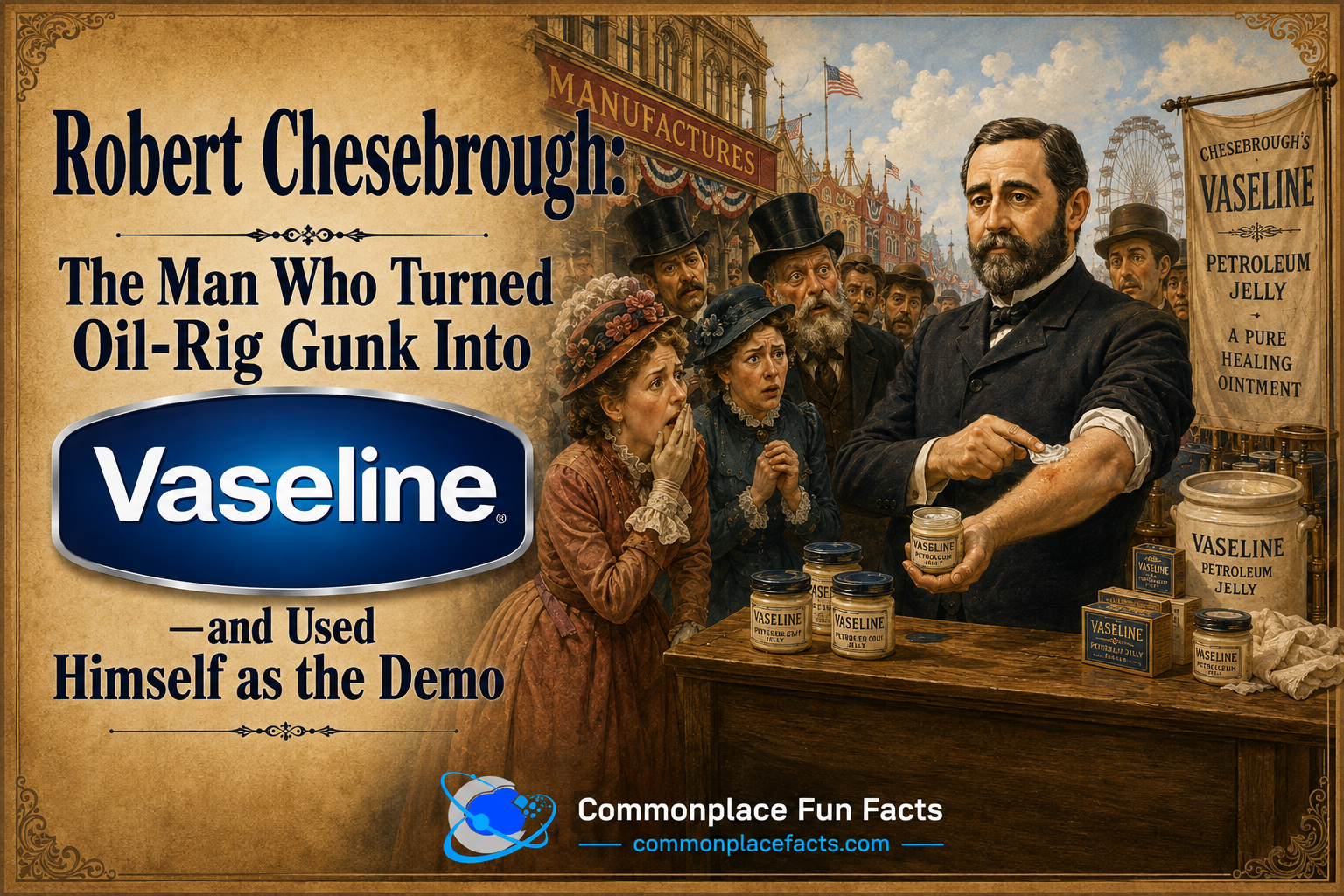

There are many ways to demonstrate confidence in a product. You can offer a money-back guarantee. You can hand out free samples. You can hire a celebrity to look meaningfully into the camera and explain that nine out of ten people who own lab coats agree that your product is terrific.
Robert Chesebrough preferred a more direct approach. When he was trying to convince people that his newly refined petroleum jelly was useful for damaged skin, he demonstrated it by deliberately injuring himself and then applying the product to the wounds.
This is the story of the man who gave us Vaseline and how he was willing to become his own before-and-after photograph.
Contents
Before Petroleum Jelly, There Were Whales
Robert Chesebrough was born in London in 1837 to American parents and grew up in New York. He became a chemist, a profession that would be interesting under just about any circumstances. In the 19th century, however, it meant there were considerably more opportunities to spend your working day around substances that would now cause an occupational-safety inspector to develop a facial twitch.

His early work involved refining oil derived from sperm whales for use in lamps. This was perfectly respectable employment until the American petroleum industry suddenly began making the future look considerably less whale-shaped.
In 1859, Edwin Drake’s famous oil well at Titusville, Pennsylvania, helped launch an oil boom. Chesebrough recognized that petroleum was not merely another product competing with the industry in which he worked. It was quite possibly the thing that was going to make his particular corner of that industry unnecessary.
He could have complained that young people no longer appreciated whale products like their parents and grandparents did. Instead, he went to Pennsylvania to investigate petroleum for himself.
The Most Promising Thing at the Oil Field Was the Stuff Nobody Wanted
Oil drilling was a messy business. One of the messy annoyances encountered by workers was a thick, waxy residue that accumulated on drilling and pumping equipment. It became known as rod wax, which sounds considerably more respectable than “sticky petroleum sludge we have to scrape off the machinery.”
The substance was mostly a nuisance, but Chesebrough noticed something interesting. Oil-field workers were putting the residue on cuts, burns, and irritated skin. They may not have stopped to contemplate the science behind their actions. What was pretty evident, however, was that the annoying goo clogging their equipment was considerably less annoying when applied to themselves.
This caught Chesebrough’s attention. He took samples back to his laboratory and began experimenting with ways to purify the petroleum residue.
It is one of those moments that makes the history of invention look deceptively simple in retrospect. Everyone else saw filthy industrial buildup that needed to be scraped away. Chesebrough saw something that might belong in the medicine cabinet.
Admittedly, “Perhaps we should rub the oil-rig waste on people” does not sound like an especially promising opening sentence for a business plan. Conventional business wisdom, however, did not account for Chesebrough’s foresight and persistence.
It was the same sort of instinct that led Margaret Knight to look at an awkward paper-bag manufacturing process and decide there had to be a better way. History’s great inventors and innovators have a gift for noticing things the rest of us have already decided to tolerate.
Turning Rod Wax Into Something You Might Actually Put on Your Face
Chesebrough spent years refining the material. His process involved petroleum residue and filtration through bone black, a form of charcoal made from animal bones. This was Victorian chemistry, so naturally the story could not progress without adding at least one ingredient that sounds worse than the original substance.

Chesebrough obtained patents related to his purification methods during the 1860s. Then, on June 4, 1872, the U.S. Patent Office issued him Patent No. 127,568 for what he described as a new product made from petroleum.
The patent contains one especially important sentence: Chesebrough declared that he had invented a petroleum product “which I have named Vaseline.”
The name is generally said to combine the German Wasser, meaning water, with the Greek elaion, meaning oil. This gives Vaseline the distinction of being not only petroleum residue subjected to an elaborate purification process, but petroleum residue with a multilingual marketing department.
The Smithsonian’s National Museum of American History places Chesebrough’s development of the substance around 1870, while the modern Vaseline company says he began distributing his purified petroleum jelly that year. The dates sometimes get compressed in retellings, but the basic chronology is clear: Chesebrough encountered the petroleum residue after going to Pennsylvania, spent years developing purification methods, began marketing his product around 1870, and secured the definitive Vaseline patent in 1872.
There Was Just One Small Problem: Convincing People to Buy It
Inventing something is only half the battle. The other half is persuading consumers that they need a jar of the substance you discovered growing on oil-field machinery. King Gillette faced much the same problem a few decades later when he had to convince people that buying a razor blade specifically designed to be thrown away was a perfectly sensible use of their money.
To convince the public, Chesebrough became an enthusiastic traveling salesman. According to Vaseline’s company history, he toured New York State in a horse-drawn carriage demonstrating his product. By 1874, the company says sales had reached more than 1,400 tins each day.
You may be picturing Chesebrough standing next to a covered wagon, peddling samples with a carnival barker’s enthusiasm. The real story is much more impressive — and more than a little disturbing.
Chesebrough’s preferred sales technique appears to have been decidedly hands-on. By this, we mean that he demonstrated the product on his own injuries. Since accidental injuries generally can’t be counted on to arrive on schedule, he took the accidental part out of the equation. Accounts commonly say he burned or otherwise damaged his skin, applied petroleum jelly, and showed audiences scars from previous wounds that he claimed had healed with its help. Some later versions get very specific, saying he used an open flame or acid.
The broad story of Chesebrough using self-inflicted injuries as part of his sales demonstrations is well established enough to appear in histories of dermatology. The exact stage directions deserve a little more caution. There is a substantial difference between “he injured himself to demonstrate the product” and “here is precisely which corrosive substance he poured on which body part on Tuesday afternoon,” and history has a habit of making good stories better every time they are retold.
Still, the underlying sales philosophy seems to have been remarkably straightforward: You don’t believe this works? Fine. Give me a minute to injure myself.
To Be Fair, Petroleum Jelly Really Is Useful
Chesebrough’s original claims were made in an era when the phrase “patent medicine” could cover everything from genuinely useful preparations to bottles of flavored alcohol whose principal medical benefit was making patients briefly less concerned about being sick.

Petroleum jelly, however, turned out to have genuine staying power. Rather than functioning as some mysterious Victorian cure-all, petrolatum works primarily as an occlusive barrier. It helps reduce moisture loss from the skin and can keep minor wounds moist while they heal.
Chesebrough was also helping establish what would become a remarkably crowded category of medicine-cabinet necessities. A few decades later, Earle Dickson would create another wound-care product to help his accident-prone wife. It became so successful that its brand name became part of everyday vocabulary: the Band-Aid.
Chesebrough himself promoted Vaseline for several purposes. Interestingly, his 1872 patent was not limited to skin care. He also suggested the substance could be used on leather, machinery, hair, and chapped hands. Even the inventor looked at his creation and thought, “I have no idea where the upper limit is here.”
The product took off. The Vaseline name became so familiar that in some countries and languages it is commonly used informally as a generic term for petroleum jelly. Something that began as residue associated with oil equipment had worked its way into households around the world.
Then Chesebrough Took Product Loyalty in an Unexpected Direction
It would be easy to assume that deliberately injuring himself during demonstrations represented the outer boundary of Robert Chesebrough’s confidence in Vaseline.
It apparently did not.
A history published in the British Journal of Dermatology reports that Chesebrough believed in Vaseline so strongly that he ate a spoonful of it every morning. The anecdote has been repeated in numerous accounts of his life, including reports that Chesebrough credited the practice with contributing to his longevity.
He lived to the age of 96, dying in 1933.
Before anyone concludes that we have therefore identified the secret to living past 90, this is where correlation would like everyone to calm down. Chesebrough’s longevity does not establish that eating petroleum jelly extended his life, and Vaseline sold today is labeled for external use. An inventor’s personal enthusiasm should not be confused with medical advice, particularly when that inventor’s preferred marketing technique included voluntarily damaging his own skin.
Strange as eating petroleum jelly sounds, Chesebrough was not even history’s most alarming practitioner of the daily-spoonful school of preventive medicine. A few centuries earlier, Martin Luther reportedly swallowed a spoonful of his own feces every day in the belief that it had curative properties. By comparison, Chesebrough’s breakfast petroleum jelly suddenly seems almost reasonable. Almost.
There is also a still stranger story associated with Chesebrough. Later accounts say that when he developed pleurisy in middle age, he instructed a nurse to cover his entire body with Vaseline and subsequently recovered. The tale has been repeated often, including in medical histories, but evidence that Vaseline had anything whatsoever to do with his recovery is another matter entirely.
At some point, belief in your product stops being brand loyalty and starts becoming a lifestyle.
From Industrial Nuisance to Bathroom Cabinet
The best part of Chesebrough’s story is not really that he injured himself in public or allegedly swallowed petroleum jelly every morning, although those details certainly do their share of the heavy lifting.

It is that his career was threatened by a technological change he could not control. Petroleum was helping displace the whale-oil business in which he had expertise. Chesebrough could have remained attached to the industry he knew and watched the world move past him. Instead, he went to see what the new industry might offer.
When he arrived, the thing that caught his attention was not the petroleum everyone was excited about. It was the waste product everyone else was scraping off the equipment.
He took it home, experimented with it, purified it, patented it, marketed it, and built a business around it. A century and a half later, petroleum jelly remains one of the most recognizable products in the world.
There is probably an inspirational business lesson in there somewhere about adaptability, observation, and recognizing value where other people see waste.
There is also another lesson: if your business plan reaches the sentence “Now I will set part of myself on fire to demonstrate customer confidence,” it may be worth asking whether the marketing department has any other ideas first.
Vaseline® is a registered trademark of Conopco, Inc., d/b/a Unilever. The use of the Vaseline name and logo in this article is for identification, historical commentary, and informational purposes only and does not imply affiliation with or endorsement by Unilever.
You may also enjoy…

The Accidental Genius Behind Band-Aids: How One Clumsy Wife Helped Heal the World
Discover the heartwarming origin of Band-Aids—how a loving husband’s solution for his accident-prone wife became one of the most iconic medical inventions in history.

James Dewar, the Thermos, and the Invention He Gave Away
James Dewar invented the vacuum flask that became the thermos—then never patented it. A story of science, trademarks, and missed fortunes.

The David Buick Story: Toilets, Bathtubs, Automobiles, and Obscurity
David Buick, born in 1854 in Scotland, contributed significantly to plumbing and the automotive industry, creating the overhead valve engine. Despite founding Buick Auto Vim, he faced business failures, losing control to William Durant. Ultimately, Buick died in obscurity in 1929, leaving behind a legacy overshadowed by his inventions.




Leave a Reply