
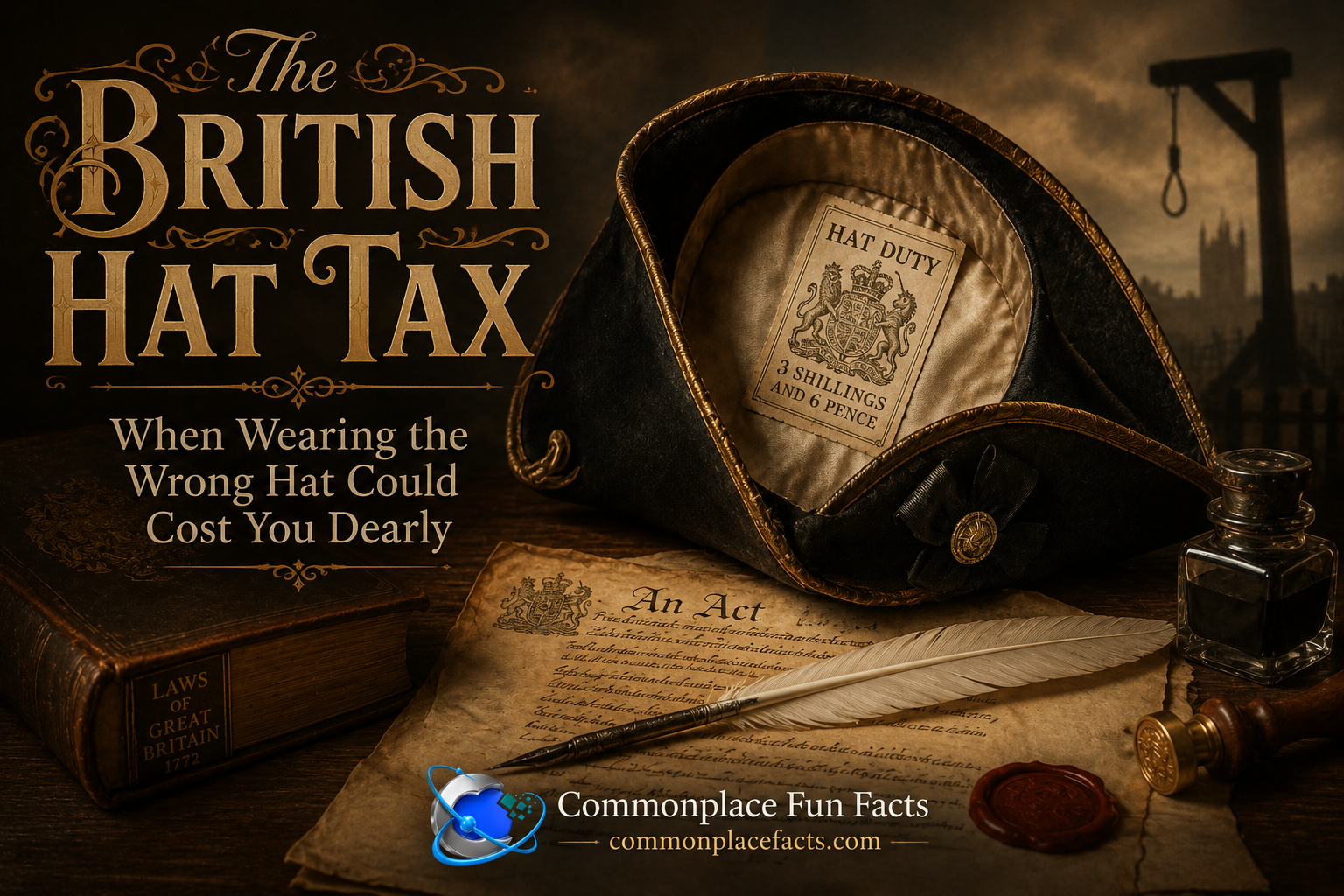

If there is one area in which you can count on unequaled creativity, it is whenever a government confronts the question, “What else can we tax?”
Windows? Certainly. Bricks? Why not? Playing cards, gloves, perfume, hair powder, wallpaper, dogs, clocks, and even the commercial collection of urine have all attracted the attention of tax collectors over the centuries. That last one deserves an explanation of its own, and trust us: we will definitely return to the Roman urine tax in a future article. For now, it is enough to know that governments have never been especially shy about identifying new revenue streams.
In 1784, the British government turned its attention upward and noticed that a large percentage of the population was walking around with taxable objects sitting directly on their heads.
Thus was born the British Hat Tax.
The idea was not quite as ridiculous as it sounds. The tax was structured so that inexpensive hats attracted a small duty while expensive hats were taxed more heavily. Hat sellers had to purchase annual licenses, display government-mandated signs, and make sure every taxable hat carried proof that the duty had been paid.
Failure to follow the rules could result in enormous fines. Forging the government stamp was considerably worse.
That could get you sentenced to death.
Contents
William Pitt Looks at Britain and Sees a Nation of Taxable Heads
The Hat Tax appeared during the first administration of William Pitt the Younger, who became prime minister in 1783 at the age of 24. This is an age at which many people are still trying to figure out whether they can afford to move out of their parents’ house. Pitt was trying to figure out how to finance Great Britain.

Britain’s finances were not in terrific shape. The recently concluded American Revolutionary War had been expensive, the national debt was substantial, and the government needed dependable sources of revenue. Pitt’s administration became associated with an impressive assortment of consumption taxes, many of which had the advantage of allowing the government to collect money without asking citizens directly how much they earned.
A hat offered an intriguing alternative.
The logic was essentially an early form of progressive consumption taxation. A wealthy gentleman might own several fashionable and expensive hats. A poorer man might own one inexpensive hat and wear it until its retirement became less a fashion decision than a humanitarian necessity. Tax the hats according to their value, and wealthier consumers would tend to pay more.
There was another advantage: hats were difficult to conceal while being used. The government may not have had an easy way of knowing what was in your bank account or stuffed into your mattress, but if you were walking down the Strand wearing an expensive beaver hat, you had quite literally placed evidence of discretionary spending on top of your head.
The British Hat Tax Becomes Law
Parliament passed the Hat Duties, etc. Act 1784 on August 19, 1784. Its formal title was considerably longer, because Parliament had not yet discovered the marketing advantages of naming legislation things like the “Stop Hiding Untaxed Hats Act.”
The law imposed duties on licenses for people selling hats at retail and separate duties on the hats themselves. It took effect on October 1, 1784, and applied to several kinds of headwear, including felt, wool, stuff, beaver, leather, and japanned hats.
Retailers in London, Westminster, Southwark, and the area covered by the Bills of Mortality had to pay an annual license duty of 40 shillings, or £2. Retailers elsewhere in Great Britain paid five shillings.
This was not an optional business registration that could be addressed whenever someone eventually got around to the paperwork. Selling taxable hats without a license exposed the seller to a £50 penalty.
For perspective, that was 25 times the annual license duty charged to a London retailer. Georgian regulators apparently believed that the best way to encourage voluntary compliance was to make the alternative financially memorable.
The More Expensive the Hat, the More Expensive the Tax
The duty on the hat itself followed four price bands, and as a percentage of the hat’s price or value it could be surprisingly substantial. A hat valued at four shillings carried a threepence tax, equal to 6.25% of its value—and the percentage was even higher on cheaper hats. Hats valued at more than four but no more than seven shillings were taxed sixpence, amounting to nearly 12.5% at the bottom of the range and 7.1% at seven shillings.
Hats valued at more than seven shillings and up to 12 shillings carried a one-shilling duty, or nearly 14.3% at the bottom of the range, falling to 8.3% at 12 shillings. Anything valued at more than 12 shillings was assessed two shillings, meaning the tax approached 16.7% at the bottom of the bracket and declined as the value of the hat increased. Georgian Britain was not merely taxing hats; depending on where your purchase landed in the brackets, the government could be claiming something approaching one-sixth of the value of your new headgear.
This made the tax at least superficially progressive. Buy cheap headgear and the Treasury took a small bite. Buy something sufficiently magnificent to announce that your hat had opinions about the French, and the government wanted considerably more.
The Stamp Commissioners administered the system. This was the same general machinery Britain used for a growing collection of taxes documented through stamped paper, tickets, and other official marks. The hat on your head was therefore not merely an article of clothing. It had become a very small tax return with a brim.
Every Hat Shop Had to Announce Itself to the Taxman
Parliament did not stop at requiring licenses. Licensed retailers had to place the words Dealer in Hats by Retail in large, legible characters over the door or somewhere visible on the front of the shop or warehouse.

This was wonderfully efficient from the government’s perspective. Rather than requiring revenue officers to investigate which businesses might secretly be selling hats, Parliament instructed hat sellers to install what amounted to a sign saying, “Taxable activity occurring here.”
The penalties were once again designed to discourage creative interpretation. A licensed dealer who sold hats without displaying the required notice could be fined 40 shillings for each hat sold. Someone who displayed the words identifying himself as a hat dealer without actually having a license could be fined £50.
The law therefore produced the unusual situation in which improperly advertising yourself as a hat seller and improperly failing to advertise yourself as a hat seller were both expensive mistakes. There was, however, a narrow path between them called “doing exactly what the government said.”
The Government Wanted Proof Inside the Hat
Collecting the duty required some way of distinguishing a properly taxed hat from the sort of dangerous black-market headwear that threatened the fiscal stability of the kingdom.

The original 1784 system used stamped paper tickets associated with the hats. Parliament revisited the system in 1796 with the wonderfully direct Duty on Hats Act, formally described as “An Act for the better Collection of the Duty on Hats.” Under the revised system, the official stamp or mark was applied to the lining itself.
That meant a revenue officer did not need to interrogate you about where you purchased your hat. In principle, he could look inside it.
The arrangement sounds peculiar today, but revenue stamps, stamped tickets, and official marks were already familiar tools of British taxation long before postage stamps became common. Hats, gloves, perfume, patent medicines, playing cards, and other products could all carry evidence that the government had received its share.
The Penny Black, Britain’s famous first adhesive postage stamp, would not appear until 1840. The government had been attaching or impressing evidence of taxes on consumer goods for decades before the same basic idea became familiar through postage.
Naturally, People Started Looking for Loopholes
A recurring lesson of tax history is that whenever a legislature carefully defines something subject to tax, someone immediately begins studying the definition with the concentrated attention of a lawyer who has just been told there is money involved.

The Hat Tax was no exception. Caps and other forms of headgear offered opportunities to avoid a law directed at specified kinds of hats. Later accounts describe manufacturers changing the names or classifications of their products to keep them outside the taxable definition, which eventually prompted Parliament to broaden the rules.
We do not have to rely entirely on later stories to know that tax avoidance through alternative headgear was part of contemporary culture. In 1797, the great political caricaturist James Gillray published Le Bonnet-Rouge;—or—John Bull Evading the Hat Tax.
Gillray showed John Bull, the personification of Britain, standing outside a shop associated with Pitt while wearing a red cap instead of a conventional taxed hat. The joke operated on several levels. The cap offered an escape from Pitt’s tax, but its revolutionary red color also evoked the French liberty cap at a time when Britain was at war with revolutionary France.
In other words, excessive taxation had driven John Bull to such desperate measures that he was beginning to accessorize like the enemy.
This Was Hardly Britain’s First Strange Tax
The Hat Tax becomes less surprising when viewed alongside Britain’s broader enthusiasm for finding taxable objects. The government imposed duties on such things as gloves, hair powder, wallpaper, bricks, windows, clocks, watches, playing cards, and patent medicines. If an 18th-century Briton owned something, there was a reasonable chance someone at the Treasury had already asked whether a stamp could be attached to it.
Britain was not alone. Russia’s Peter the Great famously imposed a tax on beards, complete with tokens proving that a man had paid for the legal privilege of remaining hairy. Compared with that example, a hat was practically begging for paperwork.
Then We Get to John Collins
Tax avoidance is one thing. Counterfeiting the government’s tax stamps was another matter altogether.
By the 1790s, Britain possessed an enormous collection of capital offenses. The system later became known as the “Bloody Code,” under which crimes against property and government revenue could carry penalties wildly disproportionate to what a modern observer might expect.

Forging hat-duty stamps fell into that dangerous category.
We know this was not merely a theoretical threat because of a laborer named John Collins. The reported case of The King v. John Collins records that Collins was tried at the Old Bailey during the September 1798 session for forging hat stamps in violation of the 1796 statute.
The indictment alleged that on July 11 he had forged, or arranged the forging of, a government mark intended to resemble the two-shilling stamp used for the most expensive class of taxable hats. The prosecution alleged that he did so with the intention of defrauding the Crown.
That is an impressive amount of legal machinery to bring down on a man over a mark inside somebody’s hat.
Collins was convicted and sentenced to death. He was executed on January 30, 1799. Some modern accounts give 1798 as the year of his execution, apparently confusing it with the year of his trial and conviction. Whatever comedy can be extracted from the idea of a government taxing hats ends rather abruptly here. Georgian Britain was perfectly capable of treating an offense against the revenue as a matter of life and death.
There is a certain grim escalation to the story. The government began with the proposition that gentlemen with expensive hats should contribute a little more to the Treasury. By 1798, a man could find himself facing the gallows because the stamp inside one of those hats was counterfeit.
Why Was Forging a Hat Stamp Treated So Seriously?
It helps to remember that the offense was not viewed simply as “avoiding a few pennies of hat tax.” A forged revenue stamp attacked the government’s entire system for collecting money. If counterfeit stamps could circulate freely, every merchant could make untaxed goods appear legitimate and the Crown’s carefully designed revenue system would become an elaborate decorative exercise.
The same logic explains why governments have traditionally punished counterfeiting currency, official seals, tax stamps, and similar instruments more seriously than the face value of any one fraudulent item might suggest. The offense threatened confidence in the mechanism itself.
The Georgian response to that problem was characteristically Georgian: protect confidence in the mechanism by threatening to kill anyone who copied it.
The Hat Tax Finally Goes Out of Fashion
The Hat Tax survived for 27 years. During that time Britain lost neither its fondness for hats nor its fondness for taxation, although the two eventually agreed to pursue separate interests.
In 1811, Parliament passed legislation bluntly titled An Act for repealing the Hat Duty in Great Britain. The repeal received royal assent on June 15 of that year. Separate hat duties in Ireland were repealed at approximately the same time.
The tax was gone, but the larger experiment in taxing everyday consumption was very much alive. Duties on windows, bricks, paper, soap, glass, and assorted other necessities and luxuries continued well into the 19th century.
Some produced predictable behavioral changes. Window taxes encouraged people to brick up windows. Brick taxes encouraged manufacturers to make larger bricks. Wallpaper taxes encouraged decorators to hang plain paper and add designs afterward. The basic pattern was remarkably consistent: Parliament defined the taxable thing, and British ingenuity immediately began looking for the nearest thing that was technically something else.
The Hat Tax Was Absurd—But Not Entirely Irrational
It is easy to look back at the British Hat Tax as proof that Georgian lawmakers had inhaled too much mercury while visiting the local milliner. In fairness, there was a coherent idea behind it.
Income was difficult for the government to measure directly. Visible consumption was much easier. Tax the things associated with wealth—expensive hats, carriages, servants, horses, large houses—and the burden would fall disproportionately on people who could afford them.
Modern governments still use consumption taxes. They simply tend not to require taxpayers to carry proof of payment inside their clothing.
The truly strange part of the Hat Tax is therefore not that Britain taxed hats. Governments have always taxed things people buy, own, make, sell, inherit, import, export, consume, and occasionally excrete. The remarkable part is the bureaucratic world that grew around the tax: annual hat-dealer licenses, mandatory storefront wording, graduated duties, official stamps, inspectors, tax-avoidance headgear, political cartoons, counterfeiters, and ultimately a capital prosecution.
All because somebody in 1784 looked at a gentleman’s hat and thought, “There is still some untaxed money under there.”
You may also enjoy…

The Russian Beard Preservation Law, Otherwise Known as the Russkaya Pravda
Facial hair used to be important in Russia. No, you don’t understand. It was REALLY important! We know this because of the Russkaya Pravda (Rus’ Justice or Rus’ Truth), one of the primary sources of Old Russian Law. It dates back to the 12th century and was designed to protect Russian beards and mustaches. OK,…

Weird Tax Laws: Quirks and Madness at the IRS
The IRS has diverse tax laws, including regulations on kidnapping and bribes. Payments for ransom may affect dependent claims, and all income types, including illegal ones, are taxable. Despite its outdated systems, the IRS ensures compliance and offers exceptions for penalties on late returns, while adapting to modern needs remains challenging.

The Great Hedge of India: When Britain Built a Living Wall to Stop Salt Smugglers
Discover the Great Hedge of India, the massive 19th-century barrier Britain built to stop salt smuggling and enforce colonial taxes.






Leave a Reply