
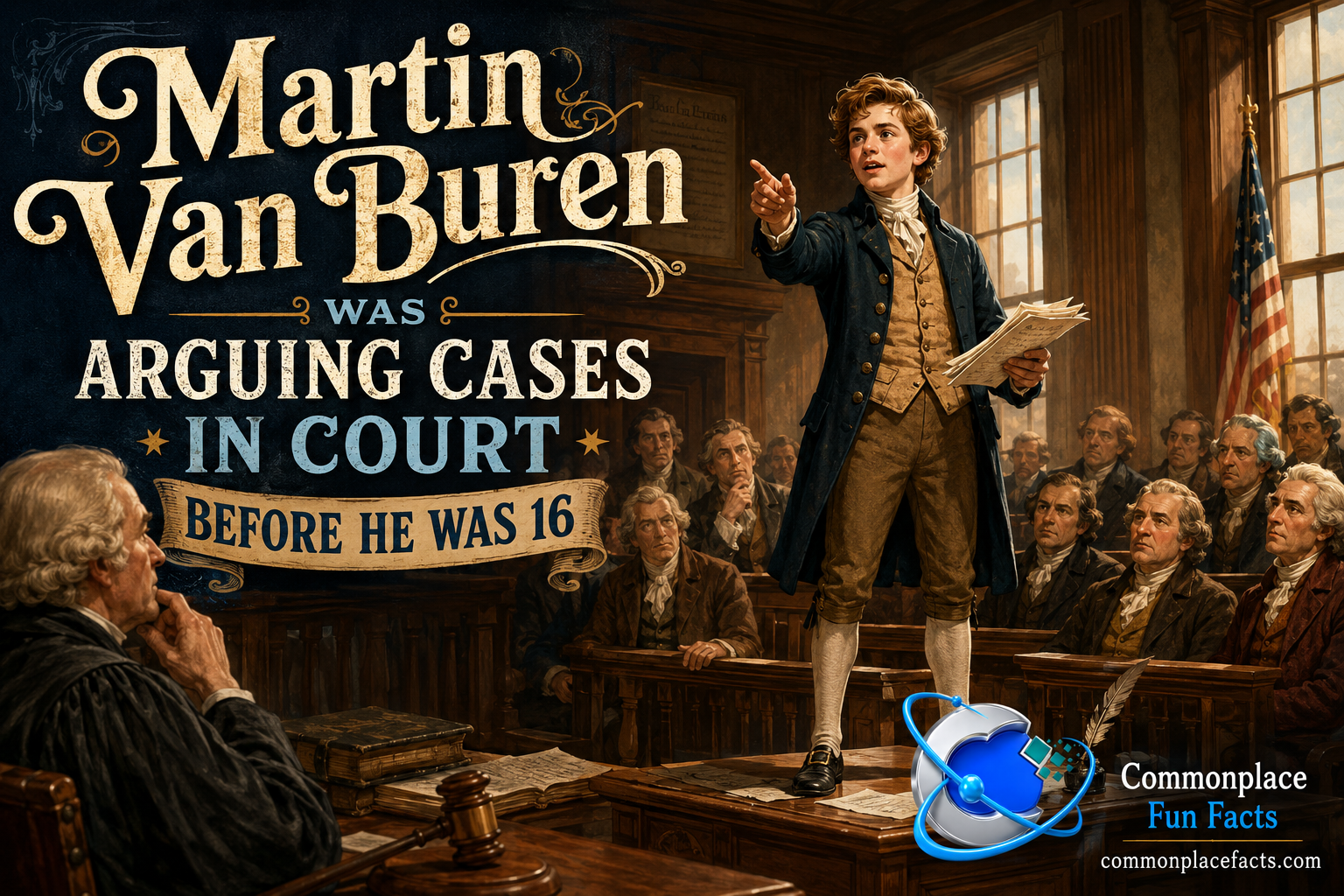

At fourteen years old, most people are still trying to figure out how to survive algebra, acne, and being seen in public with their parents.
Martin Van Buren was studying law.
Within a year or two, according to an account published while he was still alive, the future eighth president of the United States was already appearing in court, handling cases against grown lawyers, and addressing juries despite being so short that somebody apparently had to find him a piece of furniture to stand on.
It was an unusually early start to a career that would eventually take Van Buren from a tiny New York law office to the White House. It also produced one of the more charming stories from the childhood of an American president — although, as is so often the case with charming historical stories, the details got considerably more charming as the years went by.
Contents
A Fourteen-Year-Old Law Student
Martin Van Buren was born on December 5, 1782, in Kinderhook, New York, a predominantly Dutch community about 20 miles south of Albany. Dutch was his first language, making him the only U.S. president for whom English was not his native tongue.

His family was not wealthy. His father, Abraham Van Buren, was a farmer and tavern keeper, and young Martin’s formal education consisted primarily of village schools and a short period at Kinderhook Academy. College was not part of the plan.
Instead, in 1796, at the age of fourteen, Van Buren went to work in the law office of Kinderhook attorney Francis Sylvester.
Calling him a “law student” may give the modern reader the wrong picture. There was no undergraduate degree, LSAT, three years of law school, crushing student debt, bar-review course, sadistic bullying by law professors, and the prerequisite forfeiture of one’s eternal soul in exchange for a law license.
In late eighteenth-century New York, aspiring lawyers commonly learned the profession by reading law as clerks or apprentices under established attorneys. Because Van Buren had not attended college, his apprenticeship would last seven years.
Despite his tender age of fourteen, young Martin’s duties likely went well beyond sitting quietly in a leather chair contemplating Blackstone. Edward M. Shepard’s 1888 biography cautiously inferred as much, writing that it was “safe to say” Van Buren swept the office, lit fires, ran errands, served legal papers, and copied pleadings while learning the intricacies of common law and chancery practice.
In other words, the future president began his legal career somewhere between associate attorney and office boy.
Teenagers Really Could Appear in Court
The remarkable part is that Van Buren did not remain confined to copying documents for very long.

William M. Holland’s The Life and Political Opinions of Martin Van Buren, published in 1835, describes legal practice in rural New York as considerably more accommodating to apprentice lawyers than today’s courts would be.
Cases before local justices of the peace, Holland explained, were frequently entrusted to law students. Van Buren showed enough ability as a speaker and legal thinker that he soon found himself handling these cases regularly.
That means that while today’s fourteen- or fifteen-year-old might be trusted with the family lawn mower after demonstrating sufficient maturity, Martin Van Buren was being trusted with somebody else’s lawsuit.
Holland wrote that the young apprentice frequently encountered opposing attorneys who were older, experienced, and established members of the profession.
Then came the case that people apparently remembered decades later.
The Future President Takes a Case
According to Holland, Van Buren was “not yet sixteen years of age” when he was given responsibility for a case of considerable importance.
The opposing lawyer was no adolescent apprentice. Holland described him as an attorney already in full practice who would later hold several important public offices.

Unfortunately, Holland did not identify either the lawyer or the case.
That is irritating for those of us who would like to pull the court file, identify the parties, determine exactly what happened, and generally refuse to allow a perfectly good anecdote to enjoy itself without adult supervision.
Nevertheless, Holland’s account is important because it appeared in 1835. Van Buren was then vice president of the United States, very much alive, and only about forty years removed from the events being described.
According to the story, young Van Buren successfully managed the case against his older opponent and eventually addressed the jury.
There was, however, a logistical difficulty.
Martin Van Buren was short.
Really short.
Even as an adult, he stood only about five feet six inches tall. As a boy not yet sixteen, apparently, there was a serious possibility that the jury would hear a teenage lawyer’s eloquent legal argument emanating from somewhere behind the furniture.
So, Holland wrote, Van Buren was placed on a table while delivering his argument to the jury.
He won the case.
That is the earliest version of the story we have been able to locate, and it is already pretty good. A future president, not yet sixteen, standing on a table and successfully arguing a case against an experienced attorney does not particularly require embellishment.
Naturally, later biographers embellished it anyway.
“There, Mat, Beat Your Master”
More than fifty years later, Edward M. Shepard told a considerably more colorful version in his biography Martin Van Buren.
By Shepard’s telling, the opposing attorney was no longer an unidentified lawyer. It was Van Buren’s own mentor, Francis Sylvester.
The table had also become a bench.
And the judge had acquired dialogue.
After putting the diminutive young lawyer where the jury could actually see him, the justice supposedly announced: “There, Mat, beat your master.”
And according to the story, that is exactly what he did.
It is magnificent. It is compact. It has a setup, a visual gag, a memorable quotation, and a future president defeating his own teacher before he was old enough to shave with any serious sense of purpose.
It is also almost certainly not something we should quote as though a court reporter wrote it down.
How a Good Story Got Better
The difference between the 1835 and 1888 accounts provides a nice little demonstration of how historical anecdotes evolve.
Holland’s relatively early version says Van Buren was not yet sixteen, argued an important case against an experienced lawyer, stood on a table because of his small stature, and won.
It does not say the opponent was Sylvester. It does not mention a bench. It does not contain the “beat your master” line.
Half a century later, all three details appear.
Adrian H. Joline, a lawyer and collector who examined Van Buren’s legal career in the early twentieth century, noticed exactly this problem. In his 1907 book The Autograph Hunter and Other Papers, Joline compared Holland’s account with Shepard’s expanded version and openly expressed doubt that a teenage apprentice would really have been allowed to try an important case against his own employer.
His skepticism is well taken.
That does not mean the whole story was invented. In fact, the basic idea that Van Buren handled cases as a teenager is quite plausible. Holland specifically says that law students commonly managed cases before justices of the peace and that Van Buren was employed in such trials from very early in his apprenticeship.
What we appear to have, therefore, is a solid historical core surrounded by an increasingly decorative layer of biography.
Van Buren really did begin studying law at fourteen. He really did handle legal matters while still a teenager. A biography published in 1835 says that before his sixteenth birthday he successfully handled a significant case against an established attorney and had to stand on a table while addressing the jury.
The part where the judge puts him on a bench and commands, “There, Mat, beat your master” comes later.
It might have happened.
It also might have been the nineteenth-century biographical equivalent of adding a car chase because the second act was dragging.
From the Table to the White House
Whatever happened in that particular courtroom, there is little doubt that Van Buren possessed unusual political and legal ability at an absurdly early age.

While still serving his apprenticeship, he became deeply involved in local politics. In 1800, when he was only seventeen, he actively supported Thomas Jefferson and the Democratic-Republicans in the presidential campaign. Near the end of his legal training, Van Buren went to New York City to complete his apprenticeship in the office of prominent Republican attorney William P. Van Ness, exposing him to a much larger legal and political world.
Van Buren was admitted to practice in New York in November 1803, less than a month before his twenty-first birthday. He returned to Kinderhook, established a successful practice, and began the steady political climb that would eventually make him a New York state senator, state attorney general, United States senator, governor of New York, secretary of state, vice president, and finally president of the United States.
Van Buren’s teenage courtroom career is just one of the many presidential facts that sound suspiciously invented but aren’t. For one particularly colorful example, see this article about a president who served as a hangman before moving into the White House.
He also became one of the most sophisticated political organizers of the nineteenth century, earning nicknames such as “The Little Magician” for his ability to assemble coalitions, manage competing interests, and perform the sort of political maneuvering that everyone condemns loudly until their own side becomes good at it.
His presidency, from 1837 to 1841, would prove considerably less triumphant than his youthful courtroom appearance. The Panic of 1837 erupted almost immediately after he took office, the economy collapsed, and voters eventually responded with that traditional American expression of economic analysis: they elected somebody else.
But long before all of that, there was a very small boy in a very small New York town learning how to persuade people.
The Teenager Who Learned to Make His Case
There is something wonderfully appropriate about Van Buren’s first reputation being made through persuasion.
He was never a military hero like George Washington, Andrew Jackson, or William Henry Harrison. He did not possess the imposing physical presence of many nineteenth-century politicians. He was short, came from modest circumstances, spoke Dutch before he spoke English, never attended college, and began his professional life as a teenage apprentice in a country lawyer’s office.
What he could do was understand people, construct arguments, and persuade an audience.
Those skills eventually carried him astonishingly far.
We cannot say with confidence that teenage Martin Van Buren climbed onto a courtroom bench and defeated his own legal mentor while a delighted judge cried, “There, Mat, beat your master.” The earliest source doesn’t say that.
We can say something almost as remarkable.
At fourteen, Van Buren entered a law office. Before he was sixteen, according to an account published during his lifetime, he was already handling cases against experienced lawyers and addressing juries. In the case described by Holland, he was said to be so small that he had to stand on a table to address the jury.
And he won.
Forty years later, nobody needed to find him a table.
They gave him the White House.
You may also enjoy…

50 Fun Facts About Presidents and Politicians That Sound Made Up (But Aren’t)
Discover 50 surprising fun facts about presidents and politicians that sound unbelievable—but are completely true. From duels to pet raccoons, history is stranger than fiction.

Grover Cleveland: The President Who Personally Hanged Two Men
Before entering the White House, Grover Cleveland served as a New York sheriff and personally hanged two convicted murderers.

The Day President Lincoln Became a Firefighter
The job of President of the United States can often be described as one of constantly putting out fires. Of course, we expect that to be a figurative description. For one President, however, that was literally the truth. On February 10, 1864 Sergeant Smith Stimmel was standing guard for President Abraham Lincoln at the White…






Leave a Reply