

Some inventions solve problems that have plagued humanity for centuries. Others look at a perfectly manageable movement of the human arm and ask, “Could we perhaps get some gears involved?”
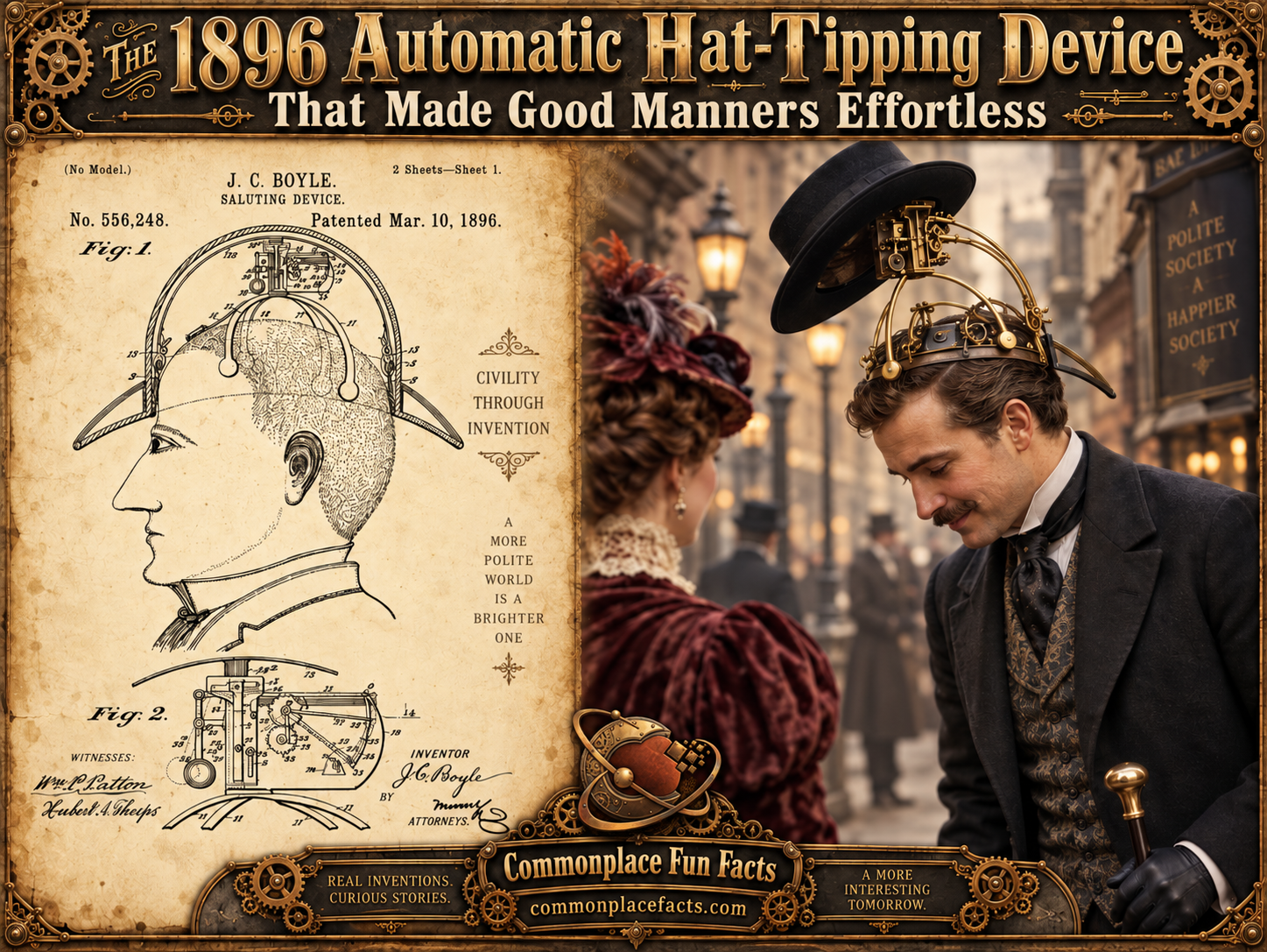
On March 10, 1896, the United States Patent Office granted Spokane, Washington, inventor James C. Boyle Patent No. 556,248 for what he called a “Saluting Device.” Its purpose was simple: whenever a gentleman bowed his head in greeting and then straightened up again, the machinery would automatically lift his hat, rotate it, and return it neatly to his head.
Boyle apparently regarded the social convention of hat tipping as an intolerable demand on the human arm. Even so, manners still maketh man. Clearly, what civilization needed was not less etiquette, but more machinery.
Table of Contents
James C. Boyle Wanted to Automate Politeness
Boyle did not describe his creation merely as a novelty hat. According to the patent, his invention was designed for “automatically effecting polite salutations” by raising and rotating a man’s hat when he bowed to another person.

The critical feature was that all of this occurred “without the use of the hands in any manner.”
This apparently represented progress.
Boyle did not eliminate every part of the greeting. The wearer still had to recognize another person, decide that a salutation was appropriate, and bow his head. Civilization could apparently continue asking a gentleman to move his neck. Requiring him to lift one arm, however, was clearly an inefficiency whose time had come.
The patent explains that when the wearer bowed and then returned to an upright position, the hidden mechanism would raise the hat, turn it, and deposit it back on his head.
Not merely tilt it, mind you.
Boyle specified that the hat could “receive a complete rotation.”
If you are going to mechanize good manners, there is little point in being timid about it.
How the Automatic Hat-Tipping Device Worked
The drawings make Boyle’s invention look less like a hat accessory and more like something Wile E. Coyote might have ordered after Acme entered the formalwear business.

The machinery was concealed inside the hat. A case containing the working parts had to remain stationary while the hat moved around it, so Boyle equipped the case with curved spring fingers that, in the carefully reassuring language of the patent, would “gently clasp” the wearer’s head.
“Gently” was probably an important word to include when marketing a spring-loaded mechanical apparatus that fastened itself to your skull.
The hat itself was attached to a bow-shaped piece connected to the internal mechanism. Clasps gripped opposite sides of the sweatband, while a post and guide assembly allowed the hat to rise above the wearer’s head and rotate.
Power came from a wound coil spring. A series of gears, lifting arms, pins, levers, and a weighted block waited patiently inside the hat for their moment of glory.
When the wearer inclined his head, gravity caused the weighted portion of the mechanism to shift. That movement released the machinery. As the gentleman straightened up, the spring-powered gears went to work, lifting the hat clear of his head, rotating it, and allowing it to drop back into its normal position.
Thus, the process of saying “Good afternoon” to Mrs. Henderson across the street could now involve a spring, several gears, a gravity block, a ratchet wheel, multiple levers, and a mechanical device clamped to your scalp.
Technology had finally liberated mankind.
Yes, You Still Had to Bow
There is something especially charming about the particular inconvenience Boyle chose to eliminate.
The wearer still needed to bow his head. In fact, bowing was essential because it triggered the machinery. Boyle had therefore automated only the part where the man reached upward, touched his hat, and lifted it.
This sounds absurd until one remembers that a large portion of modern technological development consists of eliminating movements approximately as demanding as that one.
We have buttons that close automobile trunks so we do not have to push them downward. Refrigerators can tell us what is inside because opening the door has apparently become an information-retrieval problem. Voice assistants exist because typing six words into a search box sometimes seems unreasonably strenuous.
Viewed from that perspective, Boyle was not eccentric.
He was a visionary with a very complicated hat.
Hat Tipping Was Serious Business in the 1890s
To modern eyes, Boyle’s invention may seem to automate a social gesture so minor that it hardly deserved machinery. In 1896, however, tipping one’s hat was not merely an optional bit of theatrical gallantry. It was part of an elaborate language of recognition, respect, deference, and social rank.

One of the best windows into that world is Our Society, an American etiquette manual published in 1891, just five years before Boyle received his patent. Search through the book and the scale of the problem begins to emerge. There are roughly 45 references to “bow” or “bowing” and about 30 references to what a person should do with his or her hat.
Not every one concerns a gentleman saluting someone on the street, but enough do that it becomes clear that the well-mannered person of 1891 was expected to devote a surprising amount of mental bandwidth to the proper movement of the head and its associated accessories.
The book even includes an entire section on “Salutations,” while elsewhere it pauses to answer such questions as “Who Bows First?” Taken together, its instructions explain not merely that people should bow, but who should bow first, how promptly the bow should be made, how deeply one should incline the head, whether the hat should be touched or removed, and how the rules changed depending upon the age, sex, social position, and companionship of the people involved.
This was etiquette with branching logic.
For example, between two gentlemen, a man could ordinarily touch his hat or make another gesture of acknowledgment. A careless nod, however, was beneath a gentleman even when he was in a hurry. If the person being greeted was substantially older or superior in position, the younger man was expected to remove his hat. The book also advised against the old-fashioned sweeping flourish that exposed the entire inside of the hat to public inspection. By 1891, apparently, even courtesy had learned something about restraint.
The rules became still more complicated when women entered the equation. Our Society instructed a gentleman walking with a lady to return a bow directed toward her by lifting his own hat, even if he did not personally know the person greeting her. The logic was that his companion’s acquaintances were entitled to his respect because they were worthy of hers.
If two gentlemen were walking or riding together and a lady recognized only one of them, both men were supposed to lift their hats.
Etiquette, it seems, was contagious.
The book also insisted that a bow should generally be returned even if you had no idea who had just bowed to you. Perhaps you had forgotten the person. Perhaps the stranger had mistaken you for someone else. Either way, the authors reasoned, courteous intentions deserved a courteous response.
That meant the bow was more than a greeting. It was a small public transaction. Failing to return one could communicate indifference, arrogance, hostility, or a refusal to recognize someone’s social standing. Performing it correctly told everyone involved that you understood both the relationship and the rules governing it.
And there were rules everywhere. Indoors, outdoors, at social calls, on the street, while riding, while driving, when meeting acquaintances, when accompanying women, and when encountering people of different ages or social positions, a well-bred person was expected to know who acknowledged whom and precisely how.
The result was a society in which a gentleman could plausibly lift his hat many times during an ordinary trip through town. Boyle therefore was not inventing machinery to automate some obsolete ceremonial gesture performed only during royal processions. He was attempting to mechanize a repetitive part of everyday social behavior.
Seen in that context, his invention becomes slightly less ridiculous.
Only slightly.
The Patent Was Not Just for Tipping the Hat
If Boyle had stopped there, Patent No. 556,248 would already have earned a respectable place in the museum of solutions desperately searching for problems.
But Boyle was thinking ahead.

He had already anticipated the question that eventually comes for nearly every promising new technology:
Can we put advertising on it?
Yes. Yes, we can.
The patent specifically states that Boyle’s invention could also function as a “unique and attractive advertising medium.” He proposed putting a sign or placard on the hat and sending the wearer into a crowded street.
People would naturally notice a man whose hat appeared to rise from his head and rotate by itself. Once everyone was staring at this inexplicable display, Boyle reasoned, their attention could conveniently be redirected toward whatever message had been placed on the hat.
This was remarkably efficient thinking. Boyle had simultaneously developed wearable technology, automated social interaction, and attention-based advertising in 1896.
Google Glass merely arrived a century late and with insufficient hat rotation.
The Self-Tipping Hat Actually Made the News
One of the more interesting things about Boyle’s invention is that it did not disappear into the Patent Office without anyone noticing.
Within weeks of the patent being issued, the March 28, 1896, edition of Scientific American mentioned Boyle’s “Saluting Device,” describing it as a mechanism designed to lift a hat automatically without the wearer raising his hand.
The rest of the issue gives a rather wonderful sense of what counted as cutting-edge science and technology in the spring of 1896. Readers could learn about experiments with the newly discovered X-rays, an electric railway running through the Niagara Gorge, and New York’s surface trolley system—with its electrical conduit buried beneath the street—successfully operating through a ten-inch snowstorm followed by rain and slush. There was also a report about a baby hippopotamus born unexpectedly at the Central Park Menagerie and, so far, doing quite well, because apparently no respectable scientific publication was complete without at least one hippopotamus.
The strangest juxtaposition may have appeared only a page away from Boyle’s mechanically courteous hat. Scientific American explained the workings of a stage illusion called “After the Flood,” in which an apparently empty Noah’s Ark produced ducks, chickens, pigeons, cats, dogs, a pig, and eventually a woman. Thus, a reader could move almost seamlessly from the latest advances in radiography to an explanation of where the magician had hidden the pig. The nineteenth century was nothing if not interdisciplinary.
Boyle’s automatic hat-tipping device also appeared in newspapers.
On April 9, 1896, The Democrat of Scotland Neck, North Carolina, ran a short item explaining that Boyle had patented a machine worn in the top of the hat. According to the newspaper’s description, all the wearer had to do was incline his head and the apparatus would lift the hat and return it in what the paper described as a graceful motion.
The fact that a newspaper in North Carolina was discussing the headgear innovations of a man in Spokane less than a month after the patent was granted suggests the idea had at least enough novelty to travel.
More interestingly, Boyle appears to have become locally associated with his invention.
A modern researcher who located and transcribed a September 30, 1896, item from the Spokane Chronicle reports that the newspaper identified Boyle as a member of the Drumheller Packing Company. The paper then observed that his principal claim to notoriety was inventing the patented hat lift that eliminated the “old labor” of raising one’s hat by hand.
So even Boyle’s contemporaries understood what was funny about this.
That is reassuring. Sometimes historical humor requires us to explain that people in the past were not completely oblivious to the ridiculous thing happening directly in front of them.
Who Was James C. Boyle?
Unfortunately, the patent gives us considerably more information about Boyle’s gears than about Boyle.
We know that he identified himself as a resident of Spokane, Washington. His application was filed on September 18, 1895, and the patent was issued on March 10, 1896. The document also states that Boyle assigned one-half of his rights in the invention to John Neill, also of Spokane.
Exactly what arrangement existed between Boyle and Neill is unclear. Neill may have been an investor, business associate, collaborator, or simply someone who obtained a financial interest in the invention. The patent tells us only that half the rights had been assigned to him.
The Spokane Chronicle item gives us one additional piece of biography by connecting Boyle to the Drumheller Packing Company. It also reported that he had recently returned from an extended trip that included Kansas City and other eastern destinations.
Beyond that, Boyle remains frustratingly elusive.
At least one other patent was granted to a man named James C. Boyle. In 1905, a James C. Boyle of Portland, Oregon, received a patent for an amusement device consisting of a sectional, foldable slideway for children. It is possible that the Spokane inventor later moved to Portland, but we have found no evidence connecting the two men.
It is also possible that two people in the western United States happened to have the extremely exotic name James Boyle.
Without additional evidence connecting them, there is no good reason to turn a possibility into a biography. Historical research becomes much easier if you simply assume that everybody with the same name is the same person, but it also becomes considerably less historical.
Did Anyone Actually Wear Boyle’s Automatic Hat?
Here we reach the point where many accounts of unusual patents quietly make a leap that the evidence does not support.
We know Boyle patented the device.
We know he described in considerable detail how it was supposed to work.
We know the patent included drawings.
We know contemporary publications noticed the invention and that a Spokane newspaper associated Boyle personally with his “patent hat lift.”
What we do not presently have is reliable evidence that the device went into commercial production, that Boyle sold one, that a manufacturer offered them to the public, or even that a working prototype survived.
The patent itself is marked “No model.” That does not mean the device never existed in working form; applicants were generally not required to submit working models by this period. It simply means the surviving patent record cannot be treated as a museum inventory card for an actual mechanical hat.
And this is an important distinction whenever we encounter lists of “crazy inventions from history.”
A patent establishes that someone obtained legal protection for an invention. It does not establish that factories immediately began producing it or that unsuspecting citizens soon found themselves surrounded by spring-loaded headwear.
The distinction matters because patent history is filled with people trying to solve problems creatively, commercially, optimistically, or occasionally in ways that make you wonder whether their friends were supportive to a fault.
Boyle’s invention belongs comfortably in that tradition.
Modern Japanese culture eventually gave us the concept of chindōgu, inventions that solve ordinary problems in ways so elaborate or inconvenient that the solution creates an entirely new collection of problems. Boyle was working decades before anyone coined the term, but putting a wound spring, gears, levers, clasps, and a gravity-operated trigger inside your hat because lifting it with your hand seemed bothersome certainly has the appropriate spirit.
Still, there is something more interesting happening here than simply “look at the silly old invention.”
Boyle Was Trying to Automate a Social Gesture
The automatic hat-tipping device feels surprisingly modern because the thing Boyle wanted to automate was not really labor.
He was automating social behavior.

Tipping a hat communicated recognition, courtesy, deference, respect, greeting, and sometimes apology. The physical movement mattered because everyone understood what it meant.
Boyle inserted a machine between the person and the gesture.
The gentleman would still decide whom to acknowledge. He would still bow his head. But once that signal was given, machinery would perform the socially expected response on his behalf.
That sounds considerably less strange in 2026 than it probably should.
Our phones remind us that someone has a birthday and provide a button so we can wish the person well. Email programs finish our sentences. Messaging apps suggest responses such as “Sounds good!” or “Congratulations!” before we have decided whether anything actually sounds good or deserves congratulations. Social networks tell us that someone has changed jobs and gently encourage us to demonstrate the appropriate amount of enthusiasm.
We routinely outsource tiny portions of etiquette to machines.
Boyle just did it with gears.
The Advertising Idea May Be the Most Modern Part
Even the advertising scheme has aged remarkably well.
Boyle understood something that now supports enormous portions of the modern economy: attention has value.
His automatic hat did not need to be the most efficient way to greet someone if its unusual movement caused strangers to look at it. Once Boyle had their eyes, the placard on the hat had a commercial audience.
The mechanism itself became the attention-getting device.
Anyone who has watched a website make an advertisement slide across the screen, expand into a video, bounce gently in the corner, or obscure the exact paragraph one was trying to read can appreciate the lineage.
The difference is that Boyle’s version required a man to walk down the street with machinery clamped to his head.
Modern advertising has made tremendous technological progress. The irritation can now be delivered remotely.
Maybe the Self-Tipping Hat Wasn’t So Ridiculous After All
There is a tendency to look at inventions like James C. Boyle’s automatic hat-tipping device and congratulate ourselves on how much more sensible we have become.
That confidence may be premature.
Boyle lived in a culture in which hat tipping was an ordinary and frequently repeated social expectation. He saw a repetitive human action. He devised a machine that could perform it automatically. Then he realized the machine’s novelty could capture public attention and be monetized through advertising.
Strip away the gears and the hat, and the business plan sounds unnervingly current.
Perhaps Boyle’s mistake was not that he anticipated the future.
Perhaps he anticipated it a little too literally.
You may also enjoy…

50 Fun Facts About American Inventions, Pop Culture, and Everyday Weirdness
Celebrate America’s 250 years with fun facts about inventions, pop culture, toys, snacks, gadgets, and everyday weirdness.

Invention Secrecy Act: Why Thousands of Patents Never See the Light of Day
Discover the hidden world of classified patents, where groundbreaking inventions are suppressed for national security. Learn how the Invention Secrecy Act works, who gets silenced, and which inventions were once too top secret to see the light of day.

The Straw Hat Riot: Yes, That Was Really a Thing?
In 1922, the Straw Hat Riot erupted in Manhattan when teenage boys attacked adults for wearing straw hats beyond the designated season. This clash between youthful enforcers and defiant adults escalated into chaos, causing significant disruption. The riots highlighted societal tensions over fashion and obedience to unwritten social rules, ultimately leading to the decline of…





Leave a Reply