

There was a time when commercials were not something you skipped, muted, blocked, fast-forwarded, or angrily reported to your browser extension like a tiny digital customs agent.
You watched them.
You watched them because there were only three networks, the remote control was either missing or nonexistent, and changing the channel required standing up, walking across the room, and turning a dial like you were launching a submarine. Those were the days when watching television was more than entertainment. It was character-building with vacuum tubes.
And because commercials were unavoidable, classic TV commercials became part of the common language. We did not merely remember them. We quoted them. We sang them. We repeated them in school cafeterias, grocery stores, laundry rooms, and family living rooms decorated in the warm earth tones of 1970s America, a design era apparently inspired by mushroom soup and automotive upholstery.
Some commercials sold products. Others became folklore.
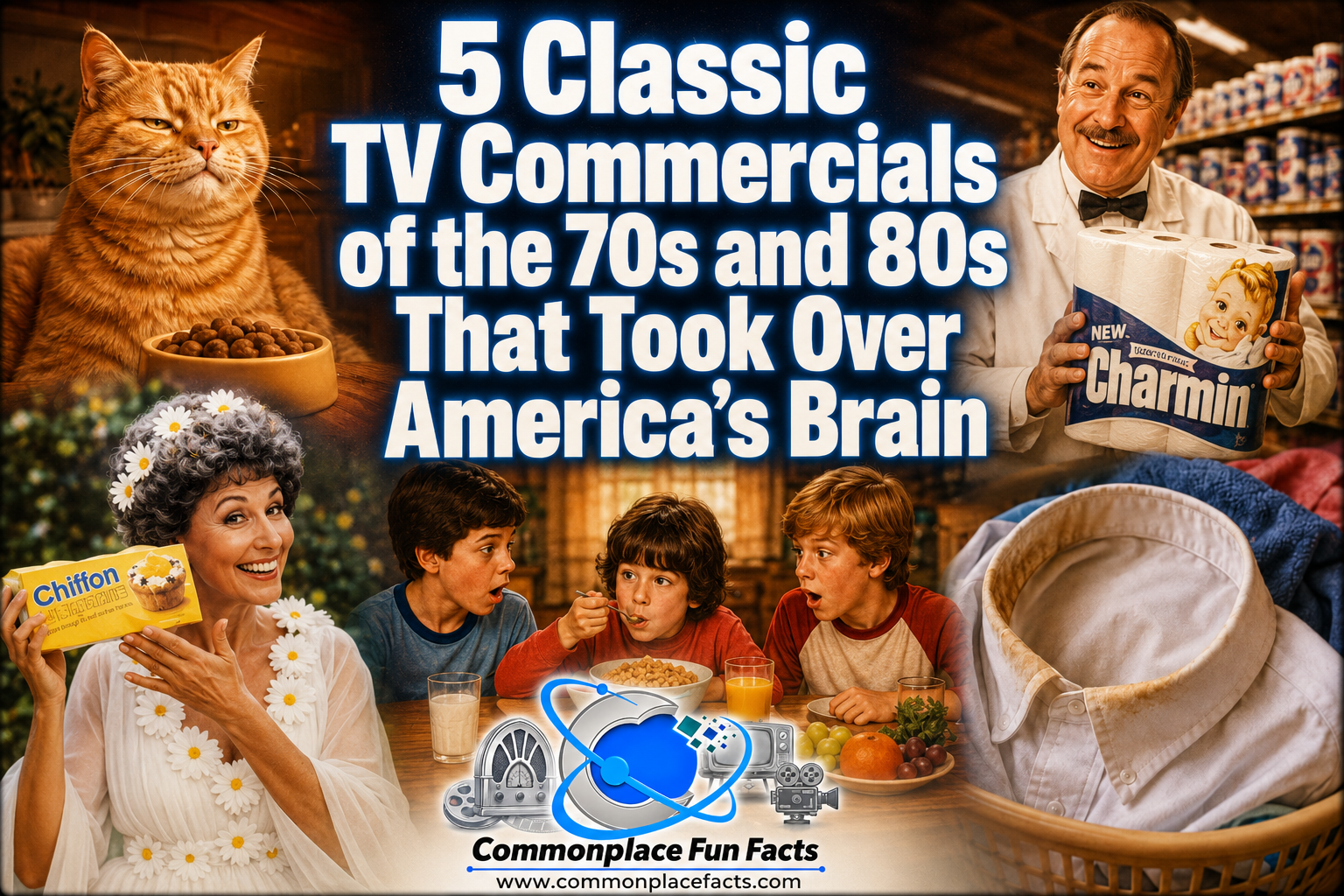
Among the great survivors of that era were five campaigns that managed to lodge themselves permanently in the national memory:
- Morris the Cat, the finicky feline who made cat food feel like fine dining with judgmental table service;
- Mr. Whipple and Charmin, the grocery-store guardian who begged America not to squeeze the toilet paper while clearly wanting to do exactly that;
- Mother Nature and Chiffon margarine, the campaign that dared to fool the natural order with a butter substitute;
- Life Cereal’s “He likes it! Hey, Mikey!”, the breakfast-table experiment that turned a picky child into advertising royalty; and
- Wisk’s “Ring around the collar,” the detergent campaign that made shirt grime sound like evidence in a domestic tribunal.
They sold cat food, toilet paper, margarine, cereal, and detergent. Glamorous stuff. Truly, the Mount Rushmore of household necessity, assuming Mount Rushmore also included a laundry stain and a judgmental cat.
But these ads worked because they were not just product pitches. They were little stories with characters, conflict, punchlines, and catchphrases. They were sitcoms in thirty seconds. Sometimes, they were morality plays. Occasionally, they were psychological warfare conducted through laundry detergent.
Contents
Morris the Cat: The Finicky Feline Who Judged Us All
Morris the Cat was not merely a mascot for 9Lives cat food. Morris was a personality. A mood. A furry orange monument to the proposition that cats are not pets so much as tiny landlords who occasionally allow humans to remain on the premises.
The original Morris was discovered in 1968 at the Hinsdale Humane Society in Illinois by animal talent scout Bob Martwick. That sentence alone deserves a moment of appreciation. Somewhere in the late 1960s, while the world was dealing with Vietnam, civil rights struggles, moon missions, and cultural upheaval, someone was wandering through an animal shelter looking for “the Clark Gable of cats.”
And somehow, he found him.
Morris became the face — technically the whiskered face — of 9Lives cat food. His defining trait was that he was “finicky.” This was advertising genius because anyone who has ever lived with a cat knows that “finicky” is the polite version. The more accurate word is “tyrannical,” but that probably tested poorly with focus groups.
The commercials usually revolved around Morris rejecting inferior cat food and accepting only 9Lives. The joke worked because Morris did not beg, perform tricks, or act grateful. He behaved exactly like a cat: mildly annoyed by service delays and unimpressed by the species that invented indoor plumbing but still cannot open a can fast enough.
What made Morris memorable was not the product claim. It was the attitude. His sardonic voiceover gave him the air of a restaurant critic trapped in a suburban kitchen. He did not eat cat food. He reviewed it.
Morris also had the sort of backstory advertisers dream about: a shelter cat who became a star. It is a lovely story, though one suspects Morris himself would have regarded fame as merely his due. “Yes, yes, rescued from obscurity. Now bring the seafood platter and try not to make eye contact.”
The original Morris died on July 7, 1978, and has been replaced by successor feline protagonists. He endured because he reflected a truth cat owners already knew: dogs want approval. Cats want management changes.
Mr. Whipple: The Man Who Tried to Save America from Soft Toilet Paper
Then there was Mr. Whipple, the fussy grocery-store manager who spent more than two decades begging shoppers, “Please don’t squeeze the Charmin.”
Played by actor Dick Wilson, Mr. George Whipple was one of the most recognizable advertising characters in American television. His entire professional life seemed dedicated to stopping women in grocery aisles from fondling packages of bathroom tissue. It was a simpler time, although not necessarily a less strange one.
The premise was beautifully ridiculous. Shoppers could not resist squeezing Charmin because it was so soft. Mr. Whipple would catch them, scold them, and then — in the inevitable twist — secretly squeeze the Charmin himself.
This was not just a commercial. This was a character study in hypocrisy, temptation, and two-ply desire.
The genius of the campaign was that it told viewers not to do the very thing it wanted them to imagine doing. “Don’t squeeze the Charmin” made squeezing the Charmin the central act. It turned toilet paper into forbidden fruit, which is a theological development Martin Luther somehow failed to anticipate.
And it worked. Mr. Whipple appeared in hundreds of commercials and became so familiar that the character outgrew the product. You did not need to be shopping for toilet paper to understand the joke. All someone had to say was, “Don’t squeeze the Charmin,” and the whole scene appeared in your head: grocery aisle, suspicious shoppers, fussy manager, soft paper, moral collapse.
There is something wonderfully odd about a nation collectively remembering a fictional grocer whose signature contribution to culture was bathroom-tissue enforcement. But advertising history is full of surprises. Sometimes the great figures of American memory are presidents, astronauts, and civil rights leaders. Sometimes they are men in aprons yelling at housewives near the paper goods.
Mr. Whipple’s power came from repetition and contradiction. He was the guardian of the Charmin and also its weakest addict. He was Asgard’s Heimdall with a softer grip and less self-control.
Mother Nature and Chiffon: Margarine Commits Identity Theft
The Chiffon margarine commercials gave us one of the great lines of the era: “It’s not nice to fool Mother Nature!”
The setup was simple. Mother Nature, played by actress Dena Dietrich, tastes what she believes to be butter. She is serene. Regal. Confident. Very much in command of the lilies, breezes, sunshine, woodland creatures, and apparently dairy products.
Then an unseen narrator tells her the terrible truth: it is not butter. It is Chiffon margarine.
This is where the campaign becomes magnificent. Mother Nature does not respond with mild surprise. She does not say, “Well, that is a perfectly acceptable butter alternative for toast and light baking.” No. She becomes insulted on behalf of creation itself.
“It’s not nice to fool Mother Nature!”
Then thunder rolls, lightning flashes, animals panic, and Chiffon makes its point: this margarine tastes so much like butter that it can deceive a cosmic authority.
During the Margarine Wars, butter producers had the government on their side. The margarine lobby responded by bringing in a mythical figure of near-limitless power. It was a bold advertising strategy. Most companies say, “Our product is good.” Chiffon said, “Our product is so good it can trick the natural order, and frankly, the natural order is taking it personally.”
The commercials also belong to a peculiar chapter in food history when margarine and butter were locked in an existential struggle for America’s toast. Margarine had long battled for legitimacy. Butter, meanwhile, had the smug advantage of actually being butter. Chiffon tried to settle the matter by staging a tiny mythological sting operation.
The catchphrase survived because it was instantly portable. You could use it any time someone was tricked, misled, or served a suspiciously buttery substance from a plastic tub. It made Mother Nature sound like a school principal with weather powers.
Even now, the phrase carries its own little thunderclap. It is hard to say “It’s not nice to fool Mother Nature” without mentally summoning clouds, wind, and a mildly offended deer.
“He Likes It! Hey, Mikey!”: Breakfast Cereal and Sibling Experimentation
The Life Cereal commercial known simply as “Mikey” may be one of the most perfect ads ever made. It is short. It is funny. It is believable. It features brothers behaving exactly like brothers, which is to say with the ethics committee nowhere in sight.
The commercial shows three brothers at breakfast. A bowl of Life Cereal sits before them. The older boys are suspicious. The cereal is supposed to be good for you, which in child logic means it probably tastes like packing material.
Naturally, they refuse to try it.
Then comes the solution: “Let’s get Mikey.”
Mikey, we are told, “hates everything.” This makes him the ideal test subject, because apparently the breakfast table has become a research laboratory and informed consent is for grown-ups.
Mikey tries the cereal. He eats it. The brothers are astonished.
“He likes it! Hey, Mikey!”
That was it. No explosions. No celebrity guest. No dancing cereal pieces. No animated marshmallow litigation. Just three kids, one bowl, and the revelation that even a famously picky child would eat Life Cereal.
Mikey was played by John Gilchrist, and the other two boys were his real-life brothers. That may be part of why the commercial felt so natural. It had the documentary realism of siblings quietly attempting to outsource personal risk to the youngest available relative.
The ad first aired in the early 1970s and ran for more than 12 years. It became one of those commercials everybody knew, partly because it captured a universal childhood truth: children trust peer review only when it is conducted on someone else.
Everybody loved the commercial. Well, almost everybody. Those named Michael or Mike may have felt differently after the 400th person shoved something in their direction and said, “Mikey likes it!” before doubling over with laughter as if no one else had ever thought to say that. Advertising immortality is wonderful, unless it turns your name into a public participation exercise.
The Urban Legend: Did Mikey Die from Pop Rocks, Soda, or Cosmic Candy?
Of course, no beloved childhood commercial can remain innocent forever. Eventually, the playground rumor mill got involved.

By the late 1970s and early 1980s, a rumor spread that the actor who played Mikey had died after eating Pop Rocks and drinking soda. In some tellings, it was Pop Rocks and Coke. In others, the quantities became absurdly specific, because urban legends like to wear a lab coat made of nonsense. Some memories swapped in related popping candies such as Space Dust or Cosmic Candy, because folklore has never met a detail it could not misremember with confidence.
The story usually ended the same way: Mikey’s stomach exploded.
This did not happen.
John Gilchrist did not die from Pop Rocks, soda, Cosmic Candy, Space Dust, or any other carbonated confectionery weapon. He grew up. He lived. He became an adult. He continued existing, which was no doubt inconvenient for the rumor but good news for everyone else.
The rumor worked because it had all the ingredients of a perfect playground legend: a famous child, a weird candy, a fizzy beverage, a gruesome ending, and absolutely no requirement that anyone verify anything. This was pre-internet misinformation, which meant the delivery system was not social media but one kid at recess saying, “My cousin knows a guy.”
Pop Rocks were already strange enough to invite suspicion. They crackled in your mouth. They made noise. They felt vaguely scientific. To a child, that meant they were either candy, part of a NASA experiment, or evidence of a crossover from a parallel dimension. Add soda to the rumor, and suddenly the digestive system became a haunted chemistry set.
The Mikey rumor endured because urban legends are hard to kill. They do not require proof. They require only repetition, a memorable victim, and a story that sounds like something an adult would hide from you. In that sense, the rumor was almost as successful as the commercial itself.
Mikey liked it. Mikey survived it. The playground, however, preferred the explosion.
“Ring Around the Collar”: Laundry Shame Gets a Catchphrase
If Morris was judgmental, Mr. Whipple was conflicted, Mother Nature was offended, and Mikey was involuntarily drafted into cereal testing, then Wisk detergent gave America something darker: public collar shame.
“Ring around the collar!”
That phrase haunted television for years. It was not spoken so much as pronounced, like a verdict. Somewhere, a man had worn a shirt. The shirt had developed a dirty ring around the collar. And now, apparently, the entire world sat in judgment.
The Wisk commercials focused on a specific laundry problem: grime around shirt collars. This was a real issue, of course. Human necks exist. Shirts touch them. Biology does what biology does. But the commercials elevated collar stains from “laundry challenge” to “domestic scandal.”
In many versions of the campaign, the shame fell not on the shirt-wearer but on the person doing the laundry, usually a wife. This was very much advertising of its time. The man’s collar got dirty, but somehow the woman’s reputation was on trial. Household products in mid-century and postwar advertising were often sold with a helpful little side order of gender anxiety. Truly, nothing says “clean shirt” like implied social judgment.
Wisk’s genius was naming the enemy. “Collar stains” would have been accurate. “Ring around the collar” was memorable. It sounded like a children’s song that had grown up, bought detergent, and become disappointed in everyone.
The phrase also had rhythm. It could be repeated. It could be whispered. It could be deployed by siblings, spouses, and cruel schoolchildren. The ad did what great advertising often does: it made consumers self-conscious about something they had previously survived without naming.
Before Wisk, you had a dirty collar. After Wisk, you had Ring Around the Collar, a condition that sounded like it belonged in either a laundry aisle or a medieval medical text.
The commercials were effective because they created a tiny crisis and then offered immediate absolution. Wisk was not merely detergent. It was forgiveness in a bottle.
The strangest part is that “Ring around the collar” outlived Wisk itself. The detergent eventually disappeared from store shelves, but the phrase kept right on going, because a catchy laundry accusation apparently has a longer shelf life than the product designed to solve it. Wisk is gone, but somewhere in the cultural laundry basket, that sing-song little indictment is still waiting to ruin a perfectly innocent shirt.
Why These Commercials Worked
Looking back, these commercials worked because they understood something modern advertising sometimes forgets: people remember stories better than claims.
These five ads were hardly alone, of course. American advertising history is full of campaigns that managed to escape the commercial break and set up permanent residence in the national memory. For more examples, see our earlier look at memorable and iconic advertisements, where the rabbit hole gets deeper and the jingles become harder to evict.
You can tell viewers your cat food is tasty, your toilet paper is soft, your margarine tastes like butter, your cereal appeals to picky kids, and your detergent removes collar stains. Fine. Accurate. Also dull enough to make a houseplant check its watch.
Or you can give people Morris, Mr. Whipple, Mother Nature, Mikey, and a disembodied voice accusing your laundry of moral failure.
The second approach wins.
These ads shared several traits. First, they had characters. Morris, Whipple, Mother Nature, and Mikey felt less like product spokespeople and more like recurring cast members.
They also had conflict. The cat rejected food. Shoppers squeezed forbidden paper. Mother Nature was fooled. Mikey was tested. The collar was dirty. These were not complicated plots, but neither was Gilligan’s Island, and that managed to keep civilization occupied for years.
They had catchphrases built for instant reuse: “Don’t squeeze the Charmin,” “It’s not nice to fool Mother Nature,” “He likes it! Hey, Mikey!”, and “Ring around the collar.”
They were easy to imitate, which meant children could repeat them, adults could joke with them, and families could use them as shorthand.
And they aired constantly, because repetition did what repetition does: it turned advertising into memory, then memory into nostalgia, then nostalgia into blog content several decades later. The circle of life, but with cleverly disguised margarine.
The media environment also helped. When millions of people watched the same programs at the same time, they also saw the same commercials. A slogan could become national language because everyone heard it together. Today, culture is fragmented across streaming services, social media feeds, targeted ads, and videos of raccoons stealing cat food from porch cameras. Back then, one catchy line could conquer the nation by Thursday.
The Weird Comfort of Shared Commercial Memory
There is something oddly comforting about these old commercials, even when they are ridiculous, dated, or quietly insane.

They remind us of a time when television was more communal. Families watched the same shows. Kids saw the same Saturday morning ads. Commercials interrupted everything, but they interrupted everyone equally. They were annoying, yes, but they were also shared. A thirty-second ad could become a reference point for an entire generation.
They also reveal what advertisers thought would motivate us. Softness. Taste. Cleanliness. Approval. Fear of dirty collars. Fear of disappointing cats. Fear of divine retaliation from a margarine-deceived earth goddess. The usual human concerns.
Some of the assumptions have aged badly. The laundry ads especially carry the unmistakable aroma of old gender roles, lightly perfumed with detergent and judgment. Other campaigns remain charming because they are built around universal comic truths. Cats are picky. Kids are suspicious. Little brothers must always be on guard against older brothers. Adults are hypocrites. Butter is delicious. Toilet paper should not feel like sandpaper. These are not trends. These are pillars of civilization.
What is striking is how small the stakes were. No one was saving the world. No one was reinventing humanity. These were commercials about ordinary household products. And yet they became cultural landmarks because they made the ordinary funny, strange, and repeatable.
Morris turned cat food into aristocratic judgment. Mr. Whipple turned toilet paper into forbidden temptation. Mother Nature turned margarine into mythological fraud. Mikey turned breakfast cereal into a sibling experiment. Wisk turned a collar stain into a public indictment.
That is advertising alchemy. Or possibly evidence that we all watched too much television.
The Classic TV Commercials We Remember Are Rarely About the Product
Here is the funny thing: when people remember these commercials, they often remember everything except the sales pitch.
They remember Morris being unimpressed. They remember Mr. Whipple saying not to squeeze the Charmin. They remember Mother Nature getting angry. They remember Mikey liking it. They remember the horrible, accusing chant of “Ring around the collar.”
The products are still there, of course, standing politely in the background. But the characters took over. The ads became bigger than the things they sold.
That is why these commercials still work as nostalgia. They are not merely reminders of cat food, toilet paper, margarine, cereal, and detergent. They are reminders of childhood living rooms, network television, Saturday mornings, grocery aisles, school rumors, and the strange little phrases that everybody knew without anyone formally teaching them.
They are also reminders that advertising, at its best or at least its most durable, does not simply make an argument. It plants a tiny scene in your head and waits there forever.
Morris is still judging dinner.
Mr. Whipple is still guarding the Charmin and losing the battle.
Mother Nature is still one fake butter pat away from weather violence.
Mikey still likes it.
And somewhere, echoing faintly from the laundry room of American memory, a voice still whispers:
“Ring around the collar.”
That is the odd little triumph of these commercials. They were supposed to make us buy cereal, cat food, toilet paper, margarine, and detergent. Instead, they gave us shared memories, family shorthand, playground rumors, and phrases that still wander through our brains decades later without paying rent.
Madison Avenue wanted brand loyalty. What it got was cultural squatter’s rights.
You may also enjoy…

Iconic Advertisements We Still Remember: From Burma-Shave and Brylcreem to Where’s The Beef
A fun, nostalgic tour through America’s most iconic advertisements, from Burma-Shave and Wildroot Cream-Oil to “Where’s the Beef?” and beyond.

The $2.5 Million Worst Super Bowl Commercial Ever
What is considered to be the worst Super Bowl commercial of all time? Learn about the Census “Snapshot of America” commercial that holds this dubious honor.

Why Do Drug Commercials List All Those Crazy Side Effects?
Why do drug commercials always come with a long list of crazy side effects? Learn the surprising explanation.




Leave a Reply