
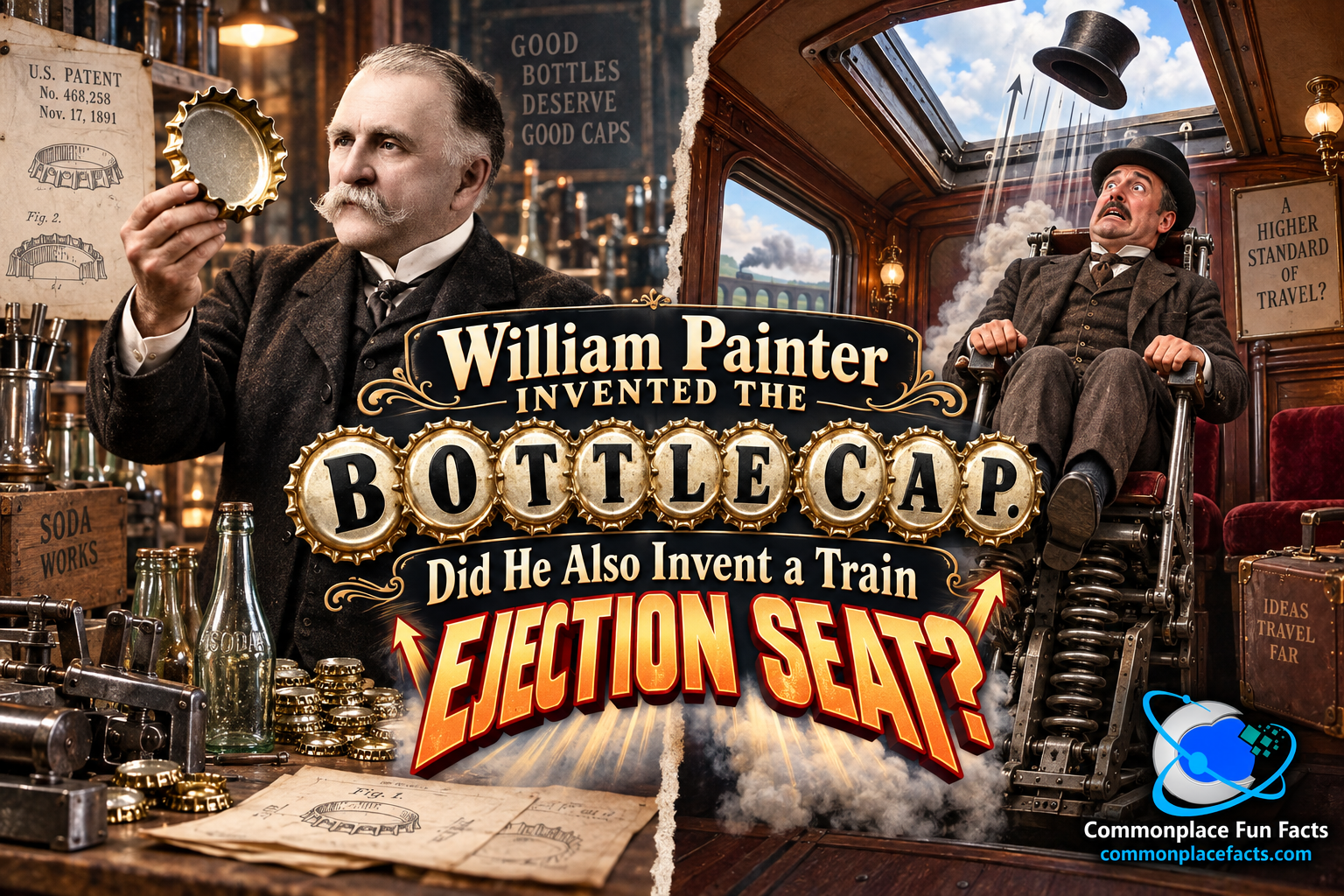

You have probably handled William Painter’s greatest invention thousands of times.
You may have pried one off a cold bottle of soda, watched one skitter across a kitchen counter, stepped on one while barefoot, or spent several minutes searching for an opener while holding a perfectly accessible set of car keys and refusing to admit defeat.
It is the ordinary metal bottle cap.
More precisely, it is the crown cork, the crimped metal cap that William Painter patented in 1892. The National Inventors Hall of Fame credits Painter with inventing the crown bottle cap, and the American Society of Mechanical Engineers has recognized the crown cork and the machinery developed to apply it as an engineering landmark.
That would be a perfectly respectable legacy. Painter took one of civilization’s more important problems—how to keep carbonated beverages carbonated until somebody wanted to drink them—and solved it with an object so cheap and reliable that people immediately began throwing it away.
But William Painter was not a one-bottle-cap sort of inventor.
He spent nearly half a century producing patents for everything from pumps and lamp burners to a counterfeit-coin detector, an electrical railway, and several devices devoted to the removal and transportation of what Victorian patent documents politely called “night-soil.” A detailed compilation of his patent record counts 86 grants, including three reissues; one of those patents was issued posthumously in 1908. The National Inventors Hall of Fame says Painter earned 85 patents during his lifetime, so the two figures are not actually in conflict. Either way, the Patent Office saw quite a lot of William Painter.
And according to several reputable accounts, one of those inventions was considerably more exciting than a bottle cap.
Painter, we are told, patented a “safety ejection seat for passenger trains.”
This is an irresistible historical fact.
There is just one problem.
It may not be true.
Contents
William Painter Started Inventing Before He Was 20
William Painter was born in Triadelphia, Maryland, on November 20, 1838. By the time most people his age were concentrating on the traditional nineteenth-century pursuits of finding employment and avoiding tuberculosis, Painter was already designing machinery.

While apprenticing in Wilmington, Delaware, he developed a machine capable of folding sheets of paper for bookmaking. A friend urged him to patent it immediately. Painter thought the machine still needed improvement and waited.
This was educational.
When Painter finally decided it was ready, he discovered that Cyrus Chambers of Pennsylvania had already patented a similar paper-folding machine. Chambers went on to make money from it. Painter went on to acquire a practical lesson in patent law: perfection is admirable, but being second is a remarkably effective way of allowing somebody else to become first.
Painter seems to have absorbed the lesson.
In August 1858, while still 19 years old, he received his first patent, No. 21,082, for a money-changing device often described in Painter biographies as a “fare box.” Later that month came Patent No. 21,356 for his “Car Seat and Couch.” Neither made him rich, but they established the pattern for the next several decades: Painter saw ordinary mechanical problems and began wondering whether there was a slightly better way to solve them.
Sometimes “slightly better” involved rather unexpected subject matter.
A Patent Portfolio That Refused to Pick a Lane
In 1862 Painter patented a counterfeit-coin detector. The following year brought a lamp burner. Later came a seed sower, gauges for steam boilers, devices for lubricating railroad-car axles, pumps, valves, telephone equipment, and an electrical railway.
Then there was 1875.

Painter apparently looked at the state of municipal sanitation and decided that humanity’s problems could no longer be entrusted solely to bottle caps he had not yet invented. In March of that year, he received patents for an “Apparatus for the Removal of Night-Soil,” a discharge gate for night-soil tanks, a measuring indicator for those tanks, and related equipment. A few months later came additional patents for transferring night soil into cars and boats and for a transit tank designed to carry it.
For anyone fortunate enough not to know, “night soil” was human waste collected from privies and cesspools. This gave rise to a profession of people known as “night soil men”, whose principal qualifications must have included a strong back and an utter absence of functioning olfactory nerves.
Painter’s patent portfolio therefore ranged from passenger seating to sewage transportation, with counterfeit money and lamp hardware somewhere in between. It reads less like the work of one specialist and more like the inventory from a hardware store that had begun making increasingly questionable acquisitions.
By the 1880s, however, Painter had begun concentrating on a problem that would finally make his fortune.
Bottles.
Carbonated Drinks Had a Bottle Problem
Carbonated beverages were becoming increasingly popular during the nineteenth century, but carbonation creates a fairly obvious engineering difficulty: gas under pressure would very much like to stop being under pressure.
That makes the container important.

By the 1880s, bottlers were using a variety of corks, plugs, mechanical stoppers, wire arrangements, and other closures. Many were reusable. Unfortunately, they could be cumbersome, expensive, unreliable, difficult to clean, or inadequate at keeping the liquid and its carbon dioxide where manufacturers preferred them—which was generally inside the bottle. The American Society of Mechanical Engineers notes that contemporary stoppers often failed to seal properly, while some metal closures could contaminate the beverage through contact with it.
Painter spent years working on bottle stoppers before reaching the design that endured.
On February 2, 1892, he received Patent No. 468,226 for his bottle-sealing system. A related patent, No. 468,258, described metallic sealing caps intended to be highly effective and inexpensive enough to discard after a single use.
That last part was important.
Painter was not merely trying to produce a better stopper. He was developing a stopper nobody needed to return, wash, maintain, or reuse. Put it on the bottle, sell the beverage, pry off the cap, discard it, and repeat the process.
We now call this “disposable packaging.”
In 1892 it was a business model waiting for somebody to put a crimped metal edge around it.
Why the Crown Cork Worked
Painter’s crown cork was deceptively simple. A metal cap covered the mouth of the bottle. Inside was a thin cork disc, backed by paper, which helped create the seal while preventing the beverage from touching the metal. Around the cap was a corrugated flange that could be crimped securely beneath a specially formed lip on the bottle neck.
The result was inexpensive, compact, disposable, and resistant to leakage.
Those are not particularly glamorous attributes. Nobody has ever stood at a cocktail party and tried to impress strangers by saying, “You should see the flange geometry on this thing.”
But they are exactly the attributes that make a technology ubiquitous.
Painter also worked with bottle manufacturers to standardize the type of neck needed for his cap. That mattered because a brilliant closure that fits approximately 37 percent of the bottles encountered in the wild is not quite the commercial triumph investors generally prefer. The cap and the bottle had to become parts of the same system.
Once they did, the crown cork spread remarkably well.
The original version had 24 corrugations, or teeth. Modern crown caps generally have 21. The cork liner has been replaced by modern sealing materials, and other dimensions have been refined, but the fundamental concept remains recognizable more than 130 years later.
Consequently, every time you pry the cap from a glass bottle of soda, you are performing essentially the same mechanical operation someone could have performed during Grover Cleveland’s second presidential campaign.
Technology advances unevenly.
Inventing the Bottle Cap Created Another Problem
There was, however, a complication.
If you intend to sell enormous quantities of disposable bottle caps, somebody has to put enormous quantities of disposable bottle caps onto bottles.
Painter therefore began developing machinery to manufacture and apply his invention. The process eventually became impressively fast. According to ASME, by 1902 Painter had introduced an eight-head automatic electric Crown bottling and capping machine capable of handling between 60 and 100 bottles per minute.
The bottle cap had created an industrial ecosystem around itself.
It also created an additional problem that anyone who has ever stared helplessly at a capped beverage already understands.
You had to get the thing off.
Painter’s crown caps were attached firmly enough that removing them required leverage. His own patent documentation acknowledged that special openers became necessary, and in 1894 he received Patent No. 514,200 for a capped-bottle opener designed to pry hard metal sealing caps from bottles.
Painter was not the first person to patent a bottle-uncapping tool. Alfred L. Bernardin received U.S. Patent No. 501,050 for a “Bottle-Uncapping Tool” on July 11, 1893, nearly seven months before Painter received his own opener patent. Bernardin’s device was designed to be mounted to a counter, while Painter’s was handheld, so Painter certainly developed and patented his own solution.
This is one of the charming features of technological progress. You solve a problem, and the solution immediately introduces itself while carrying two or three new problems that would also like your attention.
The Bottle Cap Helped Inspire the Disposable Razor
Painter’s crown cork also had an influence far beyond beverages.
One of the salesmen working for Painter’s company was King Camp Gillette, another inventor who would eventually become famous for making a small, inexpensive piece of metal that customers used briefly and then discarded.

That similarity was not entirely coincidental.
According to accounts of their relationship, Painter encouraged Gillette to think about inventing something like the crown cork: inexpensive, disposable, and capable of ensuring that customers continually returned to buy replacements. Gillette spent years thinking about the idea before realizing, while shaving, that a replaceable razor blade might fit the formula.
We have previously explored Gillette’s remarkably successful contribution to the philosophy that selling someone a product once is pleasant, but selling them part of the product forever is much better in “King Gillette: A King Who Lost His Edge Gained Fame by Encouraging Waste.”
Painter did not invent the safety razor, of course. But his crown cork offered both inspiration and a business principle: make the consumable component cheap enough to throw away and useful enough that people immediately need another.
The bottle cap and disposable razor blade are therefore distant industrial cousins.
One keeps the fizz in. The other keeps the stubble off.
Economically, they have quite a bit to talk about.
The Crown Cork Became a Global Business
Painter founded the Crown Cork & Seal Company in Baltimore to manufacture and promote his invention. The business succeeded on a scale that makes the humble cap rather difficult to continue calling humble.

By the 1930s, according to the Baltimore Museum of Industry, Crown Cork & Seal was supplying roughly half of the world’s bottle caps and operating factories in Europe, South America, and Asia.
Painter did not live to see all of that expansion. He died in Baltimore on July 15, 1906. Yet the company survived, the crown cap survived, and the basic mechanics of his invention became so ordinary that they largely disappeared from notice.
That is arguably one of the greatest compliments an invention can receive.
Nobody marvels at a bottle cap. Nobody consults instructions before operating one. Nobody pauses after opening a soda and reflects upon how fortunate it is that William Painter spent years experimenting with metal flanges and cork discs.
The thing simply works.
About William Painter’s Supposed Train Ejection Seat
And then we come to the claim that frankly caught our attention in the first place: that William Painter patented a “safety ejection seat for passenger trains.”
The claim does not come merely from random websites specializing in “27 Amazing Victorian Facts You Won’t Believe; Number 14 Will Terrify Your Horse.” Crown Holdings, the modern descendant of Painter’s company, states that its founder patented a “safety ejection seat for passenger trains.” The Lemelson-MIT program has also repeated essentially the same claim, including it among Painter’s many other inventions.

That sounds reasonably conclusive.
Then you look at the patents.
A detailed biography of Painter compiled by collector and researcher Mark A. Woodard includes a patent-by-patent inventory derived from U.S. Patent Office records. It begins with Patent No. 21,082, issued August 3, 1858, for the money-changing device Woodard lists as a “Fare Box,” followed four weeks later by Patent No. 21,356 for something called a “Car Seat and Couch.”
The latter was indeed intended for railroad passengers. But its purpose was not to eject them from the train.
Painter’s device allowed a passenger to convert the seat between sitting and reclining positions. The patent drawing shows the back and seat moving into different configurations. There is no apparent provision for detecting an imminent collision, opening the roof, launching the passenger into the countryside, or providing the gentleman with a parachute and an opportunity to reconsider his travel arrangements.
In other words, Painter appears to have invented something much closer to a nineteenth-century reclining railroad seat.
Somewhere along the way, “railroad car seat” seems to have evolved into “safety ejection seat for passenger trains.” Exactly when that transformation occurred is harder to determine. Perhaps some forgotten source badly summarized the patent, and later writers repeated it. Perhaps another invention has been confused with Painter’s. Maybe someone left one of Painter’s discarded bottle caps on a seat, producing what looked very much like an ejection when a passenger with a particularly sensitive backside sat on it.
What can be said is that the supposedly irresistible ejection-seat patent does not appear in the comprehensive list of Painter’s U.S. patents.
Which is disappointing, certainly.
On the other hand, history has now given us something almost as entertaining: the story of how the inventor of the bottle cap may have been posthumously credited with inventing a train ejection seat he did not actually invent.
Welcome to the world of the Commonplace Fun Facts Fact-Checking Department.
So, Did the Bottle Cap Inventor Really Invent a Train Ejection Seat?
Probably not—at least not on the evidence presently available.
There is no doubt that reputable sources say William Painter patented a “safety ejection seat for passenger trains.” Crown itself says so, and other biographies have repeated the claim. Once a detail has made its way into sources of that caliber, it understandably spreads.
But Painter’s documented U.S. patent record points elsewhere. No separate ejection-seat patent appears in the comprehensive patent list, and the 1858 railroad-seat patent describes a seat that could be converted between sitting and reclining positions. Unless another patent or contemporary document turns up, the ejection-seat claim is best treated as unverified; it may be a later misdescription of Painter’s railroad-seat invention.
Fortunately, William Painter hardly needs the embellishment.
He was filing patents while still a teenager. He designed machinery for everything from coins to pumps to sewage. He transformed commercial bottling with a disposable closure whose essential design remains in use today. He developed machinery capable of applying those closures at industrial speed, helped build a company that eventually supplied half the world’s bottle caps, and appears to have planted an idea about disposable razors in the mind of King Gillette.
That is plenty.
The next time you pry a metal cap from a glass bottle, take a moment to appreciate William Painter. You are holding an invention whose basic design has survived since 1892 and whose influence reaches far beyond the few square inches of metal involved.
Just don’t credit him with ejecting anybody from a train.
History is already strange enough without installing aftermarket accessories.
You may also enjoy…

King Gillette: a King Who Lost His Edge Gained Fame By Encouraging Waste
Learn about King Gillette — he lost his edge but got it back by encouraging waste.

Margaret Knight: The Woman Who Reinvented the Paper Bag—and Had to Prove It
Meet Margaret Knight, the overlooked inventor who revolutionized the flat-bottom paper bag and fought a patent battle to prove the machine was hers.

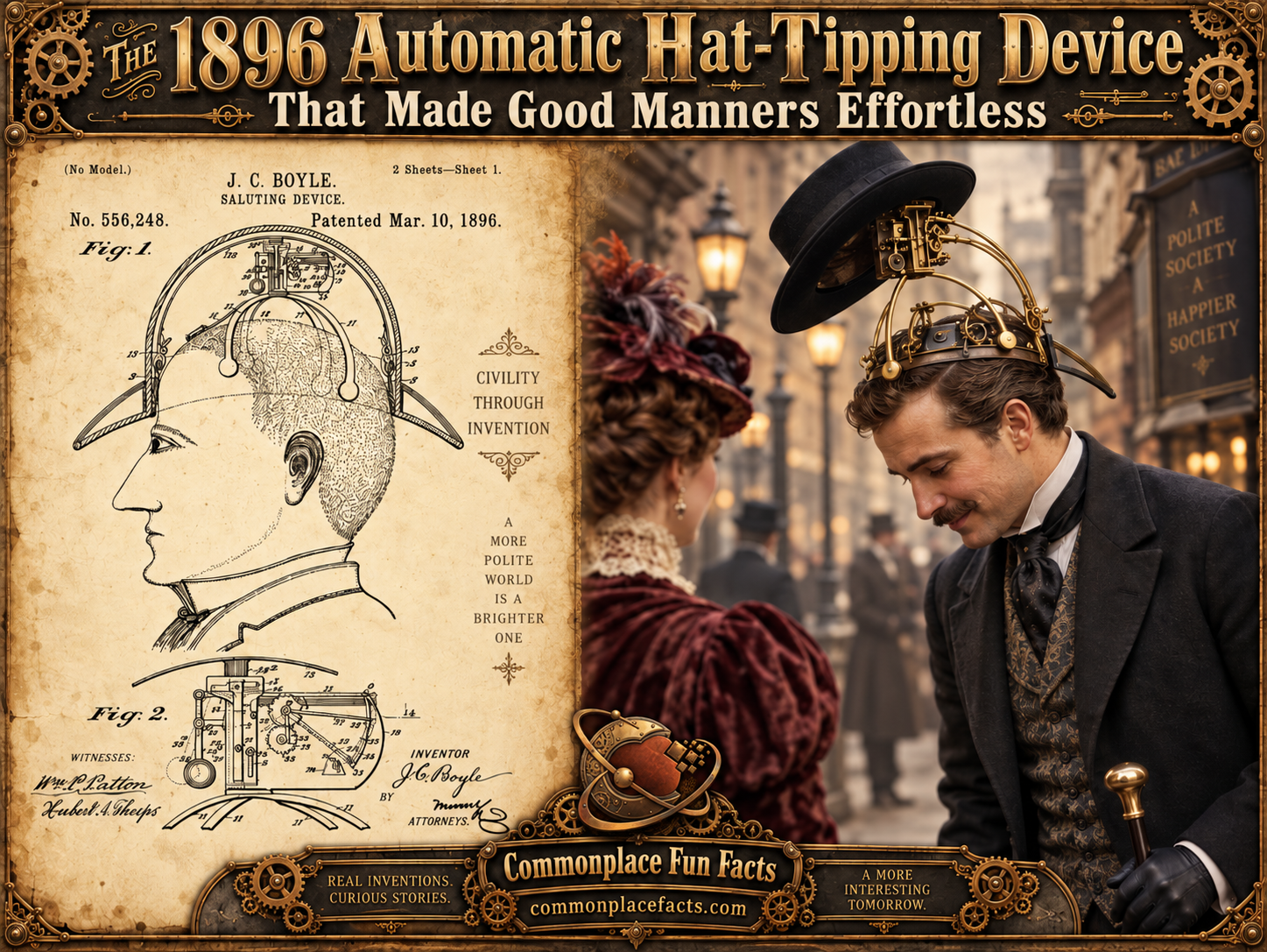
The 1896 Automatic Hat-Tipping Device That Made Good Manners Effortless
In 1896, James C. Boyle patented an automatic hat-tipping device that tipped, spun, and reset itself—and he even planned to put advertising on it.


Leave a Reply