
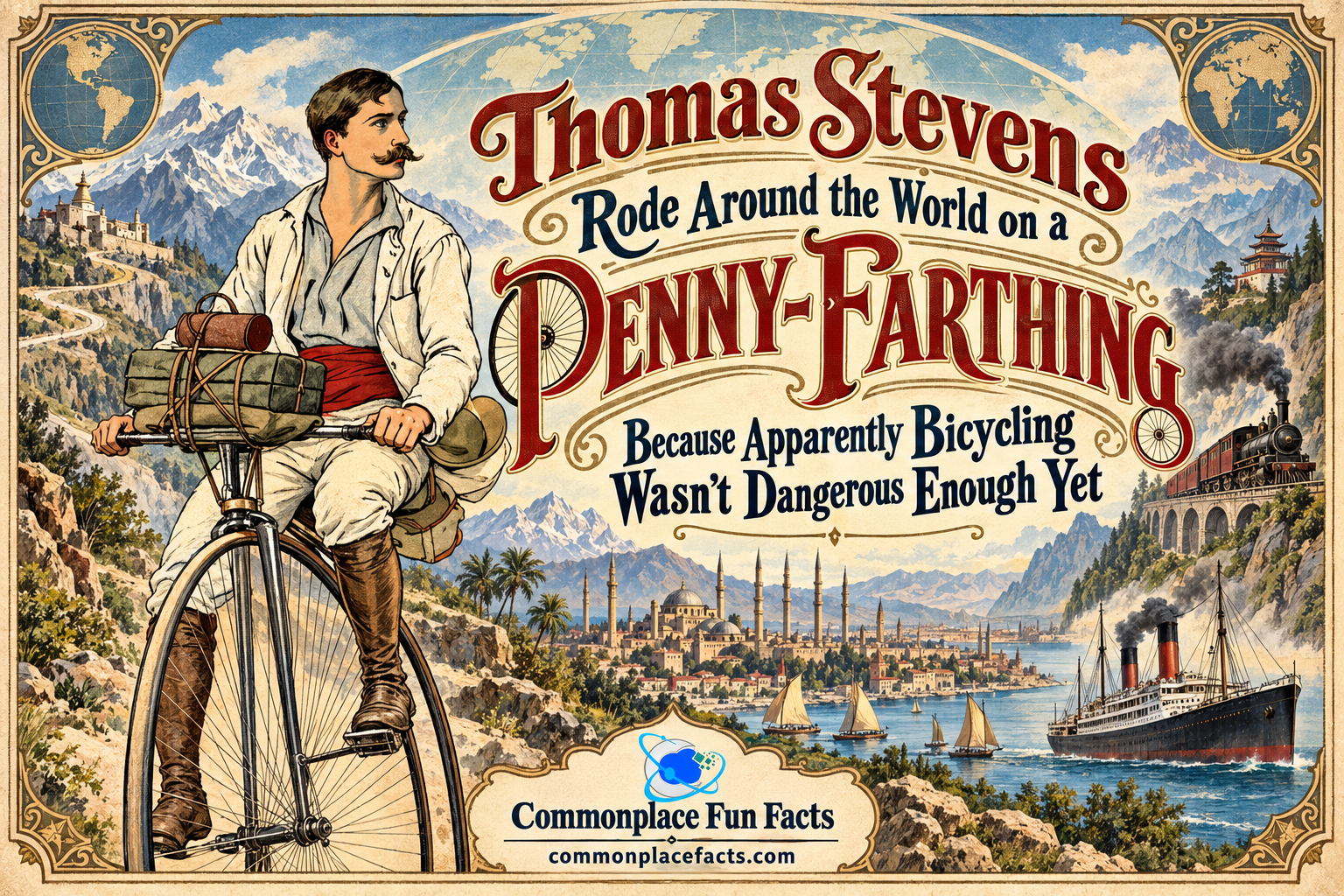

When it comes to seeing the world, some ways are easier than others.
There are ships, trains, horses, carriages, and the perfectly respectable option of remaining home and allowing other people to send postcards. Even in 1884, a sensible traveler contemplating thousands of miles of bad roads, deserts, mountains, political borders, bandits, unfamiliar languages, and large portions of geography where the concept of a road was still fairly theoretical had choices.
Thomas Stevens chose a bicycle.
Not a modern bicycle with pneumatic tires, gears, dependable brakes, a padded saddle, and two wheels that have at least agreed to be approximately the same size. Stevens rode a 50-inch high-wheel bicycle of the type now generally called a penny-farthing: enormous front wheel, tiny rear wheel, solid rubber tires, pedals attached directly to the front axle, and a saddle positioned high enough above the ground so that gravity became an irritable and unreliable travel companion.
On April 22, 1884, Stevens left San Francisco and headed east. By the time he finished the bicycle portion of his journey in Yokohama, Japan, on December 17, 1886, he had wheeled approximately 13,500 miles across North America, Europe, and Asia. Ships and trains carried him across the portions where oceans, governments, geography, or common sense made cycling impossible, but Stevens repeatedly returned to his high-wheeler and continued eastward.
By the time he finished his journey, he had become the first person recognized as having circled the globe by bicycle.
The accomplishment is impressive enough before we examine the bicycle.
But trust us: we are absolutely going to examine the bicycle.
Contents
Thomas Stevens and the Bicycle That Wanted to Kill Him
The machine Stevens rode was a Columbia high-wheel bicycle manufactured by the Pope Manufacturing Company, one of the most important early American bicycle makers. Stevens described his machine as having a 50-inch front wheel.

These bicycles made a certain amount of engineering sense. The pedals were connected directly to the front wheel, so one revolution of the pedals produced one revolution of the wheel. There were no gears to multiply the distance traveled with each turn. If you wanted to go farther with every pedal stroke, the obvious solution was to make the driven wheel larger.
Engineers kept making it larger until someone apparently forgot to ask whether the rider would also like to survive.
It doesn’t take an engineer to understand the central problem with the high-wheeler: the rider’s center of gravity sat only slightly behind that enormous front wheel. Hit an obstruction and the bicycle might stop while the rider continued forward, producing the infamous “header”—a rapid transition from transportation to ballistics.
High-wheel bicycles could put the saddle more than 1.5 meters, or about 5 feet, above the road. That was an impressive vantage point right up until the moment the road unexpectedly rose to meet you.
If the entire arrangement sounds unnecessarily dangerous, it is worth remembering that transportation inventors of the period were still working through certain details. John Joseph Merlin had pioneered roller skates without adequately addressing steering or stopping, while early experimental road vehicles were introducing humanity to entirely new categories of traffic accident.
The nineteenth century was very good at inventing ways to move faster. The section of the engineering manual titled “And Then What?” occasionally arrived in a later edition.
Why Was It Called a Penny-Farthing?
The familiar name comes from two British coins. The penny was considerably larger than the farthing, which was worth one-quarter of a penny. Put a large penny beside a much smaller farthing and the silhouette suggested the oversized front wheel and tiny rear wheel of the bicycle.
At the time Stevens made his journey, however, riders were more likely simply to call such a machine a bicycle or high-wheeler. As newer “safety bicycles” with equal-sized wheels appeared, the older design became known as the “ordinary.” The penny-farthing label became increasingly useful once people needed a convenient name distinguishing the spectacularly dangerous old bicycle from the disappointingly practical new one.
This technological transition was already underway while Stevens was circling the planet. In 1885, while he was still traveling, John Kemp Starley introduced the Rover safety bicycle, whose chain-driven rear wheel and similarly sized wheels helped establish the basic arrangement modern bicycles still use. The change eventually opened cycling to a much wider public, although society promptly discovered other things to worry about. By the 1890s, physicians and commentators were warning women about the allegedly disfiguring condition known as “bicycle face”.
Humanity had finally made the bicycle considerably safer, leaving more time to invent imaginary diseases caused by riding it.
Packing for a Trip Around the World
Anyone planning a modern round-the-world bicycle trip might assemble waterproof panniers, GPS navigation, spare tubes, specialized tools, camping equipment, first-aid supplies, water filtration, chargers, lightweight clothing, emergency communications equipment, and enough energy bars to make food seem permanently joyless.

Stevens packed somewhat lighter.
A scholarly work preserved by the Library of Congress describes the luggage visible on his bicycle as socks, a spare shirt, a raincoat that doubled as tent and bedroll, and a pocket revolver. There were also tools and writing materials associated with the journey, but by modern expedition standards Stevens approached international travel with the packing philosophy of someone who had been told there would be a strict carry-on limit.
The revolver deserves particular attention because it establishes the hierarchy of anticipated problems. A change of underwear was negotiable. Personal defense was not.
Admittedly, wearing the same underwear for the entire journey may itself have contributed to his personal defense.
Stevens was 29 years old when he began. Born in Berkhamsted, England, in 1854, he had emigrated to the United States as a young man and spent years working in the American West. By 1884 he had decided to attempt something several others had already tried and failed to accomplish: crossing the United States on a bicycle. One small complication was that, according to later accounts, he had scarcely any bicycling experience when he came up with the idea. Apparently the appropriate response to “I’ve never really done this before” was “Excellent. Let’s try San Francisco to Boston.”
First, He Had to Cross America
Stevens left San Francisco on April 22, 1884 and headed across California toward the Sierra Nevada. His route eventually carried him through Nevada, Utah, Wyoming, Nebraska, Iowa, Illinois, Indiana, Ohio, Pennsylvania, and New York before ending in Boston on August 4.
The distance was roughly 3,700 miles by the roads, trails, towpaths, and other approximations of transportation infrastructure available to him. A contemporary account in Harper’s Weekly reported that more than one-third of the route had to be walked rather than ridden. The important point was not that Stevens remained continuously on the saddle. The important point was that he got the bicycle across the continent at all.
The roads of 1884 were not waiting patiently for an international cycling tourist. Outside cities, Stevens encountered wagon tracks, mud, sand, railroad grades, mountain routes, and long stretches where “road” was partly a description and partly an aspiration.
If you have ever wondered why cyclists became enthusiastic supporters of better roads, this helps explain it. Long before automobiles turned highway construction into a national obsession, bicycle organizations were campaigning for improved surfaces. The transformation from wagon tracks to modern highways would take decades; as our history of the American Interstate Highway System shows, even early twentieth-century cross-country travel could involve heroic levels of mud.
Stevens was dealing with that problem decades earlier while balancing five feet above it.
When he reached Boston, he had completed what is generally recognized as the first transcontinental bicycle trip across the United States. Most people would have considered that sufficient material for a lifetime of irritating dinner-party stories.
Stevens decided it would make a good opening chapter.
Crossing America Was Only the Beginning
Stevens spent the winter preparing for the larger adventure and writing about his American crossing. The cycling magazine Outing backed his continued travels as a correspondent, giving him the useful combination of financial support and a professional reason to keep doing something increasingly unreasonable.
In the spring of 1885 he sailed to England. On May 2, he set off from Liverpool, accompanied for the opening miles by about 25 British cyclists who understandably wanted to participate in the journey while it still involved roads they recognized and hotels with roofs.
From Britain he crossed to continental Europe and rode through France, Germany, Austria-Hungary, and the Balkans toward Constantinople. European bicycle clubs welcomed him, crowds gathered to see the exotic traveler and his machine, and for a while the journey resembled a particularly long cycling tour.
Then he reached the part of the map where the roads, governments, and international politics became less cooperative.

The Bicycle Meets Geopolitics
One of the pleasures of reading Stevens’s own account is watching an apparently simple transportation project collide with the nineteenth-century contest of empires. He was not merely choosing roads. He was trying to pass through territories where Britain, Russia, Persia, Afghanistan, and the Ottoman Empire had strategic interests and where the arrival of a lone foreigner pushing an enormous wheeled contraption could generate understandable questions.
Stevens reached Tehran and spent the winter considering routes east. His preferred plan involved crossing Turkestan and southern Siberia toward the Pacific. Russian authorities refused permission for the necessary passage. British representatives were hardly enthusiastic about some of his alternatives either.
He tried Afghanistan.
That did not work either. British officials had already warned Stevens not to enter Afghanistan, but he crossed the frontier anyway. Afghan authorities arrested him at Farrah, escorted him to Herat, and eventually conducted him back across the border into Persia rather than allowing him to continue toward India. The problem was therefore somewhat more serious than a bureaucrat refusing to stamp the right form. Stevens had reached the stage of international travel where governments were personally returning him to where he came from.
This left him in the peculiar position of having traveled thousands of miles around the world only to discover that the shortest route forward required governments to participate in his hobby.
They declined.
Around the World by Bicycle Does Not Mean Every Mile Was Pedaled
This is an important point because “the first bicycle trip around the world” can easily create the wrong mental picture. Stevens did not ride across oceans, and he did not pedal continuously across an unbroken land route from Europe to East Asia. Nobody installed a particularly ambitious pontoon bridge across the Pacific for him.
When political borders or impossible terrain blocked the bicycle route, Stevens used ships, trains, and other transportation to reach a place where he could resume riding. After his failed attempt to continue through Afghanistan and his inability to use the Russian route, he eventually traveled west and used steamship and rail connections to reposition himself for India.
Stevens himself was admirably specific about the distinction. At the end of his published itinerary, he recorded the “distance actually wheeled” as approximately 13,500 miles. His achievement was a circumnavigation in which the bicycle served as his primary means of overland travel wherever a viable route existed, not an assertion that every inch of longitude passed beneath the front tire.
That remains enough. Anyone inclined to disqualify the accomplishment because boats were involved is welcome to demonstrate the improved method using an 1884 bicycle and the Pacific Ocean.
India Finally Gave Him a Decent Road
When Stevens resumed cycling in India in 1886, he encountered one of the most bicycle-friendly stretches of the entire expedition: the Grand Trunk Road. After mountain tracks, deserts, mud, and political dead ends, the great highway across northern India was sufficiently good that Stevens remembered this stage as among the most enjoyable parts of the journey.
The temperature was another matter. Stevens crossed northern India during fierce heat, trading some of the problems of bad roads for the new experience of being slowly cooked on a bicycle. He rode through Lahore, Amritsar, Delhi, Agra, Cawnpore—now Kanpur—Allahabad—now Prayagraj—Benares—now Varanasi—and eventually reached Calcutta.
There he faced another geographic inconvenience: cycling overland from India into China was, in his judgment, impracticable. He boarded the steamer Wing-sang, traveled through Southeast Asian waters, and eventually reached Hong Kong.
Readers who want the full nineteenth-century version of the adventure can read Stevens’s own two-volume account for free. Project Gutenberg has Around the World on a Bicycle, Volume I: From San Francisco to Teheran and Volume II: From Teheran to Yokohama.
They are valuable primary sources, although they should be read as Victorian travel writing rather than neutral ethnography. Stevens could be observant, funny, curious, and generous toward people he met, but he also carried the racial and imperial assumptions of his era. Occasionally the biggest historical artifact in the book is not the bicycle but the worldview of the man riding it.
China Was Not Particularly Interested in His Travel Plans
After securing permission to travel through southern China, Stevens headed inland. This portion of the journey presented some of his greatest difficulties. Roads could deteriorate into tracks that were barely usable even for pedestrians, much less a high-wheel bicycle. He sometimes traveled by sampan, sometimes carried or pushed the bicycle, and periodically encountered crowds whose reaction to the strange foreigner and his machine ranged from fascination to hostility.
At Ki-ngan-foo, modern Ji’an, the situation became especially tense. Stevens encountered an angry crowd and eventually found protection with local officials. He remained under official supervision for days before continuing by boat toward the Yangtze River.
This is one reason Stevens’s trip is more interesting than a simple mileage record. The bicycle was an extraordinarily visible piece of technology. In places where almost nobody had seen such a machine, he was not just another traveler. He arrived sitting above the crowd on a giant metal wheel, dressed differently, speaking little or none of the local language, and expecting everyone to accept that this was a reasonable way to cross Asia.
It is difficult to fault anyone who required a moment.
Japan Was the Home Stretch
From eastern China, Stevens traveled by steamer to Shanghai and then boarded another ship for Nagasaki. On November 23, 1886, he began the final major cycling leg: roughly 800 miles across Japan toward Yokohama.
Compared with what had come before, Japan delighted him. He found roads that were often rideable, frequent settlements, roadside inns, and scenery that made the final stage feel almost civilized. After more than two years of deserts, bureaucracy, ships, mountains, broken routes, hostile crowds, extreme weather, and the continuous possibility of being launched over the handlebars, ordinary accommodation must have seemed recklessly luxurious.
On the morning of December 17, Stevens covered the final miles into Yokohama. He later recorded that the bicycle portion of the tour that had begun in San Francisco on April 22, 1884 ended there that day.

His itinerary closed with the figure that perhaps best summarizes the undertaking: approximately 13,500 miles actually wheeled.
He then boarded the steamship City of Peking for the seventeen-day voyage to San Francisco, completing the geographic circle.
The Adventure Cycling Association recognizes him as the first person to circle the globe by bicycle. A scholarly study in World History Connected reaches the same conclusion.
The Bicycle Made It Too
There is something satisfying about the fact that Stevens did not simply survive the journey; his Columbia did too.
The bicycle endured thousands of miles of roads for which bicycles had never been intended, repeated handling aboard ships and trains, mountains, deserts, mud, repairs, and the burden of being carried whenever the world declined to provide something resembling a rideable surface.
It was, in its own way, a remarkably robust machine. High-wheelers were dangerous, but they were mechanically simple. No chain needed adjustment. No derailleur could bend because derailleurs had not yet been invented. There were no pneumatic tubes to puncture because the tires were solid rubber. The machine had relatively few complicated parts, which is comforting when the nearest specialized bicycle shop is several thousand miles and one industrial revolution away.
Pope Manufacturing reportedly preserved Stevens’s bicycle for decades after his return. Unfortunately, accounts indicate that it eventually disappeared into a World War II scrap-metal drive.
After surviving a trip around the planet, the bicycle was finally defeated by recycling.
Stevens Was Not Finished Being Thomas Stevens
Many people who had just circled the world on a penny-farthing might have concluded that life had provided enough adventure. Stevens apparently regarded the experience as evidence that he should seek employment requiring more of it.
He became a travel writer and correspondent. A few years later, he went to East Africa in connection with the search for news of explorer Henry Morton Stanley and the Emin Pasha Relief Expedition. He traveled in Russia, undertook other expeditions, and returned to India to investigate claims surrounding yogis and religious ascetics.
Eventually Stevens settled in England and became manager of London’s Garrick Theatre, which seems almost comically stationary after everything that had preceded it. He died in 1935 at the age of 80.
His bicycle trip, meanwhile, helped establish the possibilities of long-distance cycling at almost the exact moment bicycle technology was about to change dramatically.
Thomas Stevens Rode Into a Transportation Revolution
That timing may be the most interesting part of the story.
Stevens began his journey when the high-wheel bicycle represented sophisticated personal transportation. Before he finished, the safety bicycle was already pointing toward the modern design. Within a few years, chain drives, equal-sized wheels, improved brakes, pneumatic tires, and mass production would turn cycling from a specialized pursuit of athletic daredevils into something millions of ordinary people could do.
The bicycle would have consequences far beyond recreation. Its bearings, wheels, tires, chain systems, precision manufacturing, and metalworking helped develop skills and technologies that flowed into motorcycles and automobiles. It also transformed personal mobility and social customs, including the sometimes baffling distinctions that eventually produced the question of why men’s and women’s bicycle frames came to look different.
Stevens therefore rode around the world on a machine that was simultaneously cutting-edge technology and nearly obsolete.
That is a difficult trick to accomplish intentionally.
The World Was Bigger When Thomas Stevens Started Pedaling
Modern travel makes distance remarkably easy to underestimate. A flight crosses an ocean in hours. Maps appear instantly on phones. Translation software can make sense of a sign. Credit cards work thousands of miles from home. Satellite navigation tells us where we are, and if something goes badly wrong, communication with the other side of the world takes seconds.
Stevens traveled through a world where a wrong route might consume days, permission from one government might determine whether an entire continent was passable, and information about the road ahead could come from someone who had never imagined a bicycle attempting it. Much of his route had not been designed for wheeled traffic at all.
And the machine beneath him offered no insulation from any of it. A bicycle connects the traveler directly to distance. Hills have to be climbed, weather has to be endured, bad surfaces announce themselves through the frame, and every mile exists because somebody actually moved through it.
That remains true on a modern bicycle.
On a penny-farthing, it was true from five feet in the air.
The First Bicycle Trip Around the World
It would be easy to treat Thomas Stevens as another amusing Victorian eccentric: the man who looked at a penny-farthing and decided the problem was that nobody had ridden one far enough.
There is certainly room for that interpretation.
But the achievement was more substantial. Stevens crossed the United States before good roads connected much of the country. He crossed Europe under his own power. He pushed into Persia, tested the limits of imperial bureaucracy, entered Afghanistan, crossed India, struggled through southern China, and rode across Japan. When geography made cycling impossible, he found another route and resumed riding when he could.
By the time he stopped in Yokohama, he had become the first person known to circle the globe by bicycle and had actually wheeled about 13,500 miles.
Today, cyclists cross continents with carbon-fiber frames, electronic shifting, GPS navigation, technical fabrics, aerodynamic helmets, tubeless tires, satellite communicators, and equipment designed by people who have devoted entire careers to making bicycles lighter, safer, faster, and more comfortable.
Thomas Stevens had a giant front wheel, solid rubber tires, a spare shirt, a raincoat, and a revolver.
He seems to have decided the rest could be worked out along the way.
You may also enjoy…

Why Do Men’s Bicycles Have Horizontal Crossbars?
Discover why men’s bikes traditionally feature horizontal crossbars, the surprising history behind this design, and why modern bike frames are rethinking tradition.

A Warning for Women About the Dangers of Bicycle Face
Find out about Bicycle Face — a condition once feared among female cyclists.

The Vélo-Douche / Velocipede Shower Bath Lets You Pedal Your Way to Health and Cleanliness
Discover the whimsical Vélo-Douche/Velocipede Shower Bath, a quirky Victorian invention that combines a stationary bike with a shower bath. Learn how this ingenious device promised fitness, cleanliness, and a dose of steampunk charm, all powered by pedal power. Perfect for fans of oddball history and unique innovations!



Leave a Reply