
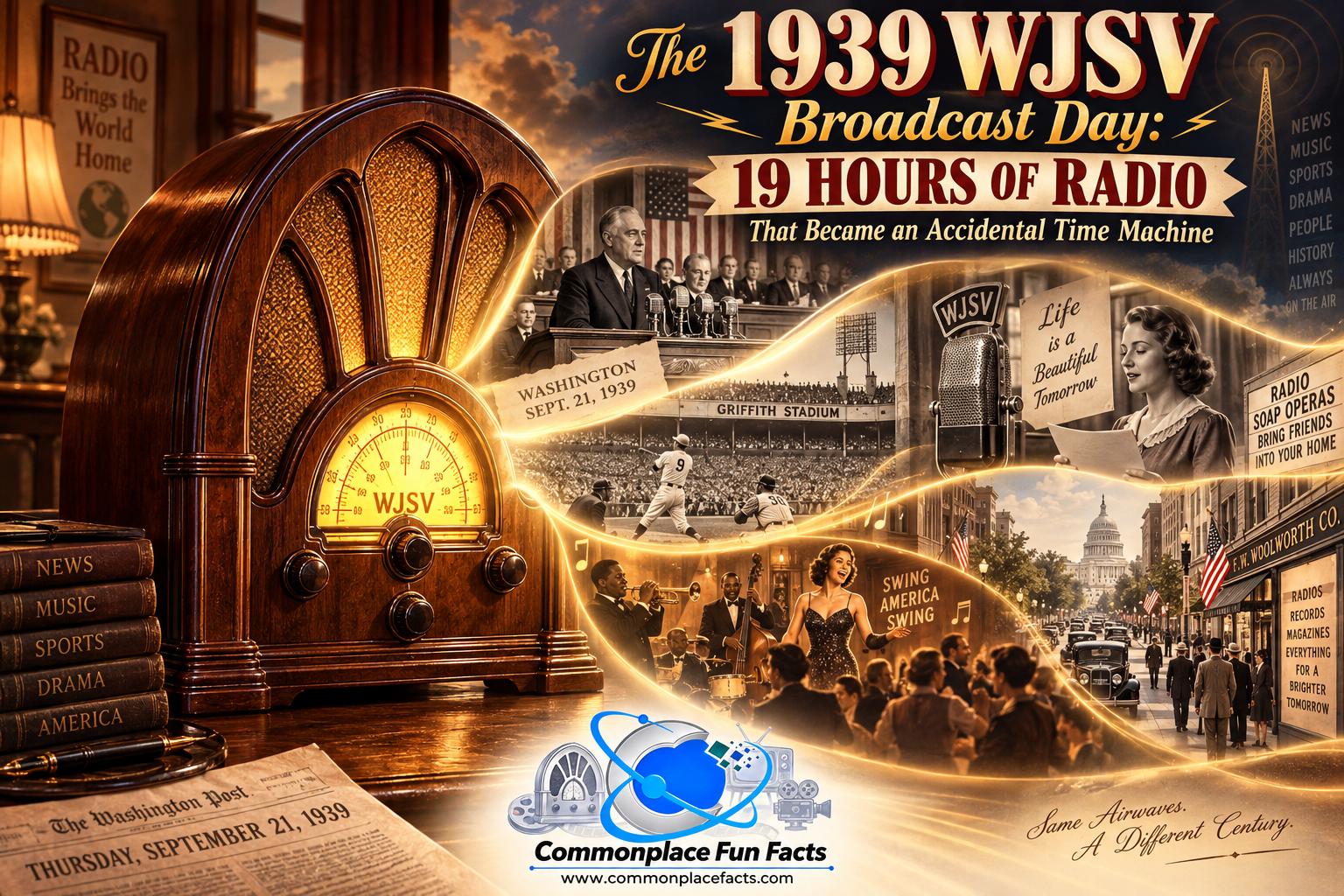

Suppose you could turn a dial and hear September 21, 1939.
Not a documentary about it. Not actors recreating it. Not a carefully edited collection of historically significant moments accompanied by a narrator explaining why you should be impressed. The actual day, passing in real time.
You would hear music before breakfast, local news, commercials, soap operas, quiz shows, baseball, comedy, political commentary, dance bands, weather reports, and announcers filling the little spaces between programs. You would hear Arthur Godfrey chatting about a boat for sale. You would hear President Franklin Roosevelt address Congress as war spread across Europe. You would hear baseball legend Walter Johnson calling a Washington Senators game. At night, you would get Amos ’n’ Andy, Major Bowes’ Original Amateur Hour, drama, news, and Louis Prima.
You would also hear technical problems, dead air, commercials for products that no longer exist, and all the miscellaneous broadcasting debris that nobody would normally think worth saving.
And you can.
On Thursday, September 21, 1939, Washington, D.C., radio station WJSV recorded its entire broadcast day from sign-on in the morning until sign-off around 1:00 the following morning. The Library of Congress describes the WJSV Broadcast Day as the first known recording of a complete broadcast day by an American radio station, while the National Archives calls it the earliest documentation of a complete day of radio.
Nineteen hours later, somebody had preserved something much rarer than a famous broadcast.
They had preserved Thursday.
Contents
Before There Was a Record Button
Today, preserving 19 hours of audio is not much of a technical achievement. Your phone could do it while simultaneously displaying weather radar, translating Norwegian, and reminding you that your screen time is becoming embarrassing.

In 1939, matters were considerably less convenient.
Magnetic tape had not yet become widely available to American broadcasters, so WJSV’s engineers had to record the day onto large transcription discs. Preserving the full 19 hours required 38 sixteen-inch, double-sided discs.
This was therefore not a matter of putting a machine in the corner and remembering to pick it up tomorrow. Someone had to make a deliberate effort throughout the day to keep the recording going. It was an extraordinarily cumbersome way to preserve ordinary radio.
The idea apparently developed from conversations between WJSV station manager Harry Butcher and R.D.W. Connor of the National Archives about the need to preserve radio broadcasts as historical records. That seems obvious now. It was considerably less obvious when radio was still something that disappeared into the air as soon as it was heard.
Radio itself had come a remarkably long way since Reginald Fessenden transmitted one of the earliest broadcasts of voice and music only a few decades earlier. By 1939, radio was no longer an experimental novelty. It was part of the furniture of American life.
Quite literally, in many cases. Those beautiful wooden cathedral radios that came to symbolize the Golden Age of Radio had helped transform the medium from a hobby for people willing to fiddle with wires and headphones into something the whole family could listen to from the living room.
6:00 A.M.: Good Morning, Washington
WJSV signed on at 6:00 a.m. Eastern Standard Time. The announcer identified the station, its CBS ownership, its Washington studios, its transmitter in Alexandria, Virginia, and its frequency of 1460 kilocycles. Then came recorded music.
And then, almost immediately, history gave us something wonderfully ordinary: a technical problem.

During that opening half hour, the station went off the air for several minutes for what listeners were told were “technical adjustments.” Because the point was to record the entire day, the silence survived too. Somewhere, someone in 1939 was presumably turning knobs and saying things that the microphone mercifully failed to preserve.
At 6:30, Arthur Godfrey arrived for Sundial, his local morning program. Godfrey had not yet become one of America’s biggest radio and television personalities, but the style that would make him famous was already there. He sounded conversational rather than grandly theatrical, chatting between records about local events, Boy Scout boxing tickets, birthdays, lost property, and a boat belonging to a station employee that he thought was a particularly good deal.
This may be one of the most historically valuable things about the recording precisely because nobody would normally have bothered to save it. Presidential speeches tend to make it into archives. Casual observations about somebody trying to unload a used boat before breakfast do not.
The complete WJSV broadcast day can be heard through the Library of Congress National Recording Registry. For anyone who prefers to wander through the day program by program rather than commit immediately to 19 consecutive hours of 1939, the Internet Archive also has the broadcast divided into individual recordings.
Fifteen Minutes of Love, Tragedy, and Household Products
Once the morning was properly underway, WJSV settled into one of the defining features of daytime radio: soap operas. Lots of soap operas.

The surviving broadcast contains 18 daytime dramas, most running just 15 minutes. Listeners could spend the morning with Bachelor’s Children, Pretty Kitty Kelly, Myrt and Marge, Hilltop House, Big Sister, When a Girl Marries, The Romance of Helen Trent, Our Gal Sunday, The Goldbergs, and a procession of other people experiencing more emotional difficulty before lunch than most of us manage in a fiscal quarter.
The programs were short because radio schedules worked differently from modern television. A sponsor could buy 15 minutes, place its product directly alongside a continuing story, and return tomorrow with another installment. Soap manufacturers became especially enthusiastic sponsors, helping give the “soap opera” its enduring name.
One program might be brought to you by cleanser, another by facial soap, another by Ivory Flakes. Commercial broadcasting had discovered an important principle very early: if audiences become emotionally invested in fictional people, there is apparently no inappropriate moment to remind them that the laundry needs attention.
The programs also demonstrate what made old-time radio so effective. There were no pictures. Everything had to be constructed through dialogue, music, sound effects, and the listener’s imagination—the same basic machinery that powered programs ranging from Lum and Abner to The Shadow.
Then an Ordinary Thursday Ran Into World History
September 21 had not been selected because everyone knew it would become historically important. It was essentially an ordinary Thursday chosen to demonstrate what a complete broadcast day sounded like.
History—for better or worse—had other plans.
Germany had invaded Poland on September 1. Britain and France had declared war two days later. World War II in Europe was less than three weeks old, and news was changing so rapidly that an apparently ordinary day could become historically significant while everyone was eating breakfast.

At 1:00 p.m., WJSV’s Sunshine Reporter carried news that Romanian Prime Minister Armand Călinescu had been assassinated by members of the fascist Iron Guard. Shortly afterward, regularly scheduled programming gave way to something rather more consequential than another chapter in somebody’s troubled romantic life.
At 1:45 p.m., WJSV switched to special coverage from Congress. After interviews and scene-setting from CBS correspondents, President Franklin D. Roosevelt began addressing the joint session shortly after 2:00. He wanted Congress to revise America’s neutrality laws, including repeal of the arms embargo, so that belligerent nations could purchase arms from the United States under a “cash-and-carry” system. The larger question hanging over the speech was obvious: with Europe at war again, how long—and under what conditions—could the United States remain outside it?
Because WJSV happened to be recording everything that day, the presidential address did not survive merely as a presidential address. It survives inside the day. Listeners move from soap operas and local advertisements into a president discussing a war whose eventual scale nobody yet understood, then back again into regular programming.
You can listen to the Roosevelt special session broadcast here.
That juxtaposition may be the most revealing thing in the entire WJSV broadcast day. History books divide existence into subjects: politics over here, entertainment over there, sports in another chapter, advertising somewhere nobody has to study unless the professor is unusually vindictive.
Real life does not work that way. The president talks about war, the speech ends, somebody tries to sell you something, and eventually it is time for baseball.
Next Up: Walter Johnson and the Washington Senators
At 4:00 p.m., WJSV joined a baseball game already underway at Griffith Stadium between the Washington Senators and Cleveland Indians. Washington lost 6–3, which was unfortunate for the Senators but considerate of them to provide future historians with a representative sample of Washington baseball frustration.

The real treasure is one of the men behind the microphone. Helping with the play-by-play was Walter Johnson, the legendary Senators pitcher known as the “Big Train.” Johnson had retired as a player more than a decade earlier after 21 seasons in Washington, leaving behind a career that would put him among the first five players elected to the Baseball Hall of Fame in 1936.
Old photographs can show us Johnson’s delivery. Statistics can tell us what he accomplished. The WJSV recording lets us hear his voice while he watches another generation play on the same field where he became famous.
The surviving WJSV baseball broadcast can be heard here. The recording joins the game in the fourth inning and continues through the final out.
Prime Time, 1939 Style
By early evening, the soaps had finally exhausted their daily supply of marriages, misunderstandings, illnesses, and stern organ chords, and WJSV moved into the programs aimed at the entire household.
At 6:00 came Amos ’n’ Andy, one of the most popular and culturally consequential programs in American broadcasting history. The surviving WJSV recording even preserves a network problem at the beginning of the program, forcing local organist Johnny Salb to fill airtime until the connection behaved itself.

You can hear that September 21 episode of Amos ’n’ Andy here.
The evening continued with comedian Joe E. Brown, the quiz program Ask-It Basket, and Strange As It Seems, which turned unusual people, historical curiosities, remarkable coincidences, and supposedly true oddities into miniature radio dramas complete with actors, sound effects, and suitably dramatic music. In other words, it occupied much the same peculiar corner of the information universe as Commonplace Fun Facts—only with a radio orchestra instead of hyperlinks and, presumably, a more respectable payroll. The resemblance becomes even stronger when you discover that one of the stories heard during the September 21 broadcast concerned Timothy Dexter, the spectacularly eccentric businessman whose improbable career we have examined before.
Strange As It Seems did, however, have something we lack: sponsorship from Palmolive Shave Cream. On this particular broadcast, another featured subject was scientist George Washington Carver, who briefly appeared on the program himself—a feat he has, surprisingly, yet to duplicate on Commonplace Fun Facts.
At 8:00 came Major Bowes’ Original Amateur Hour, which offered listeners an animal impressionist, singers, a whistling virtuoso, yodeling sisters, and even a tap dancer.
Yes, a tap dancer. On radio.
Somewhere in that sentence lies a useful reminder that old-time radio audiences were extremely good at supplying their own pictures.
It was also an audience accustomed to taking radio seriously as a source of both entertainment and information. Less than a year earlier, Orson Welles and the Mercury Theatre had demonstrated how powerfully the conventions of radio news could be imitated in the famous 1938 broadcast of The War of the Worlds. On this night, however, the news about Europe was quite real.
The Advertisements May Be More Interesting Than the Programs
Anyone accustomed to listening to old-time radio today usually encounters it in unnaturally tidy form. We select a particular episode, press play, listen to the program, and stop. It is rather like studying modern television by watching nothing except individual episodes on streaming services. You get the entertainment but lose the environment in which it originally lived.
The WJSV broadcast day gives the environment back.
You hear station identifications and time checks. You hear news updates inserted between entertainment programs. You hear announcers dealing with delays and technical failures. You hear advertisements for clothing stores, cars, patent medicines, food, beer, gasoline, soap, tires, candy, furriers, and products that apparently existed chiefly so announcers could spend 45 seconds explaining why civilization would collapse without them.
You also hear things that are uncomfortable now. Some advertising and entertainment contain racial stereotypes and material that has aged very badly. That is part of what makes an unedited historical record valuable. Nobody in 1939 cleaned it up to make themselves look better to people in 2026.
A genuine time capsule does not preserve only the parts of a culture its descendants would like to remember. It preserves what was actually there.
WJSV Had Already Lived a Rather Complicated Life
The station responsible for this extraordinary historical record had a history strange enough to deserve an article of its own.
It also had an unexpected connection to the Ku Klux Klan controversy that helped turn the 1924 Democratic National Convention into the infamous “Klanbake.” During that convention, the Klan distributed thousands of copies of The Fellowship Forum around New York City, using the newspaper to attack Al Smith and his Catholic faith. A few years later, that same publication would become part of WJSV’s family tree.
The station began broadcasting from Brooklyn in 1926 as WTRC, operated by the Twentieth District Regular Republican Club, whose pro-Klan faction was battling mainstream Republicans for control of the local party organization. After the station moved to Virginia in 1927, it became WTFF—call letters taken from The Fellowship Forum, the Klan-aligned newspaper that had been distributed during the 1924 convention. The station later became WJSV, using the initials of Fellowship Forum publisher James S. Vance.
CBS purchased the station in 1932, ending the Klan connection. The WJSV letters nevertheless remained, leading some listeners to assume they meant “Jesus Saves Virginia.” They did not. Sometimes a call sign is merely the owner’s initials, although history plainly had the opportunity to make this considerably easier to explain and chose not to.
WJSV became WTOP in 1941. The call letters would go on to become one of the most familiar names in Washington broadcasting.
After Midnight, the Bands Kept Playing

By about 11:20 p.m., the daytime dramas, baseball, prime-time variety programs, and even a late-evening rebroadcast of Roosevelt’s address were finally finished. WJSV moved into late-night dance-band broadcasts.
There was Jerry Livingstone and his orchestra, followed by Teddy Powell. At midnight, Louis Prima and his orchestra broadcast from the Hickory House in New York. Bob Chester followed from the Hotel Van Cleve in Dayton, Ohio.
If you want half an hour that immediately makes 1939 feel considerably less like a sepia photograph, listen to Louis Prima’s midnight broadcast. Eighty-seven years disappear rather quickly once the band starts playing.
At 12:55 a.m. came one final news summary. Then the weather. Then the national anthem.
At about 1:00 a.m., WJSV signed off.
The recording stopped. The world did not.
The Recording Almost Became More Important Than Anything on It
Individual pieces of the WJSV day are historically interesting. Roosevelt’s speech matters. Walter Johnson matters. Arthur Godfrey matters. The major network programs matter. Scholars of broadcasting could spend a respectable amount of time analyzing the advertising alone, thereby proving once again that graduate school can make almost anything billable by the hour.
But the real historical importance lies in having all of it together.
The National Archives describes the WJSV recordings as an “aural snapshot,” and the Library of Congress selected them for the National Recording Registry in 2003. The Registry preserves recordings considered culturally, historically, or aesthetically significant to American life.
WJSV belongs there not because every minute is extraordinary, but because most of it isn’t.
Historic recordings usually survive because somebody knew something important was happening. A president was giving a speech. A musician was making a landmark recording. A championship was being decided. Someone deliberately pointed a microphone toward History with a capital H.
The WJSV broadcast day points the microphone at ordinary life and keeps it there.
There Is No Such Thing as an Ordinary Day
Think about what September 21, 1939 must have felt like to most people living through it.
People got up and went to work. Someone wanted to sell a boat. Someone lost a watch. People listened to music while eating breakfast. Housewives followed fictional marriages and bought soap. Baseball fans wondered whether the Senators could pull out a win. Children came home from school. Dinner was prepared. Families gathered around the radio. Somebody laughed at Joe E. Brown. Somebody listened to a yodeling act on Major Bowes. Somebody stayed awake long enough to hear Louis Prima.
And in the middle of all that, Romania’s prime minister was assassinated and the president of the United States went before Congress to discuss a war that would eventually encompass much of the planet.
None of those things waited politely for the others to finish.
That is what the WJSV recording preserves better than almost any edited history can. Important events do not arrive accompanied by dramatic music and a title card informing everyone that this part will be on the exam. They happen between breakfast and baseball, take over the regular schedule for a while, occupy everyone’s attention, and then give way to the next thing.
The people listening to WJSV on September 21, 1939, probably did not think they were producing a historical document. They thought they were listening to the radio.
Fortunately, somebody kept the recorder running.
So if you have 19 hours to spare—or merely an unreasonable curiosity about what Thursday sounded like in 1939—you can listen to the complete WJSV broadcast day at the Internet Archive or access it through the Library of Congress National Recording Registry.
History preserved the president, the baseball legend, the famous entertainers, and the gathering storm of world events.
But it also preserved the commercials, the broken network connection, the morning technical difficulties, and a guy trying to sell his boat.
Sometimes the best time machine is the one nobody turned off.
You may also enjoy…

The Little Wooden Cathedral Radio That Taught America to Listen
Discover why the cathedral radio became the symbol of Old Time Radio, from Philco’s Baby Grand to America’s golden age of listening.

The CBS Talent Raid: When William Paley Went Star-Hunting and NBC Realized It Had Left the Vault Open
The CBS Talent Raid changed broadcasting forever. Learn how William Paley poached radio’s biggest stars from NBC and rewrote media history.

The Rise and Breakup of NBC’s Radio Empire
Discover how NBC built a color-coded radio empire with Red and Blue networks—and how government regulators forced a breakup that helped create ABC and reshape broadcasting.



Leave a Reply