
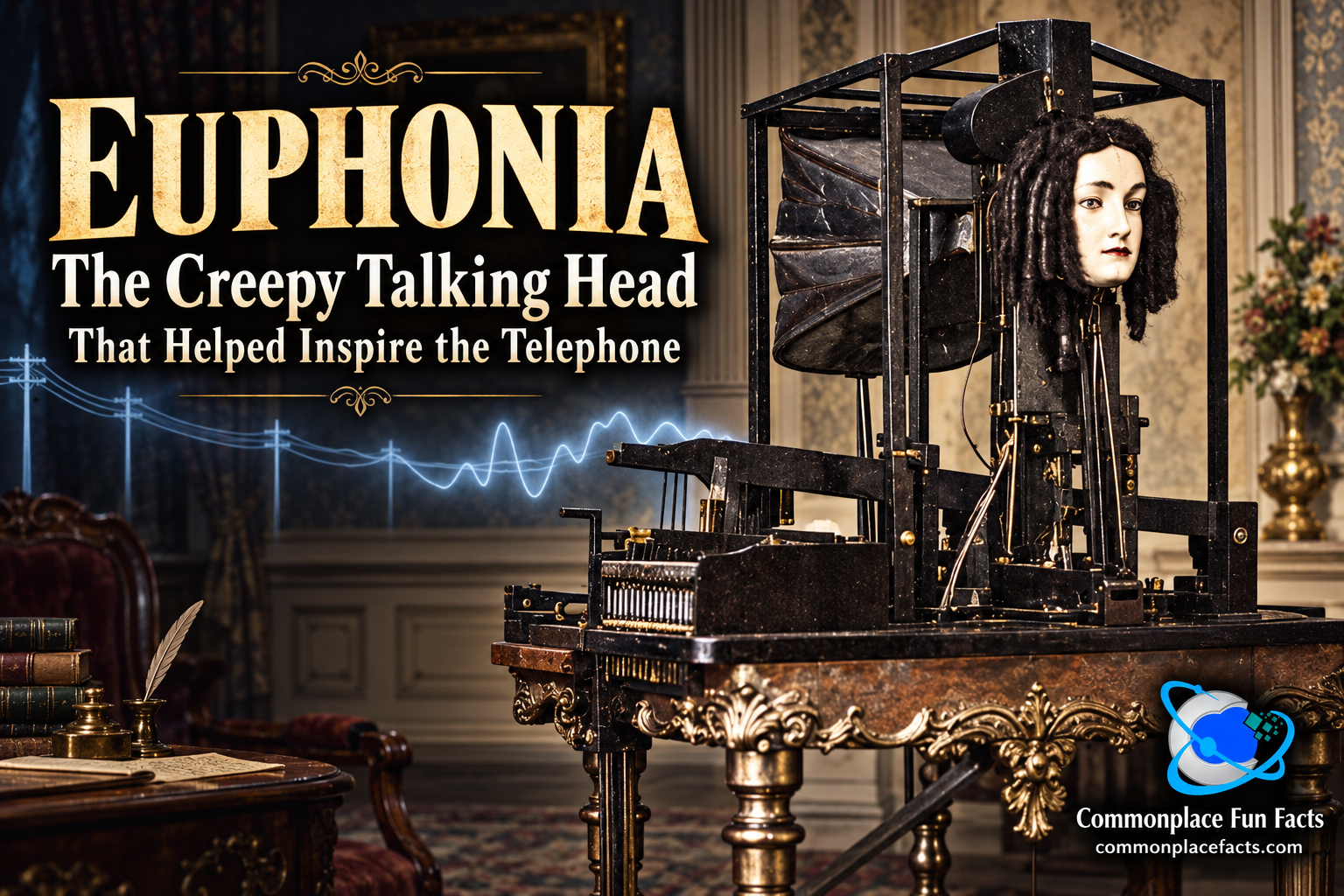

In December 1845, Joseph Faber brought a machine to Philadelphia that could talk.
Not record speech. Not play back speech. Not conceal a small and presumably underpaid man inside a cabinet. The machine actually manufactured recognizable human speech mechanically, using bellows, keys, levers, an artificial glottis, and mechanical approximations of the organs humans ordinarily use for such things.
And because apparently all of that was not sufficiently unnerving, Faber gave it a human face.
The result was a keyboard-operated mechanical talking head whose voice emerged in what one later account described as a weird, ghostly monotone. Audiences could suggest words and sentences, and Faber could make the machine say them. It was ingenious, remarkably flexible for its time, scientifically important, and creepy enough that the nineteenth century briefly seems to have wandered into a low-budget science-fiction film.
It was also, in a wonderfully indirect way, connected to the invention of the telephone.
Contents
Joseph Faber Builds a Machine That Can Talk
Joseph Faber was a German-born inventor from Freiburg who had studied in Vienna and spent years trying to reproduce human speech mechanically. He was not the first person to attempt such a thing. In the eighteenth century, Wolfgang von Kempelen had constructed a speaking machine that imitated parts of the human vocal tract, and British scientist Charles Wheatstone later experimented with an improved version.
Faber took the concept considerably farther.
By the 1840s, he had developed a machine sufficiently sophisticated that an operator could combine elementary sounds into words and entire sentences. According to an account preserved by the Smithsonian Institution Archives, Faber’s apparatus had sixteen levers or keys, rather like those of a piano, that controlled elementary speech sounds. A seventeenth controlled the artificial equivalent of the glottis. Foot-operated bellows supplied the air.

The rest of the mechanism attempted to do mechanically what the human throat, tongue, lips, mouth, and nasal passages accomplish biologically. Strings and levers substituted for muscles and tendons. Various movable parts altered the shape of the artificial vocal tract. Air passed through the apparatus, vibrations were created and modified, and recognizable speech emerged from the device.
Faber did not leave all of this machinery looking like a laboratory apparatus. He gave the machine a humanlike head, complete with a face and mouth from which the artificial speech appeared to emerge. The Smithsonian Institution Archives describes the result as a “bizarre-looking talking head,” and surviving illustrations show the face mounted prominently above the machine’s keyboard and mechanical workings. Giving a mechanical voice a human face may have made the principle easier for audiences to understand, although it also ensured that Euphonia looked rather like something that had escaped from a Victorian laboratory after its creator ignored several sensible warnings.
Creepiness aside, Faber’s accomplishment was significant. He constructed an analog speech synthesizer more than a century before anyone would have thought to call it one.
There was no stored vocabulary. The machine did not have a collection of prerecorded phrases waiting to be triggered. Faber had to play speech in real time, rather like a musician playing an instrument, except the instrument had lips and could answer questions.
This distinction is important because talking machines would later become much more familiar. Thomas Edison’s phonograph, for example, could reproduce a recorded human voice, a feat that was sufficiently astonishing that one skeptical scientist reportedly responded to an early demonstration by trying to physically expose the supposed trick. You can read about that episode in the curious story of the first phonograph demonstrations.
Faber’s machine was doing something fundamentally different. It was not preserving speech. It was creating it.
Joseph Henry Arrives Looking for the Hidden Ventriloquist
Before Faber publicly demonstrated his machine at Philadelphia’s Musical Fund Hall in December 1845, it attracted the attention of physicist Joseph Henry.

Henry was one of America’s most important scientists, particularly in the study of electromagnetism. He would soon become the first secretary of the Smithsonian Institution, and he had enough experience with supposed inventions to know that the nineteenth century contained roughly equal quantities of genuine scientific genius and men who had discovered perpetual motion immediately after discovering the location of a wealthy investor.
Henry therefore approached Faber’s machine with skepticism.
According to the Smithsonian’s account of Henry’s encounter with Faber, Henry accompanied scientist Robert M. Patterson to a private demonstration. Henry suspected that the talking machine might involve ventriloquism and believed he would be able to detect the deception.
He found no deception.
Instead, Henry came away impressed. He had already seen Wheatstone’s speaking apparatus in London, but he thought Faber’s device was far superior. Where Wheatstone’s machine could produce only a limited number of utterances, Henry reported that Faber’s could construct whole sentences from virtually any words supplied to it.
This was not merely a mechanical parlor trick. Henry recognized that Faber had broken speech into controllable components and built a machine capable of putting them back together again.
And then Henry had an idea.
What If the Talking Head Were Connected to a Telegraph?
This is where the story suddenly becomes much more interesting than “Victorian man builds alarming mechanical face.”
Henry understood electromagnetism. He understood telegraphy. Now he was standing in front of a machine whose individual speech mechanisms could be activated by keys and levers.
Why, he wondered, did those keys have to be operated by a person sitting beside the machine?
Henry suggested that electromagnets might be used to operate them remotely. Signals sent down a telegraph line could activate the appropriate mechanisms at the receiving end, causing Faber’s machine to speak words that had originated somewhere else.
That is not the telephone.
But we are getting uncomfortably close.
Bell’s eventual telephone worked on a different principle: it converted the continuously varying vibrations of a human voice into corresponding electrical variations that could be reproduced as sound at the receiving end. Henry’s concept would instead have sent electrical control signals telling a mechanical speech synthesizer which sounds to produce. The speaker’s actual voice would not have been transmitted; a mechanical voice at the receiving end would reconstruct the message from those signals.
It was, in a sense, closer to sending speech data than transmitting speech itself.
Henry even imagined a practical application: a sermon could be delivered over the telegraph wires to several churches simultaneously.
This tells us two things. First, Joseph Henry came remarkably close in 1845 to imagining electrically delivered spoken language. Second, even at the dawn of electrical communication, someone was already looking for a way to make one meeting serve several locations at once.
Humanity has been trying to invent Zoom longer than we realized.
Then Henry Went Back to Something More Interesting
The most delightful part of the episode may be what Henry did next.
Having contemplated a system in which electrical signals could cause spoken language to emerge at a distant location, Henry apparently did not rush to his workshop, lock the door, and invent the telecommunications industry.
He changed the subject.
In the same correspondence, Henry turned his attention to Michael Faraday’s recent experiments concerning magnetism and light. The Smithsonian historian who examined the episode describes Henry as having come tantalizingly close to imagining the telephone before moving on to scientific questions he considered more fundamental.
This is the sort of thing that makes technological history wonderfully untidy. We like inventions to arrive as lightning bolts: one genius, one moment, one laboratory bench, followed immediately by a patent application and several tasteful museum exhibits.
Reality is usually messier. Ideas arrive before the technology needed to realize them. Several people approach the same problem from different directions. Someone solves half of it without realizing what the other half might be. Someone else sees the future and then goes to lunch.
The telephone itself is a particularly good example, as the question of who actually invented the telephone turns out to be much messier than Alexander Graham Bell’s name on a textbook page.
Faber’s talking machine was about to become part of that mess.
Euphonia Goes to London
Faber had already spent years struggling to attract meaningful financial support. He had reportedly destroyed an earlier version of his machine in frustration after disappointing public reaction and then built another one.

That is commitment, although “I have destroyed seventeen years of work and shall now begin again” is probably not the productivity system most career coaches have in mind.
In 1846, Faber went to London in association with P. T. Barnum. His machine, now exhibited under the wonderfully optimistic name Euphonia, appeared at the Egyptian Hall in Piccadilly, one of London’s great venues for curiosities, demonstrations, spectacles, and things that sounded considerably less plausible once you got home.
A contemporary report in the Illustrated London News of July 25, 1846 described the machine in considerable detail. The reporter emphasized that the mechanism could be inspected and that there was no concealed performer. Faber operated keys in different combinations to produce articulate sounds.
The newspaper reported that Euphonia could speak German, English, French, Latin, and Greek. It could whisper. It could laugh. It could sing. The reporter supplied difficult words and phrases for Faber to reproduce, including “Philadelphia” and the distinctly patriotic “God bless Queen Victoria.”
The machine complied and reportedly added a hurrah and a laugh.
At which point one begins to suspect that the unnerving monotone was not the only thing keeping audiences awake that night.
Two weeks later, the Illustrated London News returned to the subject, noting that Faber claimed to have devoted twenty-five years to the project. The newspaper acknowledged an obvious objection: since Euphonia required a human operator to generate the speech, the operator might seem better advised simply to say the words himself.
This is true in roughly the same sense that a man playing a piano might save everyone considerable mechanical trouble by humming.
The point was not efficiency. It was that Faber had figured out how speech could be decomposed, mechanically modeled, and reconstructed.
The Bell Family Enters the Story
Among the people who saw Euphonia in London was Alexander Melville Bell.
This is where an important distinction needs to be made, because the story is sometimes compressed until it gives the misleading impression that a young Alexander Graham Bell personally saw Faber’s machine.
He did not.

His father did.
Melville Bell was deeply interested in the mechanics of human speech. He later developed Visible Speech, a system of symbols representing the positions and movements of the speech organs. Speech was not merely a professional interest in the Bell household. It was practically the family business.
According to the Smithsonian Institution Archives, Melville Bell saw Faber’s Euphonia in London in 1846 and came away deeply impressed.
Seventeen years later, in 1863, the memory was apparently still with him.
That year, Melville took his teenage son Alexander and Alexander’s brother to see Charles Wheatstone’s mechanical speaking apparatus. Afterward, he challenged the boys to construct a speaking machine themselves.
So they did.
Alexander worked on a mechanical mouth and tongue while his brother concentrated on the lungs and vocal apparatus. Their machine reportedly succeeded in producing something resembling the word “Mama.”
This was perhaps not the most extensive vocabulary ever developed, but considering the inventors were teenagers and their materials included rubber, cotton, bellows, and a skull, expectations should probably be adjusted accordingly.
More importantly, Alexander Graham Bell was learning exactly the lesson that had fascinated Faber: human speech was not magic. It was a physical process. If you understood how air, vibration, resonance, tongue position, and the shapes of the mouth and throat interacted, you could reproduce aspects of that process mechanically.
Alexander Graham Bell Was Raised in a House Full of Speech
The talking-machine experiment was not an isolated childhood diversion. Bell’s entire life was saturated with questions about speech and sound.

His father developed Visible Speech. His mother was deaf. Bell became a teacher of deaf students and devoted considerable attention to understanding how speech was produced and perceived. The National Museum of American History’s account of Bell’s sound research shows just how closely his later electrical experiments grew out of his earlier work on acoustics and speech.
In the 1870s, Bell experimented with a phonautograph, a device that translated sound vibrations into visible traces. One of his versions famously used an actual human ear as part of the mechanism, because nineteenth-century scientists were extremely good at advancing knowledge and somewhat less committed to making future museum visitors comfortable.
Bell also worked on harmonic telegraphs designed to send multiple signals over one wire. Eventually, those strands began to come together. If individual tones could be converted into electrical variations, perhaps the complex collection of vibrations making up human speech could be converted as well.
By the summer of 1874, Bell was exploring what his father called “electric speech.” He envisioned electrical currents varying with the vibrations of sound and reproducing those vibrations somewhere else.
Now we really are talking about the telephone.
Joseph Henry Meets the Bell Family’s Next Talking Machine
There is one more wonderfully circular connection in the story.
In 1845, Joseph Henry had examined Joseph Faber’s mechanical talking machine and speculated about connecting something like it to a telegraph.
Thirty years later, Alexander Graham Bell sought Henry’s advice about an apparatus intended to transmit the human voice electrically.
Bell visited Henry in Washington in March 1875 and explained his experiments. Henry took particular interest in Bell’s work and encouraged him to continue. When Bell confessed that he did not possess enough electrical knowledge to solve some of the remaining problems, Henry’s advice was admirably concise: “Get it.”
Bell did.
With Thomas Watson’s assistance, Bell continued working on the problem. He filed his famous telephone patent in February 1876; it was issued on March 7. Three days later, Bell successfully transmitted intelligible speech to Watson.
By then, the mechanical talking head had disappeared from the immediate process. Bell’s telephone did not need an artificial tongue waiting at the receiving end. The electrical signal itself carried enough information about the original sound to reproduce the speaker’s voice.
Henry’s 1845 idea had therefore been leapfrogged. Instead of transmitting electrical instructions for synthesizing speech mechanically at the receiving end, Bell’s system converted the vibrations of speech into corresponding electrical variations that could be reproduced as sound elsewhere.
Did Euphonia Inspire the Telephone?
This is where we should resist one of history’s favorite temptations: drawing a perfectly straight line through events that were considerably more tangled when people were actually living them.
It would be too strong to say that Joseph Faber invented the telephone or that Alexander Graham Bell would never have developed it without Euphonia. Bell’s work emerged from many sources: his family’s extensive study of speech, his teaching, his experiments with acoustics, harmonic telegraphs, electrical theory, and the work of other scientists and inventors. Bell was also not alone in pursuing electrical speech, as the crowded history of the telephone makes abundantly clear.
But the documentary connection is real.
Faber built a sophisticated machine that synthesized speech. Joseph Henry examined it and immediately imagined using electromagnetism to make spoken words emerge at the far end of a telegraph line. Melville Bell saw Euphonia and remained interested enough in mechanical speech that years later he encouraged his sons to experiment with a similar machine. Alexander Graham Bell then spent years investigating speech, sound, and electrical transmission before developing the telephone.
No single arrow in that chain says “Euphonia caused the telephone.”
Taken together, however, they show how one strange invention can help shape the intellectual landscape in which another invention becomes possible.
The Talking Head Was More Important Than It Looked
Faber’s machine never became a commercial success. Despite favorable attention from scientists and admirers that reportedly included the Duke of Wellington, the financial rewards were meager. According to the Smithsonian, Faber died in the 1860s without achieving the fame or fortune he had sought.

Euphonia itself nevertheless occupies an important place in the history of artificial speech. The Computer History Museum places Faber’s talking head among the mechanical robots that preceded electronic and computer-controlled robotics. Viewed specifically as a speech machine, Euphonia was also a remarkably early example of mechanical speech synthesis.
That legacy becomes easier to appreciate if we mentally remove the Victorian costume.
Faber had constructed a device that modeled the physical production of speech, accepted real-time control inputs from a human operator, and synthesized intelligible spoken output. The machine could assemble novel utterances rather than simply repeat a predetermined message.
Strip away the bellows, rubber, strings, humanlike face, and atmosphere of a particularly troubling séance, and the basic problem sounds surprisingly modern.
How do you represent human speech in a form that a machine can reproduce?
Engineers are still answering that question. The answers have progressed from mechanical vocal tracts to electrical circuits, vocoders, digital signal processing, and artificial intelligence, but the objective would have been immediately recognizable to Joseph Faber.
Technology Has a Disturbing Fondness for Creepy Heads
There is also something oddly familiar about Euphonia’s appearance in technological history.
Inventors repeatedly discover that when a machine needs to imitate something humans do, the first experimental subject frequently ends up looking less like a polished commercial product and more like an object that should be removed from a haunted nursery.
Nearly eighty years after Euphonia, John Logie Baird would use a ventriloquist’s dummy head known as Stooky Bill while developing one of the earliest working television systems. The dummy’s strongly painted features provided the contrast Baird’s primitive equipment needed, while its willingness to sit indefinitely beneath brutally hot lights gave it another advantage over actual human volunteers. Once again, a creepy artificial head proved unexpectedly useful in the development of a technology that would transform civilization.
Apparently, if history presents you with an unsettling mannequin head, the correct response is not necessarily to leave the building. You may simply be witnessing the birth of a communications revolution.
Before the Telephone Could Speak, Euphonia Had Something to Say
Joseph Faber did not invent the telephone. He did something stranger.
At a time when the telegraph represented the cutting edge of long-distance communication, he built a machine that could manufacture human speech out of air, mechanical movements, and carefully coordinated controls. One of America’s leading scientists looked at it and almost immediately imagined those controls being operated electrically from miles away.
Then Faber’s machine crossed the Atlantic, impressed the father of Alexander Graham Bell, and became one of the experiences lurking in the background of a family that would devote itself to understanding human speech.
Three decades later, Bell would achieve something Faber’s machine could not. Instead of mechanically rebuilding words at the receiving end of a telegraph wire, he found a way to convert the vibrations of the human voice into corresponding electrical variations and reproduce those vibrations as sound at the other end.
Faber did not live to see where that journey led. His elaborate talking machine never made him rich, never became a household appliance, and never occupied the place in popular memory eventually reserved for Bell’s telephone or Edison’s phonograph.
But before machines could record voices, before they could transmit them, and long before they could generate them digitally, Joseph Faber sat at a keyboard and made a mechanical face talk.
Sometimes the future does not arrive looking sleek and revolutionary.
Sometimes it arrives with bellows, foot pedals, an artificial glottis, and a face you would prefer not to find staring at you from the other side of a dark room.
You may also enjoy…

Stooky Bill: The Creepy Puppet Head That Helped Invent Television
Meet Stooky Bill, the creepy puppet head that helped John Logie Baird invent early television, survive blazing studio lights, and launch one of history’s strangest technological breakthroughs.

The Surprising Age of the First Fax Machine
The first fax machine was invented by Alexander Bain in 1843. Initially requiring specialized paper and a pendulum for scanning, Bain’s invention paved the way for modern communication technologies. His innovations predated various significant advancements, underscoring the historical impact of the fax machine.

Who Invented the Telephone? The Messy Truth About Bell, His Rivals, and Impeccable Timing
Who invented the telephone? A light-hearted deep dive into Bell, Gray, Meucci, patents, paperwork, and the messy reality behind a famous invention.



Leave a Reply