
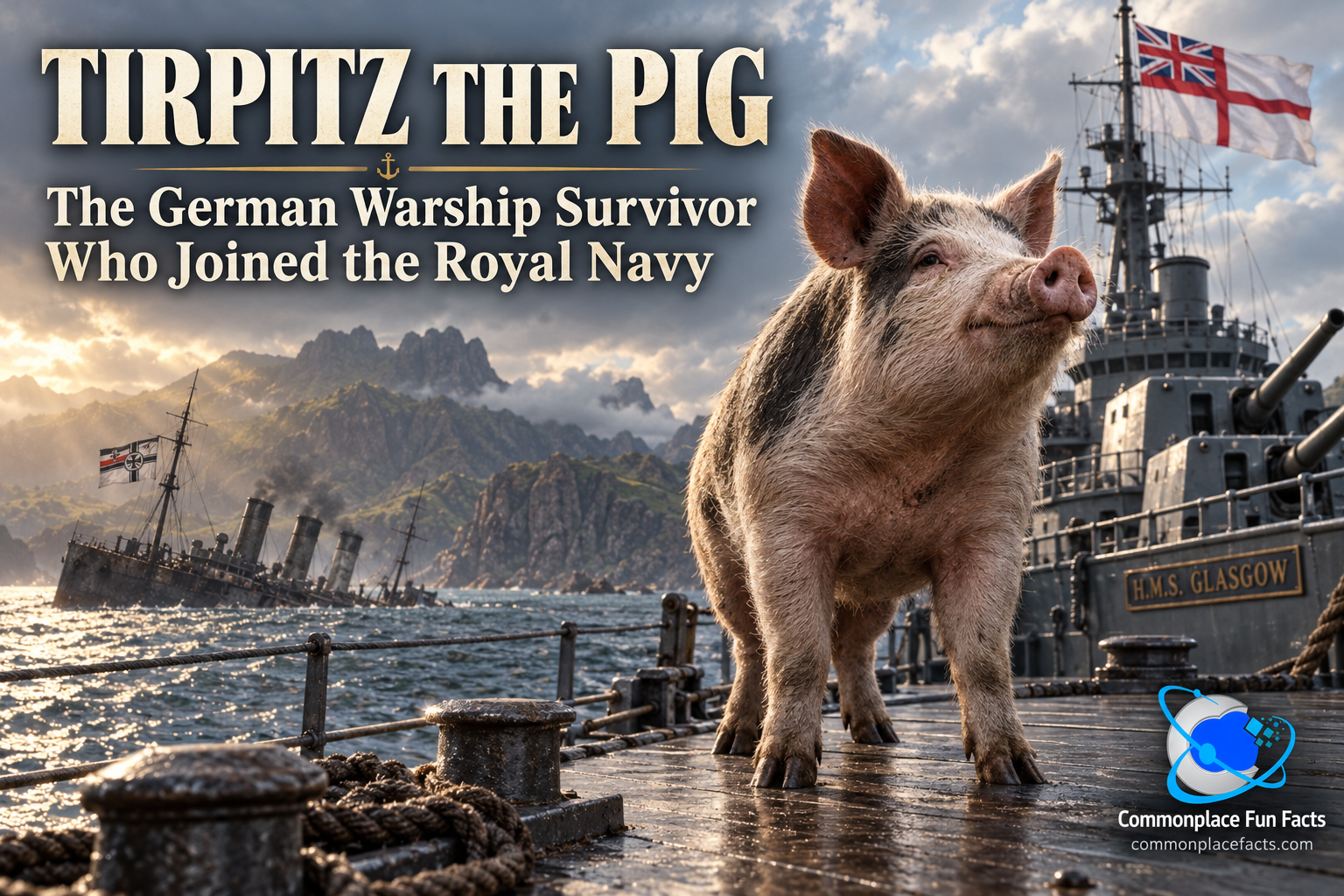

There are several traditional ways to change sides during a war. You can defect. You can surrender. You can be captured. Or, if you happen to be a pig aboard a sinking German cruiser in 1915, you can leap into the Pacific Ocean, swim toward the Royal Navy, and hope the British are feeling charitable.
That last option worked surprisingly well for Tirpitz.
During World War I, a pig aboard the German light cruiser SMS Dresden survived the destruction of the ship off the coast of Chile. British sailors from HMS Glasgow rescued the animal from the water, adopted it as their mascot, named it after one of Germany’s most famous admirals, and jokingly awarded it an Iron Cross for remaining aboard after the German sailors had left.
That would be enough for most pigs to retire on.
Tirpitz, however, still had several careers ahead: Royal Navy mascot, minor wartime celebrity, charity fundraiser, museum exhibit, and — in one final development that demonstrates history occasionally has difficulty recognizing when it should stop — part of a carving set.
Contents
Before the Pig, There Was a German Cruiser
To understand how a German pig ended up in British custody, we need to begin with SMS Dresden, because the pig did not simply wander into a naval battle while looking for truffles.
Dresden was a German light cruiser serving with Vice Admiral Maximilian von Spee’s East Asia Squadron when World War I began. The squadron scored a major victory over the Royal Navy at the Battle of Coronel off Chile on November 1, 1914, sinking two British armored cruisers.
The celebration did not last long.
On December 8, a powerful British squadron met von Spee’s ships near the Falkland Islands. The resulting Battle of the Falkland Islands was catastrophic for the Germans. Von Spee was killed, most of his squadron was destroyed, and Dresden became the principal survivor, escaping into the Pacific while British ships began hunting for her.
Among those pursuers was HMS Glasgow, which had already survived Coronel and fought at the Falklands. According to the surviving Royal Navy logbooks of Glasgow, the hunt finally ended on March 14, 1915, at Cumberland Bay in the Juan Fernández Islands, several hundred miles west of mainland Chile.
This was where an international naval confrontation would produce one of the more unusual personnel transfers of the war.
March 14, 1915: The End of Dresden
Dresden had taken refuge at the island then known as Más a Tierra, now Robinson Crusoe Island. The cruiser was short on coal, needed repairs, and was sitting inside Chilean territorial waters. Chile was neutral.

That last fact should have made things awkward.
It did.
On the morning of March 14, Glasgow, HMS Kent, and the armed merchant cruiser Orama arrived at Cumberland Bay. Glasgow’s log records sighting Dresden at 8:41 a.m. The British opened fire at 9:10, ceased briefly, then resumed. At 9:14, Dresden raised a white flag.
The British attack took place in neutral Chilean waters, a violation Britain subsequently acknowledged. The Royal Museums Greenwich preserves a photograph of Dresden in Cumberland Bay with the white flag visible and notes that the British action violated Chilean neutrality.
The situation therefore involved naval warfare, international law, diplomatic protest, and the usual assortment of people discovering that things had become more complicated than originally anticipated.
The Germans decided not to allow their ship to be captured. After the crew evacuated, charges detonated aboard Dresden. Glasgow’s log records that the German cruiser’s forward magazine exploded at 10:30 a.m. and that the ship sank at 11:37.
Most of the German crew reached shore.
One passenger chose a different route.
Enter the Pig
After Dresden went down, British sailors spotted a pig swimming among the wreckage.
The animal had apparently been kept aboard the German cruiser as livestock, which means its original position in the Imperial German Navy was less “beloved mascot” and more “future entrée.” Keeping live animals aboard ships to provide fresh meat was hardly unusual in an era before modern refrigeration.

The pig nevertheless managed to survive the destruction of the ship and swim clear.
Members of Glasgow’s crew rescued the pig from the water. Sources differ over the precise details of the rescue, including the number and identity of the sailors involved, but the central event is well documented. Imperial War Museums says that one sailor jumped into the water to save the frightened animal and nearly drowned in the process.
The rescue itself was apparently not entirely graceful. Later accounts say the frightened pig nearly drowned the sailor attempting to save it, which seems ungrateful until one remembers that nobody had explained the geopolitical situation to the pig.
Once aboard, the former German food supply underwent a rapid promotion.
The British made it a mascot.
Why Call a Pig “Tirpitz”?
The sailors named their new companion Tirpitz after Grand Admiral Alfred von Tirpitz, the powerful German naval administrator who had overseen Germany’s enormous prewar naval buildup.
This was not intended as a compliment to Admiral Tirpitz.

The joke became more elaborate when the sailors supposedly awarded their porcine recruit an Iron Cross for remaining aboard Dresden after the human crew had departed. The International Encyclopedia of the First World War documents Tirpitz’s adoption as Glasgow’s mascot, while Imperial War Museum histories preserve the Iron Cross story as part of the animal’s naval folklore.
To be clear, this was not an official German military decoration awarded through appropriate channels. Berlin was not processing paperwork for pigs who had defected to the enemy. It was shipboard humor, the Royal Navy’s way of commending Tirpitz for displaying what might charitably be described as greater devotion to the ship than its crew.
The pig had gone from potential pork dinner to British naval mascot in approximately the amount of time necessary to sink one cruiser.
Was Tirpitz Male or Female? History Is Surprisingly Unhelpful
Here we encounter one of those minor historical mysteries that makes a researcher wonder how civilization managed to record the exact minute a cruiser sank while remaining uncertain about the sex of a very large pig living aboard a warship.
Many modern sources describe Tirpitz as female. Historical accounts, however, are inconsistent, and some identify the pig as male. There are also reports that the animal was originally called “Dennis” before acquiring the much grander name Tirpitz.
The British Newspaper Archive, which traced Tirpitz through contemporary newspaper coverage, specifically notes the conflicting accounts. The scholarly 1914–1918 Online encyclopedia calls the animal female and records the earlier name Dennis.
Unless somebody uncovers a naval veterinary examination containing considerably more information than most readers require, the safest approach is simply to acknowledge the disagreement.
Tirpitz was definitely a pig. Beyond that, the Admiralty apparently had other priorities.
Life Aboard HMS Glasgow
Tirpitz remained with Glasgow and became a genuine favorite among the sailors. Photographs survive showing the pig with members of the crew, looking remarkably comfortable for an animal whose previous employer had recently exploded.
Military mascots were hardly unusual. Animals supplied companionship, amusement, identity, and morale to troops living under extraordinary stress. Sometimes they also performed useful work. As we have seen in our broader look at the strange history of military and spy animals, human beings have recruited an impressive portion of the animal kingdom whenever war created a sufficiently unusual job opening.

Some of those animals became genuine heroes. The pigeon Cher Ami carried a lifesaving message during World War I despite suffering terrible wounds. Decades later, Wojtek the bear served alongside Polish troops during World War II.
Tirpitz’s principal military qualification appears to have been surviving and being entertaining.
In fairness, those are both useful skills during wartime.
Tirpitz Comes Ashore and Immediately Causes Trouble
When Tirpitz’s seagoing career ended, the pig was sent to the Royal Navy’s gunnery establishment at Whale Island in Portsmouth Harbour.
Whale Island already housed a collection of animal mascots and curiosities, so Tirpitz was not entering entirely unfamiliar territory. Unfortunately, according to later accounts reconstructed from period reports, Tirpitz proved less interested in peaceful retirement than the authorities might have preferred.
The pig broke into chicken runs in search of food.
This appears to have exhausted the Royal Navy’s tolerance for interspecies joint operations.
Tirpitz was eventually sent back to former Glasgow captain John Luce, who by then was involved with naval aviation training at Cranwell. One account says getting Tirpitz into the transport vehicle required ten men, which, if accurate, suggests the former German prisoner had developed strong opinions about reassignment procedures.
By late 1917, however, someone realized that Tirpitz possessed something considerably more valuable than obedience: celebrity.
The Pig Becomes a Fundraiser
On December 11, 1917, Tirpitz appeared at an auction in Chester. The animal was sold to William Cavendish-Bentinck, 6th Duke of Portland, for 400 guineas, with the proceeds benefiting charitable causes including the British Red Cross.
Four hundred guineas meant £420 — a substantial amount in 1917, particularly for a pig whose primary qualifications consisted of swimming, surviving, and having once belonged to the enemy.
The Duke apparently recognized that a famous pig could be sold more than once.
According to contemporary newspaper reports traced by the British Newspaper Archive, Tirpitz was sold repeatedly for charity. After the 400-guinea sale in Chester in December 1917, a February 1918 sale at Ayr raised £840 — the equivalent of 800 guineas — and a later sale at the Nottingham Patriotic Fair raised another £505. The Duke of Portland repeatedly bought Tirpitz back, allowing the famous pig to continue making the fundraising rounds.
Imperial War Museums later summarized Tirpitz’s fundraising by stating that she raised £1,785 for the British Red Cross, although the individual newspaper-reported sales do not line up neatly with that total, and some contemporary reports say that part of the money also benefited the Agricultural Relief of the Allies Fund. What is clear is that Tirpitz raised well over £1,000 for wartime charities — an impressive fundraising record for someone without opposable thumbs or a LinkedIn account.
The War Ends, but the Pig Story Somehow Gets Stranger
World War I ended in November 1918. Days before the armistice, mutiny among German sailors at Kiel helped ignite the German Revolution, which rapidly spread across the country and contributed to the collapse of imperial rule — a story we explored in “The 1918 Kiel Mutiny: The Revolt that Ended World War I.”
Tirpitz survived the war but died in 1919.
At this point, a normal biographical account might offer a tasteful conclusion about an unlikely survivor whose life had intersected with one of history’s greatest conflicts.
The British had other plans.
Tirpitz Goes to the Imperial War Museum

The Duke of Portland had Tirpitz’s head preserved and donated it to the Imperial War Museum. The mounted head was displayed when the museum opened to the public at the Crystal Palace in 1920.
It remains associated with the museum today, where visitors can encounter physical evidence that a German pig really did survive a naval battle, join the Royal Navy, and achieve sufficient fame to become a historical artifact.
This, however, accounts only for the front end of Tirpitz.
The trotters also survived.
And Then They Made Tirpitz Into Cutlery
At some point after Tirpitz’s death, two of the pig’s trotters were fashioned into handles for a silver-mounted carving knife and fork. The set became associated with a later HMS Glasgow and eventually entered the Imperial War Museum collection as well.
There is a grim symmetry to this that even a novelist would probably reject as excessively tidy.
Tirpitz had reportedly begun life aboard Dresden as livestock intended to supply fresh meat. The pig avoided becoming dinner by surviving the destruction of the ship, defected involuntarily to the British, became a naval celebrity, raised money for charity, and then had its trotters converted into implements for carving other dinners.
History had closed the circle.
Possibly with gravy.
The Most Successful Naval Defection Ever Accomplished by a Pig
Tirpitz’s story is amusing because nearly every stage sounds invented. A German cruiser is hunted across the Pacific. It is cornered in neutral Chilean waters. Its crew scuttles it. A pig swims away. British sailors rescue the pig and name it after Germany’s leading admiral. They give it a mock Iron Cross. It moves into a naval establishment, raids a chicken coop, becomes a charity fundraiser, winds up in a museum, and leaves behind a carving set made from its feet.
Yet the basic story is unusually well documented. Glasgow’s surviving log establishes the chronology of the final action against Dresden on March 14, 1915. Imperial War Museums preserves Tirpitz’s physical remains and institutional history. Contemporary newspapers followed the pig’s celebrity career and charity auctions. Serious scholarship on animals in World War I includes Tirpitz among the conflict’s notable mascots.
It is also a reminder that military history is not composed exclusively of generals, battles, treaties, and weapons. Wars create enormous communities of people and animals operating under circumstances nobody would choose. Mascots in particular could provide humor and familiarity in environments otherwise dominated by danger and death.
Tirpitz was not Cher Ami delivering a vital message or a trained military animal performing some essential task. The pig was simply there, improbably alive, providing sailors with a story worth telling.
Sometimes that is enough.
One More Pig in the History Books
Of course, Tirpitz is hardly the only pig to have wandered unexpectedly into military history. In 1859, another unfortunate porker helped bring the United States and Britain to the brink of armed conflict on San Juan Island, an episode we covered in “Tales from the Great and Glorious Pig War of 1859.”
That pig died and nearly started a war.
Tirpitz survived a war and joined the other side.
On balance, Tirpitz seems to have made the better career choice.
You may also enjoy…

The Scandalous Saga of the Ugly Man Who Was Executed for Fathering a One-Eyed Pig
Most people want their lives to be significant. We want to be remembered after we leave this world. It is downright depressing to consider the possibility of making so little of an impact that future generations give no thought at all to you. Then again, history has produced some characters who remind us that there…

Homicidal Horses, Predatory Pigs, Robber Rats: Trials and Executions of Animals in Medieval Courts
These pages have documented many unusual stories and facts relating to capital punishment. Regardless of your personal views on the subject, it probably goes without saying that you assume we are talking about the execution of humans. For much of human history, capital punishment was no respecter of persons or species. Animal criminals, as well…

Tales from the Great and Glorious Pig War of 1859
History is replete with stories of wars that were fought over the love of a woman, the quest for power, and ideological differences. In 1859 two of the world’s greatest military powers prepared for battle over a pig. The San Juan Islands, located north of Seattle, Washington, were part of a disputed territory claimed by…




Leave a Reply