
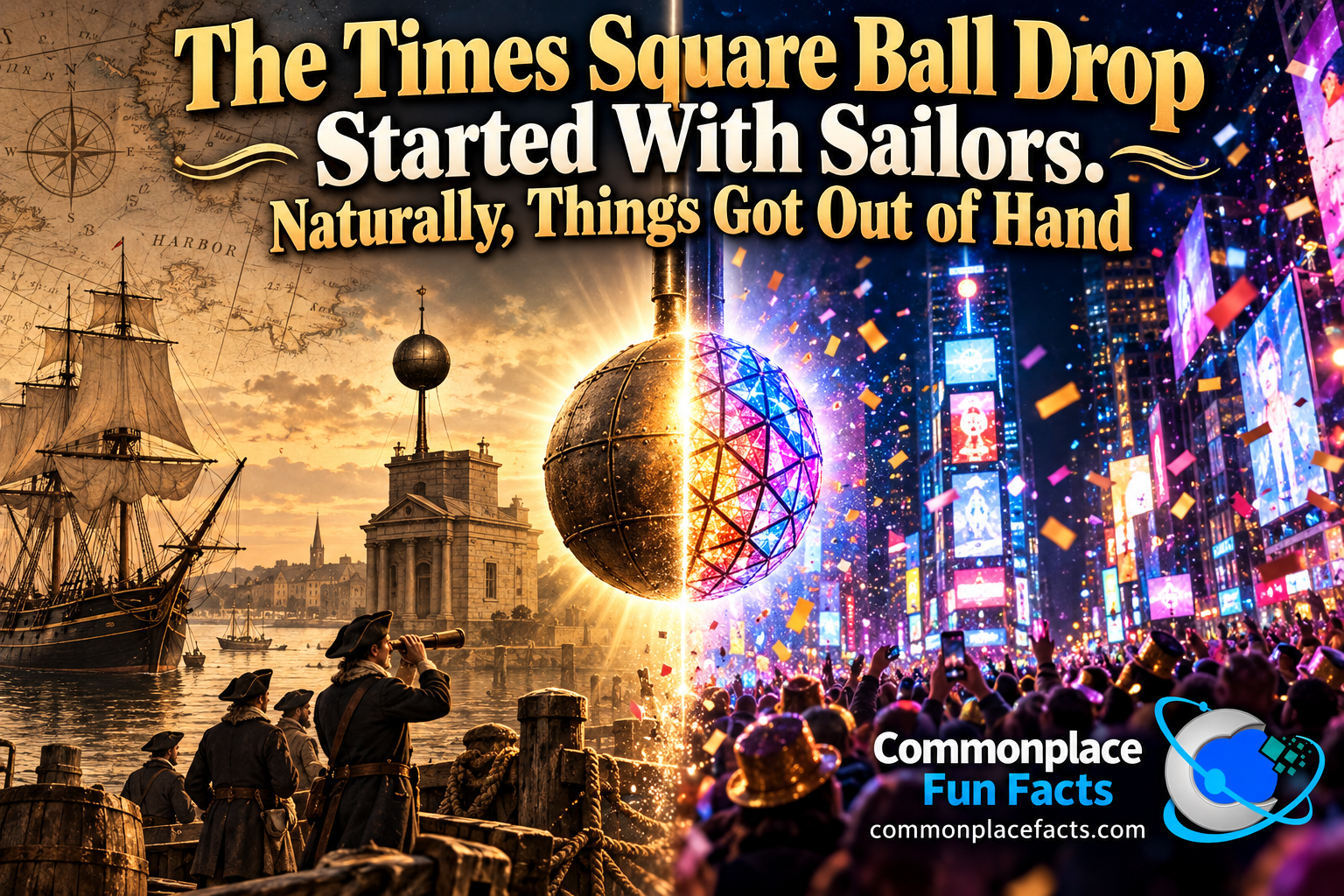

Every December 31, hundreds of thousands of people squeeze themselves into Times Square to watch a glowing ball descend a pole. Millions more watch from home, where they enjoy the added luxuries of heat, bathrooms, and the ability to leave whenever they want.
At 11:59 p.m., the ball begins its sixty-second descent. Everyone counts backward. At midnight, the ball reaches the bottom, confetti fills the air, strangers kiss, and television hosts attempt to conduct interviews while standing in what appears to be an industrial paper shredder.
The Times Square ball drop is one of the most recognizable New Year’s traditions in the world.
It is also descended from nineteenth-century navigation technology.
The idea of dropping a large ball at an exact moment was not invented for New Year’s Eve, Times Square, or even entertainment. Time balls were developed so sailors could accurately set their marine chronometers. Knowing the correct time could help a ship determine its longitude and, consequently, avoid the traditional maritime inconvenience of not knowing where it was.
Long before the Times Square ball became a glittering symbol of champagne, confetti, and promises to start exercising on January 2, its ancestors were serious scientific instruments.
Contents
Finding Longitude Required Knowing What Time It Was Somewhere Else
For centuries, figuring out a ship’s latitude was relatively straightforward. Navigators could measure the altitude of the Sun or certain stars and determine how far north or south they had traveled.
Longitude was considerably more troublesome.
The basic idea behind determining longitude with a clock is wonderfully simple. Earth rotates 360 degrees in roughly 24 hours, or about 15 degrees each hour. If a navigator could determine local noon from the position of the Sun while simultaneously knowing the exact time at a fixed reference point, the difference between those two times revealed the ship’s east-west position.

The difficulty was carrying an accurate reference clock aboard a rolling, pitching, damp, salty wooden vessel for weeks or months without having the clock drift enough to place your ship somewhere inconvenient, such as several miles inside Portugal.
The development of reliable marine chronometers in the eighteenth century, most famously through the work of John Harrison, transformed navigation. But a chronometer was useful only if sailors knew how accurate it remained. Before setting out, and whenever they had an opportunity in port, navigators wanted to compare their shipboard clocks against a trustworthy time standard.
This was part of a much larger human struggle to make everyone agree what time it was, a subject we have previously explored in “Some Timely Facts About Time Zones.” Before standardized time, “noon” was largely a local affair. The Sun reached its highest point, the town clock was adjusted, and everyone carried on until the railroad companies eventually pointed out that running trains according to hundreds of slightly different versions of reality was less than ideal.
Robert Wauchope Has an Idea: Drop Something Large
Enter Royal Navy officer Robert Wauchope.

As early as 1818, Wauchope was considering ways to provide ships with a highly visible time signal. Flags were one possibility, but flags have certain disadvantages. They flap. They droop. They become difficult to see in poor wind. Most importantly, there is not necessarily one unmistakable instant when a flag announces, “It is now precisely this time.”
A falling ball, on the other hand, provides a wonderfully obvious event.
Wauchope developed a system using two large balls mounted on a pole near the waterfront. One remained stationary at the top, while the other could be raised until the two touched. A nearby flag warned sailors that the appointed moment was approaching. At precisely the correct time, the lower ball was released, creating a visible gap between the two spheres. Sailors could then check their chronometers against the signal. The first working installation appeared at Portsmouth in 1829, as documented by the Royal Museums Greenwich and the South Street Seaport Museum.
This is worth mentioning because even the official history of the Times Square celebration has sometimes described the famous Greenwich ball as the first. It was not. Greenwich made the system famous, but Portsmouth beat it by four years.
History is untidy that way. It refuses to cooperate with the brochure.
Greenwich Turns a Falling Ball Into a Time Signal
In 1833, Astronomer Royal John Pond installed a time ball atop Flamsteed House at the Royal Observatory in Greenwich. Positioned high above the Thames, it could be seen by sailors aboard ships below.

The procedure was deliberately conspicuous. According to the Royal Observatory, the ball normally rises halfway up its mast at 12:55 p.m. At 12:58, it moves to the top. At precisely 1:00 p.m., it falls. The tradition continues today, although exceptionally strong winds can prevent the ball from operating. Apparently, even nineteenth-century scientific instruments have limits when it comes to arguing with the weather.
It still does this today.
That means London maintains a piece of nineteenth-century navigational infrastructure for the benefit of anyone who would like to know that it is exactly 1:00 p.m. and possesses a clear view of a red ball on a roof.
Originally, an Observatory employee operated the mechanism. In 1852, Astronomer Royal George Biddell Airy connected the ball to the Observatory’s electrical time system and Shepherd master clock, allowing the release to be triggered automatically.
There was an important detail that modern observers might easily misunderstand. Mariners did not note the time when the ball finished falling.
They watched for the instant it started to fall.
A turn-of-the-century description of the Greenwich system explains that the beginning of the descent was the true time signal. The ball initially fell sharply, then an air-cushion mechanism slowed its remaining descent. The exact time therefore corresponded to the release, not to the moment the ball reached the bottom.
Keep that distinction in mind. Times Square will eventually take the same basic piece of technology and use it backward.
Time Balls Begin Appearing Around the World
The idea spread because it solved a practical problem with almost comical simplicity. You did not need a radio receiver, telephone, internet connection, or subscription service. You needed functioning eyeballs and an unobstructed view.
Time balls appeared at ports around the world. Some were connected to observatories by telegraph. Others became public time signals for entire communities. A large ball would rise shortly before the appointed hour, allowing people to prepare, and then fall at the specified instant.
The United States joined the movement early. The U.S. Naval Observatory installed a time ball atop its telescope dome in Washington in 1845. Every day except Sunday, the ball dropped at precisely local mean solar noon, allowing Washington residents to set their clocks and watches while sailors on the Potomac River checked their marine chronometers.
Technology soon allowed the signal to travel much farther than eyesight. In 1865, the Naval Observatory began transmitting time signals by telegraph to the Navy Department and Washington fire stations. The service was subsequently expanded through Western Union’s telegraph network, making it possible to distribute accurate time to railroads and communities across the country.
Suddenly, a person did not have to stand outside an observatory staring expectantly at a pole. Civilization was advancing.
New York Gets Its Own Time Ball
New York City had a particularly prominent time ball atop the Western Union Telegraph Building at 195 Broadway. Installed in September 1877, the apparatus was designed by Western Union employee George May Phelps and constructed from semicircular sheets of copper. At noon, the ball dropped to signal the correct time. According to the South Street Seaport Museum, the mechanism was triggered by a signal from the U.S. Naval Observatory in Washington. New Yorkers could therefore check their watches simply by looking toward the rooftop, assuming they happened to be looking at the right moment.

This was not some forgotten contraption historians later reconstructed from mysterious gears found in an attic. Contemporary newspapers routinely reported whether the Western Union ball had dropped correctly. A 1903 report in the New York Herald, for example, announced that the ball had fallen at “exact noon” according to 75th-meridian time.
Western Union was therefore already associating the sight of a falling ball with precise timekeeping in the minds of New Yorkers years before anyone thought of putting one in Times Square.
The company itself would go on to occupy a surprisingly large portion of American cultural history. It carried business news, personal messages, military communications, and the occasional managerial novella from Florenz Ziegfeld, whose enthusiasm for enormous telegrams we examined in “Florenz Ziegfeld, Eddie Cantor, and the Fine Art of Saying Too Much.”
By the beginning of the twentieth century, therefore, a “time ball” would not have seemed especially mysterious. It was simply one of the technologies by which an increasingly interconnected society persuaded clocks to stop disagreeing with one another.
Meanwhile, Times Square Wasn’t Even Times Square Yet
The district we now know as Times Square was originally called Longacre Square. That began to change when publisher Adolph Ochs decided to build a new headquarters for The New York Times at Broadway and Seventh Avenue. In April 1904, while the imposing skyscraper was still under construction, the city renamed the surrounding area Times Square in honor of the newspaper. The Times itself would not move into its new home until January 1905. Ochs had managed to get the neighborhood named after his newspaper before the moving vans even arrived.
The Times Tower quickly became one of the neighborhood’s defining landmarks. The striking skyscraper stood at the convergence of Broadway and Seventh Avenue, providing Ochs with one of the most conspicuous advertising opportunities in Manhattan.
Ochs understood publicity very well. Having placed his newspaper inside one of the most conspicuous buildings in Manhattan and gotten the surrounding neighborhood named after it, he apparently saw little reason to become shy.
To celebrate the arrival of 1905 and the newspaper’s new home, Ochs staged an enormous New Year’s Eve celebration. More than 200,000 people reportedly packed the area while fireworks erupted around the tower.
The celebration was a success. Unfortunately for anyone who believes that successful traditions should simply be left alone, the city subsequently banned the fireworks display.
Ochs needed something else.
A Maritime Time Signal Becomes a Party Decoration
In 1907, Ochs arranged for a large illuminated ball to be lowered from the flagpole atop the Times Tower at midnight.
According to the Times Square Alliance, the original ball was five feet in diameter, weighed approximately 700 pounds, and was constructed from iron and wood. One hundred 25-watt electric light bulbs covered its surface. The ball was built by immigrant metalworker Jacob Starr, whose company, Artkraft Strauss, would oversee the famous New Year’s Eve descent for much of the twentieth century.
It descended on December 31, 1907, marking the arrival of 1908.
The New York Public Library points out that time balls were already familiar timekeeping devices when the Times Square tradition began. Smithsonian likewise traces the New Year’s Eve ball to the older maritime system and notes the likely influence of the Western Union ball downtown.
Later accounts credit Walter Palmer, the newspaper’s chief electrician, with suggesting the idea. The precise documentary trail behind Palmer’s role is less firm than the basic history of the ball itself, so that detail deserves a little caution. What is beyond serious dispute is that New York already had a long-established time-ball tradition and that Ochs transformed the concept into a midnight spectacle.
A device created to help sailors calculate longitude had entered show business.
Times Square Uses the Time Ball Backward
There is one particularly delightful difference between the original maritime system and its famous New York descendant.
At Greenwich, the correct time is signaled when the ball begins to fall.
In Times Square, midnight arrives when the ball finishes falling.
Today, according to the Times Square Alliance, the New Year’s Eve ball begins descending at exactly 11:59 p.m. It travels down the pole for sixty seconds and reaches the bottom at midnight.
So the modern Times Square ball is essentially a nineteenth-century time signal with its operating instructions reversed.
A Victorian sailor watching Greenwich waited for the release and immediately checked his chronometer. A modern New Yorker watching Times Square sees the release and begins shouting numbers in descending order while somebody nearby attempts to open sparkling wine.
Technology adapts.
The Ball Even Survived World War II
The Times Square ball has descended almost every New Year’s Eve since 1907. The notable exceptions came during the wartime celebrations welcoming 1943 and 1944.
New York was operating under wartime lighting restrictions intended to reduce the city’s visibility in the event of enemy attack. The illuminated ball therefore remained dark and did not descend.
The crowds came anyway.
Instead of the usual display, people gathered in Times Square observed a moment of silence at midnight, followed by chimes broadcast from sound trucks. Even without the ball, New Yorkers had apparently concluded that standing outside in late December with several hundred thousand strangers remained an essential civic activity.
From 700 Pounds of Iron and Wood to a Giant Crystal Sphere
The original 1907 ball would look modest beside its descendants. In November 2025, One Times Square unveiled the Constellation Ball, the largest version yet. According to the official announcement, the new sphere measures 12.5 feet in diameter, weighs 12,350 pounds, and features 5,280 circular Waterford crystals illuminated by a sophisticated LED lighting system. The original ball’s hundred incandescent bulbs suddenly seem rather restrained.

The underlying visual idea, however, would still be recognizable to Robert Wauchope.
Raise a conspicuous ball. Put it somewhere everyone can see it. At an exact moment, make it move.
That is basically the system.
It belongs to the same long human quest for universal standards that eventually gave us standardized seconds, atomic clocks, and modern measurement systems. We have previously looked at just how obsessive humanity can become about such matters in “Who Decides What a Kilogram Weighs? The Story Behind the World’s Standards of Measurement.” There is something reassuring about a civilization capable of defining a second using cesium atoms while still maintaining a giant falling ball because everybody understands that immediately.
The Technology Became Obsolete. The Ritual Didn’t.
Radio signals eventually made time balls unnecessary for navigation. Accurate time could be transmitted electronically to ships regardless of weather, visibility, or whether somebody happened to be looking toward the right building at exactly 1:00.
Most time balls disappeared.
The Greenwich ball survived, partly as a historic artifact and partly because dropping a large red sphere from a roof every afternoon is simply more satisfying than sending somebody a timestamp. It remains in operation more than 190 years after its installation.
Its most famous descendant survives for much the same reason.
Nobody in Times Square actually needs a six-ton illuminated sphere to determine when midnight occurs. Phones, watches, television networks, atomic clocks, GPS satellites, and internet time servers are already handling that assignment with considerably more precision.
But precision is not quite the point anymore.
The ball gives an invisible thing—time—a physical form. For sixty seconds, everyone can watch the old year visibly running out. The remaining distance grows shorter. The numbers count down. The ball reaches the bottom, the calendar changes, and approximately 3,000 pounds of confetti confirm that time has successfully advanced another year.
That may be why an obsolete navigational technology has survived while countless supposedly more important inventions disappeared.
We stopped needing the time ball.
We just discovered that we liked watching it fall.
From Longitude to New Year’s Eve
The next time you see the Times Square ball descending toward midnight, it is worth remembering what you are really watching. Behind the crystals, lights, celebrities, confetti, and people who voluntarily arrived twelve hours early to secure a patch of pavement lies an idea developed for ships in the age of sail.
Robert Wauchope wanted sailors to know the exact time. Greenwich turned his idea into one of the world’s most famous public time signals. Telegraph networks carried precise time across continents. Western Union gave New Yorkers their own falling ball. Adolph Ochs then borrowed the language of precision timekeeping and turned it into theater.
Nearly two centuries after the first time ball appeared at Portsmouth, the basic gesture remains instantly understandable.
A ball is up.
The ball falls.
Something important has just happened.
For a nineteenth-century sailor, it meant, “Set the chronometer.”
For us, it means, “Happy New Year.”
Somewhere, Robert Wauchope is probably wondering what all the confetti is for.
You may also enjoy…

The World’s Strangest New Year’s Traditions: Humanity’s Attempt to Bribe Time
Explore the world’s strangest New Year’s traditions—from grapes and bells to fireballs and furniture—plus what they reveal about humanity’s annual attempt to bribe time.

Some Timely Facts About Time Zones
Time zones are relatively new phenomena in world history. Prior to the late 19th century, the authoritative source for the official time of day was the town clock. At noon each day, when the sun reached the highest point in the sky, clocks could be set and checked. This system worked well in a world…

Obsolete Units of Measurement: How Much is a Peck, Bushel, or Hogshead?
Discover the quirky world of obsolete units of measurements like firkins, hogsheads, cords, and stones. Explore how people once measured beer, wool, firewood, and more—before the metric system took over.



Leave a Reply