

There are some objects that do more than sit quietly on a shelf collecting dust and making your heirs wonder whether they should call an appraiser or a dumpster company. A rotary phone means “the old days.” A typewriter means “serious writer,” even if the person using it is composing angry letters about parking. A lava lamp means “someone once made a decorating decision under questionable influences.”
And then there is the cathedral radio.
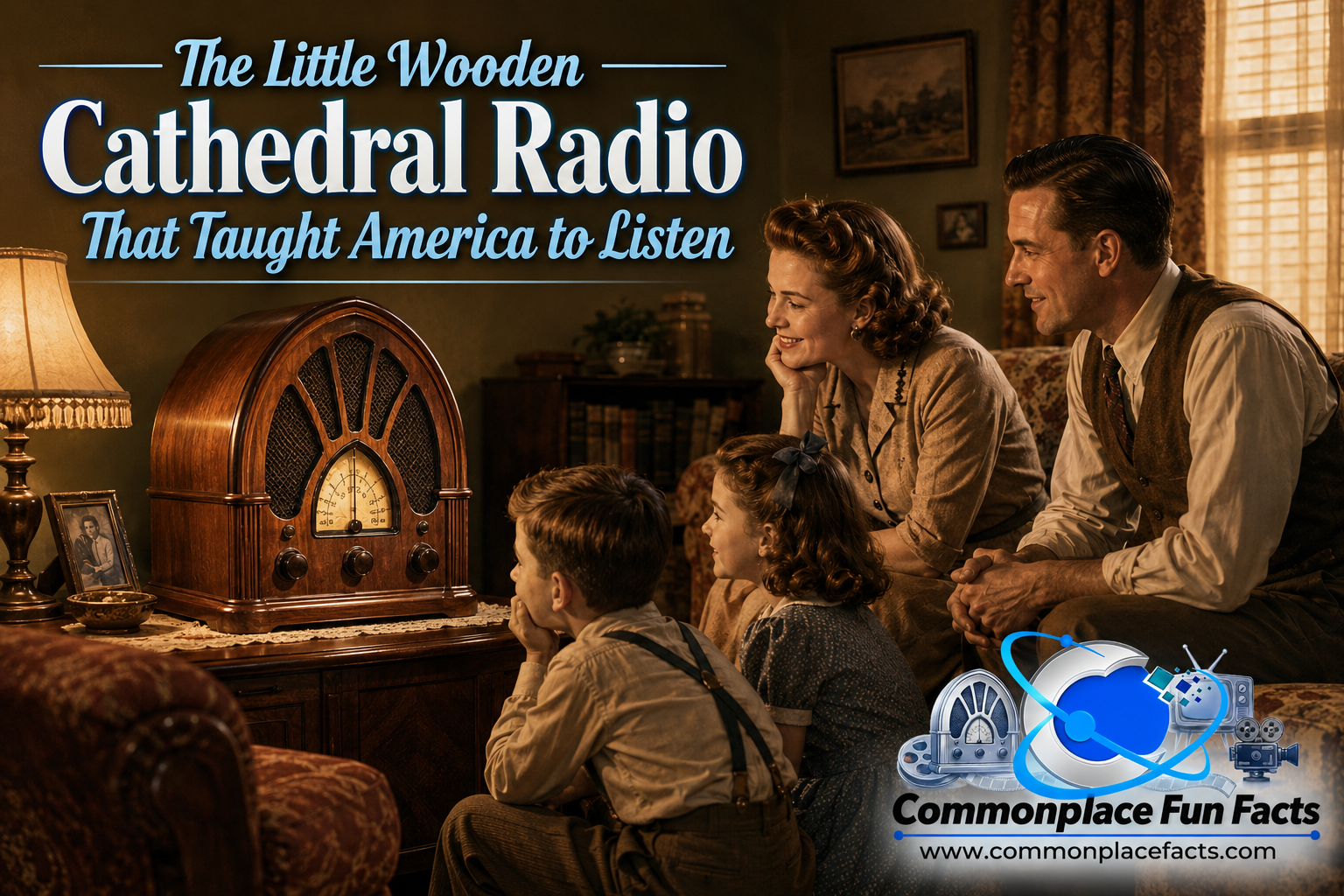
You know the one. A wooden cabinet with a rounded arch on top, a cloth speaker grille on the front, knobs below, and a general air of having once delivered both baseball scores and terrifying news bulletins with equal dignity. Even if you have never listened to The Shadow, Fibber McGee and Molly, or a single crackling episode of anything sponsored by soap flakes, you know what that radio means. It is the visual shorthand for Old Time Radio.
The question is why.
Was the cathedral radio actually special? Was it the radio everyone gathered around during the Golden Age of Radio? Or did it become famous later because nostalgia needed a mascot and the console radio was too large to fit on a podcast logo?
The answer, satisfyingly, is a little of everything. The cathedral radio became the symbol of Old Time Radio partly because of timing, partly because of design, partly because of marketing, and partly because it looked like what people wanted radio to feel like: warm, mysterious, respectable, and just theatrical enough to suggest that invisible voices traveling through the air were not witchcraft, merely progress in a better hat.
Contents
Before the Cathedral Radio, Radio Had a Decorating Problem
Early radio had a problem common to many new technologies: it was amazing, but it looked like something assembled by a nervous electrician during a thunderstorm.
In the 1920s, radio was still new enough to feel like a miracle. It brought music, news, sermons, comedy, weather reports, political speeches, sporting events, and sponsored messages into the home without requiring the family to leave the living room. This was convenient, especially for those who preferred their entertainment without putting on formal shoes or pretending to enjoy other people’s children.

But the earliest home radios were not always designed as beloved household objects. They could be complicated, expensive, bulky, and visually awkward. Some sets required separate speakers. Others looked like scientific apparatus, which was exciting if your interior design goal was “laboratory where something has gone wrong.”
That mattered because the radio was not just another appliance. It was going into the parlor, the sitting room, the living room, or whatever room the family used to prove to visitors that they owned chairs. It had to live among rugs, lamps, framed portraits, side tables, lace doilies, and furniture that had been purchased with the expectation that it would serve several generations, survive every child, grandchild, and visiting cousin, and still be considered “perfectly good” by someone’s great-great-grandchild.
Radio manufacturers understood this. If radio was going to become central to the American home, it could not look as though it had wandered in from the garage. It had to become furniture.
That is where cabinet design came in. Radio cabinets were often made of wood and styled to harmonize with the traditional furniture already sitting in respectable living rooms, silently judging everyone. Larger console radios looked like cabinets, sideboards, or small pieces of domestic architecture. Smaller tabletop radios needed the same treatment, but on a scale that would not require rearranging the entire house.
The cathedral radio solved that problem brilliantly. It made radio look intentional. It gave the machine dignity. It turned wires, tubes, coils, and strange electromagnetic sorcery into something that seemed to belong beside a lamp and a family Bible.
The Philco Baby Grand: Small Radio, Big Moment
The story of the cathedral radio really begins with Philco’s Model 20, introduced in 1930 and marketed as the “Baby Grand.” That name is important because “cathedral radio” was not necessarily the phrase ordinary buyers used at the time. The label appears to have become common later, especially among collectors. At the time, Philco was selling the idea of full-sized-radio performance in a smaller, more affordable tabletop cabinet.

The timing could hardly have been more dramatic. The Model 20 arrived just after the 1929 stock market crash and at the beginning of the Great Depression. This was not an era in which most families were cheerfully browsing luxury goods and saying, “Yes, let us purchase the deluxe model with the mahogany emotional support columns.” Money mattered. Space mattered. Value mattered.
Philco’s Baby Grand landed in precisely the right spot. It was compact enough for the average home, attractive enough to display, and affordable enough to be plausible for people who wanted radio but were not currently using hundred-dollar bills as bookmarks. Its list price was $49.50, which was still real money in 1930 — roughly $1,000 in today’s dollars — but far below the cost of some larger, grander radio-phonograph combinations that were aimed at households with more cash and presumably more servants to dust the thing.
The Model 20 was a hit. Philco produced hundreds of thousands of them, and the style quickly became influential. Other manufacturers noticed, because manufacturers have always had a keen instinct for saying, “That worked. Let us now produce something suspiciously similar while calling it innovation.”
The Baby Grand did not merely create a new cabinet shape. It helped establish a new category: the compact, all-in-one tabletop radio that could sit proudly in the home without looking like either a coffin or a breadbox with social ambitions.
Why Did It Look Like a Tiny Church?
The most obvious feature of the cathedral radio is the arch. That arched top is what gives the style its later name, because it resembles a Gothic window or church doorway. This was not accidental in the broad design sense, even if the word “cathedral” came later. The shape worked because it communicated stability, tradition, and seriousness.

That may sound excessive for a device whose duties included broadcasting comedians, crooners, soap operas, and sponsored jingles. But new technology often borrows old symbols to make itself less frightening. Automobiles began as horseless carriages. Early electric lights were placed in fixtures that resembled gas lamps. Early radio cabinets borrowed from furniture and architecture because people are more willing to accept the future when it arrives wearing a familiar costume.
The cathedral radio’s arch gave it more than decoration. It gave it presence. It suggested a little shrine, which is not a bad metaphor for what radio became in the 1930s. Families gathered around it. They listened together. They heard the same voices at the same time as millions of other people. The radio was not just a gadget. It was a domestic gathering place.
Admittedly, calling it a shrine may sound like we are one paragraph away from lighting incense before a Philco and chanting the NBC chimes. But the emotional association is real. The cathedral radio transformed broadcasting from invisible transmission into a physical object. The sound came from somewhere. That somewhere had a face, and the face had an arch.
The Philco Model 90 and the Perfect Radio Silhouette
If the Model 20 helped launch the cathedral radio, the Philco Model 90 helped perfect the look. Introduced in 1931, the Model 90 is one of the most recognizable antique radios ever made. Its cabinet, designed by Edward Combs, took the basic arched form and made it memorable: rounded top, vertical side columns, handsome veneer, cloth grille, and controls arranged neatly beneath the speaker opening.

This is why so many people picture something like the Model 90 when they hear the phrase “old radio.” The design is simple enough to be recognized in silhouette. That matters. Icons need shape. The cathedral radio has one.
A console radio may have been common in many homes, but visually it can resemble a dignified cabinet that swallowed a broadcaster. A tombstone radio has its own charm, though the name does make it sound less like family entertainment and more like an appliance purchased by Edgar Allan Poe. A later Bakelite tabletop set may evoke the 1940s or 1950s kitchen. But the cathedral radio? It says “Old Time Radio” instantly.
That is not because everyone listened to every major radio event on a cathedral set. They did not. Old Time Radio was heard through many kinds of receivers: consoles, tombstones, farm radios, car radios, plastic tabletop sets, and whatever aging family set could still pull in a signal after Uncle Harold “fixed” it with confidence and pliers.
The cathedral radio became the symbol because it had the strongest visual identity. It looked like radio’s golden age before radio’s golden age knew it needed a logo.
The 1930s: When Radio Became the Family Hearth
To understand why the cathedral radio stuck in cultural memory, we need to remember what happened during the 1930s. Radio ownership exploded. At the beginning of the decade, millions of American households had radios. By the end, radio had become one of the dominant household technologies in the United States.
This growth happened despite the Great Depression, which tells us something important. When money was scarce, Americans still valued radio. They might postpone other purchases, but radio connected them to entertainment, information, reassurance, and national life. It was not merely a luxury. It was a lifeline with tubes.
The radio brought the outside world into the home. A family could listen to comedy one night, music the next, a presidential address after that, and then a dramatic program in which aliens landed in New Jersey, probably because they read the map wrong.
Franklin D. Roosevelt understood radio’s power. His fireside chats used the medium to speak directly to Americans in a voice that felt personal and immediate. The term “fireside chat” itself reinforced the idea of radio as an intimate domestic experience. The President was not merely addressing the nation from some marble governmental distance. He was, in effect, joining families in their living rooms, which was impressive considering the Secret Service usually discourages that sort of thing.
Radio also created shared national moments. Millions could hear the same broadcast together, separated by geography but united by sound. That shared experience helped define the Golden Age of Radio. It was an age of comedians, detectives, westerns, adventure serials, soap operas, news commentators, quiz shows, big bands, and commercial jingles that burrowed into the national brain like extremely well-sponsored termites.
The cathedral radio was present at the birth of that listening culture. It arrived as radio became smaller, cheaper, more attractive, and more central to daily life. That timing mattered more than any one technical feature. The cathedral set became associated with the era because it was there when the era became itself.
Was the Cathedral Radio Technically Special?
It would be easy to assume that the cathedral radio was merely a pretty box. That would be unfair. It was frequently a very pretty box containing genuinely impressive technology.
Many cathedral radios relied on superheterodyne circuitry, the receiver design that became standard for broadcast radio. Some higher-end models had multiple tubes, improved speakers, tone controls, automatic volume control, and shortwave capability. Philco’s Model 16B cathedral radio, for example, was an eleven-tube set capable of receiving more than ordinary local broadcasts.
In other words, some cathedral radios were serious machines. They were not merely decorative wooden chapels for static. They could be powerful, sensitive, and sophisticated receivers. The fact that they also looked good was not a crime, despite what some later electronics would have us believe.
Still, the cathedral radio’s cultural importance does not come primarily from being the most advanced type of radio. Technology kept changing. Designs evolved. Cabinets shifted from wood to plastic. Styles moved from Gothic arches to Art Deco curves to streamlined modern forms. The cathedral style had a relatively brief moment of dominance before tastes changed.
That brevity may have helped preserve its symbolic power. The cathedral radio belongs strongly to a specific visual period. It does not blur into every decade. It looks like the early 1930s: hopeful, anxious, elegant, affordable if you stretched, and determined to make modern life look respectable in walnut veneer.
The Depression-Era Appeal: A Little Luxury for Hard Times
One of the most interesting things about the cathedral radio is that it became popular during hard economic times. This may seem odd until you remember that people under stress do not stop wanting beauty, comfort, connection, or distraction. In fact, they may want those things more.
The Great Depression made daily life uncertain for millions. Jobs vanished. Banks failed. Farms struggled. Families cut back, stretched meals, patched clothes, and learned the ancient household art of making something last “just one more year,” a phrase that has been uttered over everything from shoes to refrigerators to democracy.
Radio offered escape, but not only escape. It offered company. It brought music into homes that could not afford live entertainment. It brought laughter into evenings that needed it. It brought news quickly. It gave rural listeners a connection to distant cities and national events. It made the country feel smaller and less lonely.
The cathedral radio packaged that connection in an object that felt substantial. It was not disposable. It had weight. It had wood grain. It had a place in the room. A family might not have had much control over the economy, but they could gather around the radio at night and participate in a common culture.
That is why the cathedral radio’s symbolism runs deeper than “old-fashioned gadget.” It represents the moment when electronic media became domestic ritual. The home did not merely contain a receiver. The home reorganized itself around the act of listening.
Why the Cathedral Radio Became Nostalgia’s Favorite Prop
By the time people began looking back fondly on Old Time Radio, the cathedral set had become the perfect visual cue. It was old enough to look antique, distinctive enough to identify instantly, and compact enough to appear in illustrations, museum displays, logos, book covers, and nostalgic documentaries without requiring a forklift.
That compactness matters. A giant console radio may have been more representative of some households, but it is not nearly as convenient as a symbol. It takes up visual space. It looks like furniture first and radio second. The cathedral radio, by contrast, reads immediately as “radio.” Its entire front announces its purpose: here is the speaker, here is the dial, here are the knobs, here is the arch, please prepare to hear a detective explain everything in the final three minutes.
The cathedral radio also survived well as an object of collecting. Collectors love it because the cabinets are beautiful, the history is rich, and the restoration process offers the pleasant possibility of turning a silent antique into a working machine. This is noble, though it does occasionally require explaining to family members why the dining room table is covered in capacitors.
Over time, the cathedral radio became less a specific product category and more a symbol. It came to represent the whole Old Time Radio era, including years and programs that may have been heard on very different equipment. That is how symbols work. A quill pen represents writing, though most great novels were not written with one. A cowboy hat represents the Old West, though many actual cowboys wore whatever kept the sun off and did not fall into a horse trough. The cathedral radio represents Old Time Radio because it captures the feeling of the era better than it documents every technical detail.
It Was Not the Only Radio — Just the One We Remember
Here is where we must gently restrain nostalgia before it climbs onto the furniture. The cathedral radio was not the only radio of the 1930s. It was not even the only iconic style. Tombstone radios, console radios, farm sets, and later plastic models all played major roles in radio history.

Nor was the cathedral style dominant throughout the entire Golden Age of Radio. The creative peak of American radio extended well into the 1940s, by which time many radios looked quite different. If a family listened to World War II news, wartime variety shows, or postwar dramas, their receiver might have been a console or a streamlined tabletop set rather than a cathedral.
But cultural memory is not an inventory spreadsheet. It does not carefully tabulate every model, cabinet, chassis, and production year before selecting a representative image. Cultural memory points at one object and says, “That. That feels right.”
The cathedral radio feels right because it appeared at the moment radio was becoming magical to ordinary people. It was part of the transition from radio as hobbyist equipment to radio as household companion. It made modern broadcasting look warm, permanent, and familiar. It gave the invisible a body.
The Cathedral Radio as a Machine for Memory
There is something almost poetic about the cathedral radio. The cabinet evokes the past while the technology inside pointed toward the future. The form borrowed from Gothic architecture, but the function belonged to the electronic age. It looked backward and forward at the same time, which is basically the entire human condition except with better veneer.
That tension is part of its charm. The cathedral radio reassured people that new technology did not have to destroy the familiar world. It could sit in the living room, match the furniture, and behave itself. Mostly. There was still static, drifting signals, warm tubes, and the occasional need to smack the set in a way that was technically not recommended but spiritually understood.
For modern viewers, the cathedral radio compresses an entire era into one object. We see it and imagine families gathered in the evening, children sprawled on the floor, parents listening from chairs, the dial glowing, the room quiet except for a voice from far away. Whether that exact scene happened around that exact style of radio in every home is beside the point. The image carries the meaning.
Old Time Radio itself was an invisible art. Unlike film or television, radio left fewer visual memories. Its performers were voices. Its monsters were sound effects. Its living rooms, spaceships, courtrooms, jungles, police stations, and haunted houses existed inside the listener’s imagination. The cathedral radio became the visible artifact of an invisible medium.
That may be the real reason it endured. Radio needed an icon because sound disappears. The cathedral radio remained.
So Was the Association Accidental?
Only partly.
It was accidental in the sense that no one at Philco in 1930 was designing a future nostalgia symbol for Old Time Radio podcasts, museum gift shops, and internet graphics. They were trying to sell radios. Good radios. Attractive radios. Radios that ordinary people might buy during a terrible economy because the product offered beauty, connection, and utility in one handsome cabinet.
But the association was not random. The cathedral radio became iconic because it earned the role. It arrived at the right moment. It embodied the shift from experimental technology to domestic necessity. It had an unforgettable silhouette. It looked old-fashioned and futuristic at the same time. It was widely copied, widely collected, and visually perfect for representing an era built on sound.
The cathedral radio did not create Old Time Radio. It did not single-handedly produce Jack Benny, Orson Welles, George Burns, Amos ’n’ Andy, soap operas, detective dramas, singing cowboys, or announcers who could make toothpaste sound like a matter of national urgency.
But it gave the era a face.
The Little Wooden Cathedral That Taught America to Listen
The cathedral radio’s story is not simply a story about cabinet design. It is a story about how technology becomes culture.
At first, radio was astonishing because it worked. Then it became desirable because it entertained. Then it became essential because it connected people. Finally, it became nostalgic because people remembered not just what they heard, but where they were when they heard it.
The cathedral radio stands at the center of that transformation. It took the invisible miracle of broadcasting and placed it inside a beautiful wooden object that could sit in the home like it had always belonged there. Its arched cabinet suggested tradition. Its electronics delivered modernity. Its speaker filled the room with a nation learning to listen together.
That is why the cathedral radio remains the symbol of Old Time Radio. Not because every old broadcast came through one. Not because it was the only important radio design. Not because collectors later gave it a dramatic name and everyone agreed to pretend that radios had ecclesiastical ambitions.
It remains the symbol because it looks the way radio felt when radio was new: mysterious, intimate, communal, and just a little magical.
The Golden Age of Radio was built out of voices, static, music, jokes, suspense, commercials, news, imagination, and millions of people leaning toward a box in the corner of the room. The cathedral radio is the box we remember. And honestly, if an entire era of American entertainment has to be represented by one object, it could do a lot worse than a handsome little wooden arch that made the future feel at home.
You may also enjoy…

The First Radio Broadcast: From Morse Code to Music
Discover how Reginald Fessenden made history on Christmas Eve 1906 with the world’s first radio broadcast — a night that changed communication forever.

The Rise and Breakup of NBC’s Radio Empire
Discover how NBC built a color-coded radio empire with Red and Blue networks—and how government regulators forced a breakup that helped create ABC and reshape broadcasting.

The Great Gildersleeve: The Blustering Radio Character Who Invented the Spin-Off
Explore how The Great Gildersleeve became radio’s first spin-off, launching a broadcasting tradition decades before modern TV hits like Frasier and The Jeffersons.





Leave a Reply